
How to Use These Answer Cards
Each card below is a question that has appeared in the 2025–26 exams, the 2027 model papers, or both, with an answer written to the way the board's schemes award marks. They're short on purpose. Each one has just the points that earn marks, in the order you'd write them.
Work through them in two rounds. First, read each card and say the answer out loud without looking. Second, write out any card you stumbled on in full, timed: 3 minutes for a 2-mark answer, 5 for a 3-mark one.
Tags: E26-1 = 2026 Exam-1, MP4 = 2027 Model Paper 4.
Part B: Two-Mark Questions
Question 1 (E25-1 Q39, E26-2 Q24, MP1 Q21): What is Lucas reagent? Which class of alcohol gives turbidity with it immediately?
Answer. Lucas reagent is a mixture of concentrated HCl and anhydrous ZnCl.
Tertiary alcohols give turbidity with Lucas reagent immediately.
Marks: reagent 1, class of alcohol 1.
Question 2 (E26-2 Q21, MP2 Q21): Write two differences between order and molecularity.
Answer.
| Order of reaction | Molecularity of reaction |
|---|---|
| It is found by experiment. | It is a theoretical idea, worked out from the elementary step. |
| It can be zero or even a fraction. | It is always a whole number (1, 2 or 3). |
Also accepted: order applies to complex reactions too, while molecularity applies only to elementary reactions. Marks: any two, 1 each.
Question 3 (E26-1 Q23, MP4 Q22): What is the half-life of a reaction? How is it represented?
Answer. The half-life of a reaction is the time in which the concentration of a reactant becomes half of its initial concentration.
It is represented as .
Marks: definition 1, symbol 1.
Question 4 (MP2 Q22): Explain the Swarts reaction with an example.
Answer. When an alkyl chloride or alkyl bromide is heated with a metal fluoride such as AgF, HgF, CoF or SbF, an alkyl fluoride is formed. This is called the Swarts reaction.
Marks: statement 1, equation 1.
Question 5 (E25-2 Q23, E25-3 Q24, MP3 Q38): Explain the Fittig reaction.
Answer. When an aryl halide is treated with sodium in dry ether, two aryl groups join together to give a diaryl. This is called the Fittig reaction.
Marks: statement 1, equation 1.
Question 6 (E25-1 Q24, E25-2 Q26, MP4 Q24): Write two characteristics of interstitial compounds.
Answer. Characteristics of interstitial compounds:
- They have higher melting points than the pure metals.
- They are very hard.
Also accepted: they keep metallic conductivity; they are chemically inert. Marks: any two, 1 each.
Question 7 (E26-1 Q21, MP1 Q25): What are transition elements? Give an example.
Answer. Transition elements are the elements which have an incompletely filled d subshell either in their atoms or in their common oxidation states.
Example: iron (Fe), [Ar] 3d 4s.
Marks: definition 1, example 1.
Question 8 (E26-1 Q25, MP3 Q23): Write the products when anisole reacts with ethanoyl chloride and anhydrous AlCl.
Answer. Anisole undergoes Friedel–Crafts acylation. Since –OCH is ortho and para directing, the products are 4-methoxyacetophenone (major) and 2-methoxyacetophenone (minor).
Marks: 1 for each product.
Question 9 (MP5 Q22, MP3 Q21): Write the two conditions for an effective collision. Give one drawback of collision theory.
Answer. For a collision to be effective:
- The colliding molecules must have energy equal to or greater than the threshold energy.
- The colliding molecules must have the proper orientation.
Drawback of collision theory: it considers atoms and molecules as hard spheres and ignores their structure.
Marks: conditions 1, drawback 1.
Question 10 (E25-1 Q36, E26-1 Q24, MP4 Q23): List two nitrogenous bases common to DNA and RNA. Which base is in RNA only?
Answer. Two bases common to DNA and RNA are adenine and guanine (cytosine is also common).
Uracil is present only in RNA. (DNA has thymine instead.)
Marks: two common bases 1, uracil 1.
Part C, Group IV: Three-Mark Inorganic Questions
Question 11 (E25-1 Q27, E25-3 Q27, E26-1 Q29, E26-2 Q26, MP1 Q30, MP3 Q26, MP4 Q29): Write the equations for the preparation of KCrO from chromite ore.
Answer. Potassium dichromate is made from chromite ore (FeCrO) in three steps.
Step 1: Chromite is fused with sodium carbonate in free access of air to form sodium chromate.
Step 2: Sodium chromate is acidified to give sodium dichromate.
Step 3: Sodium dichromate is treated with potassium chloride to get potassium dichromate.
Marks: 1 for each step. Always write 2H in step 2; it is the only form accepted when the equation is given as a fill-in.
Question 12 (E25-2 Q30, E25-3 Q26, E26-2 Q28, MP2 Q27, MP4 Q28): Compare [Ni(CN)] and [NiCl] using VBT.
Answer. In both complexes, nickel is in the +2 state: Ni is [Ar] 3d with two unpaired electrons.
In [Ni(CN)], CN is a strong field ligand, so it pairs up the two unpaired 3d electrons. One 3d, one 4s and two 4p orbitals mix to give dsp hybridisation.
In [NiCl], Cl is a weak field ligand, so the 3d electrons stay unpaired. One 4s and three 4p orbitals mix to give sp hybridisation.
| [Ni(CN)] | [NiCl] | |
|---|---|---|
| Hybridisation | dsp | sp |
| Geometry | Square planar | Tetrahedral |
| Magnetic property | Diamagnetic (no unpaired electrons) | Paramagnetic (2 unpaired electrons) |
Marks, when one complex is asked: explanation with hybridisation 1, geometry 1, magnetic property 1.
Question 13 (E26-1 Q26, MP3 Q27, MP1 Q26): Compare [Co(NH)] and [CoF] using VBT.
Answer. In both complexes, cobalt is in the +3 state: Co is [Ar] 3d.
In [Co(NH)], NH pairs up all six 3d electrons into three orbitals, leaving two 3d orbitals empty. Two 3d, one 4s and three 4p orbitals give dsp hybridisation (inner orbital complex).
In [CoF], F is a weak field ligand, so four electrons stay unpaired. One 4s, three 4p and two 4d orbitals give spd hybridisation (outer orbital complex).
| [Co(NH)] | [CoF] | |
|---|---|---|
| Hybridisation | dsp (inner orbital) | spd (outer orbital) |
| Geometry | Octahedral | Octahedral |
| Magnetic property | Diamagnetic | Paramagnetic (4 unpaired electrons) |
Question 14 (E25-1 Q26, E25-3 Q28, MP4 Q26; MP2 Q30, MP3 Q28): State three postulates of Werner's theory. CoCl·4NH gives 1 mol AgCl with excess AgNO; write its formula.
Answer. Postulates of Werner's theory:
- In coordination compounds, metals show two types of valency: primary and secondary.
- Primary valency is ionisable and is satisfied by negative ions.
- Secondary valency is non-ionisable, is equal to the coordination number, and is directed in space.
Since only 1 mol of AgCl is formed, only one Cl is outside the coordination sphere. The formula is [Co(NH)Cl]Cl.
Marks: 1 for each postulate.
Question 15 (E25-1 Q29, E26-1 Q27, E26-2 Q22, MP1 Q28; MP4 Q27): What is lanthanoid contraction? Give its consequences and three differences between lanthanoids and actinoids.
Answer. Lanthanoid contraction is the steady decrease in the atomic and ionic radii of the lanthanoids from lanthanum to lutetium.
Consequences:
- Zirconium and hafnium have almost the same atomic radius.
- Lanthanoids have similar properties, so it is difficult to separate them.
- The basic strength of the hydroxides decreases from La(OH) to Lu(OH).
Differences between lanthanoids and actinoids:
| Lanthanoids | Actinoids |
|---|---|
| Electrons enter 4f orbitals. | Electrons enter 5f orbitals. |
| They mainly show +3 oxidation state. | They show more oxidation states, up to +7. |
| Most are not radioactive. | All are radioactive. |
| They have less tendency to form complexes. | They form complexes more readily. |
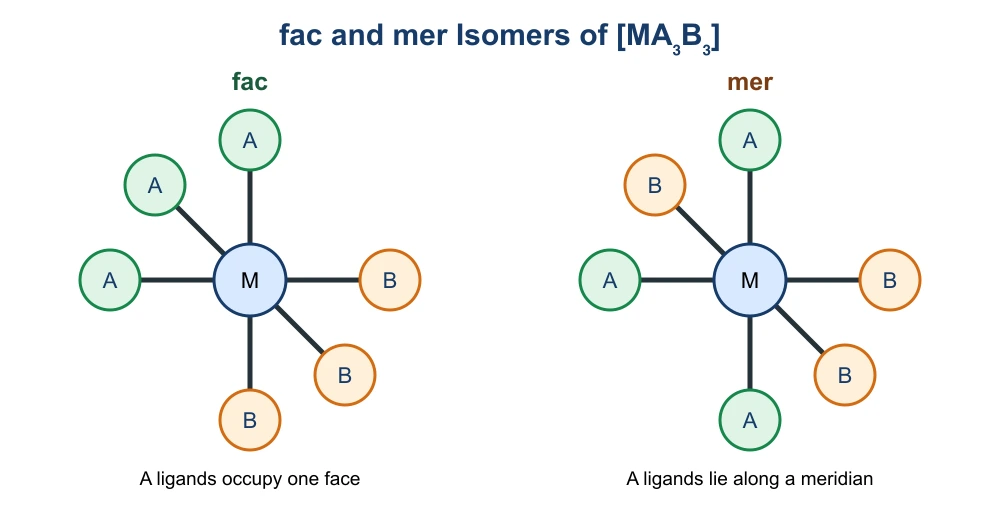
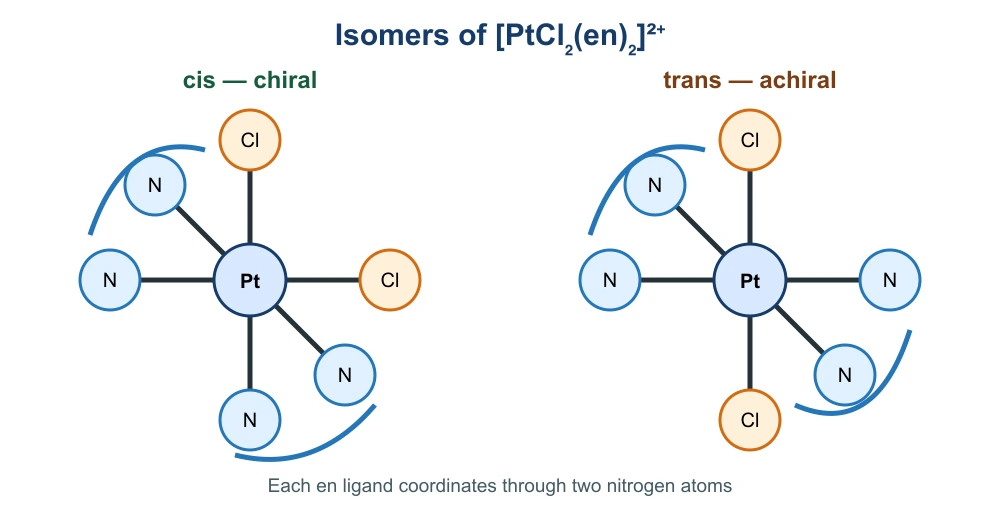
Question 16 (E25-1 Q30, MP1 Q27; E26-1 Q28, MP5 Q27; MP2 Q28): Name the geometrical isomers of [MAB] and [MX(L–L)], and say which form of the second is optically active.
Answer. [MAB] shows two geometrical isomers:
- Facial (fac): the three A ligands are on one triangular face of the octahedron.
- Meridional (mer): the three A ligands are around a meridian of the octahedron.
[MX(L–L)] shows cis and trans isomers. The cis form is optically active. The trans form has a plane of symmetry, so it is optically inactive.
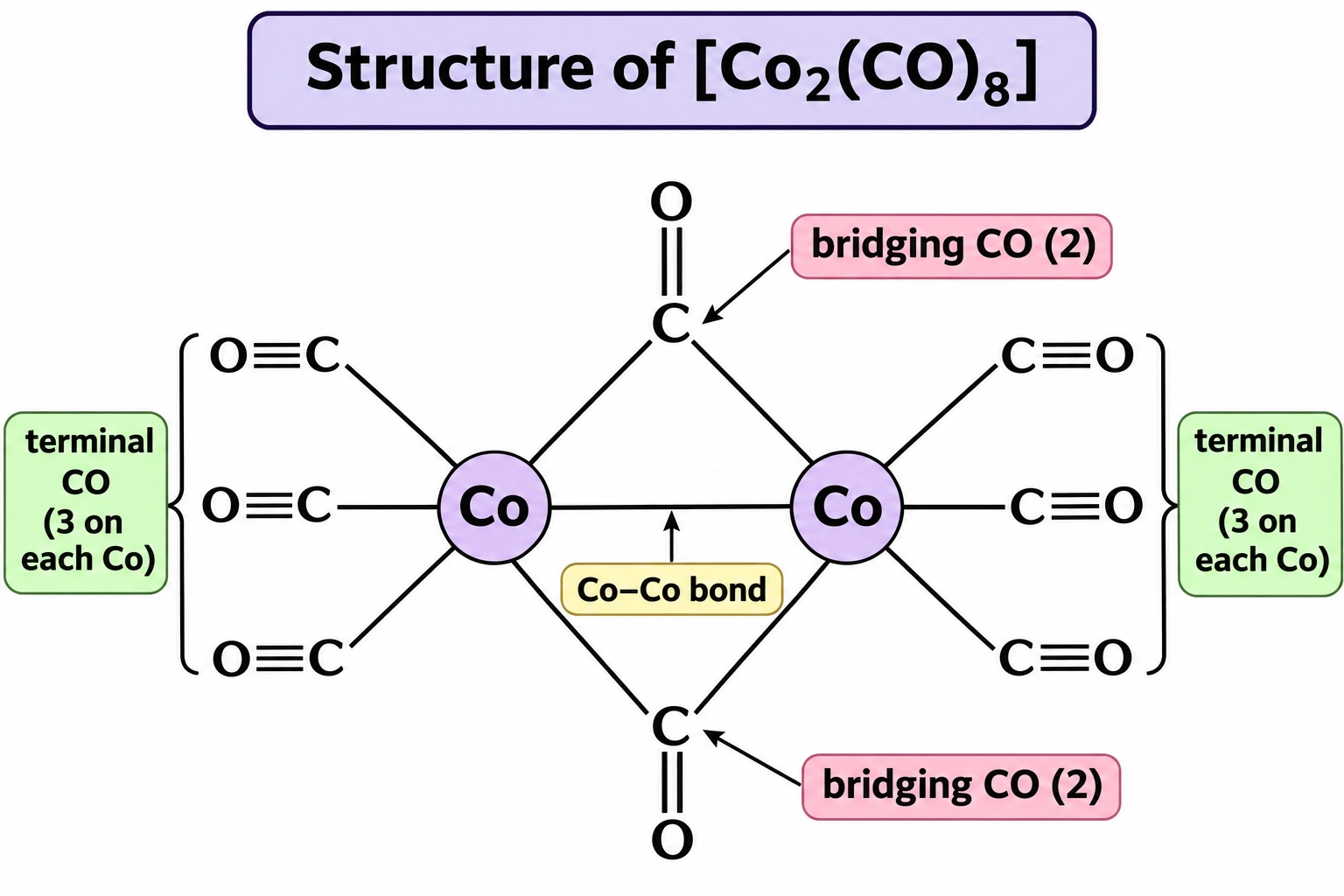
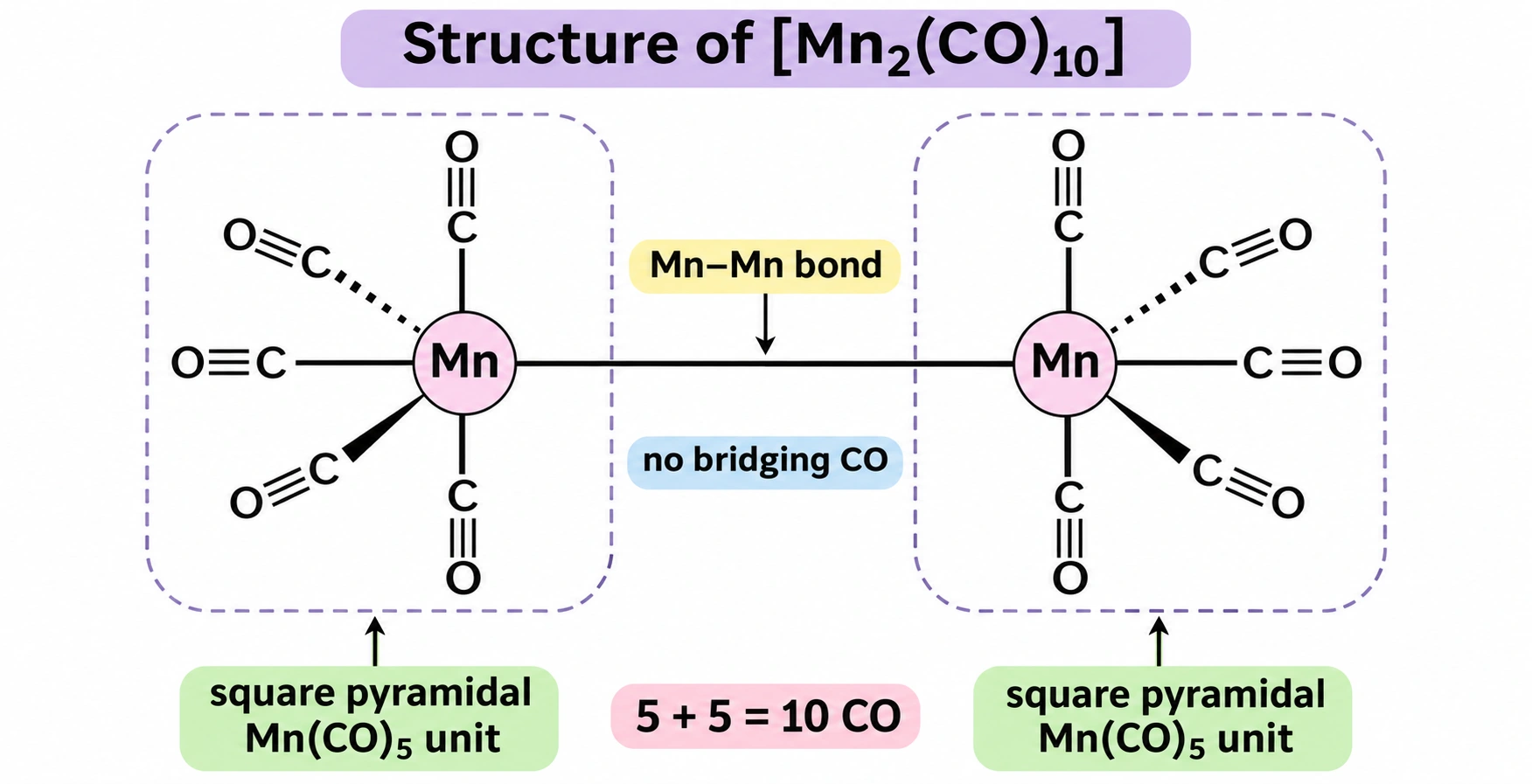
Question 17 (E25-2 Q22, E26-1 Q30, E26-2 Q29, MP3 Q30; E25-3 Q30, MP1 Q29; MP4 Q30): Describe Co(CO) and Mn(CO), and explain bonding in metal carbonyls.
Answer. Co(CO) (octacarbonyldicobalt(0)): the two Co atoms are joined by a Co–Co bond and two bridging CO groups. Each Co also has three terminal CO groups.
Mn(CO) (decacarbonyldimanganese(0)): it has two square pyramidal Mn(CO) units joined by an Mn–Mn bond. There are no bridging CO groups.
Bonding in metal carbonyls: the metal–carbon bond has both σ and π character. The σ bond is formed when the carbon of CO donates its lone pair to a vacant orbital of the metal. The π bond is formed when the metal donates electrons from a filled d orbital back into the vacant π* orbital of CO. The two together strengthen the M–C bond (synergic bonding).
Question 18 (MP2 Q26, MP1 Q30): How is KMnO prepared from MnO? What gas does KMnO give at 513 K?
Answer. Step 1: MnO is fused with KOH in the presence of air to give green potassium manganate.
Step 2: Potassium manganate disproportionates in neutral or acidic solution to give potassium permanganate.
On heating to 513 K, KMnO gives off oxygen.
Marks: 1 for each equation.
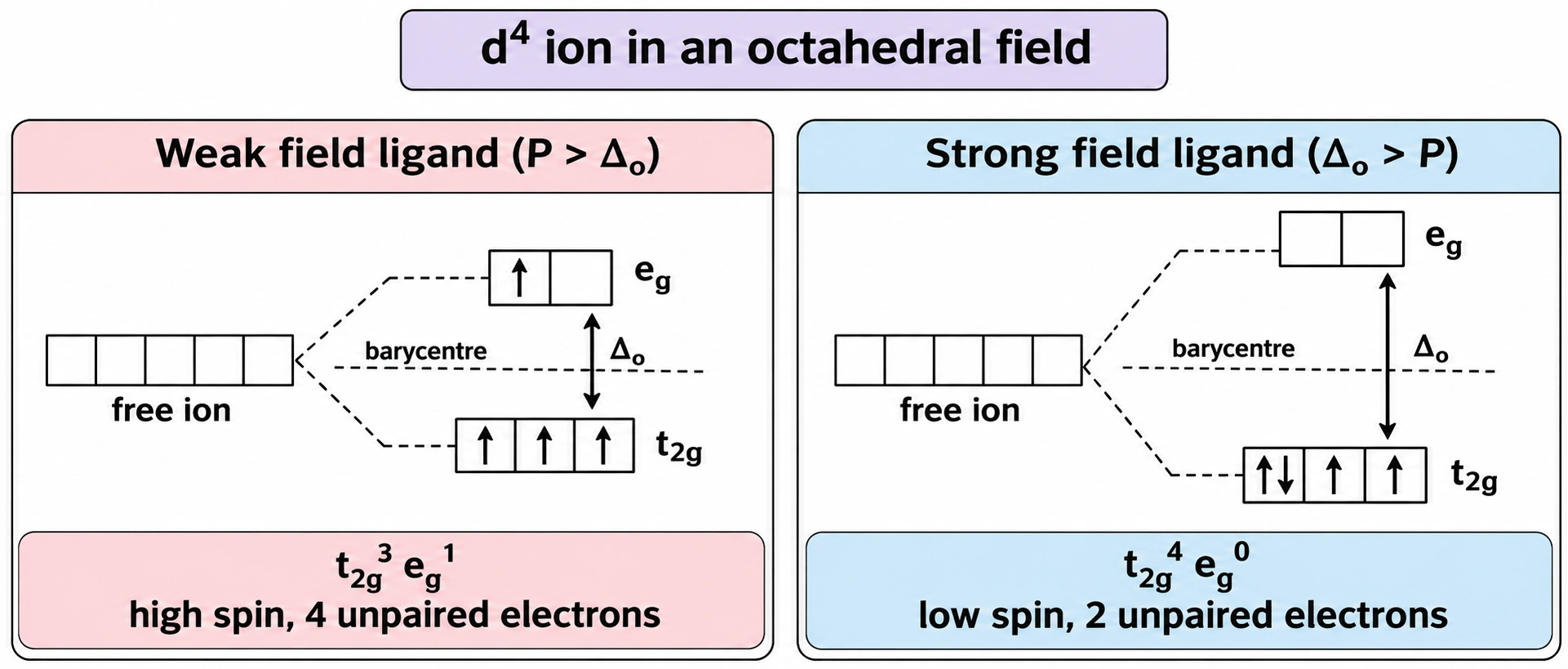
Question 19 (E25-1 Q28, E26-2 Q29, MP5 Q30): Draw the octahedral crystal field splitting and give the configuration of d when P > Δ and when Δ > P.
Answer. In an octahedral field, the five d orbitals split into a lower set of three orbitals, t (at −0.4 Δ), and an upper set of two orbitals, e (at +0.6 Δ). Draw the five d orbitals at one level and show them splitting into these two sets, with the gap labelled Δ.
When P > Δ (weak field ligand), the configuration of d is t e (high spin).
When Δ > P (strong field ligand), the configuration of d is t e (low spin).
Part C, Group V: Three-Mark Physical Chemistry Questions
Question 20 (all five exams; MP3 Q33, MP4 Q31, MP5 Q31): Derive the integrated rate equation for a first order reaction and show that its half-life doesn't depend on concentration.
Answer. Consider the first order reaction R → P.
Integrating both sides:
At , , so .
At , :
There is no in this expression, so the half-life of a first order reaction does not depend on the initial concentration.
Tip: for zero order, the same steps give and .
Question 21 (E25-2 Q32, E25-3 Q32, E26-2 Q33): Write the reactions in the H–O fuel cell.
Answer. In the hydrogen–oxygen fuel cell, hydrogen and oxygen are bubbled through porous carbon electrodes into concentrated aqueous NaOH.
Reaction at the cathode:
Reaction at the anode:
Overall reaction:
Marks: 1 for each reaction.
Question 22 (E25-3 Q34, E26-1 Q34, MP2 Q33): Mention three factors that decide the products of electrolysis.
Answer. The products of electrolysis depend on:
- The nature of the material being electrolysed (molten or aqueous).
- The type of electrodes used (inert or reactive).
- The different oxidising and reducing species present and their standard electrode potentials.
Also accepted: the concentration of the electrolyte. Marks: any three, 1 each.
Question 23 (E26-1 Q33, E26-2 Q31, MP4 Q33): Write three differences between ideal and non-ideal solutions.
Answer.
| Ideal solutions | Non-ideal solutions |
|---|---|
| They obey Raoult's law at all concentrations. | They do not obey Raoult's law. |
Marks: 1 for each difference.
Question 24 (E25-2 Q31, MP1 Q43, MP2 Q6): State Henry's law. Give two applications and the effect of temperature.
Answer. Henry's law states that at a constant temperature, the partial pressure of a gas in the vapour phase is proportional to the mole fraction of the gas in the solution: .
Applications:
- Soft drink bottles are sealed under high pressure of CO to increase its solubility.
- Scuba divers use air diluted with helium to avoid the bends.
Effect of temperature: the solubility of a gas in a liquid decreases as the temperature increases.
Question 25 (E25-1 Q34, MP3 Q32, MP5 Q34): Write the electrode reactions of the mercury cell and the overall reaction of the Ni–Cd cell.
Answer. In the mercury cell, the electrolyte is a paste of KOH and ZnO.
Reaction at the anode:
Reaction at the cathode:
Overall reaction of the Ni–Cd cell:
Question 26 (MP4 Q32, MP5 Q32; MP2 Q46): Sketch Λ against √c for a strong and a weak electrolyte. For which can Λ be found from the graph?
Answer. Graph: plot on the y-axis against on the x-axis.
For a strong electrolyte like KCl, decreases slowly and almost in a straight line as increases. Extending the line to gives .
For a weak electrolyte like acetic acid, is low at higher concentrations but rises very steeply near zero concentration. So cannot be found from the graph; it is calculated using Kohlrausch's law.
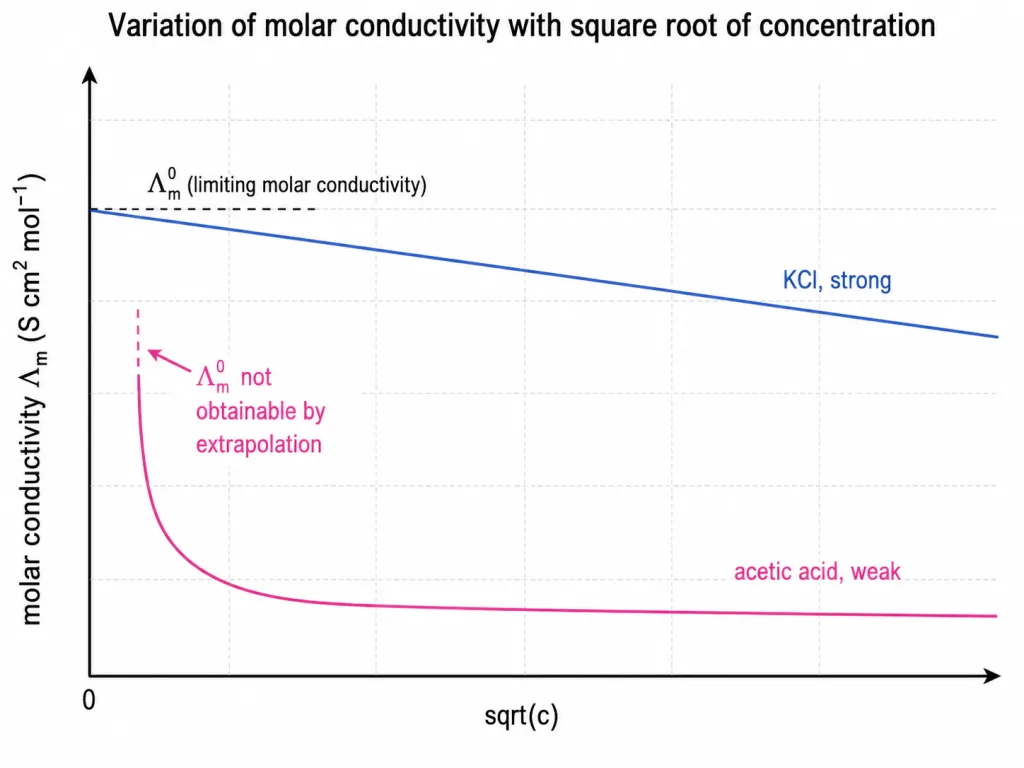
can be found from the graph only for the strong electrolyte.
Question 27 (MP2 Q32, MP3 Q34): Why is the osmotic pressure method preferred for macromolecules? What is reverse osmosis used for?
Answer. The osmotic pressure method is preferred for macromolecules because:
- It is carried out at room temperature, so biomolecules are not damaged.
- Molarity of the solution is used instead of molality.
- Even very dilute solutions give an osmotic pressure large enough to be measured.
When a pressure larger than the osmotic pressure is applied on the solution side, pure water flows out through a semipermeable membrane such as cellulose acetate. This is reverse osmosis. It is used for the desalination of sea water to get drinking water.