The Fundamental Concept

So far, we have calculated the area bounded by a single curve and a coordinate axis, or a curve and a straight line. Now, we generalize this concept to find the area completely enclosed between two general curves, say y=f(x)y = f(x) and y=g(x)y = g(x).

If f(x)g(x)f(x) \ge g(x) for all xx in the interval [a,b][a, b], then the curve y=f(x)y = f(x) lies above the curve y=g(x)y = g(x). The area of the region bounded between these two curves from x=ax = a to x=bx = b is the area under the upper curve minus the area under the lower curve.

Mathematically, Area=ab[f(x)g(x)]dx\text{Area} = \int_a^b [f(x) - g(x)] \, dx

Similarly, if we integrate with respect to yy, and the curve x=f(y)x = f(y) lies to the right of the curve x=g(y)x = g(y) on the interval [c,d][c, d], then Area=cd[f(y)g(y)]dy\text{Area} = \int_c^d [f(y) - g(y)] \, dy

The key principle is always the same:

  • upper minus lower when integrating with respect to xx
  • right minus left when integrating with respect to yy

Identifying Limits of Integration

In most problems, the limits aa and bb are not explicitly given. Instead, you are asked to find the area of the region enclosed by the two curves.

To find the limits, first determine the points where the two curves intersect by setting their equations equal: f(x)=g(x)f(x) = g(x)

Solving this equation gives the x-coordinates of the intersection points, which become the limits of integration.

If the problem is more naturally handled with respect to yy, then solve the equations to get the corresponding y-values of intersection, and those become the limits for the dydy integral.

Intersecting Curves that Cross

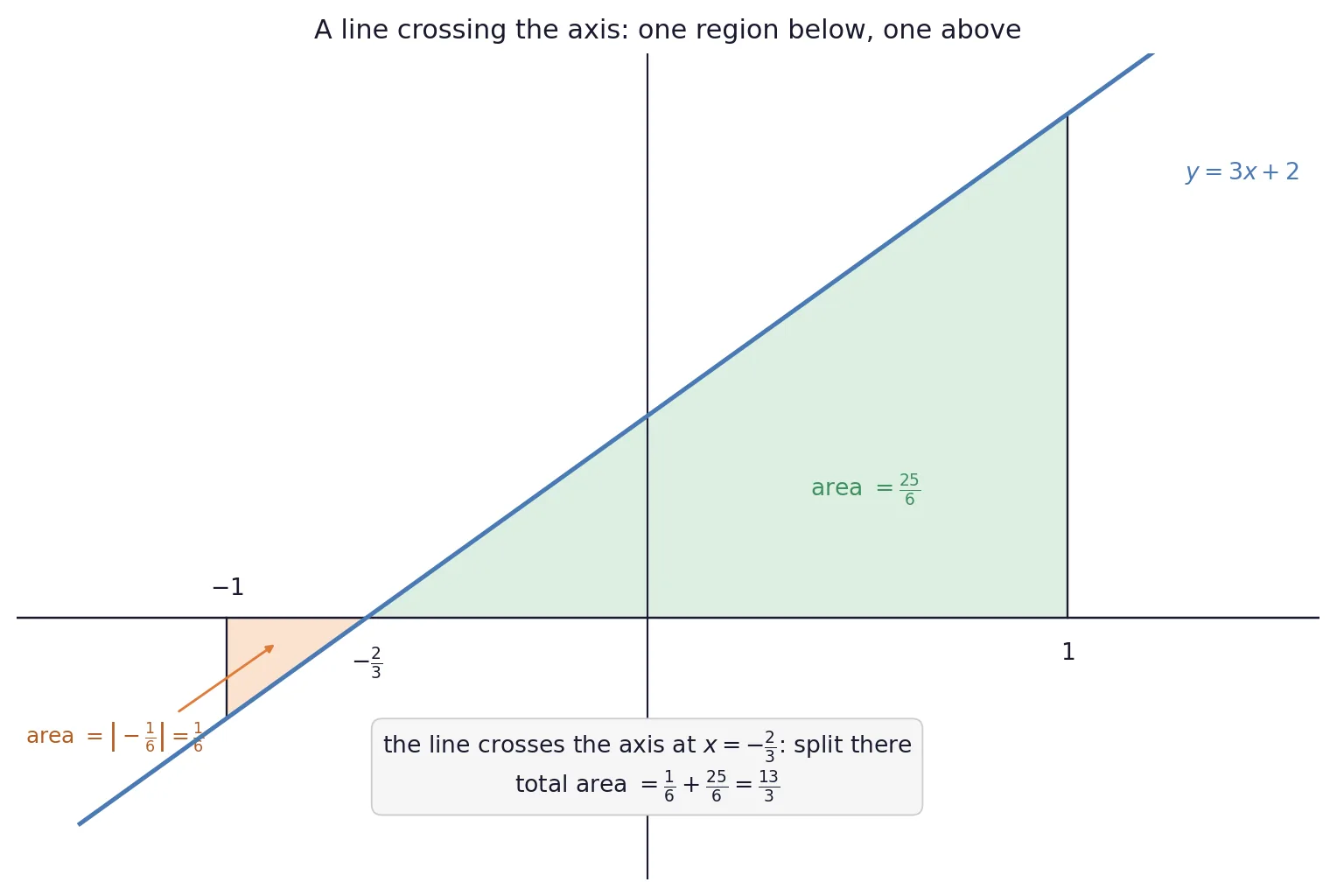
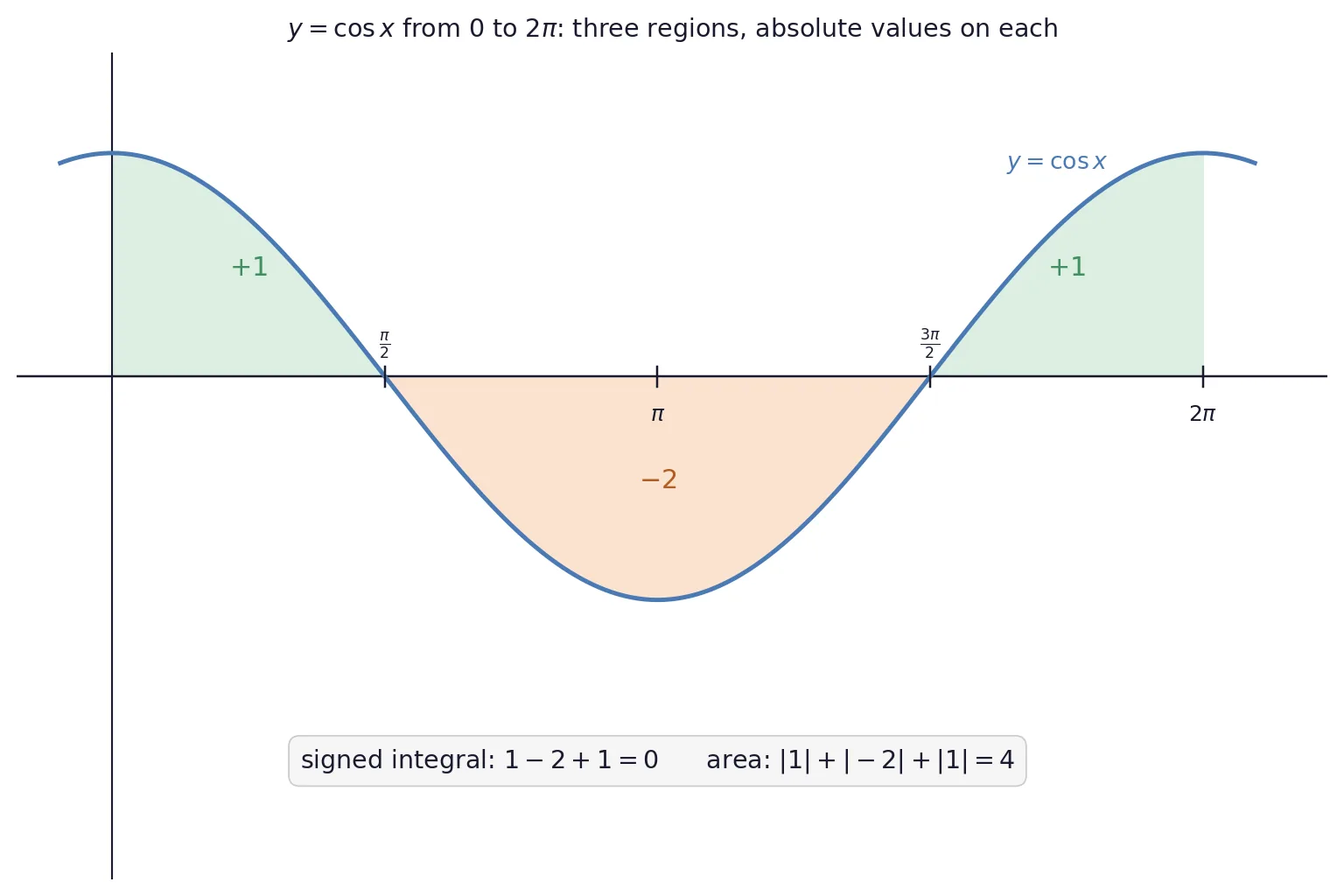
Sometimes, two curves cross each other one or more times inside the interval. In such cases, the curve that is above on one sub-interval may become the lower curve on another sub-interval.

If f(x)g(x)f(x) \ge g(x) on [a,c][a, c] and g(x)f(x)g(x) \ge f(x) on [c,b][c, b], then the total area is not ab[f(x)g(x)]dx\int_a^b [f(x)-g(x)]dx because the second part would contribute negatively.

Instead, split the area at the crossing point cc: Total Area=ac[f(x)g(x)]dx+cb[g(x)f(x)]dx\text{Total Area} = \int_a^c [f(x)-g(x)]dx + \int_c^b [g(x)-f(x)]dx

A compact way to write this is: Total Area=abf(x)g(x)dx\text{Total Area} = \int_a^b |f(x)-g(x)|dx

This idea is extremely important when the curves intersect at more than two points or form multiple enclosed regions.

Example 1: Area between Two Parabolas

Find the area of the region bounded by the two parabolas y=x2y = x^2 and y2=xy^2 = x.

Solution: Step 1: Find the points of intersection. Substitute y=x2y = x^2 into y2=xy^2 = x: (x2)2=x    x4=x    x(x31)=0(x^2)^2 = x \implies x^4 = x \implies x(x^3 - 1) = 0 So, x=0,1x = 0, 1 The corresponding points are (0,0)(0,0) and (1,1)(1,1).

Step 2: Express the second parabola in usable form. From y2=xy^2 = x, we get y=±xy = \pm \sqrt{x} For the enclosed region in the first quadrant, we use the upper branch y=xy = \sqrt{x}

Step 3: Determine the upper and lower curves. Take x=0.25x = 0.25:

  • On y=x2y = x^2, y=(0.25)2=0.0625y = (0.25)^2 = 0.0625
  • On y=xy = \sqrt{x}, y=0.5y = 0.5 So, y=xy = \sqrt{x} is above y=x2y = x^2 on [0,1][0,1].

Step 4: Set up the area integral. Area=01(xx2)dx\text{Area} = \int_0^1 (\sqrt{x} - x^2)\,dx

Step 5: Integrate. =[x3/23/2x33]01=[23x3/2x33]01= \left[ \frac{x^{3/2}}{3/2} - \frac{x^3}{3} \right]_0^1 = \left[ \frac{2}{3}x^{3/2} - \frac{x^3}{3} \right]_0^1

Step 6: Evaluate the limits. =(2313)0=13= \left(\frac{2}{3} - \frac{1}{3}\right) - 0 = \frac{1}{3}

Answer: 1/31/3 square units.

Example 2: Area between Sine and Cosine Curves

Find the area of the region bounded by the curves y=sinxy = \sin x and y=cosxy = \cos x between x=0x = 0 and x=π/2x = \pi/2.

Solution: Step 1: Find the point of intersection in the interval. sinx=cosx    tanx=1    x=π4\sin x = \cos x \implies \tan x = 1 \implies x = \frac{\pi}{4}

Step 2: Decide which curve is above in each sub-interval.

  • On [0,π/4)[0, \pi/4), cosx>sinx\cos x > \sin x
  • On (π/4,π/2](\pi/4, \pi/2], sinx>cosx\sin x > \cos x

Step 3: Split the integral. Area=0π/4(cosxsinx)dx+π/4π/2(sinxcosx)dx\text{Area} = \int_0^{\pi/4} (\cos x - \sin x)dx + \int_{\pi/4}^{\pi/2} (\sin x - \cos x)dx

Step 4: Evaluate the first integral. (cosxsinx)dx=sinx+cosx\int (\cos x - \sin x)dx = \sin x + \cos x So, [sinx+cosx]0π/4=(12+12)(0+1)=21\left[\sin x + \cos x\right]_0^{\pi/4} = \left(\frac{1}{\sqrt2} + \frac{1}{\sqrt2}\right) - (0+1) = \sqrt2 - 1

Step 5: Evaluate the second integral. (sinxcosx)dx=cosxsinx\int (\sin x - \cos x)dx = -\cos x - \sin x So, [cosxsinx]π/4π/2=(01)(1212)=1+2=21\left[-\cos x - \sin x\right]_{\pi/4}^{\pi/2} = (-0-1) - \left(-\frac{1}{\sqrt2}-\frac{1}{\sqrt2}\right) = -1 + \sqrt2 = \sqrt2 - 1

Step 6: Add both parts. Total Area=(21)+(21)=222\text{Total Area} = (\sqrt2 - 1) + (\sqrt2 - 1) = 2\sqrt2 - 2

Answer: 2222\sqrt{2} - 2 square units.

Example 3: Modulus Function and a Parabola

Find the area of the region bounded by the parabola y=x2y = x^2 and the curve y=xy = |x|.

Solution: Step 1: Find the points of intersection. Set x2=xx^2 = |x| Let u=xu = |x|. Then u2=uu^2 = u, so u(u1)=0    u=0 or 1u(u-1)=0 \implies u=0 \text{ or } 1 Hence, x=0    x=0,x=1    x=±1|x| = 0 \implies x=0, \qquad |x|=1 \implies x=\pm 1 So the curves intersect at x=1,0,1x=-1, 0, 1.

Step 2: Use symmetry. Both y=x2y=x^2 and y=xy=|x| are symmetric about the y-axis, so the region is symmetric. We can find the area from 00 to 11 and multiply by 22.

Step 3: Compare the curves on [0,1][0,1]. For x0x \ge 0, x=x|x| = x. On (0,1)(0,1), we have x>x2x > x^2 So the upper curve is y=xy=x and the lower curve is y=x2y=x^2.

Step 4: Set up the integral. Total Area=201(xx2)dx\text{Total Area} = 2\int_0^1 (x - x^2)dx

Step 5: Integrate. =2[x22x33]01=2(1213)= 2\left[ \frac{x^2}{2} - \frac{x^3}{3} \right]_0^1 = 2\left( \frac{1}{2} - \frac{1}{3} \right) =2(16)=13= 2\left(\frac{1}{6}\right) = \frac{1}{3}

Answer: 1/31/3 square units.

Example 4: Area Defined by Inequalities

Find the area of the region {(x,y):x2+y21x+y}\{(x, y) : x^2 + y^2 \le 1 \le x + y\}.

Solution: Step 1: Interpret the inequalities.

  • x2+y21x^2 + y^2 \le 1 represents the interior of the unit circle.
  • 1x+y1 \le x+y means x+y1x+y \ge 1, i.e. the region above the line x+y=1    y=1xx+y = 1 \implies y = 1-x So the required region is the part of the unit circle lying above the line y=1xy=1-x.

Step 2: Find the intersection points. Substitute y=1xy = 1-x into the circle: x2+(1x)2=1x^2 + (1-x)^2 = 1 x2+12x+x2=1x^2 + 1 - 2x + x^2 = 1 2x22x=02x^2 - 2x = 0 2x(x1)=02x(x-1)=0 Thus, x=0,1x=0, 1 The points are (0,1)(0,1) and (1,0)(1,0).

Step 3: Identify upper and lower curves. Between x=0x=0 and x=1x=1:

  • upper curve: y=1x2y = \sqrt{1-x^2}
  • lower curve: y=1xy = 1-x

Step 4: Set up the integral. Area=01(1x2(1x))dx\text{Area} = \int_0^1 \left(\sqrt{1-x^2} - (1-x)\right)dx =011x2dx01(1x)dx= \int_0^1 \sqrt{1-x^2}\,dx - \int_0^1 (1-x)dx

Step 5: Evaluate the first part. This is the area of a quarter of the unit circle: 011x2dx=π4\int_0^1 \sqrt{1-x^2}dx = \frac{\pi}{4}

Step 6: Evaluate the second part. 01(1x)dx=[xx22]01=112=12\int_0^1 (1-x)dx = \left[x - \frac{x^2}{2}\right]_0^1 = 1 - \frac{1}{2} = \frac{1}{2}

Step 7: Subtract. Area=π412\text{Area} = \frac{\pi}{4} - \frac{1}{2}

Answer: π412\frac{\pi}{4} - \frac{1}{2} square units.

Example 5: Integrating along the y-axis

Find the area of the region bounded by x=y22x = y^2 - 2 and x=yx = y.

Solution: Step 1: Choose the variable. Since both equations are given in the form x=x= function of yy, integrating with respect to yy is easiest.

Step 2: Find the points of intersection. Set y22=yy^2 - 2 = y y2y2=0y^2 - y - 2 = 0 (y2)(y+1)=0(y-2)(y+1)=0 So, y=1,2y=-1, 2

Step 3: Determine the right and left boundaries. Take y=0y=0:

  • On x=yx=y, x=0x=0
  • On x=y22x=y^2-2, x=2x=-2 So the line x=yx=y lies to the right, and the parabola lies to the left.

Step 4: Set up the area integral. Area=12[y(y22)]dy\text{Area} = \int_{-1}^{2} \left[y - (y^2-2)\right]dy =12(yy2+2)dy= \int_{-1}^{2} (y - y^2 + 2)dy

Step 5: Integrate. (yy2+2)dy=y22y33+2y\int (y - y^2 + 2)dy = \frac{y^2}{2} - \frac{y^3}{3} + 2y So, Area=[y22y33+2y]12\text{Area} = \left[ \frac{y^2}{2} - \frac{y^3}{3} + 2y \right]_{-1}^{2}

Step 6: Evaluate the limits. At y=2y=2: 4283+4=683=103\frac{4}{2} - \frac{8}{3} + 4 = 6 - \frac{8}{3} = \frac{10}{3} At y=1y=-1: 12132=12+132=562=76\frac{1}{2} - \frac{-1}{3} - 2 = \frac{1}{2} + \frac{1}{3} - 2 = \frac{5}{6} - 2 = -\frac{7}{6} Thus, Area=103(76)=206+76=276=92\text{Area} = \frac{10}{3} - \left(-\frac{7}{6}\right) = \frac{20}{6} + \frac{7}{6} = \frac{27}{6} = \frac{9}{2}

Answer: 9/29/2 square units.

Example 6: Area between Exponential Functions

Find the area bounded by the curves y=exy = e^x, y=exy = e^{-x}, and the line x=1x = 1.

Solution: Step 1: Find the point where the two curves intersect. ex=ex    e2x=1    x=0e^x = e^{-x} \implies e^{2x} = 1 \implies x = 0 So the enclosed region lies between x=0x=0 and x=1x=1.

Step 2: Decide which curve is above on [0,1][0,1]. For x>0x>0, ex>exe^x > e^{-x} So upper curve is y=exy=e^x and lower curve is y=exy=e^{-x}.

Step 3: Set up the integral. Area=01(exex)dx\text{Area} = \int_0^1 (e^x - e^{-x})dx

Step 4: Integrate. (exex)dx=ex+ex\int (e^x - e^{-x})dx = e^x + e^{-x} So, Area=[ex+ex]01\text{Area} = \left[e^x + e^{-x}\right]_0^1

Step 5: Evaluate. =(e+1e)(1+1)=e+1e2= \left(e + \frac{1}{e}\right) - (1+1) = e + \frac{1}{e} - 2

Answer: e+1e2e + \frac{1}{e} - 2 square units.

Example 7: Area between Two Overlapping Parabolas

Find the area bounded by the curves y=4xx2y = 4x - x^2 and y=x22xy = x^2 - 2x.

Solution: Step 1: Find the points of intersection. Set 4xx2=x22x4x - x^2 = x^2 - 2x 2x26x=02x^2 - 6x = 0 2x(x3)=02x(x-3)=0 So, x=0,3x=0, 3

Step 2: Determine upper and lower curves. Take x=1x=1:

  • First curve: y=4(1)1=3y=4(1)-1=3
  • Second curve: y=12=1y=1-2=-1 So y=4xx2y=4x-x^2 is above y=x22xy=x^2-2x on [0,3][0,3].

Step 3: Set up the area integral. Area=03[(4xx2)(x22x)]dx\text{Area} = \int_0^3 \left[(4x-x^2) - (x^2-2x)\right]dx =03(6x2x2)dx= \int_0^3 (6x - 2x^2)dx

Step 4: Integrate. =[3x22x33]03= \left[3x^2 - \frac{2x^3}{3}\right]_0^3

Step 5: Evaluate. =3(9)2(27)3=2718=9= 3(9) - \frac{2(27)}{3} = 27 - 18 = 9

Answer: 99 square units.

Example 8: Area Bounded by Two Circles

Find the area of the region bounded by the circles x2+y2=4x^2 + y^2 = 4 and (x2)2+y2=4(x-2)^2 + y^2 = 4.

Solution: Step 1: Understand the geometry. Both circles have radius 22. The first is centered at (0,0)(0,0) and the second at (2,0)(2,0). Their common region is a symmetric lens-shaped overlap.

Step 2: Find the points of intersection. Subtract the equations: (x2)2+y2(x2+y2)=0(x-2)^2 + y^2 - (x^2+y^2) = 0 x24x+4x2=0x^2 - 4x + 4 - x^2 = 0 4x+4=0    x=1-4x + 4 = 0 \implies x = 1 Substitute into x2+y2=4x^2+y^2=4: 1+y2=4    y=±31 + y^2 = 4 \implies y = \pm \sqrt3 So the two circles intersect at (1,±3)(1,\pm\sqrt3).

Step 3: Use symmetry about the x-axis. The total area is twice the upper-half overlap. In the upper half:

  • from x=0x=0 to x=1x=1, the boundary is given by the upper arc of the second circle: y=4(x2)2y = \sqrt{4-(x-2)^2}
  • from x=1x=1 to x=2x=2, the boundary is given by the upper arc of the first circle: y=4x2y = \sqrt{4-x^2} Thus, Area=2[014(x2)2dx+124x2dx]\text{Area} = 2\left[\int_0^1 \sqrt{4-(x-2)^2}dx + \int_1^2 \sqrt{4-x^2}dx\right]

Step 4: Evaluate each integral. By symmetry, both integrals are equal, and each one comes out to 2π332\frac{2\pi}{3} - \frac{\sqrt3}{2} Therefore, Area=2[2(2π332)]\text{Area} = 2\left[2\left(\frac{2\pi}{3} - \frac{\sqrt3}{2}\right)\right] =4(2π332)=8π323= 4\left(\frac{2\pi}{3} - \frac{\sqrt3}{2}\right) = \frac{8\pi}{3} - 2\sqrt3

Answer: 8π323\frac{8\pi}{3} - 2\sqrt{3} square units.

Example 9: Area bounded by cubic curves

Find the area of the region completely enclosed by the curves y=x3y = x^3 and y=xy = x.

Solution: Step 1: Find the points of intersection. Set x3=xx^3 = x x(x21)=0x(x^2-1)=0 x=1,0,1x = -1, 0, 1 So the curves form two enclosed regions: one on [1,0][-1,0] and one on [0,1][0,1].

Step 2: Use symmetry. The two regions are symmetric about the origin, so total area is twice the area on [0,1][0,1].

Step 3: Determine upper and lower curves on [0,1][0,1]. For 0<x<10<x<1, x>x3x > x^3 So upper curve is y=xy=x and lower curve is y=x3y=x^3.

Step 4: Set up the integral. Total Area=201(xx3)dx\text{Total Area} = 2\int_0^1 (x - x^3)dx

Step 5: Integrate. =2[x22x44]01=2(1214)= 2\left[\frac{x^2}{2} - \frac{x^4}{4}\right]_0^1 = 2\left(\frac{1}{2} - \frac{1}{4}\right) =214=12= 2\cdot\frac{1}{4} = \frac{1}{2}

Answer: 1/21/2 square units.

Example 10: Exponential Logarithmic Area

Find the area bounded by the curve y=lnxy = \ln x, the x-axis, and the y-axis, between y=0y = 0 and y=2y = 2.

Solution: Step 1: Choose the variable of integration. Since the boundaries are expressed naturally using horizontal levels y=0y=0 and y=2y=2, integrate with respect to yy.

Step 2: Express xx in terms of yy. From y=lnxy = \ln x we get x=eyx = e^y

Step 3: Identify left and right boundaries.

  • left boundary: y-axis, i.e. x=0x=0
  • right boundary: x=eyx=e^y

Step 4: Set up the integral. Area=02(ey0)dy=02eydy\text{Area} = \int_0^2 (e^y - 0)dy = \int_0^2 e^y dy

Step 5: Integrate and evaluate. =[ey]02=e21= [e^y]_0^2 = e^2 - 1

Answer: e21e^2 - 1 square units.