
From Definite Integrals to Areas
Elementary geometry hands us area formulas for triangles, rectangles, trapeziums and circles — but nothing for regions bounded by curves. Integral calculus fills that gap. The previous chapter established that a definite integral is a number computed via the Fundamental Theorem of Calculus; this chapter reads that number as an area.
The elementary strip
To find the area bounded by the curve , the -axis and the ordinates and , imagine the region sliced into a large number of very thin vertical strips. An arbitrary strip has height and width , so its area is
This elementary area sits at an arbitrary position between and . Adding up all the strips across the region:
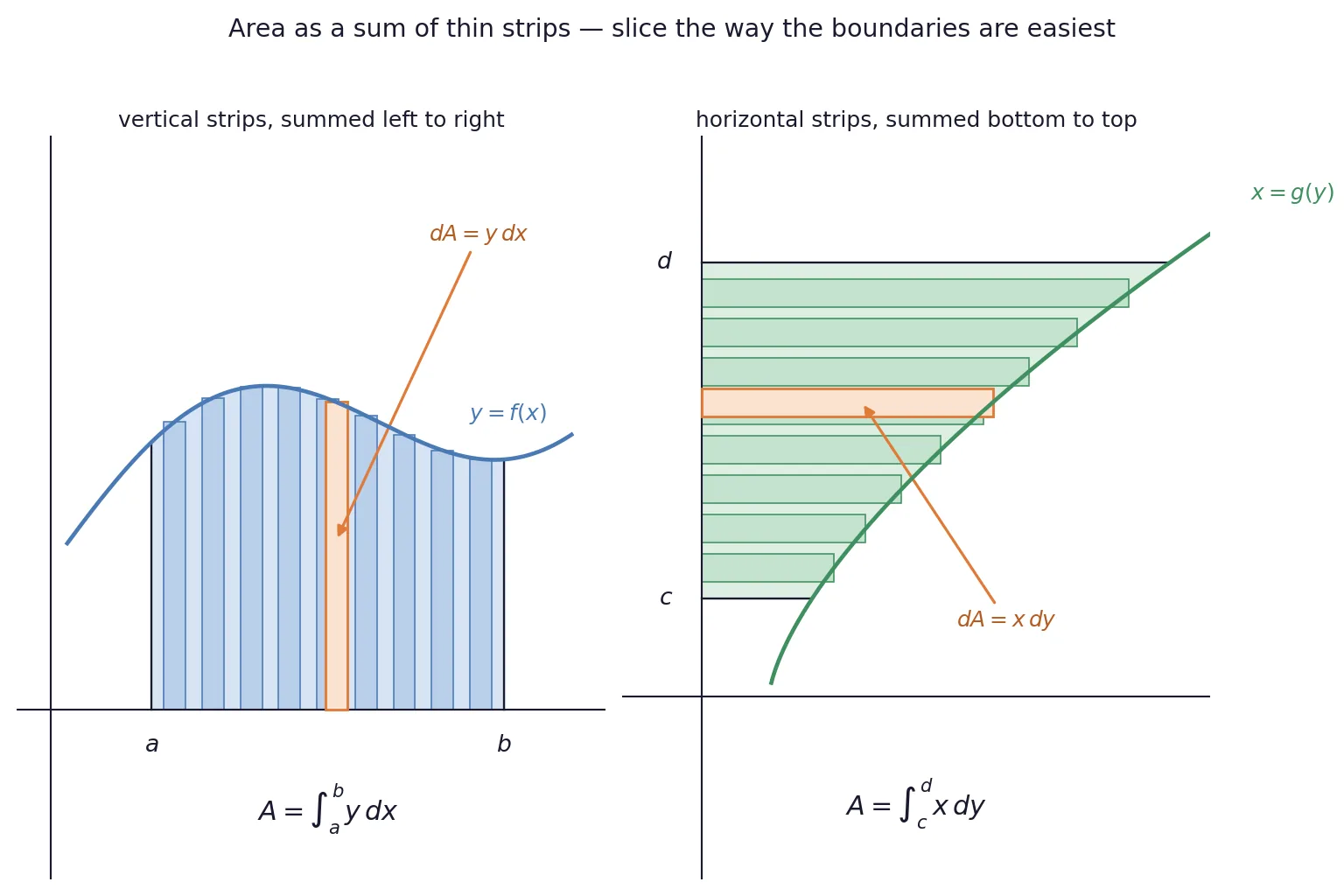
Horizontal strips — area against the -axis
If the region is bounded by the curve , the -axis and the lines , , slice it into thin horizontal strips of length and width :
Key Point: The strip is the whole method. Decide which axis the region leans on, write the area of ONE strip ( or ), then integrate between the limits. Every problem in this chapter is those three moves plus a sketch.
Choosing the strip direction
- Boundaries of the form , with a curve on top → vertical strips, integrate in .
- Boundaries of the form , with a curve on the right → horizontal strips, integrate in .
- Many regions can be done both ways (the circle in the next section is NCERT's own demonstration) — pick the direction in which the curve solves cleanly for the strip length.
[JEE Tip] In JEE Main, choosing strips instead of often converts a two-piece integral into a single clean one — for example, the region bounded by , the -axis and is a one-line with horizontal strips, but needs a subtraction setup with vertical ones.
The Sign Rule — Curves Below the Axis
If the curve lies below the -axis between and (that is, there), each strip height is negative, so the integral comes out negative. But area is a magnitude — only the numerical value counts. So for a region entirely below the axis:
Mixed regions — the rule
Generally a curve may run partly above and partly below the axis. If the piece below contributes and the piece above contributes , the bounded area is
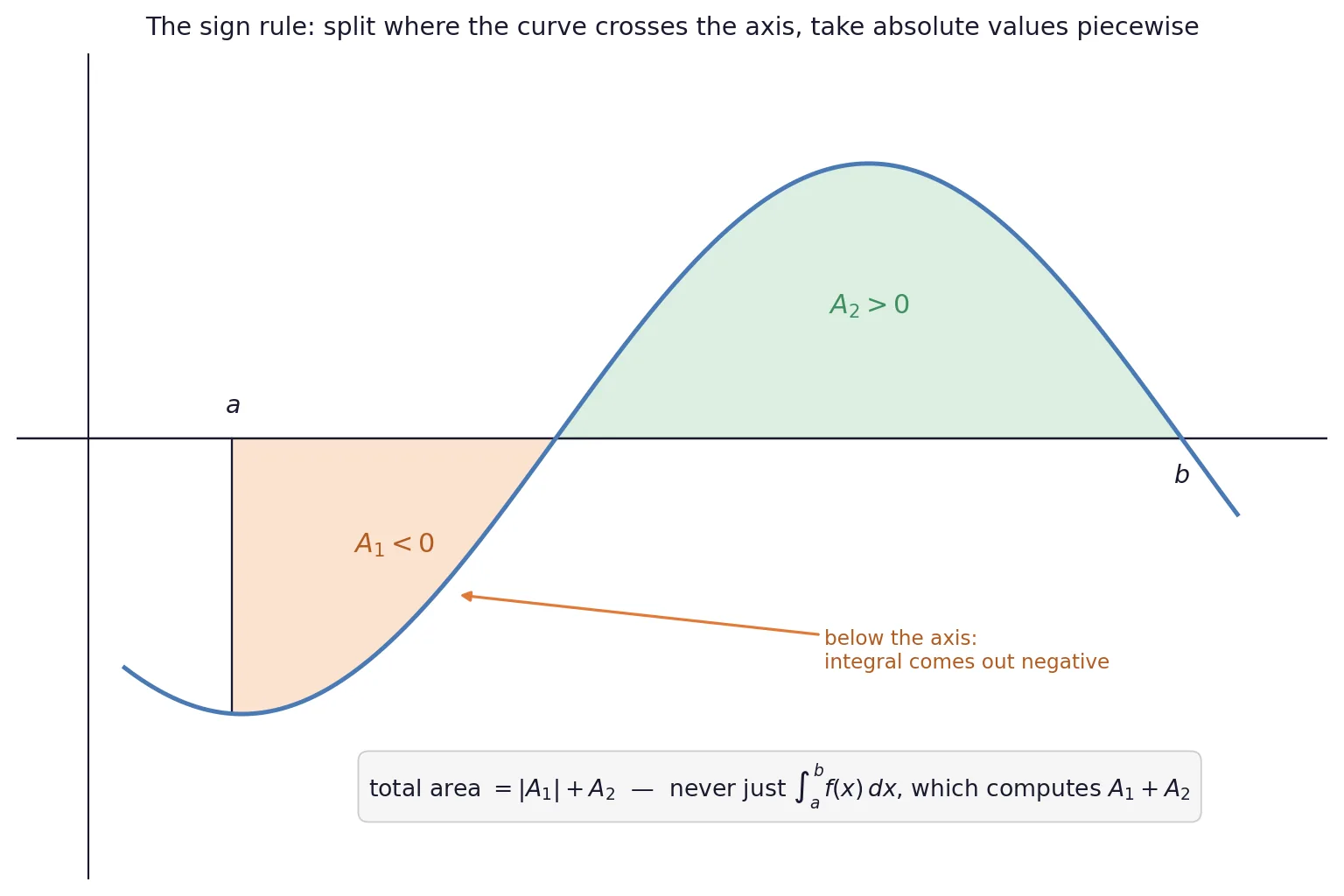
The working procedure:
- Sketch the curve and mark where it crosses the -axis inside (solve ).
- Split the integral at every crossing point.
- Integrate each piece separately, take the absolute value of each, and add.
Key Point: computes the signed sum , not the area. Blind integration across a sign change silently cancels area against area — the single most common error of this chapter. Split first, then integrate.
Contrast worth memorising: (signed), but the area between and the -axis over is (two arches of area each).
[JEE Tip] JEE sets exactly this trap with odd powers: the area bounded by , the -axis, and is , while the unsplit integral gives — and both wrong values appear among the options.
Solved Examples
Example 1: A triangle, two ways
Find the area bounded by the line , the -axis and the ordinates and .
Solution:
- Set up vertical strips: .
- Evaluate: .
- Geometric check: the region is a triangle with base and height : . ✓
Final Answer: square units.
Example 2: Area under a parabola
Find the area under from to .
Solution:
- Set up: the parabola lies above the axis, so .
- Evaluate: .
Final Answer: square units — one third of the bounding rectangle, the classic parabola fraction.
Example 3: A root curve
Find the area bounded by , the -axis and .
Solution:
- Set up: .
- Evaluate: .
Final Answer: square units.
Example 4: Horizontal strips
Find the area of the region bounded by the curve , the -axis and the lines , .
Solution:
- Choose the strip: the region leans on the -axis with given in terms of — horizontal strips: .
- Evaluate: .
Final Answer: square units.
Takeaway: No conversion to was needed — when the curve arrives as , ride the -axis and integrate in directly.
Example 5: An exponential region
Find the area bounded by , the -axis and the ordinates , .
Solution:
- Set up: everywhere, so no sign worries: .
- Evaluate: .
Final Answer: square units (about ).
Example 6: The hyperbola arm
Find the area bounded by , the -axis and the ordinates , .
Solution:
- Set up: on , : .
- Evaluate: .
Final Answer: square units.
Takeaway: Areas under are logarithms — this is exactly why appears in nature as accumulated growth.
Example 7: One arch of sine
Find the area bounded by and the -axis between and .
Solution:
- Check the sign: on all of — a single arch above the axis.
- Evaluate: .
Final Answer: square units — the famous "area of one sine arch".
Example 8: Below the axis
Find the area bounded by , the -axis and the ordinates , .
Solution:
- Check the sign: on — the region lies entirely below the axis.
- Integrate: .
- Take the absolute value: area .
Final Answer: square units.
Takeaway: A negative answer from an area integral is a message, not a mistake — it says the region is below the axis. Report its absolute value, and split first whenever the curve crosses the axis inside the interval.