
Where Areas Sit in JEE — and the One Formula NCERT Trimmed
JEE Main's integral calculus syllabus includes determining areas of the regions bounded by simple curves in standard form — expect one area question in most sessions. JEE Advanced pushes the same idea into multi-curve regions and parameter problems. Crucially, JEE freely asks the area between two curves, which the rationalized NCERT no longer covers — so it's the first add-on to learn here.
Area between two curves
If on , the region between the two graphs has strip height (top minus bottom), so
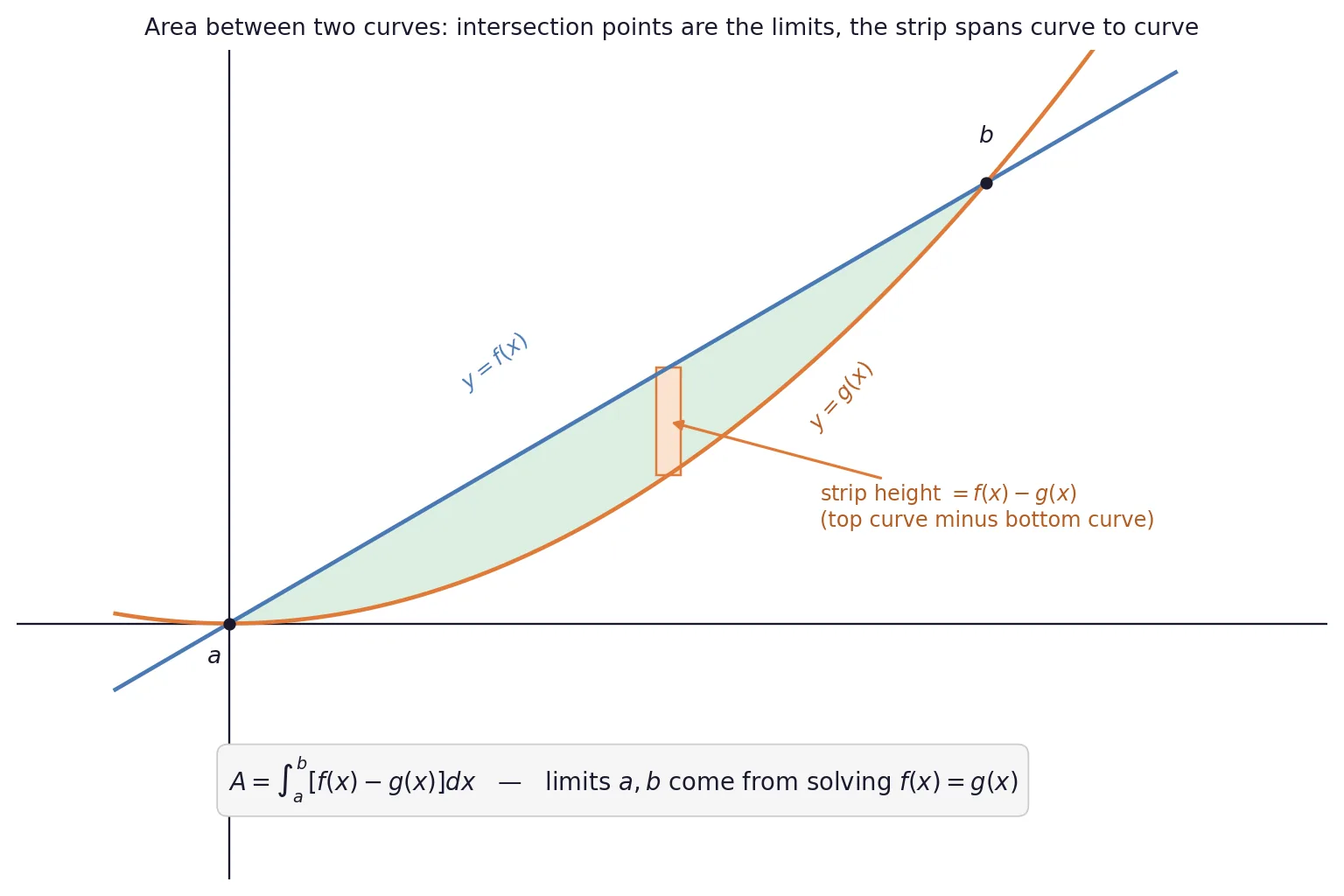
The working routine:
- Find the intersections: solve — these are the limits and .
- Decide who's on top on (test one point, or read the sketch).
- Integrate the difference. If the curves cross inside the interval, split at the crossing and keep top-minus-bottom in each piece.
- For regions leaning sideways, the mirror version is .
Key Point: Because the strip runs curve-to-curve, the -axis plays no role — no sign-splitting for axis crossings is needed. The only splits are where the two curves cross each other.
Results worth carrying into the exam
- Line and parabola , : area . More generally, the region between and has area .
- Two parabolas and : area ; the unit case , gives .
- Parabolic arch versus its chord: a parabola cuts off of the bounding rectangle (Archimedes) — instant answers for latus-rectum and chord regions.
[JEE Tip] In the exam, compute intersections first and mark them on a ten-second sketch. Most wrong answers in area questions come from wrong limits or the wrong curve on top, not from wrong integration.
The Speed Toolkit
- Symmetry first. Regions symmetric about an axis: compute one half and double. The lobes of versus are point-symmetric — twice the first-quadrant lobe.
- Choose strips deliberately. For regions bounded by -type curves and horizontal lines, horizontal strips avoid square roots entirely: the region under up to against the -axis is in one line.
- Standard fractions of standard figures. Circle: (full), , ; ellipse: and its quarters; parabola-in-rectangle: — assemble regions from these blocks before integrating anything.
- Circle-segment template. The area cut from by the chord (right side) is — root formula, two evaluations, done.
- Inverse (parameter) problems. "Find so that the area is ": set up the integral with symbolic, integrate, solve the resulting equation. The area under on is — so area forces , i.e. .
- Area splitting by a curve. "The line divides the region into two equal parts" — write both sub-areas as integrals, set them equal, solve for .
Traps that cost real marks
- Wrong top curve. with the roles swapped flips the sign; if your area comes out negative, you subtracted in the wrong order — fix the order, don't just drop the sign blindly.
- Curves crossing mid-interval. Between and on , the top changes at … and again the strip direction matters: split at every crossing.
- Extraneous intersection roots. Squaring equations while solving can introduce fake intersections — check each root on the original curves.
- Modulus boundaries. -type boundaries mean the region's description changes branch at the corner — treat each branch as its own curve.
[JEE Tip] The +4/−1 economy rewards the memorised special results (items 1-3 above and , ): recognising the configuration is worth the full +4 in under a minute, and these five cover a large share of the area questions actually asked.
JEE-Pattern Worked Examples
Example 1: The classic sixth [JEE Main pattern]
Find the area of the region bounded by the parabola and the line .
Solution:
- Intersections: gives .
- Top curve: on , — the line is on top.
- Integrate: .
Final Answer: square units.
Example 2: Two parabolas [JEE Main pattern]
Find the area enclosed between the parabolas and .
Solution:
- Intersections: substituting into : , so or , i.e. . Points: and .
- Top and bottom on : upper (from ), lower .
- Integrate: .
Final Answer: square units — matching with .
Example 3: Line through a parabola [JEE Main pattern]
Find the area bounded by and .
Solution:
- Intersections: gives , so .
- Top: the line is above the parabola between the roots.
- Integrate: .
Final Answer: square units.
Example 4: Trig curves crossing [JEE Main pattern]
Find the area bounded by , and the -axis, for .
Solution:
- Who's on top: on , ; they meet at .
- Integrate: .
Final Answer: square units.
Example 5: Parabola and an oblique line [JEE Main pattern]
Find the area of the region enclosed by and .
Solution:
- Intersections: gives , so .
- Top: the parabola is above the line between the roots (test : ).
- Integrate: .
Final Answer: square units.
Example 6: An inverse problem [JEE Main pattern]
The area bounded by , the -axis and is square units. Find .
Solution:
- Area as a function of : .
- Impose the condition: , so .
- Solve: .
Final Answer: . (Check: . ✓)
Example 7: Cubic versus line — symmetric lobes [JEE Advanced pattern]
Find the total area enclosed between and .
Solution:
- Intersections: gives — two enclosed lobes.
- Right lobe : the line is on top: .
- Left lobe : by the odd symmetry of both curves, congruent to the right lobe: another .
- Add: .
Final Answer: square units.
Takeaway: Blindly integrating from to gives — the lobes cancel in the signed integral exactly as axis-crossing regions do. Intersections inside the range are split points, always.