Introduction to the Concept

Finding the area bounded by a curve and a straight line is a natural extension of finding the area under a simple curve. In this case, the region is enclosed not by a curve and a coordinate axis, but by two different graphs.

The key idea is simple:

  • at each point in the interval, take the upper function minus lower function if integrating with respect to xx,
  • or take the right function minus left function if integrating with respect to yy.

Before writing the integral, we must first identify the shape of the enclosed region. This requires finding the points of intersection of the given curve and line, because these points provide the limits of integration.

So every problem of this type begins with geometry and algebra together:

  1. understand the region,
  2. find intersection points,
  3. decide whether to integrate with respect to xx or yy,
  4. subtract the lower boundary from the upper boundary (or left from right).

Steps to Find the Area

To solve such problems systematically, follow these steps:

Step 1: Sketch the Region Draw a rough graph of the given curve and line. This helps you see:

  • where they intersect,
  • which graph lies above the other,
  • whether symmetry can be used,
  • whether one integral or split integrals are needed.

Step 2: Find the Points of Intersection Solve the equations simultaneously. These points usually provide the lower and upper limits of the integral.

Step 3: Choose the Variable of Integration

  • If the graphs are naturally written as y=f(x)y=f(x), integrate with respect to xx.
  • If the graphs are naturally written as x=f(y)x=f(y), integrate with respect to yy.
  • Choose the variable that avoids splitting the region unnecessarily.

Step 4: Set up the Correct Difference

  • Integrating with respect to xx: If the top curve is y=f(x)y=f(x) and the bottom curve is y=g(x)y=g(x), then Area=ab[f(x)g(x)]dx\text{Area} = \int_a^b [f(x)-g(x)]\,dx
  • Integrating with respect to yy: If the right boundary is x=f(y)x=f(y) and the left boundary is x=g(y)x=g(y), then Area=cd[f(y)g(y)]dy\text{Area} = \int_c^d [f(y)-g(y)]\,dy

Step 5: Evaluate the Integral Carefully Always simplify first if possible, then integrate and apply the limits.

The most common mistake in these problems is reversing the order and writing lower minus upper, which gives a negative result. Since area must be positive, always check the geometry before writing the integrand.

Symmetry and Standard Results

Symmetry can reduce calculation substantially. For example, if the bounded region is symmetric about the x-axis or y-axis, it is often easier to find half the area and multiply by 2.

For the parabola y2=4axy^2 = 4ax, the line x=ax=a is its latus rectum. Since the parabola is symmetric about the x-axis, the area cut off by this line can be found using one half and doubling it.

A useful standard result is:

Area bounded by the parabola y2=4axy^2 = 4ax and the line y=mxy = mx Area=8a23m3\text{Area} = \frac{8a^2}{3m^3}

This formula is obtained by finding the points of intersection and integrating the difference between the upper branch of the parabola and the line. It is useful for checking your answer quickly.

Example 1: Parabola and a Horizontal Line

Find the area of the region bounded by the parabola y=x2y = x^2 and the line y=4y = 4.

Solution: Step 1: Understand the geometry. The parabola y=x2y=x^2 opens upward, and the horizontal line y=4y=4 cuts it in two points. The enclosed region lies between the line and the parabola and is symmetric about the y-axis.

Step 2: Find the points of intersection. Set x2=4x^2 = 4 So, x=2, 2x = -2,\ 2 Thus the intersection points are (2,4)(-2,4) and (2,4)(2,4).

Step 3: Identify upper and lower curves. Between x=2x=-2 and x=2x=2:

  • upper curve: y=4y=4
  • lower curve: y=x2y=x^2

Hence, Area=22(4x2)dx\text{Area} = \int_{-2}^{2} (4-x^2)\,dx Using symmetry, Area=202(4x2)dx\text{Area} = 2\int_0^2 (4-x^2)\,dx

Step 4: Integrate. 202(4x2)dx=2[4xx33]022\int_0^2 (4-x^2)\,dx = 2\left[4x-\frac{x^3}{3}\right]_0^2

Step 5: Apply the limits. =2(883)=2(2483)=2163=323=2\left(8-\frac{8}{3}\right)=2\left(\frac{24-8}{3}\right)=2\cdot\frac{16}{3}=\frac{32}{3}

Answer: 323\frac{32}{3} square units.

Example 2: Parabola and its Latus Rectum

Find the area bounded by the parabola y2=4axy^2 = 4ax and its latus rectum.

Solution: Step 1: Write the equation of the latus rectum. For the parabola y2=4axy^2=4ax, the latus rectum is the vertical line x=ax=a

Step 2: Find the points where this line meets the parabola. Substitute x=ax=a into y2=4axy^2=4ax: y2=4a(a)=4a2y^2 = 4a(a)=4a^2 So, y=±2ay=\pm 2a The bounded region is symmetric about the x-axis.

Step 3: Express yy in terms of xx. From y2=4axy^2=4ax we take the upper branch in the first quadrant: y=2ax=2axy=2\sqrt{ax}=2\sqrt{a}\sqrt{x}

Step 4: Find the upper half-area and double it. Area=20aydx=20a2ax1/2dx\text{Area} = 2\int_0^a y\,dx = 2\int_0^a 2\sqrt{a}\,x^{1/2}\,dx =4a0ax1/2dx=4\sqrt{a}\int_0^a x^{1/2}\,dx

Step 5: Integrate. =4a[x3/23/2]0a=4a23[a3/20]=4\sqrt{a}\left[\frac{x^{3/2}}{3/2}\right]_0^a = 4\sqrt{a}\cdot \frac{2}{3}\left[a^{3/2}-0\right] =83aa3/2=8a23=\frac{8}{3}\sqrt{a}\,a^{3/2}=\frac{8a^2}{3}

Answer: 8a23\frac{8a^2}{3} square units.

Example 3: Parabola and an Oblique Line

Find the area of the region bounded by the curve y=x2y = x^2 and the line y=xy = x.

Solution: Step 1: Find the points of intersection. Set x2=xx^2=x x(x1)=0x(x-1)=0 So, x=0, 1x=0,\ 1 The intersection points are (0,0)(0,0) and (1,1)(1,1).

Step 2: Decide which graph lies above the other on (0,1)(0,1). Take a test point, say x=12x=\frac12:

  • line: y=x=12y=x=\frac12
  • parabola: y=x2=14y=x^2=\frac14 Thus the line lies above the parabola.

Step 3: Set up the area integral. Area=01(xx2)dx\text{Area} = \int_0^1 (x-x^2)\,dx

Step 4: Integrate. 01(xx2)dx=[x22x33]01\int_0^1 (x-x^2)\,dx = \left[\frac{x^2}{2}-\frac{x^3}{3}\right]_0^1

Step 5: Evaluate. =1213=326=16=\frac12-\frac13=\frac{3-2}{6}=\frac16

Answer: 16\frac{1}{6} square units.

Example 4: Circle and a Vertical Line

Find the area of the smaller region bounded by the circle x2+y2=16x^2 + y^2 = 16 and the line x=2x = 2.

Solution: Step 1: Understand the region. The circle has radius 44 and center at the origin. The vertical line x=2x=2 cuts the circle and forms a smaller segment on the right side. This segment is symmetric about the x-axis.

Step 2: Use the upper semicircle. From x2+y2=16x^2+y^2=16 we get y=16x2y=\sqrt{16-x^2} for the upper half.

Step 3: Set up the integral. The smaller segment lies between x=2x=2 and x=4x=4. So the required area is Area=22416x2dx\text{Area} = 2\int_2^4 \sqrt{16-x^2}\,dx

Step 4: Use the standard integral: a2x2dx=x2a2x2+a22sin1(xa)\int \sqrt{a^2-x^2}\,dx = \frac{x}{2}\sqrt{a^2-x^2} + \frac{a^2}{2}\sin^{-1}\left(\frac{x}{a}\right) with a=4a=4. Hence, Area=2[x216x2+8sin1(x4)]24\text{Area} = 2\left[\frac{x}{2}\sqrt{16-x^2}+8\sin^{-1}\left(\frac{x}{4}\right)\right]_2^4

Step 5: Evaluate at the upper limit x=4x=4. 421616+8sin1(1)=0+8π2=4π\frac{4}{2}\sqrt{16-16}+8\sin^{-1}(1)=0+8\cdot\frac{\pi}{2}=4\pi

Step 6: Evaluate at the lower limit x=2x=2. 22164+8sin1(12)=12+8π6=23+4π3\frac{2}{2}\sqrt{16-4}+8\sin^{-1}\left(\frac12\right)=\sqrt{12}+8\cdot\frac{\pi}{6}=2\sqrt3+\frac{4\pi}{3}

Step 7: Subtract and multiply by 2. Area=2(4π234π3)\text{Area} = 2\left(4\pi-2\sqrt3-\frac{4\pi}{3}\right) =2(12π4π323)=2(8π323)=2\left(\frac{12\pi-4\pi}{3}-2\sqrt3\right)=2\left(\frac{8\pi}{3}-2\sqrt3\right) =16π343=\frac{16\pi}{3}-4\sqrt3

Answer: 16π343\frac{16\pi}{3}-4\sqrt3 square units.

Example 5: Integration along the y-axis

Find the area bounded by the curve x=y2x = y^2 and the line x=y+2x = y + 2.

Solution: Step 1: Choose the variable of integration. Since both equations are already in the form x=x= function of yy, integrating with respect to yy is easiest.

Step 2: Find the points of intersection. Set y2=y+2y^2 = y+2 y2y2=0y^2-y-2=0 (y2)(y+1)=0(y-2)(y+1)=0 So, y=1, 2y=-1,\ 2

Step 3: Determine which curve is to the right. Take a test value, say y=0y=0:

  • parabola: x=y2=0x=y^2=0
  • line: x=y+2=2x=y+2=2 So the line is to the right, and the parabola is to the left.

Step 4: Set up the integral. Area=12[(y+2)y2]dy\text{Area} = \int_{-1}^{2} \Big[(y+2)-y^2\Big] \, dy

Step 5: Integrate. (y+2y2)dy=y22+2yy33\int (y+2-y^2)\,dy = \frac{y^2}{2}+2y-\frac{y^3}{3} So, Area=[y22+2yy33]12\text{Area} = \left[\frac{y^2}{2}+2y-\frac{y^3}{3}\right]_{-1}^{2}

Step 6: Evaluate. At y=2y=2: 42+483=2+483=103\frac{4}{2}+4-\frac{8}{3}=2+4-\frac{8}{3}=\frac{10}{3} At y=1y=-1: 122+13=12+132=562=76\frac{1}{2}-2+\frac{1}{3}=\frac{1}{2}+\frac{1}{3}-2=\frac{5}{6}-2=-\frac{7}{6} Thus, Area=103(76)=206+76=276=92\text{Area} = \frac{10}{3}-\left(-\frac{7}{6}\right)=\frac{20}{6}+\frac{7}{6}=\frac{27}{6}=\frac{9}{2}

Answer: 92\frac{9}{2} square units.

Example 6: Area in the First Quadrant

Find the area in the first quadrant enclosed by the x-axis, the line y=xy = x, and the circle x2+y2=32x^2 + y^2 = 32.

Solution: Step 1: Understand the region. The circle has radius 32=42\sqrt{32}=4\sqrt2 and center at the origin. The line y=xy=x meets the circle in the first quadrant, and the enclosed region consists of:

  • a triangular-type part under y=xy=x from x=0x=0 to the intersection point,
  • a curved part under the circle from the intersection point to the positive x-intercept of the circle.

Step 2: Find where the line meets the circle. Substitute y=xy=x into the circle: x2+x2=32x^2+x^2=32 2x2=322x^2=32 x2=16x^2=16 x=4x=4 So the point of intersection is (4,4)(4,4).

Step 3: Split the area. From x=0x=0 to x=4x=4, the upper boundary is the line y=xy=x. From x=4x=4 to x=42x=4\sqrt2, the upper boundary is the upper semicircle y=32x2y=\sqrt{32-x^2} Hence, Area=04xdx+44232x2dx\text{Area} = \int_0^4 x\,dx + \int_4^{4\sqrt2} \sqrt{32-x^2}\,dx

Step 4: Evaluate the first integral. 04xdx=[x22]04=8\int_0^4 x\,dx = \left[\frac{x^2}{2}\right]_0^4 = 8

Step 5: Evaluate the second integral using the standard formula. a2x2dx=x2a2x2+a22sin1(xa)\int \sqrt{a^2-x^2}\,dx = \frac{x}{2}\sqrt{a^2-x^2}+\frac{a^2}{2}\sin^{-1}\left(\frac{x}{a}\right) with a=42a=4\sqrt2. So, 44232x2dx=[x232x2+16sin1(x42)]442\int_4^{4\sqrt2}\sqrt{32-x^2}\,dx = \left[\frac{x}{2}\sqrt{32-x^2}+16\sin^{-1}\left(\frac{x}{4\sqrt2}\right)\right]_4^{4\sqrt2}

At x=42x=4\sqrt2: 0+16π2=8π0+16\cdot\frac{\pi}{2}=8\pi At x=4x=4: 4216+16sin1(12)=24+16π4=8+4π\frac{4}{2}\sqrt{16}+16\sin^{-1}\left(\frac{1}{\sqrt2}\right)=2\cdot4+16\cdot\frac{\pi}{4}=8+4\pi Thus the second integral is 8π(8+4π)=4π88\pi-(8+4\pi)=4\pi-8

Step 6: Add both parts. Area=8+(4π8)=4π\text{Area} = 8+(4\pi-8)=4\pi

Answer: 4π4\pi square units.

Example 7: Line passing through the vertex of a parabola

Find the area bounded by the parabola y2=4xy^2 = 4x and the line y=2xy = 2x.

Solution: Step 1: Find the points of intersection. Substitute y=2xy=2x into y2=4xy^2=4x: (2x)2=4x(2x)^2=4x 4x2=4x4x^2=4x 4x(x1)=04x(x-1)=0 So, x=0, 1x=0,\ 1 Hence the intersection points are (0,0)(0,0) and (1,2)(1,2).

Step 2: Identify upper and lower boundaries between x=0x=0 and x=1x=1. The parabola gives y=2xy=2\sqrt{x} for the upper branch. Take a test point such as x=14x=\frac14:

  • parabola: y=21/4=1y=2\sqrt{1/4}=1
  • line: y=214=12y=2\cdot\frac14=\frac12 So the parabola lies above the line.

Step 3: Set up the integral. Area=01(2x2x)dx=201(x1/2x)dx\text{Area} = \int_0^1 (2\sqrt{x}-2x)\,dx = 2\int_0^1 (x^{1/2}-x)\,dx

Step 4: Integrate. =2[x3/23/2x22]01=2[2312]=2\left[\frac{x^{3/2}}{3/2}-\frac{x^2}{2}\right]_0^1 = 2\left[\frac{2}{3}-\frac12\right]

Step 5: Simplify. =2(436)=216=13=2\left(\frac{4-3}{6}\right)=2\cdot\frac16=\frac13

Answer: 13\frac{1}{3} square units.

Example 8: Area between Ellipse and a Line

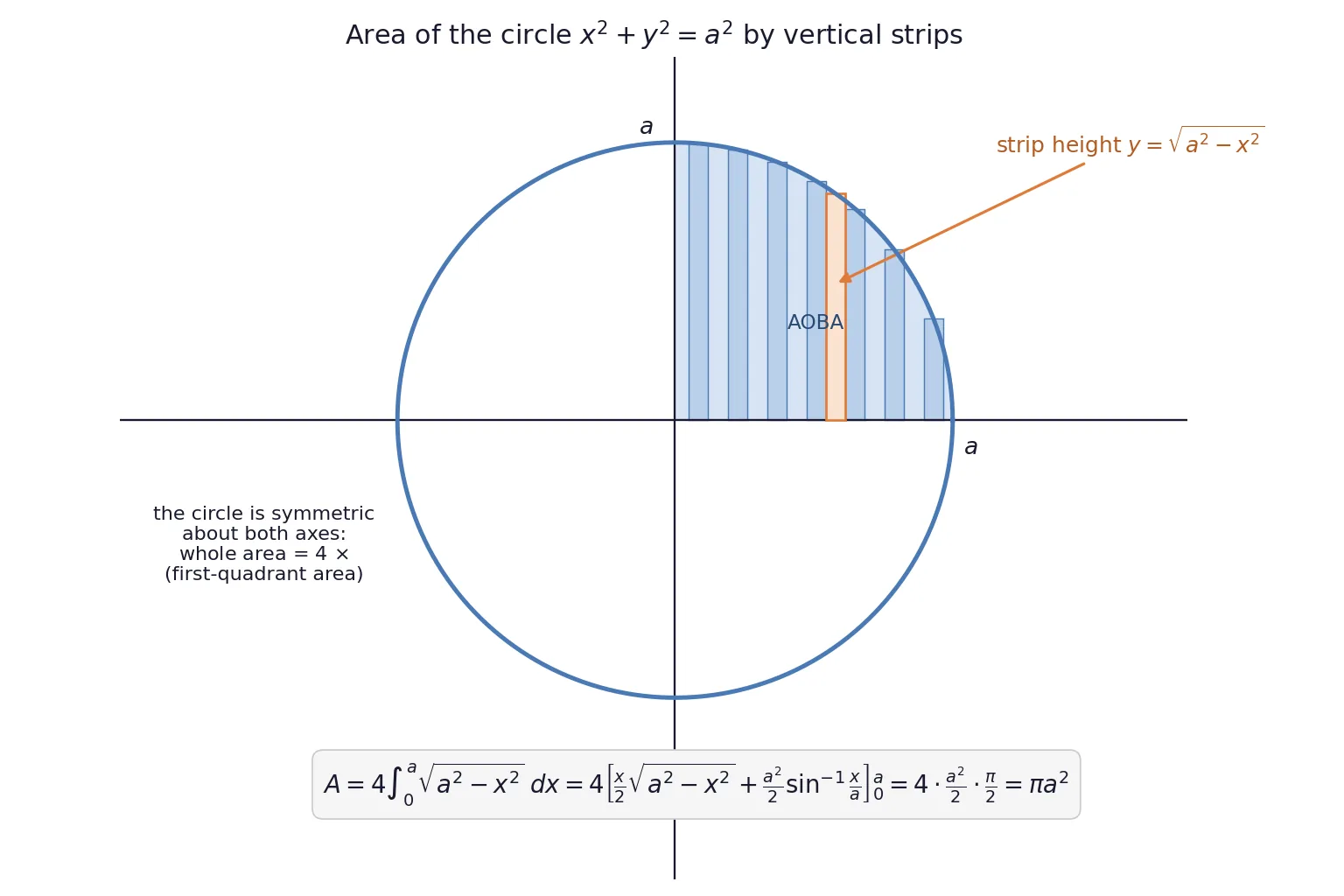
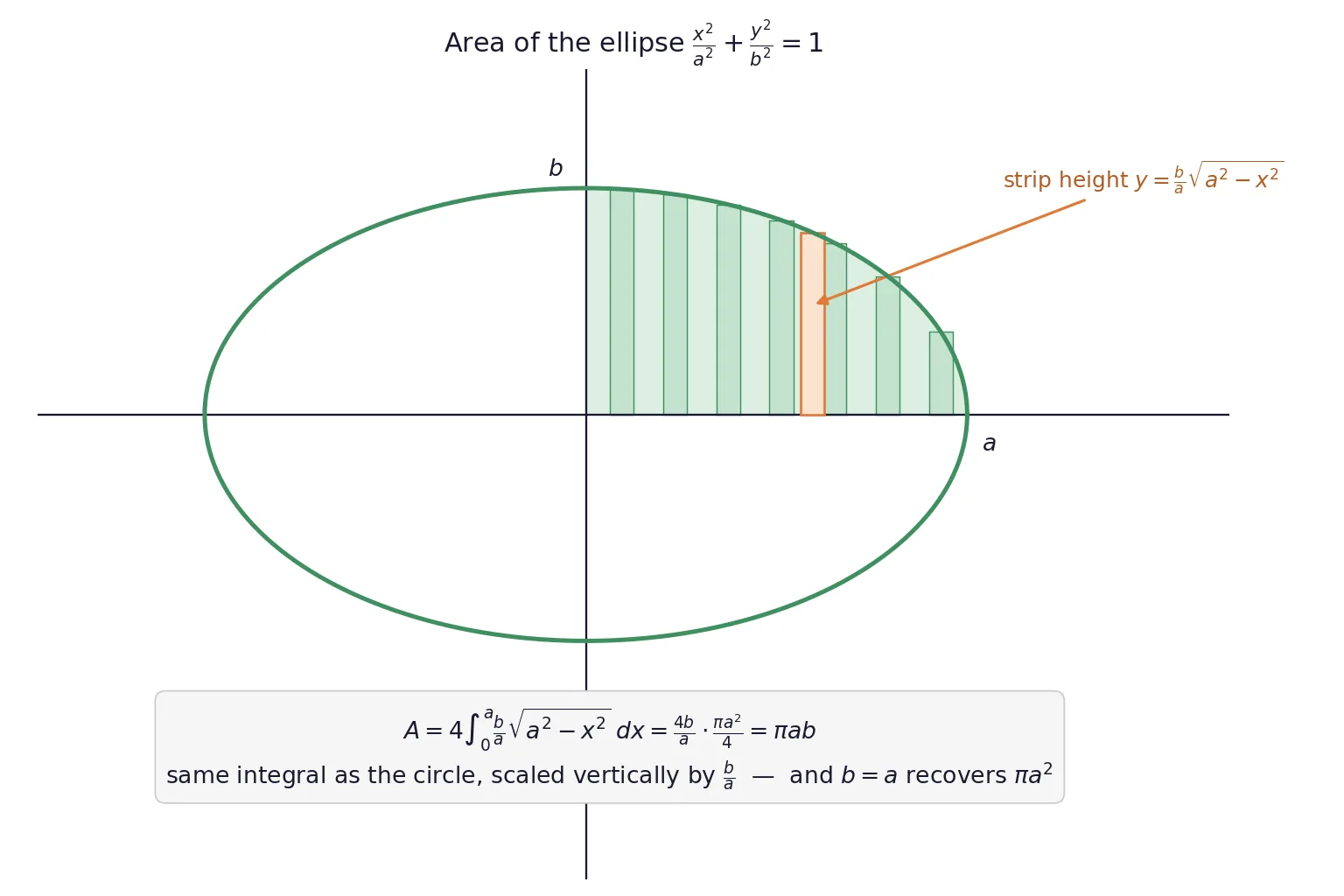
Find the area of the smaller region bounded by the ellipse x2a2+y2b2=1\frac{x^2}{a^2} + \frac{y^2}{b^2} = 1 and the straight line xa+yb=1\frac{x}{a} + \frac{y}{b} = 1.

Solution: Step 1: Identify the intersection points. The line meets the axes at (a,0)(a,0) and (0,b)(0,b). These points also satisfy the ellipse equation, so they are the intersection points. The smaller enclosed region lies in the first quadrant.

Step 2: Write both curves in the form y=y= function of xx. From the ellipse: y2b2=1x2a2\frac{y^2}{b^2}=1-\frac{x^2}{a^2} y=baa2x2y=\frac{b}{a}\sqrt{a^2-x^2} for the upper half.

From the line: yb=1xa\frac{y}{b}=1-\frac{x}{a} y=ba(ax)y=\frac{b}{a}(a-x)

Step 3: Determine upper and lower curves. In the first quadrant between x=0x=0 and x=ax=a, the ellipse lies above the line. So, Area=0a[baa2x2ba(ax)]dx\text{Area} = \int_0^a \left[\frac{b}{a}\sqrt{a^2-x^2}-\frac{b}{a}(a-x)\right]dx =ba0a(a2x2a+x)dx=\frac{b}{a}\int_0^a \left(\sqrt{a^2-x^2}-a+x\right)dx

Step 4: Integrate each part. Using 0aa2x2dx=πa24,0aadx=a2,0axdx=a22\int_0^a \sqrt{a^2-x^2}\,dx = \frac{\pi a^2}{4}, \qquad \int_0^a a\,dx = a^2, \qquad \int_0^a x\,dx = \frac{a^2}{2} we get Area=ba(πa24a2+a22)\text{Area} = \frac{b}{a}\left(\frac{\pi a^2}{4}-a^2+\frac{a^2}{2}\right) =ba(πa24a22)=\frac{b}{a}\left(\frac{\pi a^2}{4}-\frac{a^2}{2}\right) =ab(π412)=ab\left(\frac{\pi}{4}-\frac12\right) =ab4(π2)=\frac{ab}{4}(\pi-2)

Answer: ab4(π2)\frac{ab}{4}(\pi-2) square units.

Example 9: Modulus Function and a Line

Find the area bounded by the curve y=xy = |x| and the line y=3y = 3.

Solution: Step 1: Find the points of intersection. Set x=3|x|=3 So, x=±3x=\pm 3 Thus the bounded region extends from x=3x=-3 to x=3x=3.

Step 2: Use symmetry. The graph y=xy=|x| is symmetric about the y-axis, so we can find the area from 00 to 33 and double it.

Step 3: In the first quadrant, x=x|x|=x. Hence, Area=203(3x)dx\text{Area} = 2\int_0^3 (3-x)\,dx

Step 4: Integrate. =2[3xx22]03=2\left[3x-\frac{x^2}{2}\right]_0^3 =2(992)=292=9=2\left(9-\frac92\right)=2\cdot\frac92=9

This matches the geometry too: the region is a triangle of base 66 and height 33, so Area=1263=9\text{Area}=\frac12\cdot 6\cdot 3=9

Answer: 99 square units.

Example 10: Offset Parabola and a Line

Find the area bounded by the parabola y=x2+1y = x^2 + 1 and the line y=x+3y = x + 3.

Solution: Step 1: Find the points of intersection. Set x2+1=x+3x^2+1 = x+3 x2x2=0x^2-x-2=0 (x2)(x+1)=0(x-2)(x+1)=0 So, x=1, 2x=-1,\ 2

Step 2: Determine which graph lies above the other. Take x=0x=0:

  • parabola: y=1y=1
  • line: y=3y=3 So the line lies above the parabola between x=1x=-1 and x=2x=2.

Step 3: Set up the integral. Area=12[(x+3)(x2+1)]dx=12(x+2x2)dx\text{Area} = \int_{-1}^{2} \Big[(x+3)-(x^2+1)\Big]dx = \int_{-1}^{2} (x+2-x^2)\,dx

Step 4: Integrate. (x+2x2)dx=x22+2xx33\int (x+2-x^2)\,dx = \frac{x^2}{2}+2x-\frac{x^3}{3} Hence, Area=[x22+2xx33]12\text{Area} = \left[\frac{x^2}{2}+2x-\frac{x^3}{3}\right]_{-1}^{2}

Step 5: Evaluate. At x=2x=2: 42+483=683=103\frac{4}{2}+4-\frac{8}{3}=6-\frac{8}{3}=\frac{10}{3} At x=1x=-1: 122+13=12+132=76\frac12-2+\frac13=\frac{1}{2}+\frac{1}{3}-2=-\frac{7}{6} Thus, Area=103(76)=206+76=276=92\text{Area}=\frac{10}{3}-\left(-\frac{7}{6}\right)=\frac{20}{6}+\frac{7}{6}=\frac{27}{6}=\frac92

Answer: 92\frac{9}{2} square units.