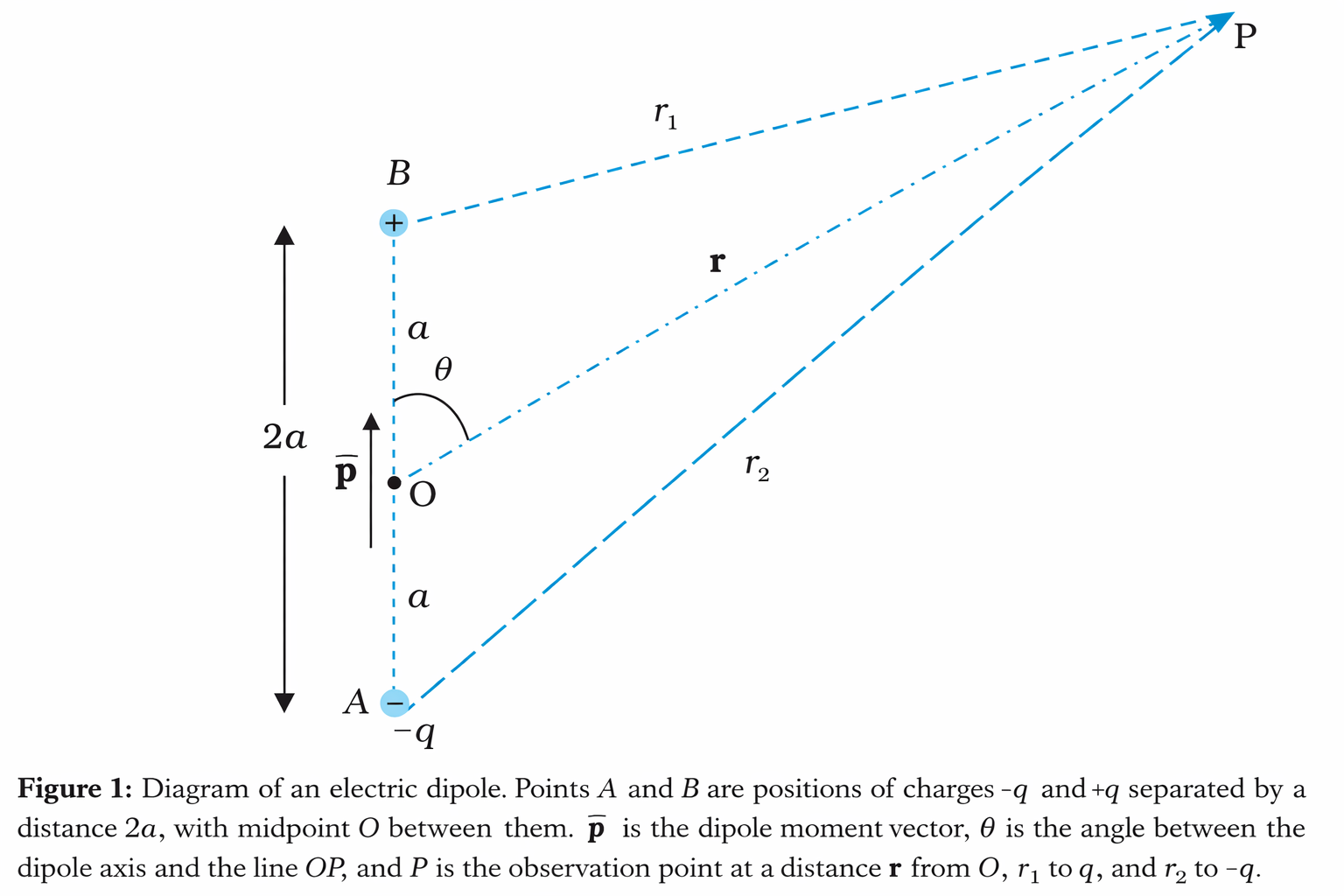
In the previous section, we saw that the potential of a single point charge falls off as 1/r. An electric dipole consists of two equal and opposite charges (+q and −q) separated by a small distance 2a. Because the charges are opposite, their potentials tend to cancel out, leading to a potential that decreases much faster with distance than that of a single charge.
Detailed Derivation: Potential at a General Point
1. The Setup:
Consider an electric dipole consisting of charges −q and +q placed at points A and B respectively. The center of the dipole is at the origin O. The dipole moment p has magnitude p=q×2a and is directed from −q to +q.
We wish to find the potential V at a point P defined by the position vector r relative to the center O. Let the angle between r and the dipole moment p be θ.
2. Superposition Principle:
The potential at P is the algebraic sum of the potentials due to individual charges +q and −q:
V=V+q+V−q=4πϵ01(r1q−r2q)V=4πϵ0q(r11−r21)— (Eq. 1)
Where r1 is the distance from +q to P, and r2 is the distance from −q to P.
3. Geometrical Approximation (for r≫a):
Using the law of cosines in triangles OPB and OPA:
r12=r2+a2−2racosθr22=r2+a2+2racosθ
Since r≫a, we can factor out r2 and ignore the (a/r)2 term:
r12=r2(1+r2a2−r2acosθ)≈r2(1−r2acosθ)
Taking the square root and inverting (using Binomial expansion (1−x)−1/2≈1+x/2):
r11≈r1(1−r2acosθ)−1/2≈r1(1+racosθ)
Similarly:
r21≈r1(1−racosθ)
4. Final Potential Calculation:
Substitute these into Eq. 1:
V=4πϵ0rq[(1+racosθ)−(1−racosθ)]V=4πϵ0rq(r2acosθ)V=4πϵ01r2(q×2a)cosθ
Since p=q×2a, we get:
V=4πϵ01r2pcosθ
Special Cases
Case 1: At a point on the Axial Line
For points on the axis near the positive charge, θ=0∘, so cos0∘=1.
Vaxial=4πϵ01r2p
For points near the negative charge, θ=180∘, so Vaxial=−r2kp.
Case 2: At a point on the Equatorial Line
For points on the perpendicular bisector, θ=90∘, so cos90∘=0.
Vequatorial=0Critical Fact: No work is done in moving a charge along the equatorial plane of a dipole because the potential is zero everywhere on that plane.
Dipole Potential vs. Point Charge Potential
Feature
Point Charge
Electric Dipole
Symmetry
Spherical symmetry
Axial symmetry about p
Distance Dependence
V∝1/r
V∝1/r2
Angular Dependence
Independent of θ
Depends on θ (angle with p)
Potential Sign
Depends on sign of charge
Depends on θ
Memory Capsule
The Master Formula:V=r2kpcosθ.
Power of r: For a dipole, potential drops much faster (1/r2) than for a point charge (1/r).
The Zero Zone: The equatorial plane is an equipotential surface with V=0.
Vector Relation:V=4πϵ01r2p⋅r^.
Example 1: Potential on the Axial Line
A dipole has a dipole moment of 4×10⁻⁹ C m. Calculate the potential at a point 0.3 m away from the center on the axial line near the positive charge.
Solution:
Formula for axial point:V=r2kp
Given:p=4×10⁻⁹C m,r=0.3m,k=9×10⁹
Substitute:V=(0.3)2(9×10⁹)(4×10⁻⁹)
Calculate:V=0.0936=400V
Final Answer:V=400V
Example 2: Potential at a General Point
Find the potential at a point 1 m away from the center of a dipole of dipole moment 2×10⁻¹² C m, if the point makes an angle of 60∘ with the dipole axis.
Solution:
General formula:V=r2kpcosθ
Given:p=2×10⁻¹²C m,r=1m,θ=60∘
Since
cos60∘=21
Substitute:V=12(9×10⁹)(2×10⁻¹²)(1/2)
Calculate:V=9×10⁻³V
Final Answer:V=9mV
Example 3: Potential on the Equatorial Line
What is the potential at a point on the equatorial line of a dipole at a distance 0.5 m from the center?
Solution:
On the equatorial line,
θ=90∘
Therefore,
cos90∘=0
Using the general formula,
V=r2kpcosθ=r2kp⋅0=0
Final Answer:V=0
Concept Check: The result is independent of the actual value of p and r as long as the point lies on the equatorial line.
Example 4: Potential on the Negative Axial Side
A dipole has dipole moment 6×10⁻⁸ C m. Find the potential at a point 0.6 m from the center on the axial line near the negative charge.
Solution:
On the axial line near the negative charge,
θ=180∘
Hence,
cos180∘=−1
Formula becomes:
V=−r2kp
Substitute values:
V=−(0.6)2(9×10⁹)(6×10⁻⁸)
Calculate:
V=−0.36540=−1500V
Final Answer:V=−1.5×10³V
Example 5: Finding Dipole Moment from Potential
At a point on the axial line 0.2 m from the center, the potential due to a dipole is 1800 V. Find the dipole moment.
Solution:
For an axial point,
V=r2kp
Rearranging:
p=kVr2
Substitute the values:
p=9×1091800×(0.2)2
Calculate:
p=9×1091800×0.04=9×10972=8×10⁻⁹C m
Final Answer:p=8×10⁻⁹C m
Example 6: Finding Distance from Given Potential
The potential on the axial line of a dipole of moment 9×10⁻⁹ C m is 900 V. Find the distance of the point from the center.
Solution:
Formula on axial line:
V=r2kp
Rearranging for distance:
r2=Vkpr=Vkp
Substitute values:
r=900(9×10⁹)(9×10⁻⁹)
Calculate inside the square root:
r=90081=0.09
Therefore,
r=0.3m
Final Answer:r=0.3m
Example 7: Comparing Potentials at Two Angles
For a fixed dipole moment and fixed distance, compare the potentials at θ=60∘ and θ=120∘.
Solution:
General relation:
V=r2kpcosθ
At 60∘:
V1=r2kpcos60∘=2r2kp
At 120∘:
V2=r2kpcos120∘=r2kp(−1/2)=−2r2kp
Hence,
V1=−V2
Final Answer:
The two potentials are equal in magnitude but opposite in sign.
Example 8: Potential Becomes One-Fourth
At a distance r from a dipole, the potential at a certain angle is V. At what distance will the potential become V/4 if the angle remains the same?
Solution:
For fixed p and fixed θ,
V∝r21
Therefore,
V2V1=r12r22
Given:
V2=4V1
so,
V1/4V1=r12r22
Hence,
4=r12r22r2=2r1
Final Answer:
The distance must be doubled.
Example 9: Work Done Along the Equatorial Line
How much work is done in moving a 5μC charge from one point to another on the equatorial line of a dipole?
Solution:
On the equatorial line of a dipole,
V=0
at every point.
Therefore the potential difference between any two such points is:
ΔV=0
Work done is:
W=qΔV
Substitute:
W=(5×10⁻⁶)(0)=0
Final Answer:W=0
Reason: No work is needed because the entire equatorial line is an equipotential region.
Example 10: Potential at the Center of a Dipole
Find the potential at the center of an electric dipole whose charges are +q and −q.
Solution:
The center is equidistant from both charges.
Let the distance of each charge from the center be a.
Potential due to +q at the center:
V+=akq
Potential due to −q at the center:
V−=−akq
Net potential:
V=V++V−=akq−akq=0
Final Answer:V=0
Example 11: Finding Angle for Half the Axial Potential
At a fixed distance from a dipole, the potential is half of the axial potential on the positive side. Find the angle θ.
Solution:
Potential at a general point:
V=r2kpcosθ
Axial potential on positive side:
Vaxial=r2kp
Given:
V=21Vaxial
Therefore,
r2kpcosθ=21⋅r2kp
Cancel common terms:
cosθ=21
Hence,
θ=60∘
Final Answer:θ=60∘
Example 12: Ratio of Potentials at Two Distances
A point lies on the axial line of a dipole. If its distances from the center are 2 m and 4 m in two cases, find the ratio of potentials.
Solution:
On the axial line,
V∝r21
Therefore,
V2V1=r12r22
Substitute:
V2V1=2242=416=4
Final Answer:V1:V2=4:1
Ready to test your knowledge?
Take a quick interactive quiz on this topic —
free, works without login.