Electrostatic potential energy is the energy stored in a configuration of charges. It is defined as the work done by an external force in assembling the charges by bringing them from infinity to their respective locations, without acceleration.
Think of it this way: charges of the same sign repel each other. To hold them close together, you must perform work. That work doesn't vanish; it is stored in the system as potential energy.
Potential Energy of a System of Two Point Charges
Derivation
Initial State: Imagine two points P1 and P2 at a distance r12 from each other. Initially, there are no charges in the universe (V=0 everywhere).
Bringing q1: We bring charge q1 from infinity to point P1. Since there is no electric field to oppose it, the work done W1=0.
The Field of q1: Now, charge q1 creates a potential V1 at point P2:
V1=4πϵ01r12q1
Bringing q2: Now we bring charge q2 from infinity to point P2. The work done W2 is charge × potential at that point:
W2=q2⋅V1=4πϵ01r12q1q2
Total Energy (U): The total work done W=W1+W2 is stored as the potential energy U:
U=4πϵ01r12q1q2
Potential Energy of a System of Three Point Charges
Derivation:
Following the same logic, if we bring a third charge q3 to point P3:
Work against q1:W31=4πϵ01r13q1q3
Work against q2:W32=4πϵ01r23q2q3
Total Energy (U): Summing all interactions:
U=4πϵ01(r12q1q2+r13q1q3+r23q2q3)Rule: For a system of n charges, U is the sum of energies for all possible distinct pairs.
Potential Energy in an External Field
Sometimes, charges are placed in a region where an electric field already exists (created by some external sources we don't see).
A. Single Charge in External Field
If a charge q is at a point with external potential V(r), the potential energy is simply:
U=q⋅V(r)
B. Two Charges in External Field
The total energy is the sum of their individual energies in the external field PLUS their mutual interaction energy:
U=q1V(r1)+q2V(r2)+4πϵ01r12q1q2
Potential Energy of a Dipole in an External Field
Derivation
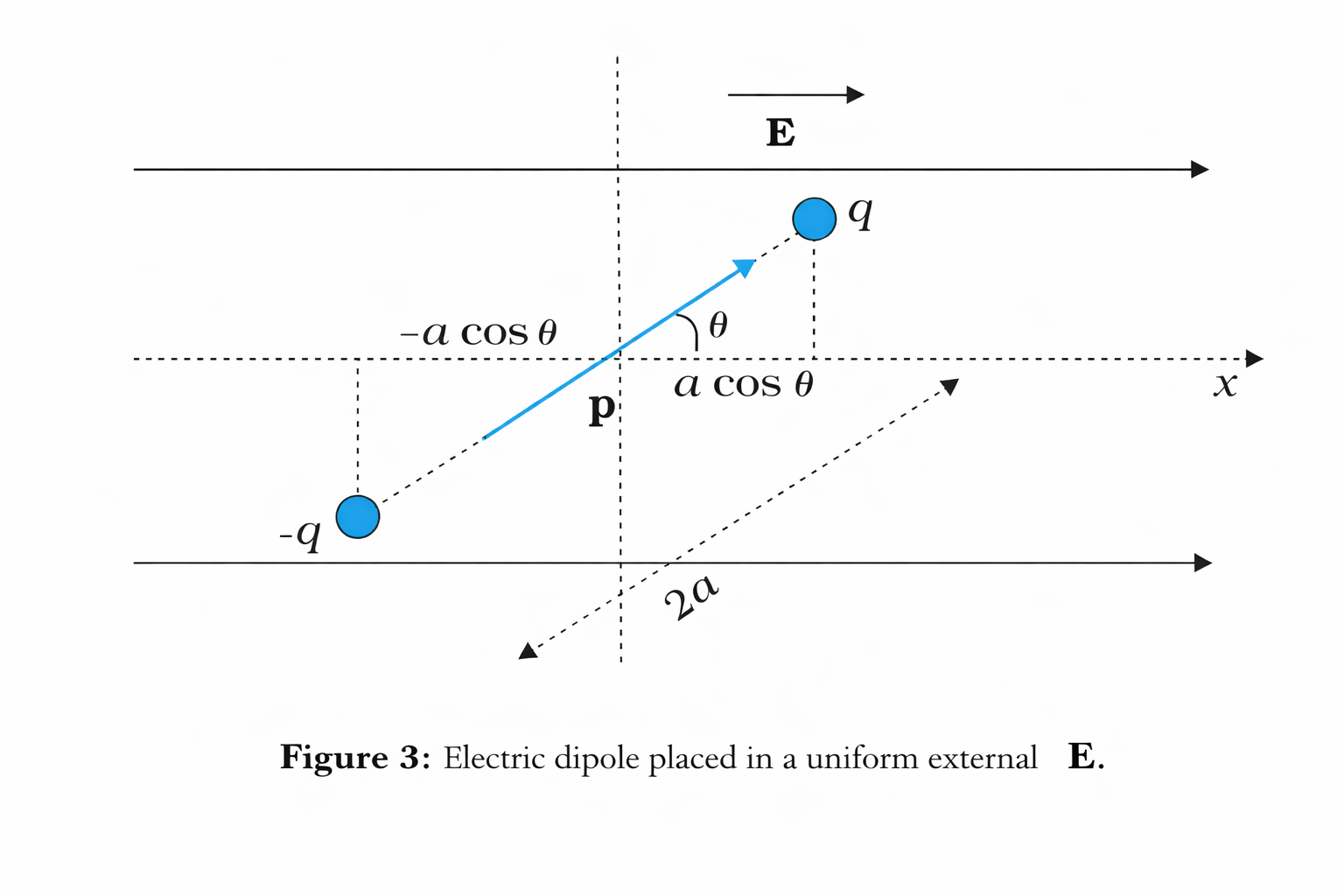
Consider a dipole with dipole moment p placed in a uniform external electric field E. The dipole experiences a torque τ=pEsinθ.
Work to Rotate: The small work done dW in rotating the dipole through a small angle dθ is:
dW=τdθ=pEsinθdθ
Total Work: To rotate it from angle θ0 to θ1:
W=∫θ0θ1pEsinθdθ=pE[−cosθ]θ0θ1W=pE(cosθ0−cosθ1)
Standard Reference: We choose the zero energy position at θ0=90∘ (where the dipole is perpendicular to the field).
U(θ)=pE(cos90∘−cosθ)=−pEcosθVector Form:U=−p⋅E
🧠 Memory Capsule
Two-charge energy:U=kq1q2/r. (Use signs of charges!).
Multi-charge energy: Sum of energies for all possible pairs.
In External Field:Utotal=∑Uext+∑Umutual.
Dipole energy:U=−pEcosθ. Points to remember: 0∘ is stable, 180∘ is unstable.
Work Done in rotation:W=U(θ2)−U(θ1)=pE(cosθ1−cosθ2).
Example 1: Energy of an Equilateral Triangle
Three charges +q,+q, and −q are placed at the vertices of an equilateral triangle of side a. Find the total potential energy of the system.
Solution:
Identify pairs: There are three pairs: (+q,+q), (+q,−q), and (+q,−q).
All pair separations are equal: Each distance is a.
Use pairwise energy formula:U=k(aq⋅q+aq⋅(−q)+aq⋅(−q))
Simplify:U=k(aq2−aq2−aq2)=−kaq2
Final Answer:U=−4πϵ01aq2
Example 2: Rotating a Dipole from Aligned to Perpendicular
A dipole of moment p=5×10⁻⁸ C m is aligned with an electric field E=104 N/C. How much work is required to turn the dipole so that its axis is perpendicular to the field?
Solution:
Initial and final angles:θ1=0∘,θ2=90∘
Use work formula:W=pE(cosθ1−cosθ2)
Substitute values:W=(5×10⁻⁸)(104)(cos0∘−cos90∘)
Calculate:W=5×10⁻⁴(1−0)=5×10⁻⁴J
Final Answer:W=5×10⁻⁴J
Example 3: Dissociating a Molecule
To pull two charges q1=1.6×10⁻¹⁹ C and q2=−1.6×10⁻¹⁹ C from an initial separation of 10−10 m to infinity, how much external work must be done?
Now calculate Ui:Ui=9×109⋅10−10−2.56×10−38=−23.04×10⁻¹⁹J=−2.304×10⁻¹⁸J
External work needed:Wext=0−(−2.304×10⁻¹⁸)=2.304×10⁻¹⁸J
Final Answer:Wext≈2.3×10⁻¹⁸J
Example 4: Basic Two-Charge System
Two point charges +2μC and −3μC are separated by 10 cm. Find the potential energy of the system.
Solution:
Given:q1=2×10⁻⁶C,q2=−3×10⁻⁶C,r=0.1m
Use formula:U=krq1q2
Substitute values:U=9×109⋅0.1(2×10⁻⁶)(−3×10⁻⁶)
Calculate:U=9×109⋅0.1−6×10−12=−0.54J
Final Answer:U=−0.54J
Example 5: Energy of a Square Configuration
Four equal charges q are placed at the corners of a square of side a. Find the total potential energy of the system.
Solution:
Count the interacting pairs: Total number of distinct pairs is 6.
Side pairs: There are 4 pairs separated by distance a.
Usides=4(kaq2)
Diagonal pairs: There are 2 pairs separated by distance 2a.
Udiag=2(k2aq2)=2kaq2
Add all pair energies:U=Usides+Udiag=akq2(4+2)
Final Answer:U=akq2(4+2)
Example 6: Separating Two Like Charges to Infinity
How much external work is required to separate two charges q1=4μC and q2=5μC from 10 cm to infinity?
Solution:
Initial energy of the system:Ui=krq1q2
Substitute values:Ui=9×109⋅0.1(4×10⁻⁶)(5×10⁻⁶)
Calculate:Ui=9×109⋅0.120×10−12=1.8J
Final energy at infinity:Uf=0
External work required:Wext=Uf−Ui=0−1.8=−1.8J
Interpretation: Since the charges repel, the electric field itself does positive work during separation. So the required external work in magnitude is zero if we simply let them go, but if the question asks for the change in potential energy of the system, it is −1.8 J.
Final Answer:ΔU=−1.8J
Note: The field does +1.8J of work while the system loses 1.8J of potential energy.
Example 7: External Field Potential Energy of a Single Charge
A charge of 2μC is placed at a point in an external field where the potential is 500 V. What is its potential energy?
Solution:
Use formula:U=qV
Substitute values:U=(2×10⁻⁶)(500)
Calculate:U=10−3J
Final Answer:U=1mJ
Example 8: Rotating a Dipole from Stable to Unstable Position
An electric dipole with p=2×10⁻⁸ C m is aligned with a field E=104 V/m. Find the work done in turning it from 0∘ to 180∘.
Solution:
Angles:θ1=0∘,θ2=180∘
Use work formula:W=pE(cosθ1−cosθ2)
Substitute:W=(2×10⁻⁸)(104)(1−(−1))
Calculate:W=2×10−4×2=4×10⁻⁴J
Final Answer:W=4×10⁻⁴J
Example 9: Range of Dipole Potential Energy
For a dipole in a uniform electric field E, what is the difference between maximum and minimum potential energy?
Solution:
Minimum energy: At θ=0∘,
Umin=−pE
Maximum energy: At θ=180∘,
Umax=+pE
Difference:ΔU=Umax−Umin=pE−(−pE)=2pE
Final Answer:ΔU=2pE
Example 10: Work Done in Moving Along a Circle Around a Fixed Charge
A charge Q is fixed. Another charge q is moved along a circle of radius R centered on Q. Find the work done by the electrostatic force.
Solution:
Potential energy at any point on the circle:U=kRQq
Since the radius remains constant, the separation between the charges does not change.
Therefore potential energy remains constant throughout the motion:
ΔU=0
Work done by electrostatic force is:
W=−ΔU=0
Final Answer:W=0
Example 11: Potential Energy of Two Charges in an External Field
Two charges q1=1μC and q2=−2μC are placed at points where the external potentials are 300 V and 100 V respectively. Their separation is 0.2 m. Find the total potential energy of the system.
Solution:
Use the total energy formula:U=q1V(r1)+q2V(r2)+kr12q1q2