
Potential due to a System of Charges
Just like the Electric Field, Electrostatic Potential follows the Principle of Superposition. However, because potential is a scalar quantity, calculating the total potential is much simpler—no vector addition is required!
The Statement: The electrostatic potential at any point due to a system of point charges is the algebraic sum of the potentials due to the individual charges.
Derivation:
Consider a system of point charges at distances from a point .
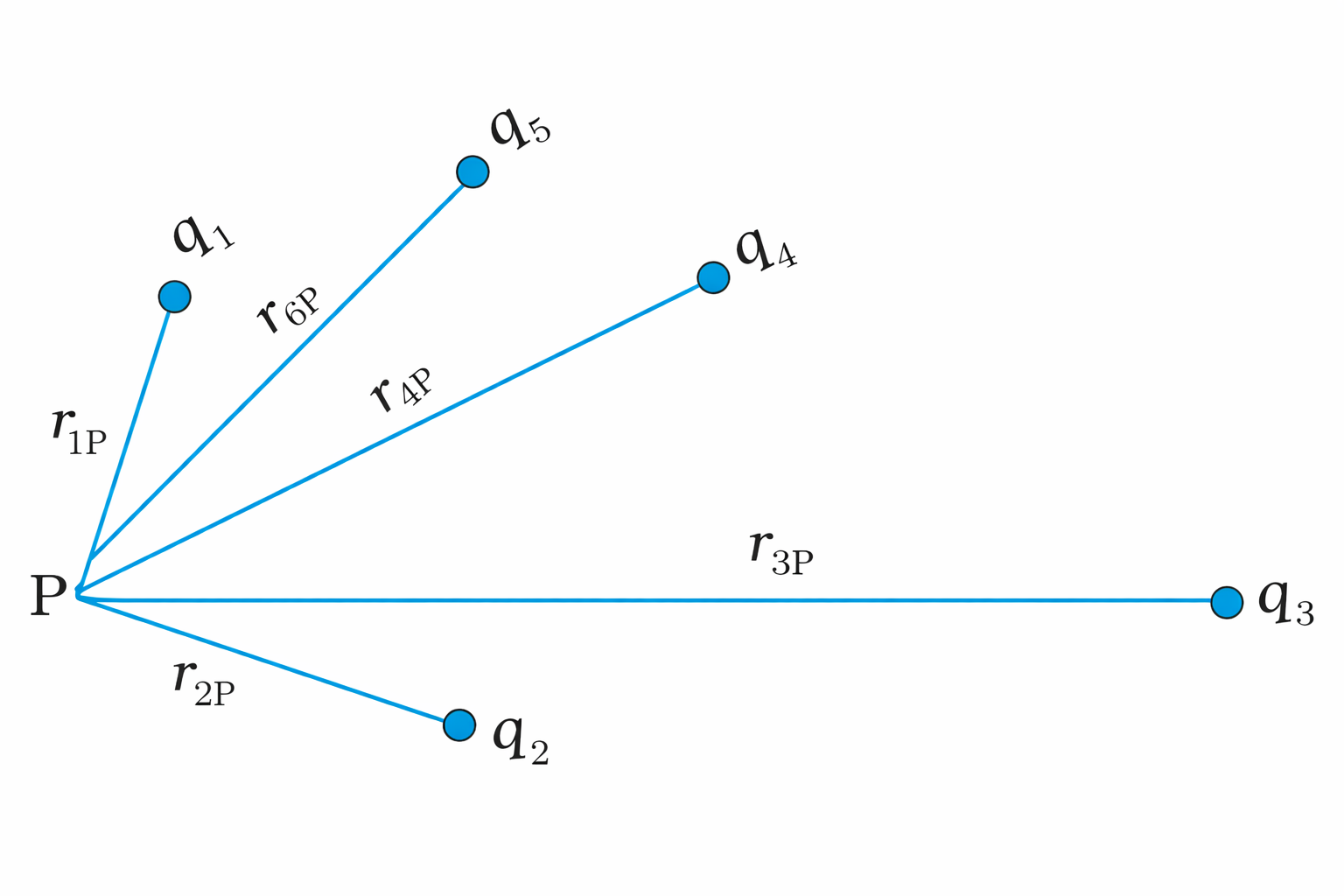
- The potential at due to charge is:
- Similarly, , and so on.
- By the superposition principle, the total potential at is:
Note: Always include the sign of the charge while calculating the sum. Positive charges contribute positive potential, and negative charges contribute negative potential.
Equipotential Surfaces
An equipotential surface is a surface that has the same electric potential at every point on it. In simpler terms, if you move a test charge from one point to another on such a surface, the potential does not change.
Key Properties of Equipotential Surfaces:
- Work Done is Zero: Since the potential difference between any two points () on an equipotential surface is zero, the work done in moving a charge is:
- Electric Field is Perpendicular: The electric field is always directed normal (perpendicular) to the equipotential surface at every point.
- Why? If there were a component of along the surface, work would be required to move a charge against that component, which contradicts the definition of an equipotential surface.
- Density and Field Strength: Equipotential surfaces are closer together in regions of strong electric fields and farther apart in regions of weak electric fields.
- No Intersection: Two equipotential surfaces can never intersect. If they did, a single point would have two different potentials, which is physically impossible.
Relationship between Electric Field and Potential
One of the most powerful formulas in electrostatics relates the electric field to the spatial 'rate of change' of potential.
Consider two closely spaced equipotential surfaces with potentials and . The electric field is given by:
- The Negative Sign: This indicates that the electric field points in the direction where the potential decreases most steeply.
- Potential Gradient: The term is called the potential gradient.
- Magnitude: The magnitude of the electric field is given by the change in potential per unit displacement normal to the equipotential surface.
Shapes of Equipotential Surfaces:
- Point Charge: Concentric spherical shells centered at the charge.
- Uniform Electric Field: Planes perpendicular to the field lines.
- Electric Dipole: Surfaces are 'squeezed' between the charges.
- Two Identical Positive Charges: Surfaces 'push' away from each other near the center.
Example 1: Potential at the Center of a Square
Four point charges , , , and are located at the corners of a square ABCD of side 10 cm. What is the potential at the center of the square?
Solution:
- In a square of side , the distance from each corner to the center is:
- By superposition,
- Sum of charges:
- Therefore,
- Calculation gives:
- Final Answer:
Example 2: Work Done on an Equipotential Surface
Two points A and B are on the same equipotential surface of 100 V. A charge of is moved from A to B. Find the work done.
Solution:
- On an equipotential surface,
- Work done is:
- Substituting,
- Final Answer:
Example 3: Potential at Midpoint of Two Equal Positive Charges
Two equal charges of are separated by 20 cm. Find the potential at the midpoint.
Solution:
- Distance of midpoint from each charge:
- Potential due to one charge:
- Since potential is scalar, total potential is:
- Hence,
- Final Answer:
Example 4: Potential at Midpoint of Equal and Opposite Charges
A charge and a charge are placed 12 cm apart. Find the potential at the midpoint.
Solution:
- Midpoint is equidistant from both charges, so:
- Potential due to :
- Potential due to :
- These are equal and opposite, so they cancel.
- Final Answer:
Example 5: Potential at a Point Due to Two Unequal Charges
Charges and are at distances 0.2 m and 0.3 m respectively from a point P. Find the potential at P.
Solution:
- Use superposition:
- Substitute values:
- Simplify each term:
- Hence,
- Final Answer:
Example 6: Potential at the Center of an Equilateral Triangle
Three charges of each are placed at the corners of an equilateral triangle of side 6 cm. Find the potential at the center.
Solution:
- For an equilateral triangle, the distance from the center to each vertex is:
- Potential due to one charge:
- Since all three charges are equal and equidistant,
- Substitute:
- Simplify:
- Final Answer:
Example 7: Finding Charge from Total Potential
Two identical charges are placed 0.5 m from a point P. If the total potential at P is 7200 V, find each charge.
Solution:
- If each charge is , then potential due to one charge is:
- Total potential due to two identical charges:
- Rearranging,
- Substitute values:
- Simplify:
- Final Answer:
Example 8: Potential Difference and Work Done
A charge of is moved between two points on different equipotential surfaces of 40 V and 10 V. Find the work done by an external agent.
Solution:
- Work done by external agent for slow movement is:
- Let the charge move from 40 V to 10 V.
- Then,
- Therefore,
- Meaning of sign: Negative work means the electric field does positive work.
- Final Answer:
Example 9: Separation of Equipotential Surfaces and Field Strength
In one region, two equipotential surfaces differing by 20 V are 0.5 cm apart. Find the magnitude of electric field in that region.
Solution:
- Use the relation for magnitude:
- Convert distance:
- Substitute:
- Calculate:
- Final Answer:
Example 10: Comparing Two Regions Using Equipotential Spacing
Two adjacent equipotential surfaces differ by 50 V in each of two regions. In region A they are 2 mm apart, and in region B they are 5 mm apart. Which region has stronger electric field, and by what factor?
Solution:
- Electric field magnitude is:
- For region A:
- For region B:
- Compare:
- Conclusion: Region A has the stronger electric field.
- Final Answer: Region A has the stronger field, and it is times that in region B.
Example 11: Why Equipotential Surfaces Cannot Intersect
Suppose two equipotential surfaces of 20 V and 30 V intersect at a point P. Explain why this is impossible.
Solution:
- If two equipotential surfaces intersect, the intersection point belongs to both surfaces.
- Therefore point P would have potential 20 V and 30 V simultaneously.
- But electrostatic potential at a given point must have a unique value.
- This is a contradiction.
- Final Answer: Two equipotential surfaces cannot intersect because one point cannot have two different potentials at the same time.