
Principles of Biotechnology
Biotechnology is the use of live organisms, cells or their enzymes to make products and processes useful to humans. Modern biotechnology rests on two core techniques:
- Genetic engineering (recombinant DNA technology) - techniques to change the chemistry of the genetic material (DNA and RNA) and introduce it into a host organism to change its phenotype.
- Bioprocess (chemical) engineering - maintaining sterile (aseptic) conditions so that only the desired microbe or cell is grown in large quantities to manufacture the product.
The three steps of genetically modifying an organism
- Identify the DNA with the desirable gene.
- Introduce the identified DNA into the host.
- Maintain the introduced DNA in the host and transfer it to the progeny.
The first recombinant DNA was constructed by Stanley Cohen and Herbert Boyer (1972) by joining an antibiotic-resistance gene to a plasmid vector using a restriction enzyme and DNA ligase.
One-liners: biotech = organisms/enzymes for useful products; two techniques = genetic engineering + bioprocess engineering; steps = identify -> introduce -> maintain/transfer the gene; first rDNA = Cohen & Boyer.
Restriction Enzymes - the 'Molecular Scissors'
Restriction enzymes cut DNA at specific sites and are one of the most important tools of recombinant DNA technology. They were discovered while studying how bacteria restrict the growth of invading bacteriophages. The first restriction endonuclease to be characterised was Hind II, which always cuts DNA at a specific sequence of 6 base pairs. Today more than 900 are known.
Nucleases and nomenclature
- Nucleases are of two kinds: exonucleases remove nucleotides from the ends of the DNA, while endonucleases cut at specific positions within the DNA. Restriction enzymes are endonucleases.
- Nomenclature (e.g. EcoRI): the first letter (E) is from the genus Escherichia; the next two (co) from the species coli; R from the strain; and the Roman numeral I shows the order in which it was isolated.
Palindromes and sticky ends
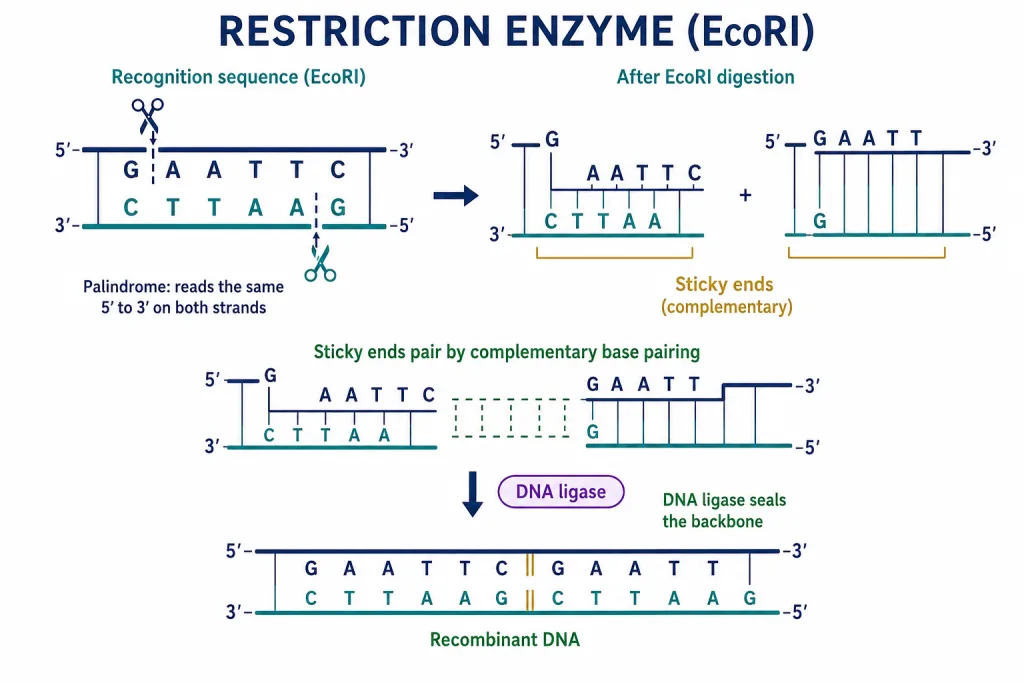
- A restriction enzyme recognises a specific palindromic sequence - one that reads the same on the two strands when read in the same (5' to 3') direction (e.g. GAATTC).
- The enzyme cuts the sugar-phosphate backbone of both strands a little away from the centre of the palindrome, between the same two bases. This leaves short single-stranded overhangs called sticky ends.
- The complementary sticky ends of two different DNA pieces (cut by the same enzyme) can pair up and be sealed by DNA ligase, forming recombinant DNA.
One-liners: Hind II = first restriction enzyme (6 bp); exonuclease = ends, endonuclease = internal; EcoRI - E(genus)/co(species)/R(strain)/I(order); recognise palindromes; leave sticky ends joined by DNA ligase.