
Cloning Vectors
A cloning vector is a DNA molecule that can carry a foreign DNA fragment and replicate inside a host. Plasmids (small circular extra-chromosomal DNA of bacteria) and bacteriophages are commonly used because they can replicate independently, often to a high copy number.
Features a good vector must have
- Origin of replication (ori) - the sequence where replication starts; it controls the copy number. Any foreign DNA linked to it can be made to replicate.
- Selectable marker - a gene that helps identify and eliminate non-transformants and selectively permit the growth of transformants. Genes for antibiotic resistance (against ampicillin, tetracycline, kanamycin, etc.) are useful markers, because normal E. coli is sensitive to these antibiotics.
- Cloning sites - recognition sites for restriction enzymes where the foreign DNA is inserted. Preferably the vector has a single recognition site for a given enzyme (more than one makes cloning complicated).
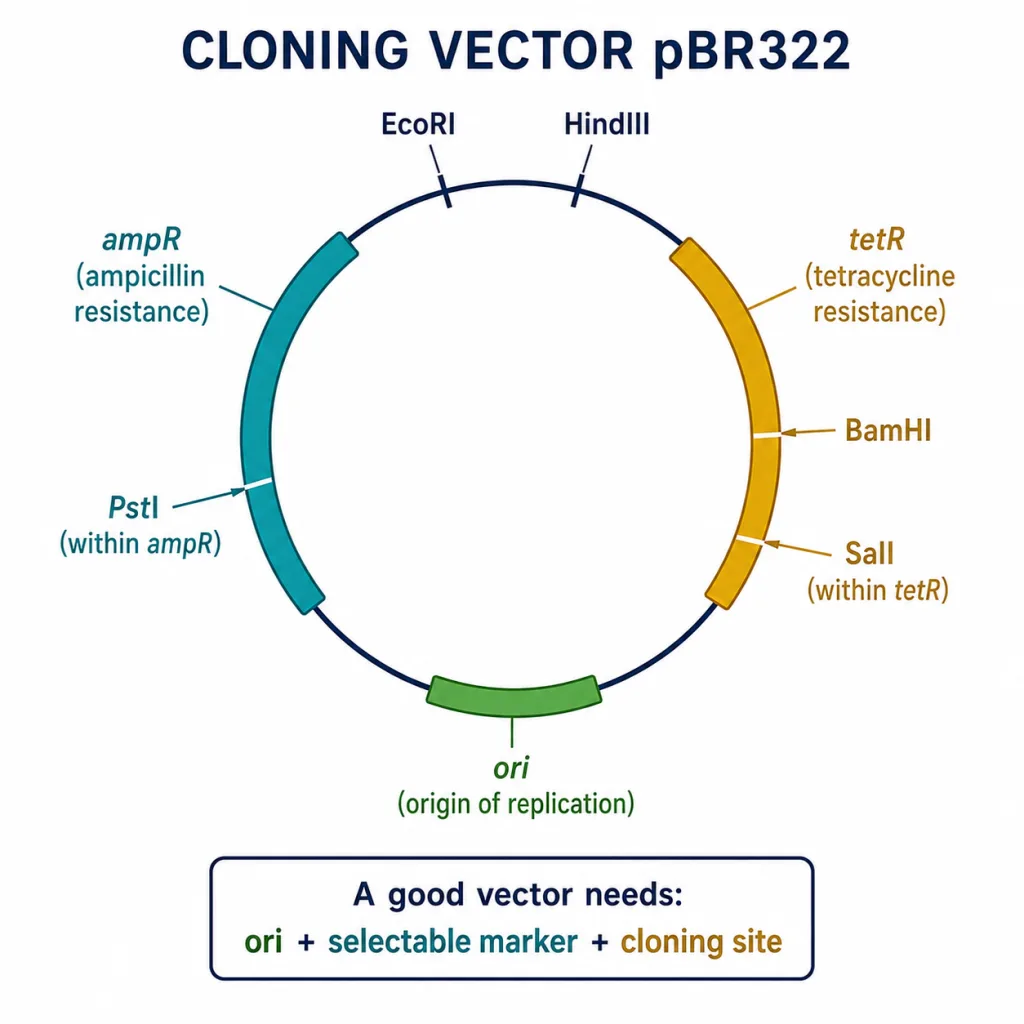
The plasmid pBR322 is a classic cloning vector; it carries an ori, two antibiotic-resistance genes (ampicillin and tetracycline resistance) and several restriction sites.
One-liners: vector features = ori (copy number) + selectable marker (antibiotic resistance) + cloning/restriction sites (single preferred); pBR322 has ori + ampR + tetR.
Insertional Inactivation, Plant/Animal Vectors and the Competent Host
Insertional inactivation
Selecting recombinants using two antibiotic markers is cumbersome, so insertional inactivation is used. If the foreign DNA is inserted within an antibiotic-resistance gene (e.g. at the BamHI site in the tetracycline-resistance gene of pBR322), that gene is inactivated, so the recombinants lose tetracycline resistance (they still resist ampicillin) - and can be selected.
- A simpler alternative uses the enzyme beta-galactosidase: foreign DNA is inserted into its gene, so recombinants cannot make the enzyme. With a chromogenic substrate, non-recombinant colonies turn blue and recombinant colonies remain white (blue-white selection).
Vectors for plants and animals
- Agrobacterium tumefaciens, a pathogen of many dicot plants, transfers a piece of its Ti (tumour-inducing) plasmid into plant cells. The disarmed Ti plasmid is used as a vector to deliver desired genes into plants.
- Retroviruses in animals (which can turn normal cells cancerous) are similarly disarmed and used to deliver desirable genes into animal cells.
The competent host (making cells take up DNA)
Because DNA is hydrophilic, it cannot pass through the cell membrane, so the host must be made 'competent':
- Treat bacterial cells with a specific concentration of a divalent cation (e.g. calcium, Ca2+), which increases the efficiency with which DNA enters through pores in the cell wall. The cells are incubated with the recombinant DNA on ice, given a brief heat shock (about 42 C), and put back on ice - and they take up the DNA.
- Other methods: micro-injection (DNA injected directly into the nucleus of an animal cell) and biolistics / gene gun (plant cells bombarded with high-velocity gold or tungsten particles coated with DNA).
One-liners: insertional inactivation - insert into an antibiotic gene (BamHI -> tetR of pBR322) -> recombinants lose that resistance; blue-white selection (beta-galactosidase, chromogenic substrate); Agrobacterium Ti plasmid = plant vector; retrovirus = animal vector; competent cells via Ca2+ + heat shock; also micro-injection, gene gun.