
Amplification of DNA by PCR
The Polymerase Chain Reaction (PCR) makes multiple copies of a gene (or a DNA segment) in vitro using two sets of primers and the enzyme DNA polymerase. Each cycle has three steps:
- Denaturation - the double-stranded DNA is heated (to about 94 C) so it separates into two single strands.
- Annealing - the temperature is lowered so that the two primers (small chemically synthesised oligonucleotides complementary to the regions flanking the target) bind (anneal) to the single strands.
- Extension - a thermostable DNA polymerase extends the primers using the four nucleotides, making new complementary strands. The enzyme used is Taq polymerase, isolated from the bacterium Thermus aquaticus, which stays active through the high denaturation temperature.
Repeating the cycle many times amplifies the DNA about a billion times (roughly 2 to the power n copies after n cycles). The amplified fragment can then be ligated into a vector for cloning or used directly.
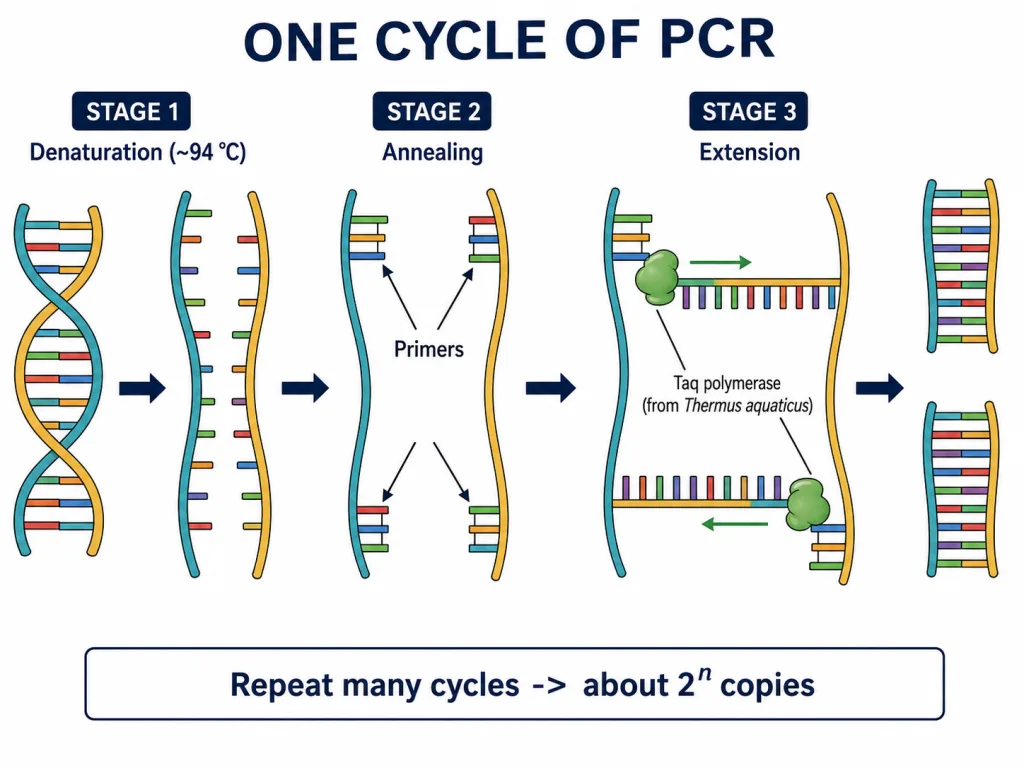
One-liners: PCR steps = denaturation (94 C) -> annealing (primers bind) -> extension; enzyme = Taq polymerase from Thermus aquaticus (thermostable); n cycles -> about 2^n copies.
Insertion into the Host and Obtaining the Product
Insertion of recombinant DNA into the host
The recombinant DNA (vector + gene of interest) is introduced into a competent host by transformation. Once inside, the DNA multiplies and, if it carries the right control sequences, the gene is expressed to make the foreign gene product. The identical copies produced are a clone.
Obtaining the foreign gene product in bioreactors
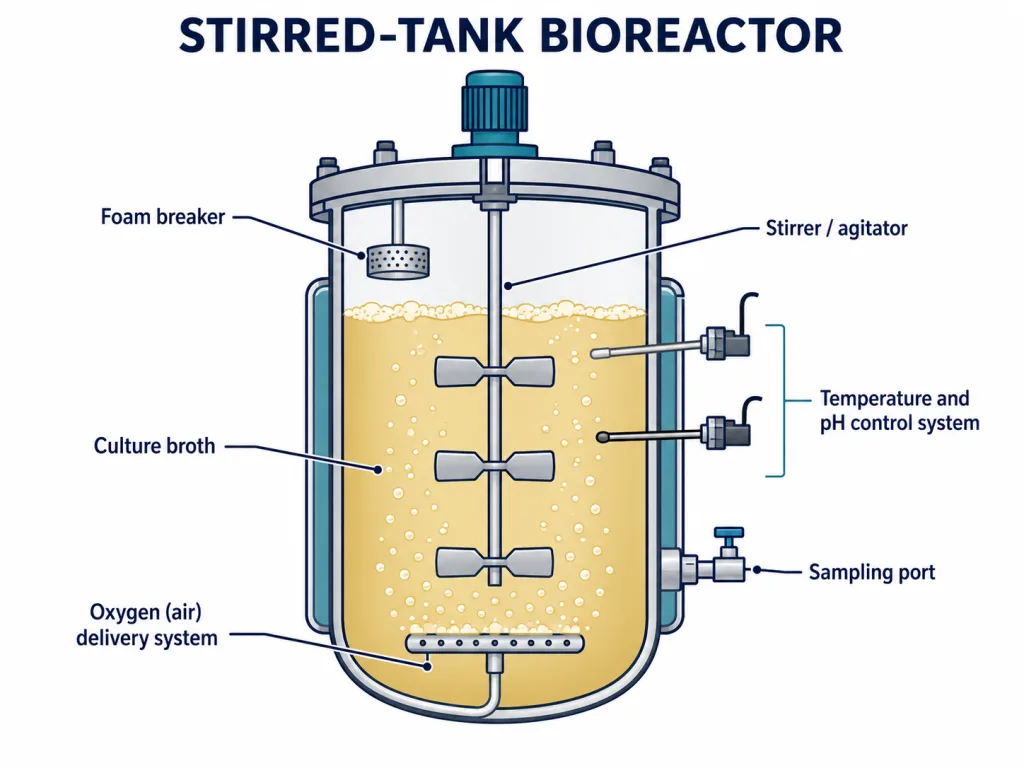
For small amounts, cultures are grown in the laboratory; but for large-scale production the cells are grown in bioreactors - large vessels (often 100-1000 litres or more) that provide the optimum conditions (temperature, pH, substrate, vitamins and oxygen) for the culture.
The most common type is the stirred-tank bioreactor, usually cylindrical or with a curved base to help mixing. It has:
- a stirrer (agitator) that mixes the contents and supplies oxygen,
- an oxygen delivery system and a foam-control system,
- a temperature- and pH-control system, and
- a sampling port to withdraw small volumes.
Downstream processing
After the product is formed, it goes through downstream processing - it is separated and purified, then formulated with suitable preservatives. Drugs must also pass clinical trials and strict quality-control testing before they can be sold.
One-liners: rDNA into host = transformation; large-scale product made in a bioreactor (stirred-tank: stirrer, oxygen, foam & temp/pH control, sampling port); then downstream processing = separation + purification + formulation (+ clinical trials/QC for drugs).