
Systems of Classification
Before looking at the plant groups, understand how botanists have classified plants over time.
- Artificial systems used only one or a few characters for grouping. Linnaeus's sexual system (based on the stamens) is the classic example. They gave equal weight to vegetative and sexual characters - a weakness, because unrelated plants can share one feature.
- Natural systems are based on natural affinities and use all available characters - external form plus internal evidence (anatomy, embryology, phytochemistry). Bentham and Hooker's system (a natural system) is still widely used in herbaria.
- Phylogenetic systems are based on evolutionary relationships - plants of a taxon are assumed to share a common ancestor.
Newer tools refine classification:
- Numerical taxonomy - uses computers; many characters (even hundreds) are scored and each is given equal importance.
- Cytotaxonomy - uses cytological information (chromosome number, structure and behaviour).
- Chemotaxonomy - uses the chemical constituents of the plant.
Kingdom Algae
Algae are chlorophyll-bearing, simple, thalloid, autotrophic and largely aquatic organisms. They reproduce vegetatively (fragmentation), asexually (usually by flagellated zoospores) and sexually - isogamous (similar gametes), anisogamous (dissimilar) or oogamous (a large non-motile female gamete + a small motile male gamete, as in Volvox and Fucus).
The three classes
| Feature | Chlorophyceae (green) | Phaeophyceae (brown) | Rhodophyceae (red) |
|---|---|---|---|
| Pigments | Chlorophyll a, b | Chlorophyll a, c + fucoxanthin | Chlorophyll a, d + r-phycoerythrin |
| Stored food | Starch | Laminarin / mannitol | Floridean starch |
| Cell wall | Cellulose + pectose | Cellulose + algin | Cellulose, pectin & polysulphate esters |
| Flagella | 2-8, equal, apical | 2, unequal, lateral | Absent |
| Examples | Chlamydomonas, Volvox, Ulothrix, Spirogyra, Chara | Ectocarpus, Dictyota, Laminaria, Sargassum, Fucus | Polysiphonia, Porphyra, Gracilaria, Gelidium |
Brown algae often have a holdfast, stipe and frond; red algae are mostly marine and grow at greater depths.
Economic importance
Algae fix roughly half of all the CO2 on earth by photosynthesis. Uses: food (Porphyra, Laminaria, Sargassum), agar (from Gelidium and Gracilaria), carrageen (red algae), algin (brown algae) and protein-rich Chlorella (a food supplement).
Visual - The Plant Kingdom at a Glance
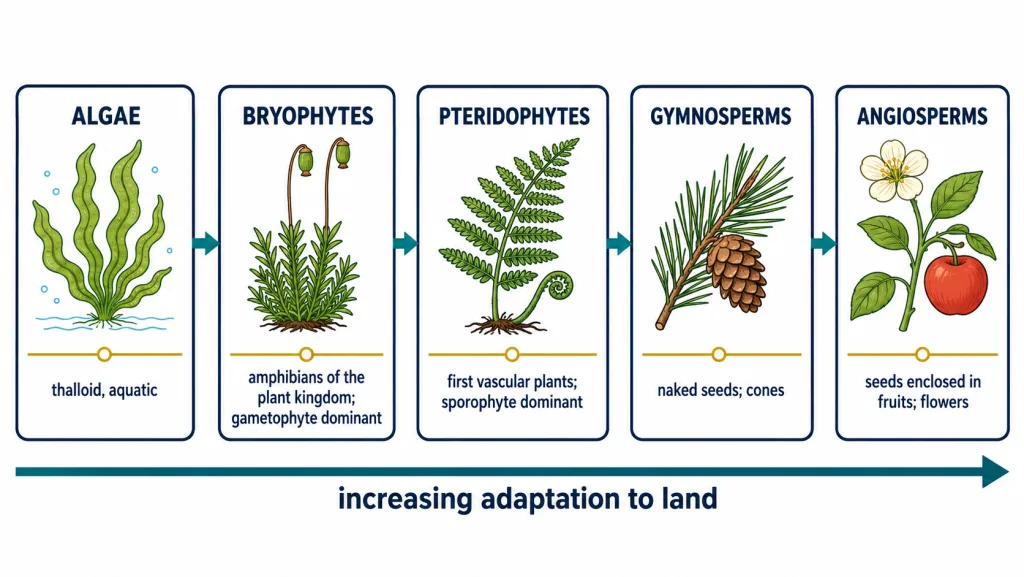
Left to right is broadly the evolutionary sequence, with increasing adaptation to land (vascular tissue, seeds, flowers).
Visual - The Three Classes of Algae
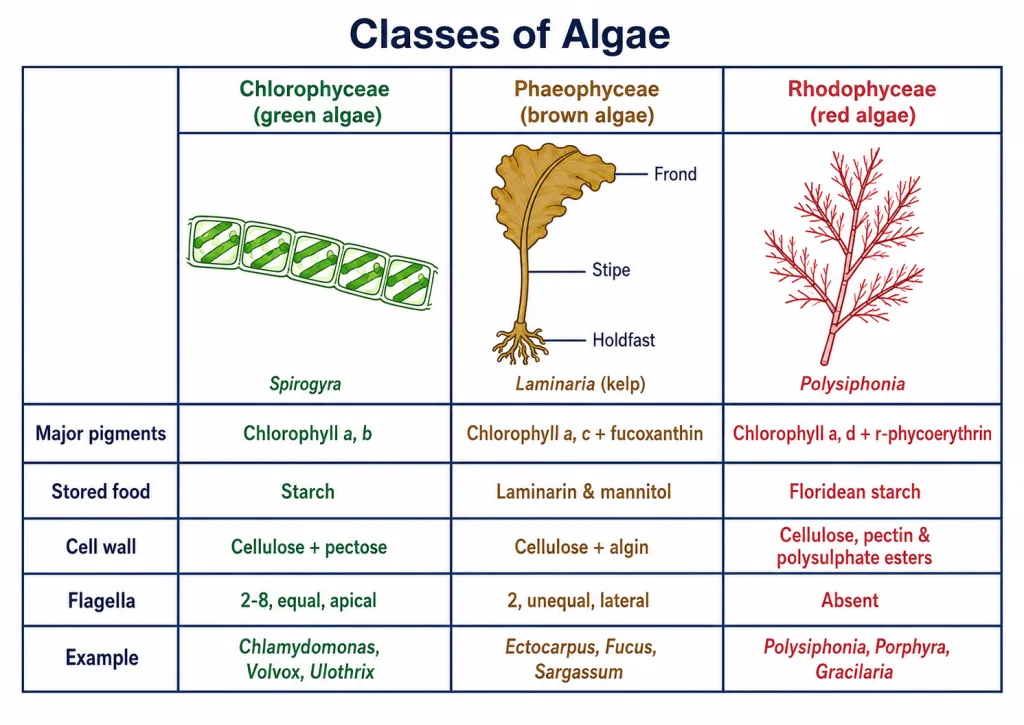
Side-by-side comparison of Chlorophyceae (green), Phaeophyceae (brown) and Rhodophyceae (red) on their major pigment, stored food, cell wall and flagella - the exact rows NEET tests.