
Gymnosperms - Plants with Naked Seeds
In gymnosperms the ovules are not enclosed by an ovary wall, and the seeds remain exposed (naked) - there is no fruit.
- Plants range from small to giant (Sequoia is among the tallest trees). Roots are usually taproots; Cycas has coralloid roots that house N2-fixing cyanobacteria, and Pinus roots have a mycorrhizal (fungal) association. Stems are unbranched (Cycas) or branched (Pinus).
- Conifer leaves are needle-like with xerophytic adaptations - a thick cuticle and sunken stomata - to reduce water loss and withstand extremes.
- Gymnosperms are heterosporous: microspores and megaspores form in microsporangia and megasporangia borne on microsporophylls and megasporophylls spirally arranged into male and female cones (strobili).
- The microspore becomes the male gametophyte (pollen grain), carried by wind to the ovule (no water needed). The megaspore becomes the female gametophyte bearing archegonia, and it is retained on the parent sporophyte. After fertilisation the ovule becomes a naked seed.
Examples: Cycas, Pinus, Ginkgo, Ephedra.
[NEET Important] In gymnosperm anatomy, xylem lacks vessels (except in Gnetales, e.g. Ephedra/Gnetum) and phloem lacks companion cells and sieve tubes (it has sieve cells).
Angiosperms - The Flowering Plants
In angiosperms the seeds are enclosed within fruits. They range from the tiny Wolffia to the tall Eucalyptus and are divided into dicotyledons (two cotyledons) and monocotyledons (one cotyledon).
- The stamen bears pollen grains (the male gametophyte); the pistil/carpel contains the ovule with the embryo sac - the female gametophyte, which is 7-celled and 8-nucleate: an egg apparatus (one egg + two synergids), a central cell with two polar nuclei, and three antipodal cells.
- Double fertilisation (unique to angiosperms): one male gamete fuses with the egg to form the diploid zygote (syngamy); the other fuses with the two polar nuclei to form the triploid primary endosperm nucleus -> endosperm (triple fusion).
- After fertilisation, ovules become seeds and the ovary becomes the fruit.
[NEET Important] Syngamy gives a 2n zygote; triple fusion gives a 3n endosperm. Double fertilisation is found only in angiosperms.
Visual - The Angiosperm Embryo Sac
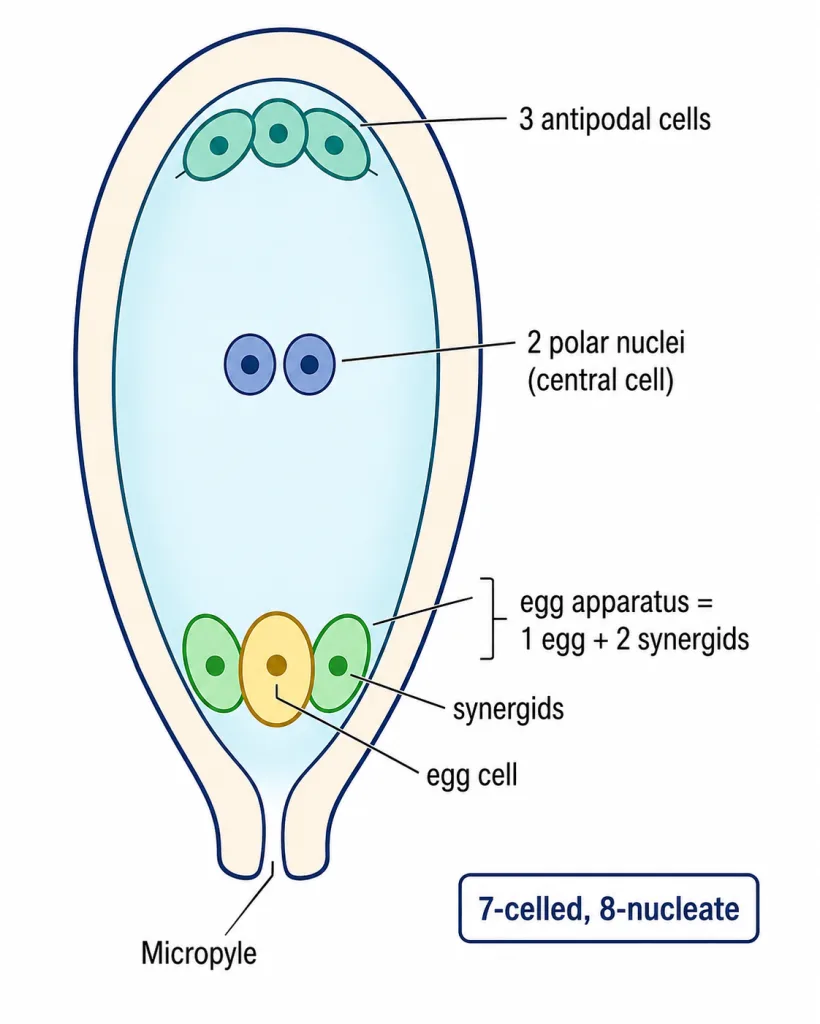
A mature embryo sac is 7-celled and 8-nucleate: the egg apparatus (1 egg + 2 synergids) at the micropylar end, 3 antipodal cells at the chalazal end, and a large central cell with 2 polar nuclei. In double fertilisation one male gamete fuses with the egg (syngamy -> zygote, 2n) and the other with the two polar nuclei (triple fusion -> primary endosperm nucleus, 3n).