
Alternation of Generations
Every plant life cycle alternates between two phases:
- a diploid sporophyte (2n) that produces haploid spores by meiosis, and
- a haploid gametophyte (n) that produces gametes by mitosis.
Fertilisation of two gametes gives the diploid zygote, which grows into the sporophyte - and the cycle repeats. This regular alternation of a haploid (gametophyte) and a diploid (sporophyte) phase is called alternation of generations.
Remember the two divisions: spores are made by MEIOSIS (in the sporophyte); gametes are made by MITOSIS (in the gametophyte).
The Three Life-Cycle Patterns
Plant groups differ in which phase is dominant:
- Haplontic - the gametophyte (n) is the dominant, free-living, photosynthetic phase; the sporophyte is only the one-celled zygote, which undergoes meiosis (no free-living diploid phase). Examples: many algae - Spirogyra, Chlamydomonas, Volvox.
- Diplontic - the sporophyte (2n) is the dominant, free-living phase; the gametophyte is reduced to a few cells. Examples: all seed plants (gymnosperms and angiosperms), and the brown alga Fucus.
- Haplo-diplontic - both phases are multicellular and free-living (biphasic). Examples: bryophytes (gametophyte dominant) and pteridophytes (sporophyte dominant); also some algae - Ectocarpus, Polysiphonia, kelps.
Dominant phase by group
| Group | Life cycle | Dominant phase |
|---|---|---|
| Most algae | Haplontic | Gametophyte |
| Bryophytes | Haplo-diplontic | Gametophyte |
| Pteridophytes | Haplo-diplontic | Sporophyte |
| Gymnosperms & Angiosperms | Diplontic | Sporophyte (gametophyte reduced) |
Visual - Alternation of Generations
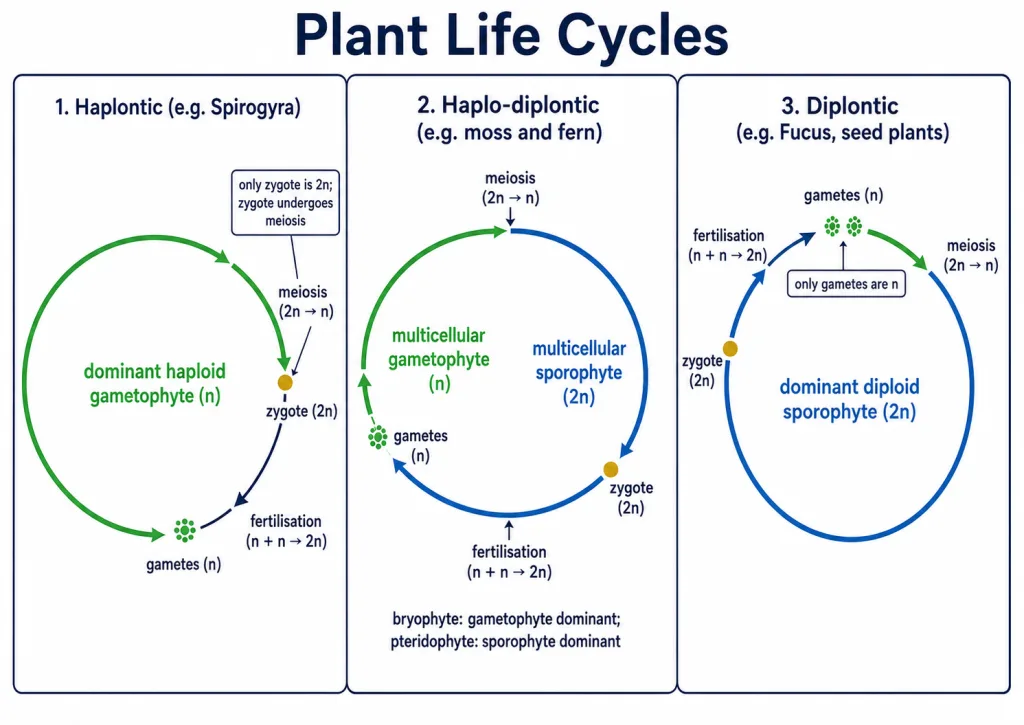
*Three patterns compared: haplontic (dominant haploid gametophyte, e.g. *Spirogyra/Chlamydomonas*; only the zygote is diploid), diplontic (dominant diploid sporophyte, e.g. *Fucus, seed plants; only gametes are haploid) and haplo-diplontic (both phases multicellular, e.g. bryophytes - gametophyte dominant; pteridophytes - sporophyte dominant).