
Fermentation (Anaerobic Respiration)
Fermentation is the incomplete oxidation of glucose under anaerobic (O2-absent) conditions. It starts with glycolysis; the pyruvate formed is then converted further, without oxygen.
Two types
- Alcoholic fermentation (in yeast and some microbes): pyruvate -> ethanol (ethyl alcohol) + CO2. Two enzymes act - pyruvate decarboxylase and alcohol dehydrogenase.
- Lactic acid fermentation (some bacteria; animal muscle when O2 is short): pyruvate -> lactic acid. Enzyme lactate dehydrogenase.
In both, the NADH + H+ made in glycolysis is re-oxidised to NAD+ - this regenerated NAD+ keeps glycolysis running.
Key features (learn the traps)
- Net gain is only 2 ATP per glucose (just the glycolytic ATP) - no further ATP is made.
- Less than 7% of the energy in glucose is released, and not all of it is trapped as ATP - fermentation is energetically very inefficient.
- It is hazardous: when alcohol or acid exceeds a certain level it kills the organism.
One-liners: yeast -> alcohol + CO2 (pyruvate decarboxylase, alcohol dehydrogenase); muscle -> lactic acid; both give only 2 ATP; NADH is oxidised back to NAD+.
Aerobic Respiration - the Link Reaction & the Krebs Cycle
Aerobic respiration occurs in the mitochondria and needs O2. Pyruvate made in the cytoplasm is transported into the mitochondrial matrix, where it is completely oxidised.
The link (transition) reaction
- Pyruvate (3-C) + CoA + NAD+ -> acetyl CoA (2-C) + CO2 + NADH + H+
- Catalysed by the pyruvate dehydrogenase complex (needs Mg2+ among others), in the matrix.
- This oxidative decarboxylation is where the FIRST CO2 of respiration is released (recall: glycolysis releases NO CO2).
- Two pyruvate per glucose give 2 acetyl CoA + 2 CO2 + 2 NADH.
The Krebs cycle (TCA / citric-acid cycle)
Discovered by Hans Krebs; occurs in the mitochondrial matrix.
- Acetyl CoA (2-C) + oxaloacetic acid, OAA (4-C) -> citric acid (citrate, 6-C) (enzyme citrate synthase); CoA is released.
- Citrate is rearranged and oxidised through isocitrate -> alpha-ketoglutarate (+CO2, +NADH) -> succinyl-CoA (+CO2, +NADH) -> succinate (+ATP via GTP) -> fumarate (+FADH2) -> malate -> OAA (+NADH), regenerating OAA to keep the cycle turning.
Per TURN of the Krebs cycle (memorise)
- 2 CO2 released
- 3 NADH + H+
- 1 FADH2
- 1 ATP (as GTP, by substrate-level phosphorylation)
- OAA is regenerated
Because each glucose gives 2 acetyl CoA, the cycle turns twice per glucose. Only one FADH2 and one substrate-level ATP are made per turn - a favourite trap.
Visual - The Krebs (TCA) Cycle
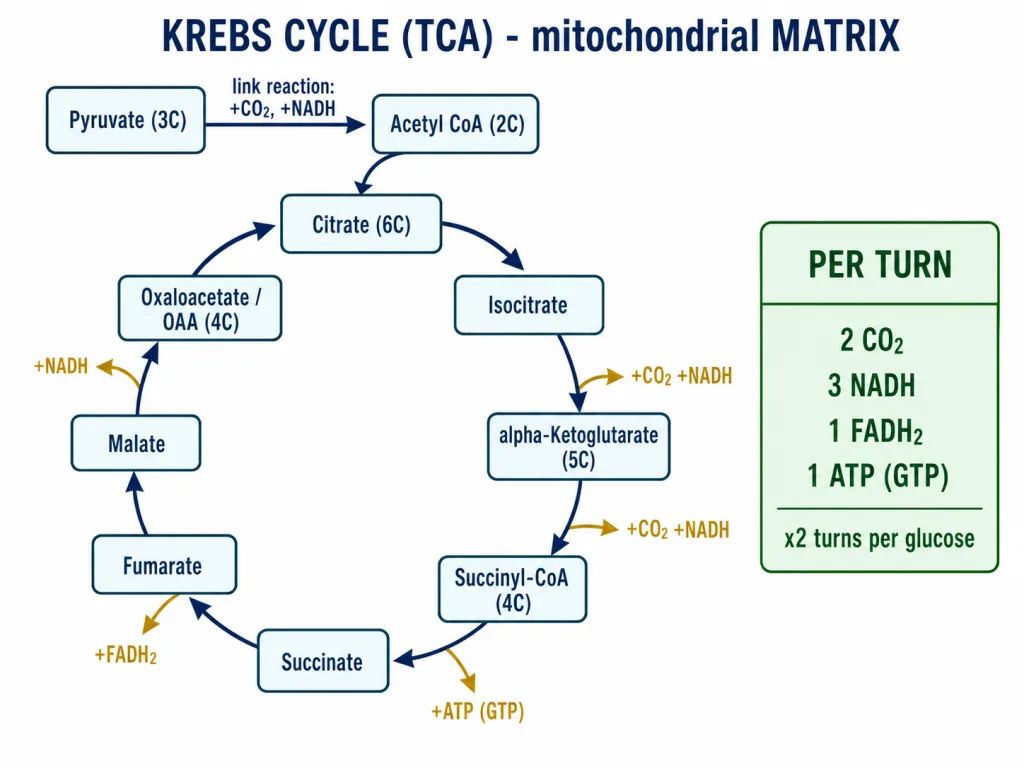
The Krebs cycle in the mitochondrial matrix: acetyl CoA (2-C) joins OAA (4-C) to form citrate (6-C); one turn yields 2 CO2, 3 NADH, 1 FADH2 and 1 ATP (GTP) and regenerates OAA.