
The Electron Transport System (ETS) & Oxidative Phosphorylation
The NADH and FADH2 made in glycolysis, the link reaction and the Krebs cycle are energy-rich. Their electrons are passed down the electron transport system (ETS) to release that energy for ATP synthesis. The ETS is located on the inner mitochondrial membrane.
The flow of electrons
- NADH + H+ is oxidised by Complex I (NADH dehydrogenase); its electrons pass to ubiquinone (coenzyme Q).
- FADH2 (produced in the Krebs cycle by succinate dehydrogenase = Complex II) passes its electrons also to ubiquinone - it bypasses Complex I.
- Ubiquinone -> Complex III (cytochrome bc1) -> cytochrome c (a small mobile carrier) -> Complex IV (cytochrome c oxidase, containing cytochromes a and a3 and copper).
- Complex IV passes the electrons to O2, the terminal (final) electron acceptor: 2H+ + 1/2 O2 + 2e- -> H2O (metabolic water).
Oxygen is essential - it removes hydrogen/electrons from the system. Without O2 the whole chain (and the NADH/FADH2 re-oxidation) stops.
Oxidative phosphorylation & the chemiosmotic hypothesis
- As electrons flow, protons (H+) are pumped from the matrix into the intermembrane space, building a proton gradient (proton-motive force) across the inner membrane.
- Protons flow back into the matrix through the ATP synthase (Complex V, F0-F1) - F0 is the membrane proton channel, F1 the catalytic head - and this drives ATP synthesis. This coupling of ETS to ATP synthesis is oxidative phosphorylation (the chemiosmotic mechanism).
Energy yield of the carriers (learn)
- Each NADH -> ~3 ATP; each FADH2 -> ~2 ATP (FADH2 yields less because it enters at ubiquinone, past Complex I).
- The role of O2 is only at the very end, yet without it nothing upstream can proceed.
One-liners: ETS = inner mitochondrial membrane; O2 = terminal electron acceptor -> water; ATP synthase = F0-F1 (Complex V); NADH = 3 ATP, FADH2 = 2 ATP; Complex II (succinate dehydrogenase) links the Krebs cycle to the ETS.
Visual - Electron Transport System & Oxidative Phosphorylation
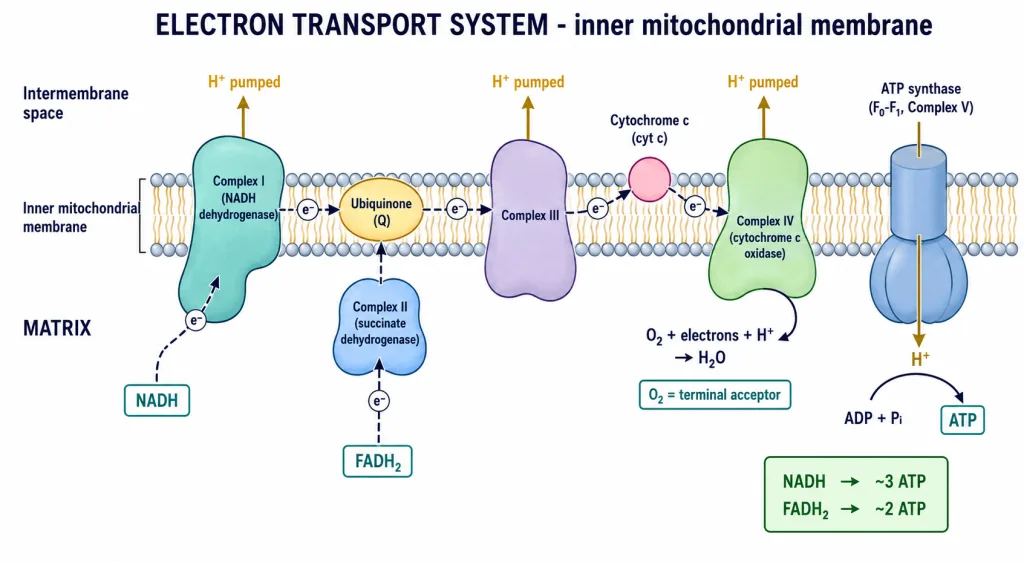
The ETS on the inner mitochondrial membrane: electrons from NADH (Complex I) and FADH2 (Complex II) pass through ubiquinone, Complexes III and IV to O2 (forming water); pumped protons return through F0-F1 ATP synthase to make ATP.