
The Respiratory Balance Sheet - 38 ATP per Glucose
The complete aerobic oxidation of one glucose yields a theoretical maximum of 38 ATP. The account:
| Stage | Site | ATP (direct) | NADH | FADH2 | ATP via ETS |
|---|---|---|---|---|---|
| Glycolysis | cytoplasm | 2 (net) | 2 | - | 6 |
| Link reaction (x2) | matrix | - | 2 | - | 6 |
| Krebs cycle (x2 turns) | matrix | 2 (GTP) | 6 | 2 | 18 + 4 |
| Total | 4 | 10 | 2 | 34 |
- NADH = 3 ATP; FADH2 = 2 ATP. So 10 NADH -> 30, 2 FADH2 -> 4, giving 34 ATP from oxidative phosphorylation, plus 4 ATP by substrate-level phosphorylation (2 glycolysis + 2 Krebs) = 38 ATP.
- Per glucose, respiration also consumes 6 O2 and releases 6 CO2 (2 from the link reaction + 4 from the Krebs cycle; none from glycolysis).
Why 38 is only theoretical (the assumptions)
The 38-ATP figure assumes: a sequential, orderly pathway with one substrate forming the next; glucose is the only substrate and nothing is withdrawn for other pathways; the NADH made in glycolysis (cytoplasm) is fully transferred into the mitochondrion and oxidised. In a living cell these rarely hold exactly, so the real yield is lower (often ~30-36). Compare: fermentation gives only 2 ATP - aerobic respiration is far more efficient.
One-liners: 38 ATP/glucose (theoretical); 34 by oxidative + 4 substrate-level; 6 CO2 and 6 O2 per glucose; NADH = 3, FADH2 = 2 ATP.
Amphibolic Pathway & the Respiratory Quotient (RQ)
Respiration is amphibolic
Respiration is usually treated as catabolic (breaking food down), but its intermediates are also withdrawn to build molecules (anabolism). For example, acetyl CoA is drawn off for fatty-acid and steroid synthesis, and alpha-ketoglutarate and OAA for amino acids. Because the pathway is used for both breakdown and synthesis, it is called an amphibolic pathway (NOT purely catabolic).
- When fats are respired, they are first broken to glycerol + fatty acids; fatty acids are converted to acetyl CoA and enter respiration. Proteins are broken to amino acids, which (after removing the amino group) enter as pyruvate, acetyl CoA or Krebs intermediates.
Respiratory Quotient (RQ)
RQ = volume of CO2 evolved / volume of O2 consumed (measured with a respirometer).
- Carbohydrates: RQ = 1. e.g. glucose: C6H12O6 + 6O2 -> 6CO2 + 6H2O (6/6 = 1).
- Fats: RQ < 1 (about 0.7) - fats are more reduced and need extra O2. e.g. tripalmitin ~ 0.7.
- Proteins: RQ ~ 0.9.
- Organic acids: RQ > 1 (they are already O-rich; e.g. oxalic acid RQ = 4).
In living tissue several substrates are used together, so RQ is usually around 0.9. In pure anaerobic breakdown no O2 is used, so RQ tends to infinity.
One-liners: RQ = CO2 out / O2 in; carbohydrate = 1, fat < 1 (~0.7), protein ~0.9, organic acid > 1; respiration is amphibolic, not purely catabolic.
Visual - Respiratory Balance Sheet
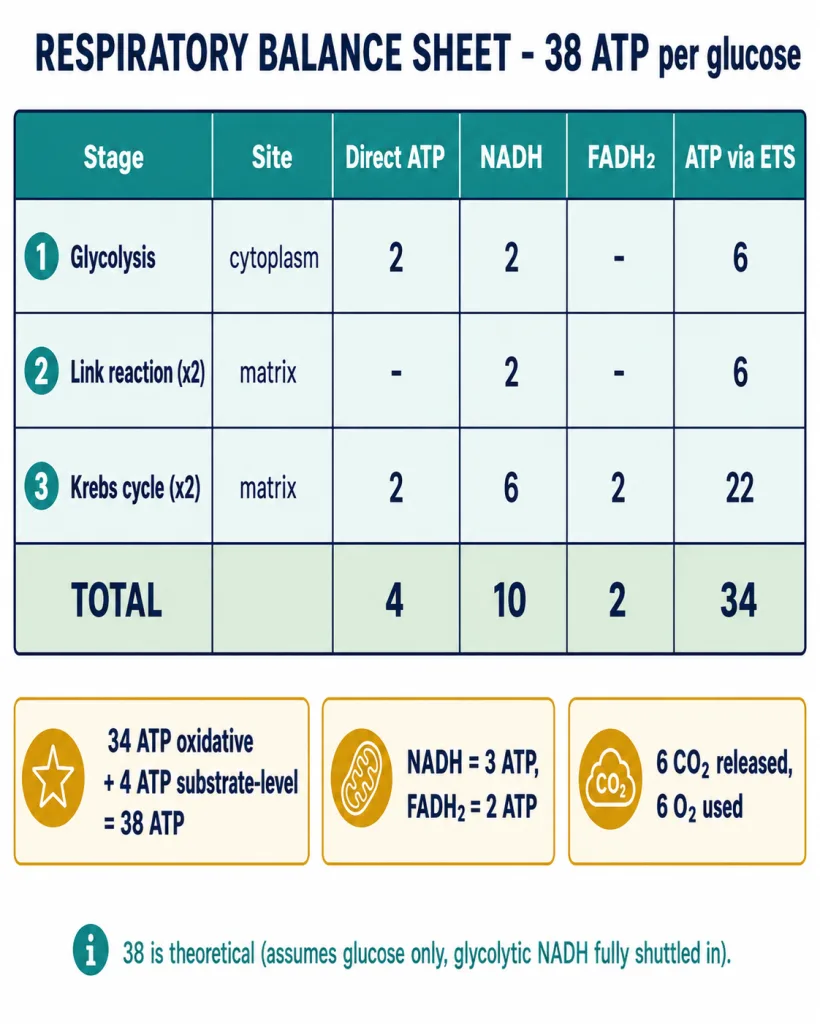
The 38-ATP balance sheet per glucose: glycolysis (8), link reaction (6) and two Krebs turns (24) - with 34 ATP from oxidative phosphorylation and 4 from substrate-level phosphorylation.