
Chemical Coordination and Integration: NEET Focus
This chapter rewards exact source-hormone-action matching. NEET frequently keeps two parts of a statement correct and changes only the synthesis site, target, direction of action or hypo-/hypersecretion. Revise each hormone as a four-link chain: source -> hormone -> principal target -> effect.
Highest-Yield Areas
- Hypothalamus and pituitary: releasing and inhibiting hormones reach the anterior pituitary through portal blood; Keep pars distalis, pars intermedia and pars nervosa with their correct hormones.
- Opposed hormone pairs: insulin lowers blood glucose while glucagon raises it; PTH raises blood calcium while thyrocalcitonin lowers it. Direction words decide many questions.
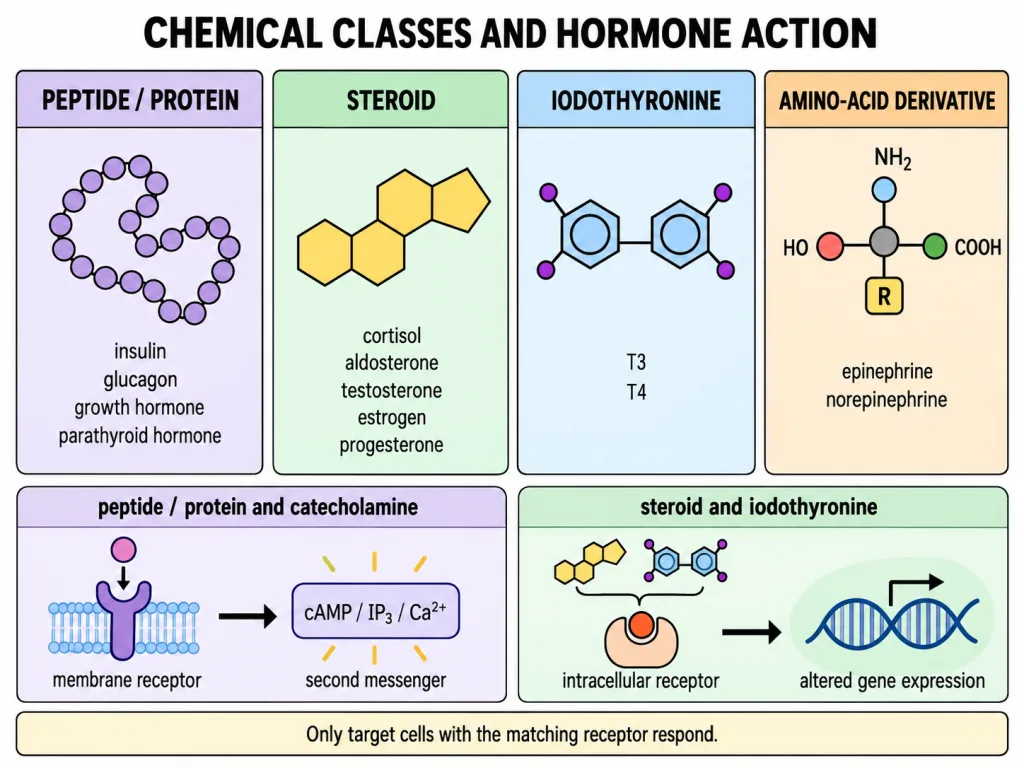
- Adrenal split: the central medulla releases catecholamines for the immediate fight-or-flight response; the outer cortex releases glucocorticoids, mineralocorticoids and small amounts of androgens.
- Thyroid precision: T3 and T4 require iodine and carry a wide metabolic brief. Do not confuse them with thyrocalcitonin, which lowers blood calcium.
- Pancreas and gonads: fix the cell or structure first, then the hormone, then the direction in which it moves blood glucose or drives the cycle.
- Disorders in brief: every disorder in this chapter is a gland plus a direction plus, sometimes, an age. Name all three before choosing.
NEET Exam Approach
For a multi-statement item, judge each statement independently. First locate the gland or cell, then identify the hormone, and only then decide whether the effect raises or lowers the variable. In disorder questions, write a mental three-part label: hormone, direction, age or tissue. In match-the-column questions, anchor the pair you are most certain of first, then strike every option that contradicts it.
[NEET Important] The most dangerous words in this chapter are synthesised, stored, released, raises, lowers, hypo and hyper. Read them before reading the hormone name.