
The Gland That Straddles the Windpipe
The thyroid gland is the largest of the endocrine glands and the easiest to locate. It is made of two lobes, one lying on either side of the trachea, and the two lobes are joined across the front of the windpipe by a thin flap of connective tissue called the isthmus. Picture a bow tie laid over the neck: two wings, one narrow knot in the middle. Students lose marks here by remembering "two lobes" and forgetting both the reference structure and the connecting flap, so fix all three together, lobes, trachea, isthmus.
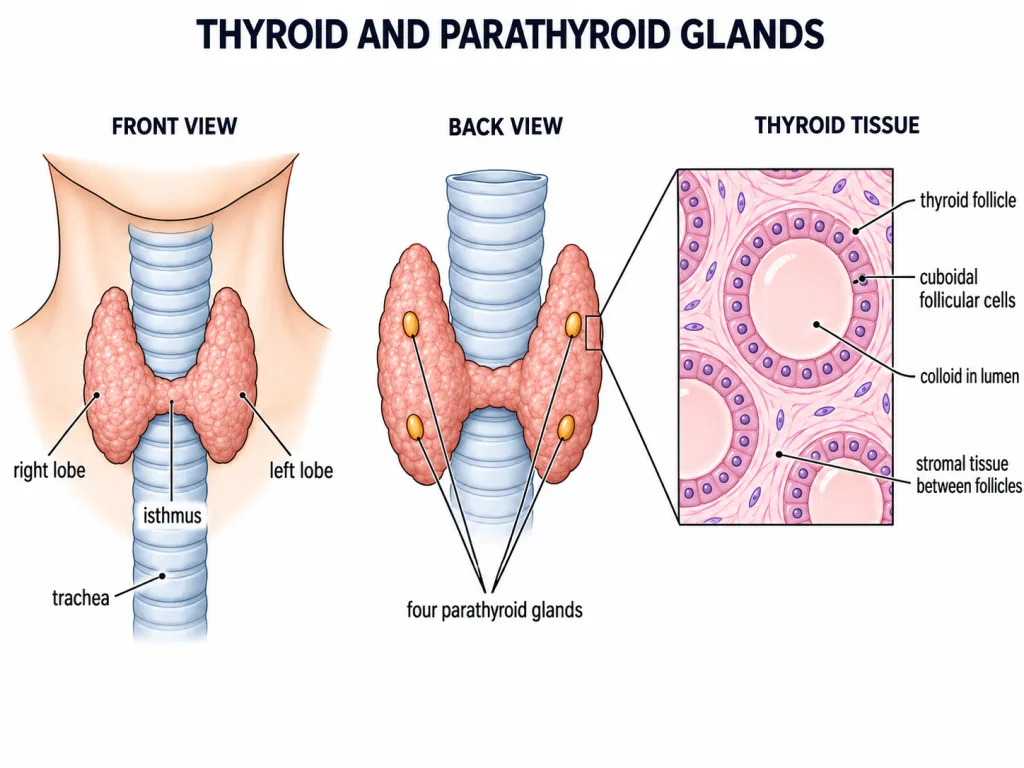
Cut the gland open and you find that it is composed of two kinds of tissue: follicles and stromal tissue. The follicle is the rounded sac that actually does the secretory work, and it is the functional unit of the gland. Stromal tissue is the supporting packing material lying between the follicles. Almost every student can name the gland; far fewer can name its unit.
[NEET Important] Anatomy questions on this gland are usually two facts chained, not one: number of lobes plus the structure they flank, or tissue types plus which of the two is the functional unit. Learn them as pairs and the chained item becomes a single memory.
Iodine, T3 and T4
The thyroid follicles make two closely related hormones. One is tetraiodothyronine, better known as thyroxine and written T4; the other is triiodothyronine, written T3. The arithmetic is inside the names. Tetra means four, so T4 carries four iodine atoms; tri means three, so T3 carries three. If you can decode the prefix you never have to memorise the count separately, and you will not mix up which of the two is thyroxine.
Because iodine is built into these molecules, the element is not optional. Iodine is essential for the normal rate of thyroid hormone synthesis. Note the wording carefully: the point is the rate, not mere presence. Supply enough iodine and the gland works at its proper pace; starve it and production slows, whatever else the body does.
What do these hormones then do? Their exam-ready action map is broader than fuel metabolism. T3 and T4 regulate the basal metabolic rate, support red blood cell formation, control the metabolism of carbohydrates, proteins and fats, and influence water and electrolyte balance. They are also important for normal development. Keep this list separate from thyrocalcitonin, which acts on blood calcium; the next note turns the full function list into a quick decision map.
When the Iodine Runs Short
Diet is the weak link. If the intake of iodine stays low for long enough, the gland cannot sustain normal hormone production and hypothyroidism follows. At the same time the gland itself enlarges. That enlargement of the thyroid, arising from dietary iodine deficiency, is goitre. Notice that the two changes run in opposite directions: the gland gets bigger while its output gets smaller. A larger gland is not a busier one, and reasoning "swollen, therefore overactive" is exactly the trap.
Thyroid deficiency in a growing child produces cretinism. For examination purposes learn the feature set that the description carries: mental retardation, low intelligence quotient, abnormal skin and deaf-mutism. Learn these four as one block. Adult hypothyroid states are described separately, and in an adult woman one recognised consequence is irregularity of the menstrual cycle.
[NEET Important] Goitre and cretinism are not one fact wearing two hats. Goitre is about the gland, its dietary cause and its swelling. Cretinism is about the child and the features listed above. Answer each on its own ground.
The Calcium Side of the Neck
The thyroid has a third product that has nothing to do with iodine. It secretes a protein hormone called thyrocalcitonin, abbreviated TCT, which regulates the level of calcium in the blood and brings that level down. Hold this as two linked facts: the gland makes a protein hormone besides its iodine-bearing pair, and that hormone lowers blood Ca2+.
Sitting on the back surface of the thyroid are four small glands, the parathyroid glands, arranged as one pair embedded in each thyroid lobe. Their secretion is a peptide hormone named parathyroid hormone, or parathormone, abbreviated PTH. Number, position and name are what you are expected to hold: four glands, posterior surface, parathormone.
Parathyroid hypoactivity is the disorder to know. When these glands work below par, the level of Ca2+ in the blood falls, and muscle responds to that fall with severe and rapid spasms. That condition is tetany. The chain worth rehearsing is short and complete: underactive parathyroids, blood calcium down, violent muscular spasms.
[NEET Important] Do not let the two neighbouring glands blur. The parathyroids are separate glands with their own hormone and their own deficiency disorder, even though they are physically stuck to the back of the thyroid and their name borrows the thyroid's.
Thyroid Hormones: Build the Complete Action Map
The follicular cells synthesise triiodothyronine (T3) and tetraiodothyronine or thyroxine (T4). Both require iodine. NEET often tests their functions through a mixed list, so do not reduce their role to a single phrase such as "control metabolism". The NCERT action map has four parts:
- regulation of the basal metabolic rate (BMR);
- support of red blood cell formation;
- control of carbohydrate, protein and fat metabolism;
- influence on water and electrolyte balance.
They are also important for normal physical and mental development. The fastest way to solve a function-based question is to first identify whether the option describes whole-body metabolic regulation. If it does, T3/T4 are strong candidates. If it specifically describes a fall in blood calcium, the hormone is thyrocalcitonin instead.
[NEET Trap] T3 has three iodine atoms and T4 has four, but the numeral does not indicate the number of amino acids, receptor types or thyroid lobes. Thyroxine is T4, not T3.
Hypothyroidism and Hyperthyroidism: Read the Direction First
For every thyroid disorder, decide whether hormone action is below normal or above normal before matching symptoms. Prolonged iodine deficiency lowers thyroid-hormone synthesis and may enlarge the gland, producing simple goitre. During pregnancy, severe maternal hypothyroidism can impair development of the growing foetus; the NCERT-described childhood condition is cretinism, with stunted growth, mental retardation, low intelligence quotient, abnormal skin and deaf-mutism. In adult women, hypothyroidism may disturb the menstrual cycle.
Hyperthyroidism is the opposite direction. Excess synthesis and secretion raise metabolic activity. Exophthalmic goitre is a hyperthyroid condition characterised by enlargement of the thyroid, increased BMR and protruding eyeballs.
[NEET Decision Rule] Enlargement alone does not tell you the direction: iodine-deficiency goitre accompanies low output, whereas exophthalmic goitre accompanies high output. Use the accompanying clues - iodine shortage and low activity versus increased BMR and protruding eyes.
PTH and Thyrocalcitonin: An Antagonistic Calcium Pair
Parathyroid hormone (PTH) is a peptide hormone whose secretion is regulated by circulating Ca2+. It is a hypercalcaemic hormone: it raises the concentration of Ca2+ in blood. It does so by stimulating bone resorption, increasing renal reabsorption of Ca2+, and increasing absorption of Ca2+ from digested food. Thyrocalcitonin (TCT), secreted by the thyroid, acts in the opposite direction and lowers blood calcium. Together, PTH and TCT help maintain calcium balance.
When parathyroid secretion is too low, blood Ca2+ falls and sustained muscular spasms may occur; this condition is tetany.
[NEET Application] In a question that gives low blood calcium plus muscular spasms, trace the chain backward: tetany -> inadequate PTH -> parathyroid hyposecretion. In a question asking for the hormone that raises blood calcium through bone, kidney and intestinal actions, select PTH, not TCT.
The Adrenal Gland: One Organ, Two Tissues
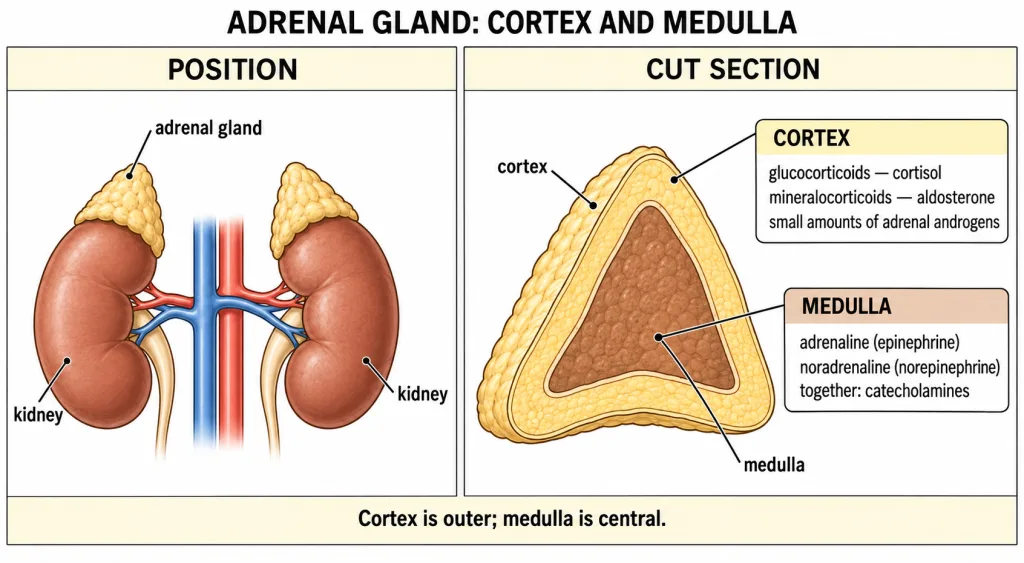
Human beings carry a single pair of adrenal glands. One gland sits at the anterior part of each kidney, which is why the pair also goes by the older name suprarenal glands. Each gland is not one tissue but two, and almost every difficulty in this topic comes from mixing the two up. The centrally located tissue is the adrenal medulla. Wrapped around it on the outside is the adrenal cortex. Inner is medulla, outer is cortex. Fix that once and half the topic falls into place, because the two tissues secrete entirely different hormones with entirely different action lists.
[NEET Important] The commonest slip in this whole area is reversing the two tissues. Medulla is central, cortex is peripheral. Every functional question about the adrenal begins by settling which of the two you are standing in.
The Medulla and Its Catecholamines
The medulla secretes two hormones: adrenaline, also called epinephrine, and noradrenaline, also called norepinephrine. Taken together, the two are called catecholamines. That gives you three names to keep straight at once - two individual hormones, each carrying a second name of its own, and one collective name that covers both. Adrenaline goes with epinephrine, and noradrenaline goes with norepinephrine, so the prefix nor- travels with the prefix nor-.
Catecholamines act on stored fuel. They stimulate the breakdown of glycogen, a process named glycogenolysis, and they also stimulate the breakdown of lipids and of proteins. Beyond metabolism, they produce increased alertness, and they cause sweating.
The Cortex: Three Layers and Two Main Classes
The adrenal cortex is not uniform. It is built of three layers, and the order from the inside outwards runs zona reticularis, then zona fasciculata, then zona glomerulosa. Learn all three positions rather than just one end of the sequence. Note also that the layers are the only structural fact required here, so do not attach a particular hormone to a particular layer.
The cortex secretes many hormones, known collectively as the corticoids. Two classes matter. Glucocorticoids, of which cortisol is the main one, and mineralocorticoids, of which aldosterone is the main one. Small amounts of adrenal androgens are secreted by the cortex as well.
[NEET Important] Learn the class-to-example pairing in both directions. Cortisol is the leading glucocorticoid; aldosterone is the leading mineralocorticoid. The reversed pairing is offered constantly, and knowing only one of the two names is not enough to reject it.
What the Two Cortical Classes Do
Glucocorticoids regulate carbohydrate metabolism. They stimulate gluconeogenesis, which is the making of glucose afresh out of non-carbohydrate sources, and they stimulate the breakdown of proteins and of fats. The clause students most often lack is that these same hormones inhibit the cellular uptake and utilisation of amino acids. Read the direction carefully: inhibit, not promote. Cortisol in particular helps maintain cardiovascular and kidney functions, produces anti-inflammatory reactions, suppresses the immune response, and stimulates the formation of red blood cells.
Mineralocorticoids handle water and salts instead. Aldosterone acts on the kidney to cause reabsorption of Na+ and of water, and excretion of K+ and of phosphate ions. Through those movements, aldosterone maintains electrolyte balance, body fluid volume, osmotic pressure and blood pressure.
Notice how the two classes divide the labour between them. One class is about fuel, the other is about fluid and salts. Any adrenal action put to you is worth sorting into fuel or fluid first, and only then attaching to a named hormone. That single sorting step will carry you through most of the confusion in this part of the chapter.
Hypoactivity of the Cortex
The cortex can under-secrete. Hyposecretion of the adrenal cortical hormones produces Addison's disease. That is the gland, the direction of the fault, and the name of the condition, and for this chapter that is the whole requirement. Do not go looking for clinical detail beyond it.
Keeping the Boundaries Straight
Three boundary points are worth stating plainly, because each of them regularly costs marks.
First, glycogenolysis and gluconeogenesis sound alike and are not the same process. Dismantling an existing glycogen store is what the medullary hormones do. Assembling glucose from non-carbohydrate precursors is a cortical action. The similarity of the two words is the whole trap.
Second, both tissues break down lipids and proteins, so those two actions cannot be used to tell the medulla and the cortex apart. Use glycogen breakdown as the medullary marker and gluconeogenesis as the cortical one; those are the actions that genuinely belong to one tissue and not the other.
Third, the adrenal cortex is under the control of a tropic hormone released by the pituitary, so cortical activity and pituitary activity are linked. That link is real and worth knowing, but when a question is about the adrenal, keep the answer inside the adrenal. The gland roster for this chapter is closed at eight, and the adrenal's own two tissues supply everything you need for this part of it.
Catecholamines: Translate the Emergency into Organ Responses
Adrenaline and noradrenaline are rapidly secreted during stress and emergency, so they are called emergency hormones or hormones of fight-or-flight. Their effects prepare several organs at the same time: heartbeat becomes faster and cardiac contraction stronger; the rate of respiration rises; pupils dilate; piloerection and sweating occur; alertness increases. They also mobilise stored fuel through glycogenolysis, lipolysis and proteolysis, helping increase the availability of metabolic substrates.
[NEET Application] If a stem combines a sudden threat with tachycardia, rapid breathing, sweating and greater alertness, identify the adrenal medulla and catecholamines. Do not select cortisol merely because the situation is stressful; the immediate, coordinated emergency response is the medullary pattern.
Cortex Decision Map: Fuel, Salt-Water or Secondary Sex Traits
Sort a cortical action into one of three buckets before choosing a hormone.
| Functional clue | Cortical group | Key example |
|---|---|---|
| Gluconeogenesis, protein and fat breakdown, anti-inflammatory or immune suppression | Glucocorticoids | Cortisol |
| Na+ and water reabsorption, K+ and phosphate excretion, maintenance of fluid volume and blood pressure | Mineralocorticoids | Aldosterone |
| Growth of axial, pubic and facial hair during puberty | Adrenal androgens | Small cortical output |
This map prevents the common same-gland error in which an authentic adrenal action is paired with the wrong adrenal hormone.
[NEET Trap] Glycogenolysis is a prominent catecholamine action, whereas gluconeogenesis is a glucocorticoid action. Their similar names do not make them interchangeable.
Follow the Physiological Chain
Aldosterone increases renal retention of Na+ and water. Retaining these raises body-fluid volume and helps maintain osmotic pressure and blood pressure, while K+ and phosphate are excreted. Thus, a question may describe the final change in blood pressure without naming the hormone; follow the chain back to mineralocorticoid action.
Cortisol promotes gluconeogenesis and mobilisation of fats and proteins. It also produces anti-inflammatory effects, suppresses immune responses and stimulates red blood cell formation. These are glucocorticoid clues, not catecholamine clues. Hyposecretion of adrenal cortical hormones causes Addison's disease.
[NEET Boundary] The medulla is central and releases catecholamines; the cortex is peripheral and releases corticoids plus small amounts of androgens. Resolve tissue first, then hormone class, then physiological effect.
Pancreas: Structure Before Function
The pancreas is a composite gland because the same organ has an exocrine part and an endocrine part. The exocrine tissue sends enzyme-rich pancreatic juice through a duct, whereas the endocrine islets of Langerhans release hormones directly into blood. A normal human pancreas contains about one to two million islets, together forming only 1-2% of the pancreatic tissue.
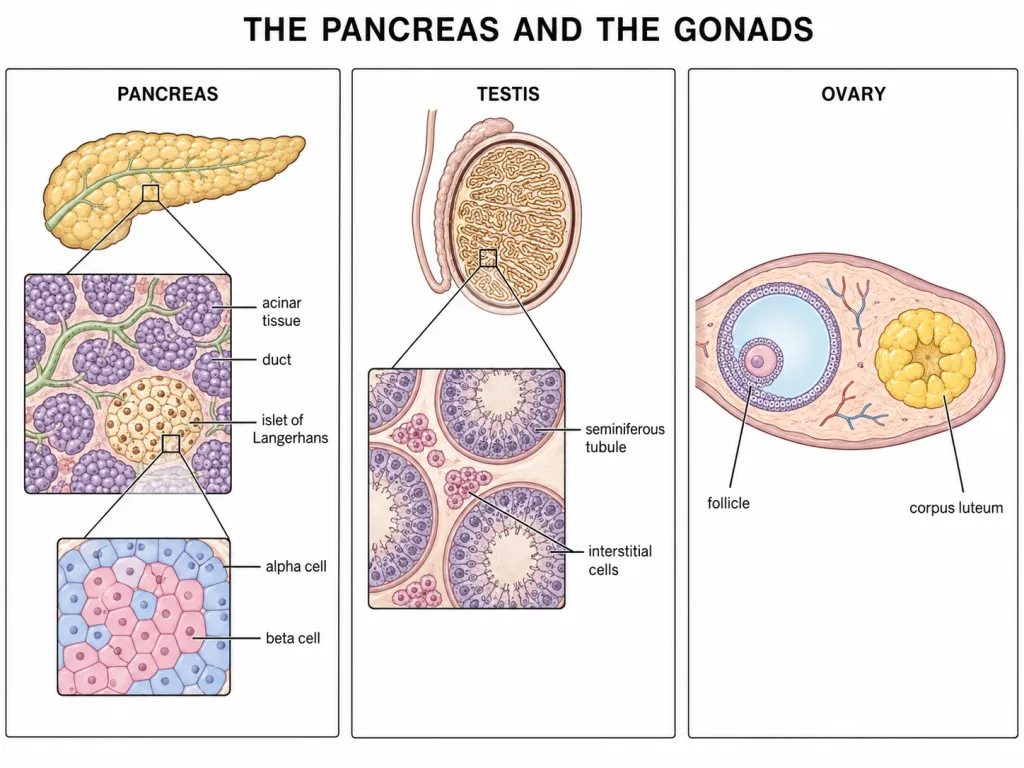
Inside the islets, alpha cells secrete glucagon and beta cells secrete insulin. NEET often reverses either the cell-hormone pairing or the direction of the hormone's effect. Fix both pairings before analysing a longer statement.
Glucose Homeostasis: Learn the Opposed Pair
Glucagon is hyperglycaemic. It acts mainly on hepatocytes and raises blood glucose by stimulating glycogenolysis and gluconeogenesis; it also reduces cellular glucose uptake and utilisation. Insulin is hypoglycaemic. It acts mainly on hepatocytes and adipocytes, enhances cellular uptake and utilisation of glucose, and stimulates glycogenesis. Together, their opposing actions maintain glucose homeostasis.
Persistent insulin deficiency can produce prolonged hyperglycaemia, loss of glucose through urine and formation of harmful ketone bodies: the NCERT description of diabetes mellitus. Do not confuse it with diabetes insipidus, which concerns water balance and ADH.
[NEET Important] Read the process suffix: glycogenolysis breaks glycogen, while glycogenesis makes glycogen. A single reversed process changes the answer.
Testis: Endocrine Tissue Between the Tubules
The testis produces sperm in the seminiferous tubules, but its principal endocrine cells are the interstitial or Leydig cells between those tubules. Leydig cells secrete androgens, mainly testosterone. Androgens support the development, maturation and functions of male accessory sex organs; produce male secondary sexual characters; stimulate spermatogenesis; influence libido through the central nervous system; exert anabolic effects on protein and carbohydrate metabolism.
Keep two lists separate. The epididymis, vas deferens, seminal vesicles and prostate are accessory sex organs. Facial and axillary hair, a low-pitched voice and increased muscular growth are secondary sexual characters.
Ovary: Source Changes Across the Cycle
The ovary produces ova and also secretes steroid hormones. Growing ovarian follicles are the main source of estrogens. After ovulation, the ruptured follicle becomes the corpus luteum, which secretes progesterone. Estrogens promote growth and activity of female secondary sex organs, development of growing follicles, female secondary sexual characters, mammary-gland development and female sexual behaviour. Progesterone supports pregnancy and, in NCERT's account, stimulates mammary alveolar formation and milk secretion.
[NEET Exam Method] For any endocrine statement, test four links in order: source -> hormone -> principal target -> direction of effect. Most difficult options preserve three links and reverse only one.