
Health Is More Than Not Being Ill
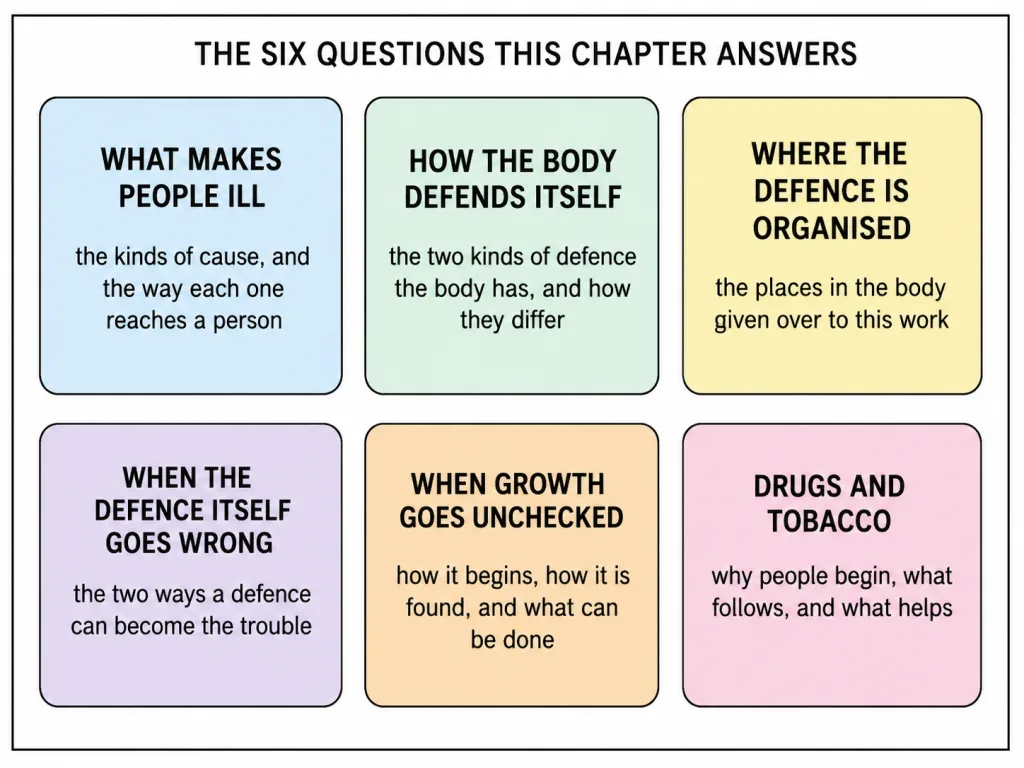
Health is a state of complete physical, mental and social well-being. The definition is deliberately wide, and the clause most students drop is the one that carries the marks: health is not merely the absence of disease. Somebody free of infection who sleeps badly, eats poorly or lives under constant strain does not meet the standard. Read "complete" as an instruction to check three fronts at once: body, mind, and the person's place among other people.
[NEET Important] The trap answer is almost always the one that defines health negatively, as freedom from illness or infirmity. Learn the positive wording.
What Pulls Health Down, and What Holds It Up
Three broad forces act on health. Genetic disorders are deficiencies a child is born with, inherited from the parents; they arrive with the individual and cannot be picked up from a neighbour. Infections come from organisms that enter the body from outside. Lifestyle covers the food and water taken, rest and exercise, and habits and personal choices. Maintenance runs on a separate list: a balanced diet, personal hygiene and regular exercise; yoga practised regularly; awareness about diseases and the way they spread; immunisation against them; proper disposal of wastes; and control of vectors. The last two are the ones candidates overlook, and much of vector control is household work: not letting water stagnate, cleaning coolers, mosquito nets, wire mesh on doors and windows.
Pathogens, Parasites and Infectious Disease
Organisms that cause diseases are called pathogens. Diseases that are easily transmitted from one person to another are infectious, or communicable. Most pathogens are parasites: they live in or on the host, draw their nourishment from it, and harm it in the process. Transmissibility, not severity, decides the category. A grave inherited condition is not infectious; a trivial cold is.
Three words are confused. A pathogen is the organism that produces the disease. A vector is an animal that ferries that organism from one host to another, as the mosquitoes of this chapter do. A carrier moves the organism from one place to another without falling ill of it. A human carrier harbours it inside the body and stays well; a housefly carries it on the body surface and harbours nothing at all, which is why it is called a mechanical carrier.
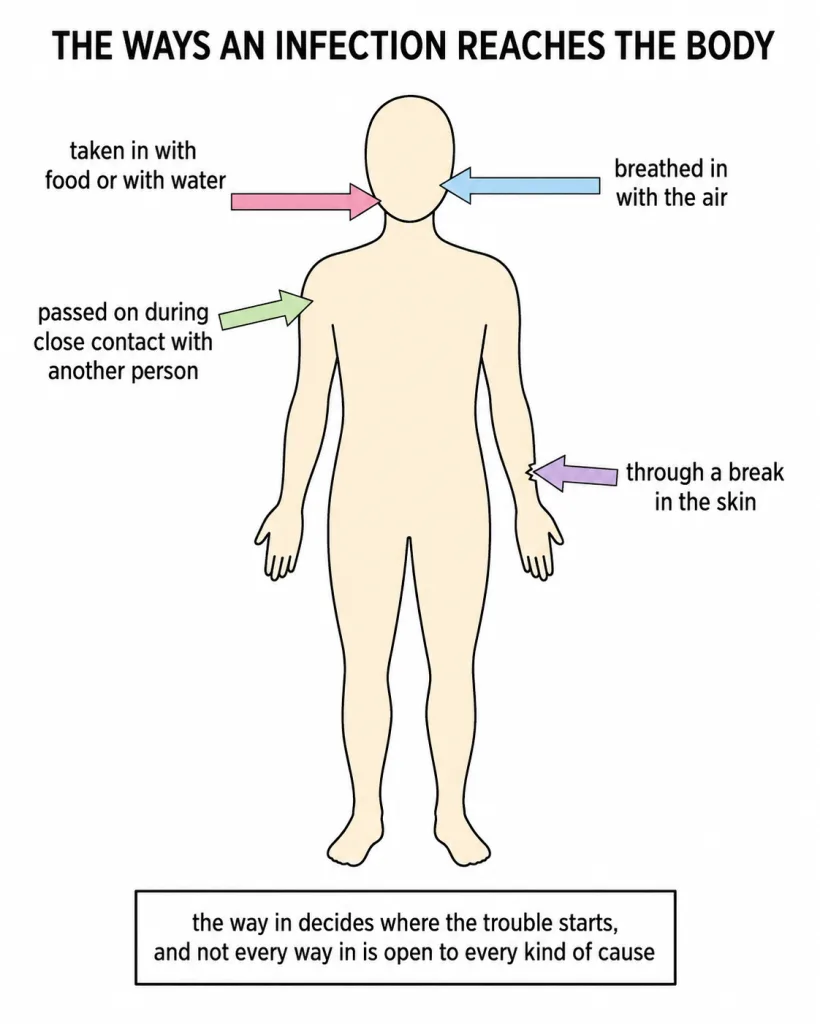
An infection reaches a new host by one of four routes, and sorting a disease by its route repays study. Direct contact carries some infections between people. Droplets coughed or sneezed into the air, and the objects those droplets settle on, carry pneumonia and the common cold. Contaminated food and water carry gut infections. A vector carries the rest: Aedes mosquitoes bring dengue and chikungunya, Anopheles brings malaria, Culex brings filariasis; the housefly, a mechanical carrier rather than a true vector, ferries gut organisms from filth to food.
The roster also sorts by the kind of organism. Pneumonia is bacterial; the common cold, dengue and chikungunya are viral; amoebiasis is protozoan; ascariasis is caused by a roundworm.
Typhoid: Entry, Site and Spread
Typhoid is caused by Salmonella typhi, a pathogenic bacterium. It is taken in through the mouth with contaminated food and water, reaches the small intestine, and from there migrates to other organs through the blood. The illness shows sustained high fever of 39 to 40 degrees C, weakness, stomach pain, constipation, headache and loss of appetite. The fever is described as sustained because it holds at that level instead of swinging. In severe cases the intestinal wall may be perforated and death may follow. Typhoid is confirmed by the Widal test, which looks for antibodies against the organism in the patient's serum.
[NEET Important] Mary Mallon, remembered as Typhoid Mary, was a cook by profession who spread typhoid through the food she prepared while never falling ill herself. She is the textbook illustration of carrier transmission.
Pneumonia and the Common Cold
Pneumonia in humans is caused by two bacteria, Streptococcus pneumoniae and Haemophilus influenzae. They infect the alveoli, the alveoli get filled with fluid, and severe problems in respiration follow. Fever, chills, cough and headache are usual, and in severe cases the lips and finger nails may turn grey to bluish - a sign that follows directly from the poor supply of oxygen. Two routes carry the disease: inhaling the droplets or aerosols released by an infected person, and sharing glasses and utensils with one.
The common cold is caused by rhino viruses. They infect the nose and the respiratory passage but not the lungs, and that exclusion is the cleanest way to separate a cold from a chest infection. Nasal congestion and discharge, sore throat, hoarseness, cough, headache and tiredness usually last three to seven days. Transmission is direct, through droplets from a cough or sneeze that are inhaled, or indirect, through contaminated objects - pens, books, cups, doorknobs, computer keyboards and the mouse.
Dengue and Chikungunya
Both are viral diseases, and both are transmitted by Aedes mosquitoes. That pair of facts - the agent and the vector - is all the chapter offers and all that is expected. Draining and covering stored water cuts both at once, which is why vector control sits on the health-maintenance list. A mosquito genus tells you nothing about the kind of organism it carries: a vector is a courier, and couriers do not resemble their parcels.
Malaria: One Parasite, Two Hosts
Malaria is caused by Plasmodium, a protozoan. Three species of Plasmodium account for the malaria this chapter deals with: Plasmodium vivax, P. malariae and P. falciparum. They are not interchangeable. Malignant malaria, produced by P. falciparum, is the most serious of the three and can even prove fatal, while the other two produce a milder illness. The way they are picked up and the tissues they pass through are shared, and the chill and fever recur every three to four days.
The parasite cannot finish its life cycle in one organism. It needs two hosts: a human being and a mosquito. The mosquito is therefore the vector, and the vector has a precise identity - the female Anopheles. Both halves matter. Male mosquitoes do not take blood meals, so they transmit nothing at all; and mosquitoes of other genera, such as Aedes and Culex, do take blood but cannot support the development of this particular parasite. A question that offers "female Culex" or "male Anopheles" is testing whether you learned the pair of conditions or only one of them.
Inside the human body the parasite reproduces asexually, twice over. It multiplies in liver cells and bursts them, releasing parasites into the blood; it then multiplies inside red blood cells and bursts those as well. Gametocytes develop in the red cells, but no fertilisation happens in a person.
[NEET Important] When the parasites rupture red blood cells they release a toxic substance called haemozoin, and it is haemozoin - not the parasite itself - that is responsible for the chill and high fever recurring every three to four days. The recurrence is a consequence of the ruptures happening in waves. Liver-stage multiplication releases no haemozoin, which is why it produces no fever pattern.
The remainder of the cycle belongs to the mosquito. Gametocytes are taken up with the blood meal of a female Anopheles. Fertilisation and further development take place in the mosquito's gut, and the sporozoites that are formed are stored in the salivary glands. When that mosquito bites another human being, the sporozoites go in with the saliva. This is why a single mosquito can infect a series of people over the days that follow one infected meal.
Amoebiasis and Ascariasis: The Faecal-Oral Group
Amoebiasis, also known as amoebic dysentery, is caused by Entamoeba histolytica, a protozoan parasite of the large intestine of humans. The clinical picture is constipation, abdominal pain and cramps, and stools with excess mucous and blood clots. Drinking water and food contaminated with faecal matter are the main sources of infection.
The housefly deserves a paragraph of its own because it is so often misread. Houseflies act as mechanical carriers. A fly moves from the faeces of an infected person to food and food products and contaminates them by contact. Nothing develops inside the fly; it is not a host, and carries no stage of the parasite's life cycle. Contrast this with the mosquito in malaria, which genuinely harbours the parasite and in which fertilisation occurs. Carrier and host are different jobs.
Ascariasis is caused by Ascaris, the common round worm, an intestinal endoparasite. Its effects are internal bleeding, muscular pain, fever, anaemia and blockage of the intestinal passage. Eggs of the parasite are excreted with the faeces of infected persons and contaminate soil, water and plants. A healthy person acquires the infection through contaminated water, vegetables and fruits. There is no insect involved anywhere in this route.
Filariasis and Ringworm: Lymph and Skin
Filariasis is caused by the filarial worms Wuchereria bancrofti and W. malayi, transmitted by the bite of female mosquito vectors. The worms cause slow, chronic inflammation of the lymphatic vessels of the lower limbs, which may persist for years and produce the gross deformity called elephantiasis. The genital organs are often affected as well. Note that the disease is called elephantiasis or filariasis: the two words name one disease and not two, and the obstruction is of lymph drainage rather than of blood flow.
Ringworm is the odd one in this group: its English name gives no clue to the fungi responsible, which are Microsporum, Trichophyton and Epidermophyton. They produce dry, scaly lesions on skin, nails and scalp, with intense itching. The lesion is dry and flaking, not weeping.
[NEET Important] Heat and moisture help these fungi to grow, which explains their distribution on the body: they occur in areas such as the groin or the folds between toes, where the skin stays warm and damp. Infection is acquired from soil, or from using towels, clothes or even the comb of an infected person.
Reading a Case
Site of infection is the fastest discriminator when a case is described. Large intestine points to amoebiasis; intestine to ascariasis; lymphatic vessels of the lower limbs to filariasis; skin, nails and scalp to ringworm; liver and red blood cells to malaria. Pair that with the route - insect bite, or contaminated food and water - and most descriptions resolve in one step.