Ribs, Sternum and the Rib Cage
Humans possess 12 pairs of ribs, or 24 ribs. Each rib is a thin, flat bone connected dorsally to the vertebral column. NCERT describes each rib as bicephalic because its dorsal end has two articulation surfaces.
The first seven pairs are true ribs. Each attaches dorsally to a thoracic vertebra and ventrally to the sternum through hyaline cartilage. The 8th, 9th and 10th pairs do not connect directly to the sternum; their ventral ends join the cartilage of the 7th rib. They are vertebrochondral, or false, ribs. The 11th and 12th pairs have no ventral connection and are called floating ribs.
The sternum is a flat bone on the ventral midline of the thorax. The thoracic vertebrae, ribs and sternum together form the rib cage, which protects the heart and lungs and assists the mechanics of breathing.
Axial count check
Skull bones 22 + ear ossicles 6 + hyoid 1 + vertebral column 26 + ribs 24 + sternum 1 = 80 axial bones. This arithmetic is a powerful way to verify every sub-count.
Joints: Classification and Degree of Movement
A joint is a point of contact between bones, or between a bone and cartilage. Joints act as fulcrums for movements produced by skeletal muscles. For NEET, classify a joint from the material or space between its articulating elements and then connect that structure with the movement allowed.
Fibrous joints
In fibrous joints, dense fibrous connective tissue holds the bones together. These joints do not permit movement. Sutures between the flat bones of the skull are the standard NCERT example.
Cartilaginous joints
In cartilaginous joints, bones are joined with the help of cartilage. They permit limited movement. The joints between adjacent vertebrae, where an intervertebral disc lies between vertebral bodies, are the standard example.
Synovial joints
A synovial joint has a fluid-filled cavity between the articulating surfaces and permits considerable movement. Do not confuse this cavity with the cartilage joining bones in a cartilaginous joint.
[NEET Important] The high-yield structure-movement chain is: fibrous tissue means no movement; cartilage means limited movement; synovial cavity means considerable movement.
Synovial Joint Types and Their Exact Sites
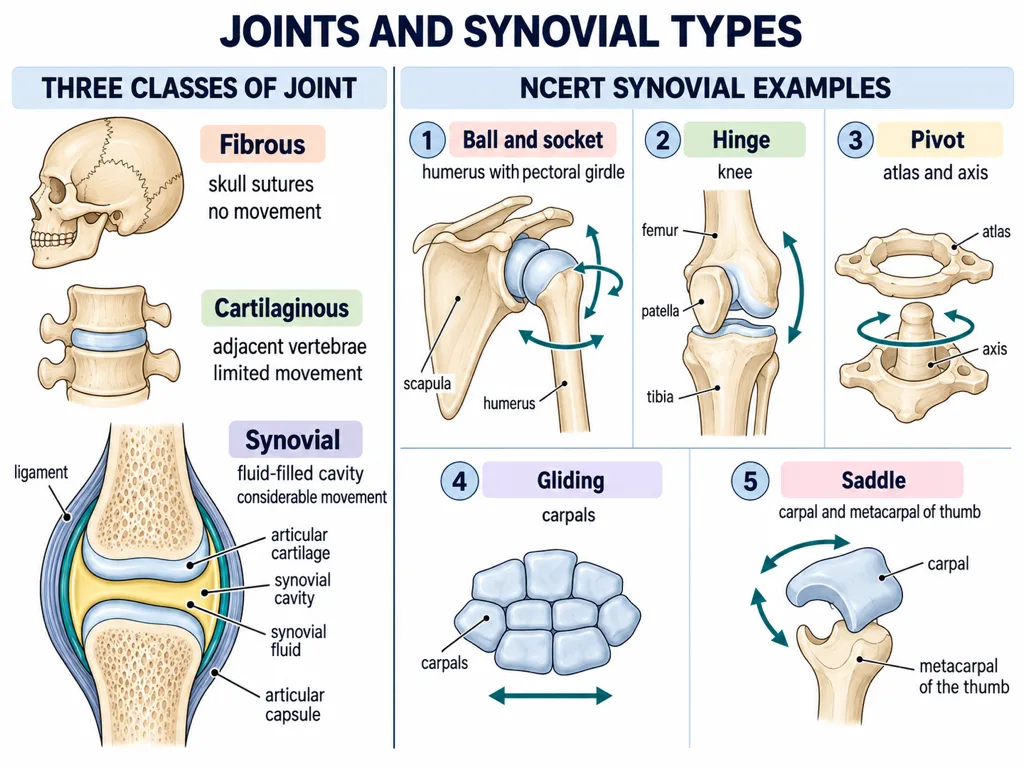
Learn the five NCERT synovial types with their exact sites; most NEET errors are one-word swaps.
- Ball-and-socket: between the humerus and pectoral girdle at the shoulder; it permits movement in several directions, including rotation.
- Hinge: knee joint; it mainly permits flexion and extension in one plane. The elbow is another familiar hinge joint.
- Pivot: between atlas and axis; it permits rotation of the head.
- Gliding: between carpals; adjacent surfaces slide over one another. Intertarsal joints are another gliding example.
- Saddle: between a carpal and the metacarpal of the thumb; it enables the thumb's wide range of movement.
[NEET Trap] The shoulder is ball-and-socket, not hinge; the knee and elbow are hinge, not pivot; atlas-axis is pivot, not saddle; and the thumb base is saddle, not gliding.
Disorders of Skeletal Muscle
Myasthenia gravis
This is an autoimmune disorder affecting the neuromuscular junction. It causes fatigue, weakening and paralysis of skeletal muscles. The scoring keyword is autoimmune, not inherited.
Muscular dystrophy
This is progressive degeneration of skeletal muscles, mostly due to a genetic disorder. The scoring pair is inherited/genetic plus progressive degeneration, not autoimmune damage to the neuromuscular junction.
Tetany
Tetany is marked by rapid spasms or wild contractions of muscles due to a low level of in body fluid. Never reverse the calcium direction: low , not high , is the NCERT association.
[NEET Important] Separate the three by cause: autoimmune junction disorder, genetic muscle degeneration, and low-calcium spasms.
NEET Chapter Map and Scoring Strategy
Locomotion and Movement rewards exact NCERT associations. Build the chapter as five connected maps and use each map to eliminate swapped statements.
1. Movement and muscle types
Movement may or may not produce a change of place; locomotion always does. Macrophages and leucocytes show amoeboid movement through pseudopodia. Cilia move material through the trachea and help transport ova through the female reproductive tract. Spermatozoa move with a flagellum. Skeletal muscle is striated, voluntary and multinucleate; smooth muscle is non-striated, involuntary and uninucleate; cardiac muscle is striated, involuntary, branched and connected by intercalated discs.
2. Sarcomere address map
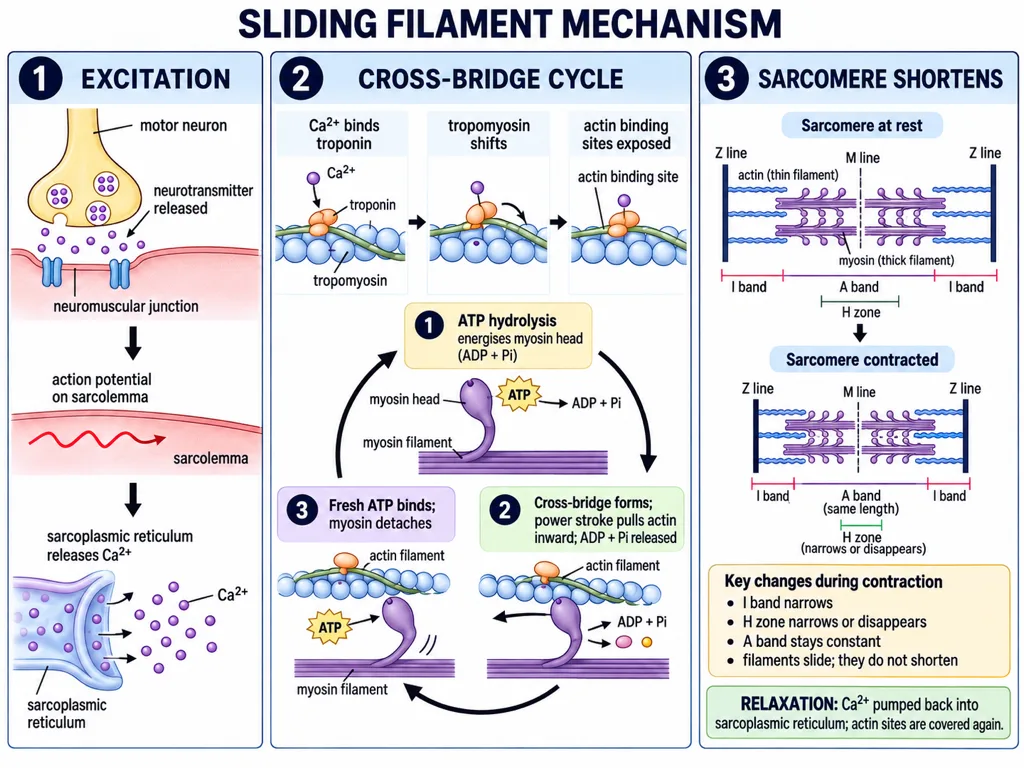
A sarcomere extends from one Z line to the next. The I band contains only thin filaments and is bisected by a Z line. The A band corresponds to the full length of thick filaments. Its central H zone has only thick filaments, and the M line lies at the centre. Thin filaments contain two F-actin strands, tropomyosin and troponin. Thick filaments are polymers of myosin; each meromyosin has a globular head, short arm and tail, and the head has ATPase activity plus an actin-binding site.
3. Contraction sequence and band changes
Use this order: neural signal reaches the neuromuscular junction; acetylcholine produces an action potential on the sarcolemma; the sarcoplasmic reticulum releases ; calcium binds troponin; tropomyosin shifts and exposes actin sites; an energised myosin head forms a cross bridge; the power stroke pulls actin towards the centre; a fresh ATP detaches myosin; and calcium is pumped back for relaxation. During contraction the sarcomere, I band and H zone shorten, while the A band remains constant because thick-filament length does not change.
[NEET Trap] Calcium exposes actin sites; it does not detach the cross bridge. ATP binding detaches myosin, while ATP hydrolysis energises the head for another cycle.
4. Skeleton, ribs and joints
The adult skeleton has 206 bones: 80 axial and 126 appendicular. The skull has 22 bones, with six ear ossicles and one hyoid counted separately in the axial skeleton. The adult vertebral column has 26 bones arranged as 7 cervical, 12 thoracic, 5 lumbar, 1 sacrum and 1 coccyx. Humans have 12 pairs of ribs: 7 vertebrosternal, 3 vertebrochondral and 2 floating vertebral pairs. Each rib is bicephalic. Fibrous joints are immovable, cartilaginous joints permit limited movement, and a fluid-filled cavity allows considerable movement in synovial joints.
5. Disorders: never swap the cause
Myasthenia gravis is autoimmune and affects the neuromuscular junction. Muscular dystrophy is progressive skeletal-muscle degeneration, mostly due to a genetic disorder. Tetany involves rapid spasms due to low in body fluid. Arthritis means inflamed joints. Osteoporosis means decreased bone mass with increased fracture risk and is commonly associated with decreased estrogen. Gout involves uric acid crystal accumulation in joints.
Fast solving rules
For a statement set, test the absolute words first -- all, every, except, only -- because a NEET statement set is usually decided by one over-stated claim rather than by the facts you are sure of. For a matching item, lock the one pair you are certain of, strike every option that contradicts it, and only then work on the pair you are least sure of; the four options are almost never four independent guesses. For a sequence item, trace the actual pathway or the actual anatomy in order rather than recognising the string, since the distractors are built by transposing exactly one neighbouring pair.