
Control and Coordination
Control and Coordination has carried 4 to 8 marks in the recent board papers: 5 in the 2026-27 sample paper, 8 in February 2026, 7 in May 2026 and 4 in 2025.
It usually gives one or two MCQs (brain parts, hormones, plant movements), a 2-mark question that often has an OR, and a 3-mark question. February 2026 set a case study on tropisms, and May 2026 made it the 5-mark question with a reflex-arc flow chart.
Where marks are usually lost:
- a reflex arc or flow chart with the sensory and motor neurons swapped, or with no arrows;
- mixing up the cerebellum (balance) and the medulla (involuntary actions);
- saying auxin collects on the side facing the light;
- calling the folding of touch-me-not leaves a growth movement or a tropism.
Revise in 5 Minutes
Nervous system
- Receptors: photo- (eye, light), phono- (ear, sound), olfactory (nose, smell), gustatory (tongue, taste), thermo- (skin, heat).
- Neuron: dendrite → cell body → axon → nerve ending. At the nerve ending, chemicals cross the gap (synapse) and start an impulse in the next neuron.
- Reflex action: a sudden, automatic response to a stimulus, without thinking.
- Reflex arc: receptor → sensory neuron → spinal cord (relay neuron) → motor neuron → effector (muscle or gland). It sits in the spinal cord because thinking in the brain is too slow for danger. The brain gets the message later.
- CNS = brain + spinal cord. PNS = cranial nerves + spinal nerves.
- Protection: skull with a fluid-filled balloon (shock absorber) for the brain; vertebral column for the spinal cord.
- Muscle cells: special proteins change shape and arrangement, so the cells shorten.
| Part of brain | Job |
|---|---|
| Forebrain | Thinking, memory, voluntary actions; areas for sight, hearing, smell |
| Medulla | Blood pressure, salivation, vomiting |
| Cerebellum | Posture, balance, precise voluntary actions |
Plants
- Touch-me-not: no growth; electrical-chemical message; cells change shape by gaining or losing water.
- Tropisms (growth, directional): photo (shoot to light, root away), geo (root down, shoot up), hydro (root to water), chemo (pollen tube to ovule). Tendril: side away from the support grows faster.
- Auxin: made at the shoot tip, moves to the shady side. Gibberellin: stem growth. Cytokinin: cell division (fruits, seeds). Abscisic acid: inhibits growth, wilting.
Hormones
| Gland | Hormone | Job |
|---|---|---|
| Hypothalamus | Releasing hormones | Act on the pituitary |
| Pituitary | Growth hormone | Growth (lack in childhood: dwarfism) |
| Thyroid | Thyroxin (needs iodine) | Metabolism (lack of iodine: goitre) |
| Adrenal | Adrenaline | Emergency: faster heartbeat and breathing |
| Pancreas | Insulin | Lowers blood sugar (lack: diabetes) |
| Testes / ovaries | Testosterone / oestrogen | Puberty changes |
- Feedback: sugar up → more insulin; sugar down → less insulin.
- Nerve impulses reach only cells joined by nerves and need reset time, so hormones are also used.
Traps
- Auxin moves away from light, not towards it.
- Touch-me-not folding is not a tropism.
- Endocrine glands are ductless; the pancreas also has a duct for its digestive juice.
- Sensory neuron brings the message in; motor neuron takes it out.
How to use this page: try each question on paper first, then read the answer. The marks against each step show what an examiner looks for. The 1-mark MCQs and Assertion-Reason questions are in the quiz at the end, together with questions that test how well you understand the chapter; every quiz answer comes with its explanation.
Short Answer Questions (2 and 3 Marks)
Question 1 (3 marks)
Answer the following about a nerve cell (neuron).
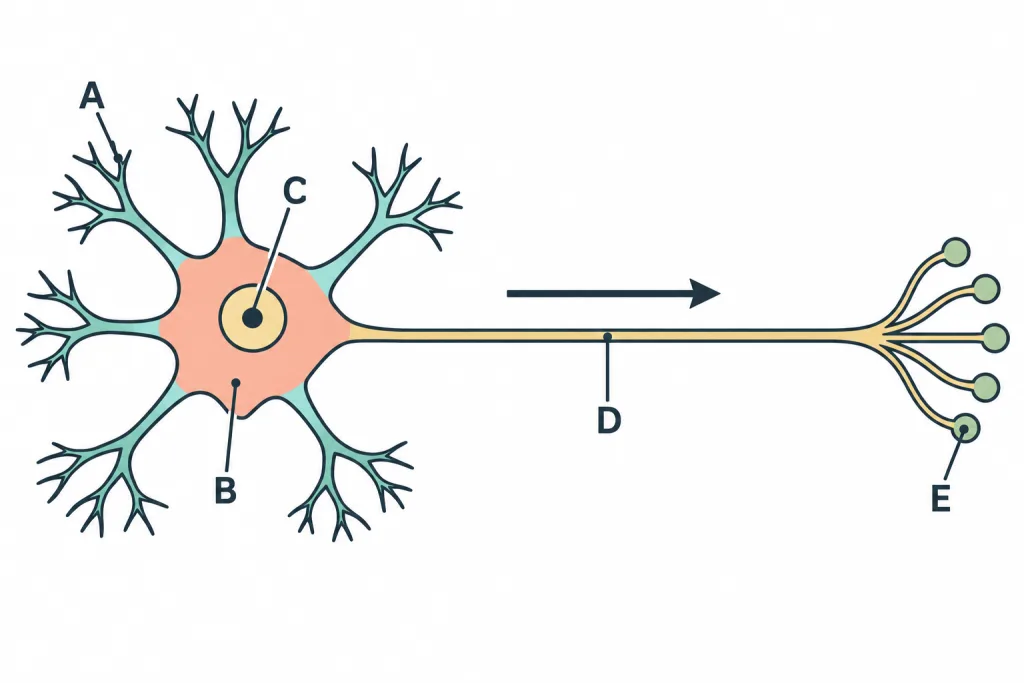
(a) Draw a neat labelled diagram of a neuron. Show the direction in which the impulse travels with an arrow. (2 marks)
Answer.
Model answer:
The diagram is shown below. Key: A dendrite, B cell body, C nucleus, D axon, E nerve ending. The arrow shows the direction of the impulse.
Marking scheme:
- Correct diagram: branched dendrites, cell body with nucleus, a long axon ending in branched nerve endings, with the arrow from dendrite towards nerve ending — 1 mark
- Any four labels correct, 0.25 each: dendrite, cell body, nucleus, axon, nerve ending — 1 mark
(b) At which part of the neuron is the information first picked up, and in what form does it then travel along the axon? (1 mark)
Answer.
- At the tips of the dendrites (0.5); a chemical reaction there sets off an electrical impulse, which travels along the axon (0.5) — 1 mark
Question 2 (3 marks)
Saloni touches a very hot pan by mistake and pulls her hand away at once. She feels the pain a moment later.
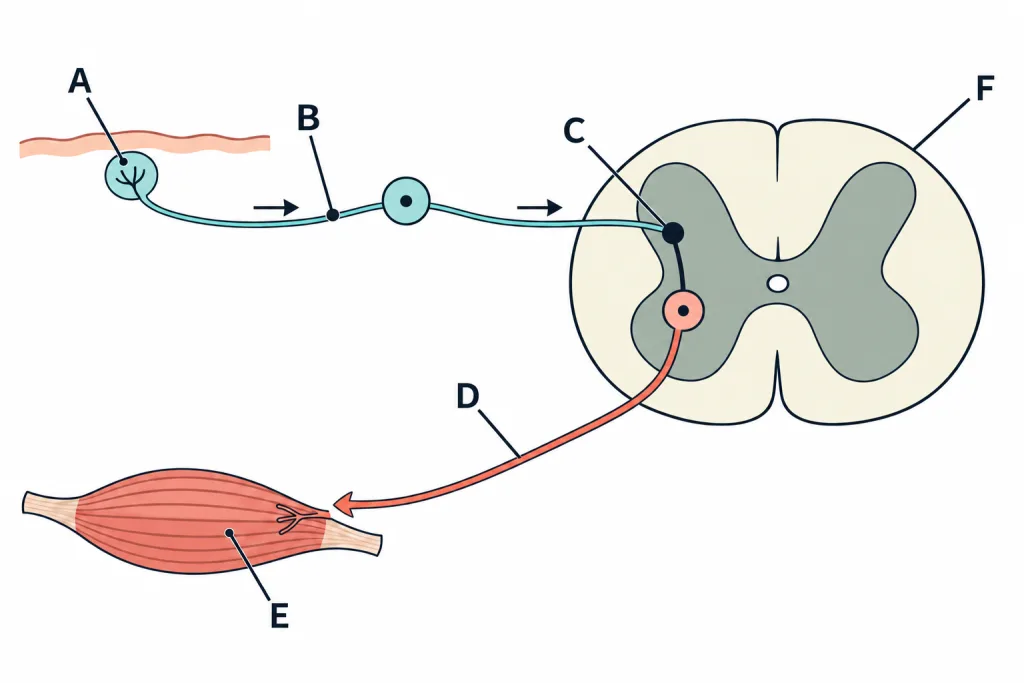
(a) Draw a labelled diagram of the reflex arc involved in this action. Label the receptor, sensory neuron, relay neuron, motor neuron and effector, and show the direction of the message. (2 marks)
Answer.
Model answer:
The diagram is shown below. Key: A receptor in the skin, B sensory neuron, C relay neuron in the spinal cord, D motor neuron, E effector (muscle), F spinal cord (cross-section). The arrows show the path of the message.
Marking scheme:
- Correct diagram: receptor in the skin, sensory neuron entering the spinal cord, relay neuron inside it, motor neuron going out to the muscle, with arrows in the right direction — 1 mark
- Five parts labelled correctly (receptor, sensory neuron, relay neuron, motor neuron, effector) — 1 mark
(b) The hand moved before Saloni felt any pain. Does the message about the hot pan reach her brain at all? Explain. (1 mark)
Answer.
Model answer:
Yes. In the spinal cord, the sensory nerve does not only connect to the motor nerve. The message also goes up the spinal cord to the brain. The hand is pulled away first because the reflex arc in the spinal cord acts at once. The message reaches the brain a little later, and then she feels the pain.
Marking scheme:
- Yes: the sensory nerve also connects to nerves going up the spinal cord to the brain, so the brain gets the message and she feels pain, but only after the reflex has already acted — 1 mark
Question 3 (2 marks)
Classify each action as voluntary, involuntary or reflex, and name the part of the nervous system that controls it.
(i) Reading a notice on the school board
(ii) Vomiting after eating stale food
(iii) Jerking the foot away when a pin pricks it
(iv) Threading a needle
Answer.
- (i) Voluntary; forebrain — 0.5 marks
- (ii) Involuntary; medulla in the hind-brain (also accept: reflex; medulla) — 0.5 marks
- (iii) Reflex; spinal cord — 0.5 marks
- (iv) Voluntary; forebrain, with the cerebellum making the movement precise (accept either) — 0.5 marks
Question 4 (2 marks)
Name the kind of receptor that picks up the stimulus in each case.
(i) You smell pakoras frying in the kitchen.
(ii) You feel the heat of a candle flame near your hand.
(iii) You hear the school bell ring.
(iv) You squint when you step out into bright sunlight.
Answer.
- (i) Olfactory receptors (nose) — 0.5 marks
- (ii) Thermoreceptors (skin) — 0.5 marks
- (iii) Phonoreceptors (ear) — 0.5 marks
- (iv) Photoreceptors (eye) — 0.5 marks
Question 5 (2 marks)
What is a reflex action? Give one example. Why is it useful that the reflex arc for such an action is completed in the spinal cord and not in the brain?
Answer.
- A sudden, automatic response to a stimulus, done without thinking; e.g. pulling the hand away from a flame (0.5 + 0.5) — 1 mark
- Thinking in the brain takes time; in the spinal cord the sensory nerve connects straight to the motor nerve, so the body responds at once and is saved from harm — 1 mark
Question 6 (2 marks)
A touch-me-not leaf that folds when touched opens up again after some time. But a shoot that has bent towards a window does not straighten when the plant is turned around. Explain this difference.
Answer.
- The leaf folds because its cells lose water and change shape; no growth takes place, so when the cells take in water again the leaf opens — 1 mark
- The shoot bent by growth: cells on one side grew longer than on the other; growth cannot be undone, so the bend stays — 1 mark
Question 7 (3 marks)
The adrenal glands are often called the glands of emergency.
(a) Where are these glands located? Name the hormone they release and say how it reaches the organs it acts on.
(b) State two changes this hormone brings about in the body.
(c) Why is less blood sent to the digestive system and the skin at such a time?
Answer.
- (a) On top of the kidneys (0.5); adrenaline, secreted directly into the blood, which carries it to the target organs (0.5) — 1 mark
- (b) Any two: the heart beats faster; breathing becomes faster as the diaphragm and rib muscles contract faster; small arteries around the digestive system and skin contract — 1 mark
- (c) So that more blood, with more oxygen, goes to the skeletal muscles, which have to work hard to run or fight — 1 mark
Question 8 (3 marks)
The figure shows the positions of some endocrine glands in the human body.
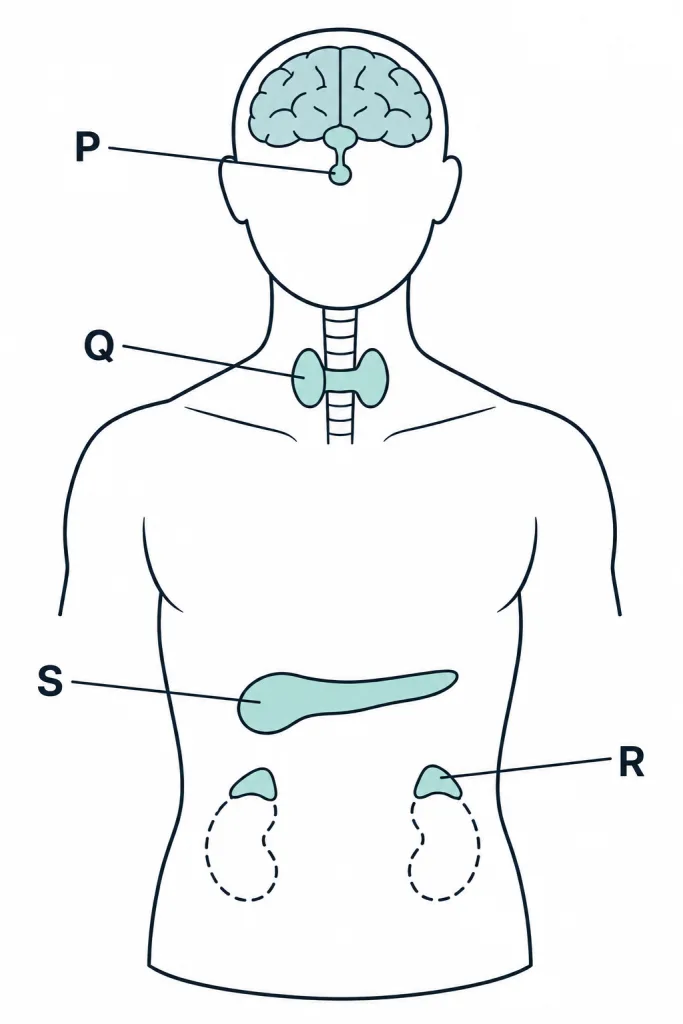
(a) Name the glands P, Q, R and S. (2 marks)
Answer.
- P pituitary gland; Q thyroid gland — 1 mark
- R adrenal gland; S pancreas — 1 mark
(b) Name the hormone made by Q. Why can a lack of iodine in the diet make the neck swell? (1 mark)
Answer.
- Thyroxin (0.5); the thyroid needs iodine to make thyroxin, so without enough iodine it cannot make enough thyroxin and the gland swells, which is goitre (0.5) — 1 mark
Question 9 (3 marks)
Riya hears someone call her name from behind. She recognises her friend's voice, turns around and waves. Explain how her forebrain makes this possible.
Answer.
Model answer:
- Hearing: the receptors in her ear pick up the sound. Nerve impulses carry it to the area of the forebrain that is meant for hearing.
- Understanding: in the association areas of the forebrain, this sound is put together with information already stored in the brain, such as the memory of her friend's voice. So she knows who is calling, and a decision is made to turn and wave.
- Acting: the decision goes to the motor areas of the forebrain. They send messages through motor nerves to the voluntary muscles of her neck, body and arm.
Marking scheme:
- The sound is picked up by receptors in the ear, and the impulses reach the area of the forebrain that is specialised for hearing — 1 mark
- Association areas interpret this by putting it together with information already stored (memory of the friend's voice), and a decision is made to respond — 1 mark
- The decision is passed to the motor areas, which send messages to the voluntary muscles to turn the body and wave the hand — 1 mark
Question 10 (3 marks)
Give reasons for the following.
(a) A person whose spinal cord is badly injured in the lower back may be unable to move the legs, although the brain is not hurt.
(b) We cannot make our heart beat slower or our blood pressure fall just by deciding to.
(c) The brain is held in a fluid-filled balloon inside the skull.
Answer.
- (a) Messages from the brain to the leg muscles travel down the spinal cord; if the cord is damaged, the messages cannot get through, so the legs do not move — 1 mark
- (b) These are involuntary actions controlled by the hind-brain (medulla), not by the thinking forebrain — 1 mark
- (c) The fluid acts as a shock absorber, so a jerk to the head does not directly hurt the soft brain — 1 mark
Long Answer and Case-Based Questions
Question 11 (5 marks)
Attempt either option (A) or (B).
(A) Answer the following about the nervous system.
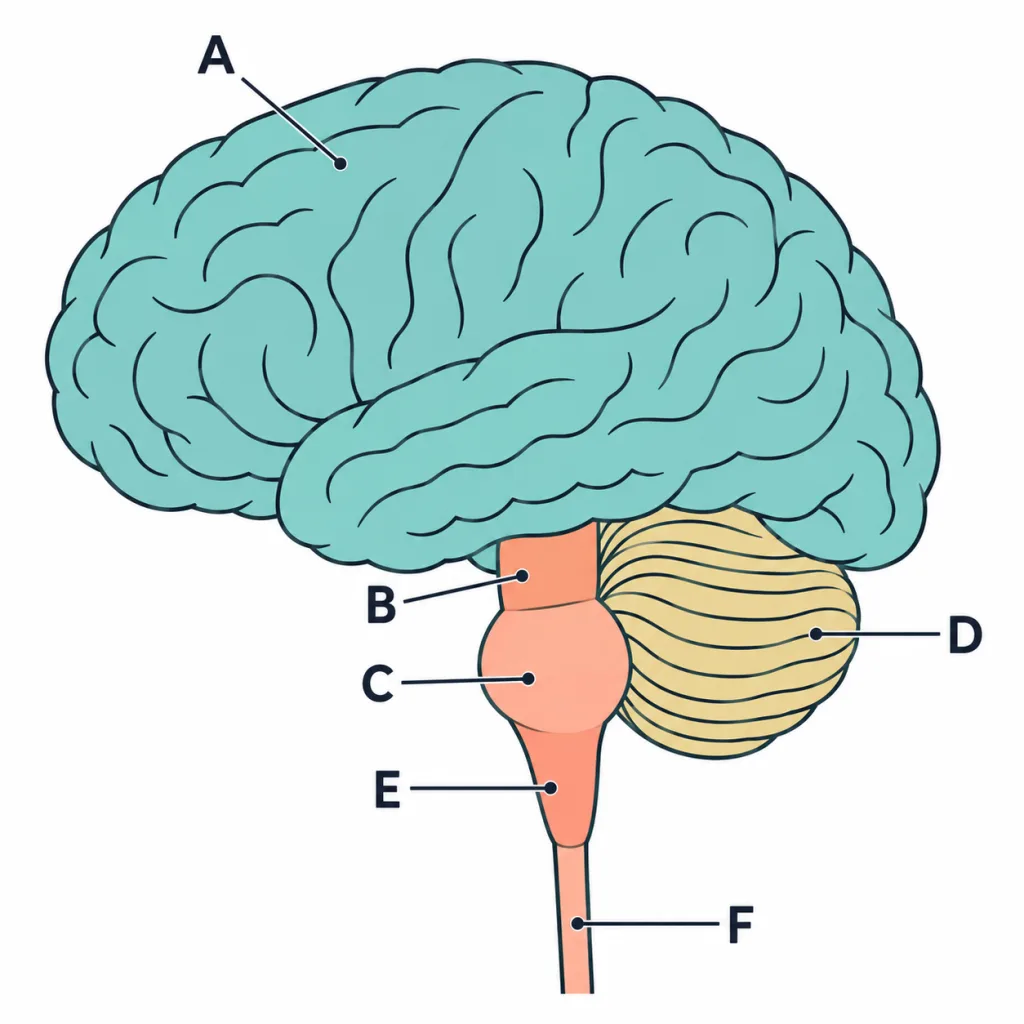
(i) Draw a diagram of the human brain as seen from the side. On it, label the pons and the parts that (I) do the thinking, (II) keep the posture and balance of the body, and (III) control blood pressure and vomiting. (3 marks)
Answer.
Model answer:
The diagram is shown below. Key: A forebrain (cerebrum), B midbrain, C pons, D cerebellum, E medulla, F spinal cord.
Marking scheme:
- Correct diagram of the brain with the cerebrum, the brain stem and the cerebellum at the back — 1 mark
- (I) Forebrain (cerebrum) and (II) cerebellum labelled correctly — 1 mark
- (III) Medulla and the pons labelled correctly — 1 mark
(ii) Name the two main parts of the human nervous system and state what each is made of. What is the job of the second part? (2 marks)
Answer.
- Central nervous system: brain and spinal cord; peripheral nervous system: cranial nerves from the brain and spinal nerves from the spinal cord — 1 mark
- The peripheral nervous system links the central nervous system with all other parts of the body, carrying messages both ways — 1 mark
OR
(B) Answer the following about coordination in plants.
(i) Name the plant hormone that (I) helps the stem to grow, (II) promotes cell division and (III) inhibits growth and causes wilting of leaves. In which parts of a plant would you expect the hormone in (II) in large amounts, and why? (3 marks)
Answer.
- (I) Gibberellin (also accept auxin); (II) cytokinin — 1 mark
- (III) Abscisic acid — 1 mark
- Cytokinin is present in larger amounts in fruits and seeds, because cells divide rapidly there — 1 mark
(ii) The tendril of a pea plant touches a thin stick and coils around it over the next few days. Explain how the tendril coils. (2 marks)
Answer.
- The part of the tendril away from the stick grows faster than the part in contact with the stick — 1 mark
- This unequal growth makes the tendril curve round the stick; it is a growth movement in response to touch — 1 mark
Question 12 (4 marks)
Mr Das went to a hospital in Kanpur with pain in the upper abdomen. Tests showed a small stone blocking his pancreatic duct. The doctor found that fatty food was not being digested properly, but his blood sugar was normal. In the same ward, Mrs Rao digests her food well, but her blood sugar stays high for hours after every meal.
(a) Why is Mr Das not able to digest fat properly? (1 mark)
Answer.
- Pancreatic juice, which has the enzyme lipase for digesting fats, cannot reach the small intestine through the blocked duct — 1 mark
(b) Why is his blood sugar still normal, although the duct is blocked? (1 mark)
Answer.
- The pancreas releases insulin directly into the blood, not through the duct, so insulin still reaches the blood — 1 mark
(c) What is most likely wrong with Mrs Rao? Why may her doctor give her insulin injections? (2 marks)
Answer.
- Her pancreas is not making enough insulin (0.5); the condition is diabetes (0.5) — 1 mark
- Insulin lowers the sugar level of the blood; injected insulin makes up for what her pancreas does not make — 1 mark
OR
(c) How is an endocrine gland different from a gland that pours its juice into a duct? Give one example of each, other than the pancreas. (2 marks)
Answer.
- An endocrine gland has no duct and releases its hormone directly into the blood; the other kind pours its juice into a duct that carries it to a particular place — 1 mark
- Endocrine: thyroid, adrenal or pituitary gland (0.5); with a duct: salivary glands or liver (0.5) — 1 mark
Question 13 (4 marks)
Ravi filled a wide tray with dry sand and sowed gram seeds all over it. In one corner he buried a small unglazed clay pot full of water, so that water slowly seeped into the sand only near the pot. He sprinkled just enough water for the seeds to germinate. After ten days he gently dug out some seedlings. The roots of the seedlings near the pot had bent sideways towards it, while all the shoots had grown straight up.
(a) Name the movement shown by the roots and the stimulus for it. (1 mark)
Answer.
- Hydrotropism (0.5); the stimulus is water (0.5) — 1 mark
(b) The shoots grew straight up even though the water was on one side. Name one stimulus to which the shoots were responding. (1 mark)
Answer.
- Gravity: the shoots grow away from it (negative geotropism); also accept light from above (phototropism) — 1 mark
(c) Why is this movement of the roots useful to a plant? Give two reasons. (2 marks)
Answer.
- The roots reach water even when most of the soil is dry, so the plant can survive dry spells — 1 mark
- Water is needed for photosynthesis and for keeping the plant fresh, and it brings dissolved minerals from the soil — 1 mark
OR
(c) If Ravi had watered the whole tray evenly, in which direction would the roots have grown? Give a reason. (2 marks)
Answer.
- Straight down into the sand — 1 mark
- With water spread evenly there is no side on which water is more, so there is no sideways bending; the roots respond only to gravity (positive geotropism) — 1 mark
Question 14 (4 marks)
In a class activity, Rohit holds a 30 cm ruler upright, just above Sana's open fingers. Without warning he lets it drop, and Sana catches it as quickly as she can. The distance the ruler falls before she catches it shows how quickly she responds. In five tries the ruler fell 14 cm, 16 cm, 13 cm, 15 cm and 17 cm. After a week of daily practice, the ruler fell only about 9 cm before she caught it, and her grip was neater.
(a) Find the average distance the ruler fell. Is catching the ruler a voluntary action or a reflex action? (1 mark)
Answer.
- Average cm (0.5); it is a voluntary action (0.5) — 1 mark
(b) Which receptors pick up the falling ruler, and which part of the brain decides to close the fingers? (1 mark)
Answer.
- The photoreceptors in the eyes (0.5); the forebrain (0.5) — 1 mark
(c) Catching the ruler stayed a voluntary action even after the practice. Name the two parts of the brain that work together in it, and state what each part does. (2 marks)
Answer.
- Forebrain: it makes sense of what the eyes see, decides to close the fingers and sends the command to the voluntary muscles — 1 mark
- Cerebellum (hind-brain): it keeps the posture and balance and makes the voluntary movement precise, so the grip is neat — 1 mark
OR
(c) Show, as a flow chart, the path of the message from the moment Sana sees the ruler falling to the moment her fingers close on it. (2 marks)
Answer.
- Eye (photoreceptors) sensory nerve (optic nerve) forebrain, where the message is interpreted and the decision is made — 1 mark
- Forebrain spinal cord motor nerve muscles of the fingers (effector), which contract and close on the ruler (also accept: eye sensory nerve forebrain motor nerve finger muscles) — 1 mark