
Heredity
Heredity carries 5 to 7 marks in the board paper: 5 in the 2026-27 sample paper and in the 2025 and February 2026 papers, and 7 in the May 2026 paper.
The usual pattern is one or two 1-mark MCQs (Mendel's ratios, chromosome numbers in gametes and zygotes) plus either a 4-mark case-based question on a Mendelian cross or a 3-mark question asking you to show a cross. The syllabus covers Mendel's rules and a short idea of sex determination.
Where marks are usually lost:
- writing 3 : 1 when the question asks for the genotypic ratio (1 : 2 : 1);
- picking the wrong group in a dihybrid F2, such as 3/16 when the question needs two groups added;
- showing a cross without writing the gametes;
- saying the mother decides the sex of the child.
Revise in 5 Minutes
Key terms
- DNA (deoxyribonucleic acid) in the chromosomes carries the information for traits. A gene is a section of DNA with the information for one protein.
- Body cells carry two copies of each gene; a gamete carries one. Dominant shows with one copy (T); recessive only with two (tt).
- Genotype = the genes (TT, Tt, tt). Phenotype = what we see (tall, dwarf). Pure-breeding = both copies alike.
- Asexual reproduction gives little variation (DNA copying errors only); sexual reproduction gives much more.
- Skills learnt in life are not inherited; only what is in the DNA of the germ cells is passed on.
Mendel's crosses
| Cross | F1 | F2 phenotype | F2 genotype |
|---|---|---|---|
| TT × tt | all Tt, tall | 3 tall : 1 dwarf | 1 TT : 2 Tt : 1 tt |
| RRYY × rryy | all RrYy, round yellow | 9 : 3 : 3 : 1 | 16 boxes |
- Dihybrid F2 (out of 16): both dominant 9, one dominant 3 + 3, both recessive 1; pure for both traits 4.
- New combinations in F2 show independent inheritance.
Gene to trait: gene → enzyme → amount of growth hormone → height.
Chromosomes and sex
- Gametes are made by meiosis (reduction division): one chromosome of each pair, so half the number. Fertilisation restores it, keeping the number and the DNA constant.
- Human body cell: 22 pairs + XX (woman) or XY (man). Egg 22 + X; sperm 22 + X or 22 + Y.
- X sperm + egg → girl; Y sperm + egg → boy; 50% each. The father's sperm decides.
- In some reptiles the egg temperature decides sex; some snails change sex.
Diagrams: monohybrid cross to F2 with gametes and checkerboard; sex-determination flow chart.
Traps
- 3 : 1 is phenotype, 1 : 2 : 1 is genotype.
- "Dominant" does not mean common or stronger.
- No blending: violet × white gives fully violet F1.
How to use this page: try each question on paper first, then read the answer. The marks against each step show what an examiner looks for. The 1-mark MCQs and Assertion-Reason questions are in the quiz at the end, together with questions that test how well you understand the chapter; every quiz answer comes with its explanation.
Short Answer Questions (2 and 3 Marks)
Question 1 (2 marks)
What are chromosomes? Write the full form of DNA, and state how genes and DNA are related to chromosomes.
Answer.
Model answer:
- Chromosomes are thread-like structures in the nucleus of a cell. They are made of DNA and proteins, and they carry the information that passes from parents to their offspring.
- DNA (deoxyribonucleic acid) is the chemical in which this information is written. A gene is a section of DNA on a chromosome that has the information for making one protein. So each chromosome is one long DNA molecule with many genes along it.
Marking scheme:
- Chromosomes are thread-like structures in the nucleus, made of DNA and proteins; they carry the information that passes from parents to offspring — 1 mark
- DNA (deoxyribonucleic acid) is the chemical that carries this information; a gene is a section of DNA on a chromosome with the information for one protein, and each chromosome carries many genes — 1 mark
Question 2 (2 marks)
What is meant by the genotype and the phenotype of a plant? In the F2 generation of a cross between pure-breeding tall and pure-breeding dwarf pea plants, how many different phenotypes and how many genotypes appear? Name them.
Answer.
Model answer:
- Genotype is the pair of genes a plant carries for a trait, for example Tt. Phenotype is how the trait actually shows in the plant, for example tall.
- In F2 there are 2 phenotypes: tall and dwarf, in the ratio 3 : 1. There are 3 genotypes: TT, Tt and tt, in the ratio 1 : 2 : 1. TT and Tt plants look the same (tall), which is why there are fewer phenotypes than genotypes.
Marking scheme:
- Genotype: the pair of genes a plant carries for a trait (e.g. Tt); phenotype: how the trait shows in the plant (e.g. tall) — 1 mark
- 2 phenotypes, tall and dwarf (3 : 1); 3 genotypes, TT, Tt and tt (1 : 2 : 1) — 1 mark
Question 3 (2 marks)
Ravi has practised the tabla for ten years and plays it very well. His daughter has his curly hair, but she cannot play the tabla at all. Why was the curly hair passed on to her, but not the skill?
Answer.
Model answer:
- Curly hair is controlled by genes. Ravi's genes reached his daughter through his sperm, so she got his hair type.
- Playing the tabla is a skill learnt by practice. Practice changes Ravi's hands and brain, but not the DNA in his germ cells. Only what is in the DNA of the germ cells is passed on, so his daughter will have to learn the tabla herself.
Marking scheme:
- Hair type is controlled by genes in the DNA, and these reach the child through the germ cells (sperm and egg) — 1 mark
- A skill learnt by practice does not change the DNA of the germ cells, so it cannot be inherited; the daughter has to learn it herself — 1 mark
Question 4 (2 marks)
A human egg is much bigger than a sperm. Even so, the father and the mother contribute equally to the traits inherited by their child. Explain.
Answer.
Model answer:
- The egg is big because it carries a store of food for the embryo in its early days. Its size does not mean it has more genes.
- The egg and the sperm each carry 23 chromosomes, one from every pair. At fertilisation they join to give 46 chromosomes in the zygote, so the child has one copy of every gene from the mother and one from the father.
Marking scheme:
- The egg is bigger because it stores food for the early embryo, not because it carries more genes — 1 mark
- Egg and sperm each carry one set of 23 chromosomes, one from every pair, so the child gets one copy of every gene from each parent — 1 mark
Question 5 (2 marks)
Mendel started his experiments with pure-breeding pea plants, and he counted the number of plants of each kind in every generation. How did each of these two steps help him work out the rules of inheritance?
Answer.
Model answer:
- Pure-breeding parents: both copies of the gene were alike in each parent, so Mendel knew exactly what each parent could pass on. Any new kind of plant in the offspring could then be explained from the parents.
- Counting the plants: the counts showed fixed ratios, such as 3 tall : 1 dwarf in F2. These ratios are what told him that traits are controlled by pairs of factors, one from each parent. Simply noting "some tall, some dwarf" would not have shown any rule.
Marking scheme:
- Pure-breeding parents: he knew exactly what each parent carried (both copies alike), so every result could be traced back to the parents — 1 mark
- Counting: the numbers showed fixed ratios such as 3 : 1 and 9 : 3 : 3 : 1, and these ratios revealed the rules; just describing the plants would not — 1 mark
Question 6 (3 marks)
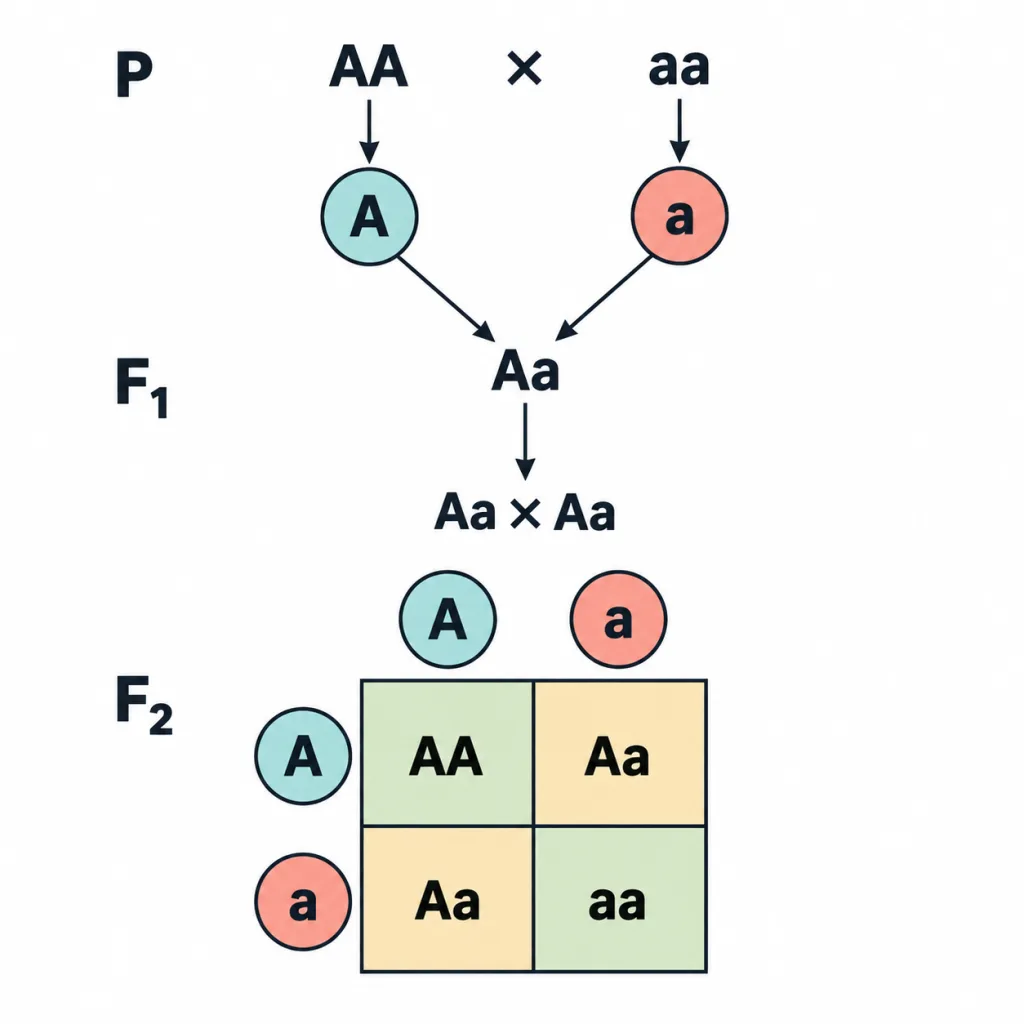
In pea plants, axial flowers (A) are dominant over terminal flowers (a). A pure-breeding plant with axial flowers is crossed with a pure-breeding plant with terminal flowers, and the F1 plants are self-pollinated. Show the cross up to the F2 generation using a checkerboard. Write the phenotypic and the genotypic ratio of the F2 plants.
Answer.
Model answer:
The cross is shown in the figure below. In it, P stands for the parents, F1 and F2 for the first and second generations, and the letters in circles are the gametes.
- Parents: AA (axial) × aa (terminal). AA gives only A gametes and aa gives only a gametes.
- F1: every plant is Aa. Since A is dominant, all F1 plants have axial flowers.
- F2 (Aa × Aa): each F1 plant gives A and a gametes in equal numbers. The checkerboard gives AA, Aa, Aa and aa.
Phenotypic ratio = 3 axial : 1 terminal. Genotypic ratio = 1 AA : 2 Aa : 1 aa.
Marking scheme:
- Parents AA × aa give gametes A and a; all F1 plants are Aa with axial flowers — 1 mark
- F1 × F1 (Aa × Aa): each gives gametes A and a; checkerboard gives AA, Aa, Aa, aa — 1 mark
- Phenotypic ratio 3 axial : 1 terminal; genotypic ratio 1 AA : 2 Aa : 1 aa — 1 mark
Question 7 (3 marks)
In pea plants, violet flowers (V) are dominant over white flowers (v), and green pods (G) are dominant over yellow pods (g). A plant that is pure-breeding for violet flowers and green pods is crossed with a plant that is pure-breeding for white flowers and yellow pods, and the F1 plants are self-pollinated.
(a) What percentage of the F2 plants will have violet flowers and yellow pods?
(b) What percentage of the F2 plants will breed true for both traits?
(c) Among the F2 plants with white flowers, what fraction will have green pods?
Answer.
Model answer:
The parents are VVGG and vvgg, so every F1 plant is VvGg. When F1 is self-pollinated, the two traits sort out independently, and the F2 is made of 16 equal parts.
(a) Violet needs at least one V (3 parts in 4) and yellow pods need gg (1 part in 4). So the fraction is 3/4 × 1/4 = 3/16 = 18.75%.
(b) A plant breeds true for both traits only if both genes are pure: VVGG, VVgg, vvGG or vvgg. Each is 1 part in 16, so together 4/16 = 25%.
(c) White flowers (vv) are 4 parts of the 16. Of these, green pods (GG or Gg) are 3 parts, just as in any 3 : 1 split. So the fraction is 3/4.
Marking scheme:
- (a) Parents VVGG × vvgg, F1 VvGg; violet with yellow pods (VVgg or Vvgg) = 3 of 16 = 18.75% — 1 mark
- (b) True-breeding for both: VVGG, VVgg, vvGG and vvgg, 1 each, = 4 of 16 = 25% — 1 mark
- (c) White-flowered plants are 4 of 16, and 3 of these have green pods, so the fraction is 3/4 — 1 mark
Question 8 (3 marks)
Two pea plants of the same variety grow side by side in the same soil and get the same water and sunlight. One grows tall, while the other stays dwarf. Explain how a difference in a single gene can cause this.
Answer.
Model answer:
- Gene makes a protein. A gene is a section of DNA that has the information for making one protein. The height of a pea plant depends on a growth hormone, and this hormone is made with the help of an enzyme, which is a protein.
- Different gene forms, different enzymes. The tall plant carries a form of the gene that makes an efficient enzyme, so a lot of hormone is made. The dwarf plant carries a changed form of the gene, so its enzyme works poorly and less hormone is made.
- Hormone decides height. With less hormone, the stem grows less and the plant stays dwarf. The soil, water and light are the same for both plants, so the difference must come from the gene.
Marking scheme:
- A gene is a section of DNA with the information to make a protein, here an enzyme needed to make a plant growth hormone — 1 mark
- The tall plant has the gene form that makes an efficient enzyme, so plenty of growth hormone is made; the dwarf plant has a changed form that makes a less efficient enzyme — 1 mark
- Less hormone means less growth of the stem, so the plant stays dwarf; since soil, water and light are the same, the difference must be in the gene — 1 mark
Question 9 (3 marks)
The body cells of a dog have 78 chromosomes.
(a) How many chromosomes will there be in (I) a sperm of a dog, (II) the zygote formed at fertilisation and (III) a skin cell of a puppy?
(b) Name the kind of cell division by which gametes are made.
(c) Explain how this kind of division keeps the number of chromosomes at 78 from one generation of dogs to the next.
Answer.
Model answer:
(a) (I) A sperm gets one chromosome of each of the 39 pairs, so it has 39. (II) The zygote gets 39 from the sperm and 39 from the egg: 78. (III) The puppy's skin cell comes from the zygote by ordinary division, so it also has 78.
(b) Gametes are made by meiosis (reduction division).
(c) In meiosis, each gamete takes only one chromosome from every pair, so it carries half the number, 39. At fertilisation 39 + 39 = 78, the same as in the parents. If gametes carried all 78, the puppies would have 156 and the number would keep doubling.
Marking scheme:
- (a) Sperm 39; zygote 78; skin cell of the puppy 78 — 1 mark
- (b) Meiosis (reduction division) — 1 mark
- (c) Each gamete gets one chromosome of every pair (39); egg and sperm together give 39 + 39 = 78 in the zygote, so the number does not double each generation — 1 mark
Question 10 (3 marks)
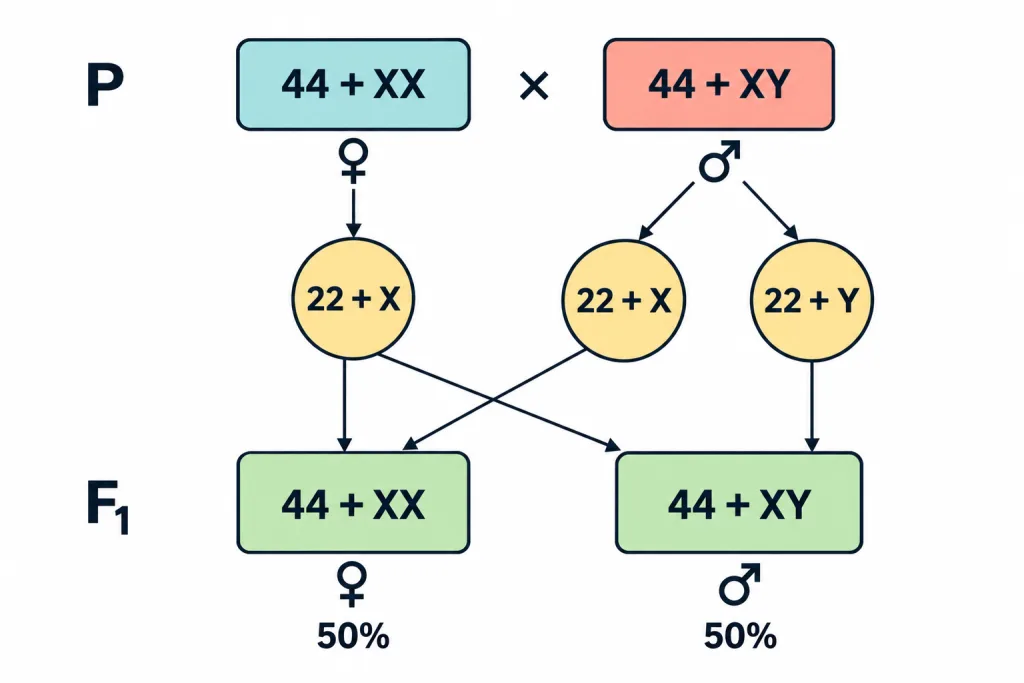
With the help of a flow chart, explain how the sex of a child is decided in human beings. A woman is blamed by her family for giving birth only to daughters. Is this fair? Give a reason.
Answer.
Model answer:
- Human cells have 22 pairs of ordinary chromosomes and one pair of sex chromosomes. A woman is 44 + XX and a man is 44 + XY.
- A woman makes only one kind of egg, 22 + X. A man makes two kinds of sperm in equal numbers, 22 + X and 22 + Y.
- If an X-carrying sperm fertilises the egg, the child is 44 + XX, a girl. If a Y-carrying sperm fertilises it, the child is 44 + XY, a boy. So each child has a 50% chance of being either (see the flow chart; P = parents, F1 = children).
Blaming the mother is not fair. She always gives an X chromosome, so she cannot decide the sex. The sex depends on which kind of sperm from the father reaches the egg first, and that is a matter of chance.
Marking scheme:
- A woman (44 + XX) makes only one kind of egg, 22 + X; a man (44 + XY) makes two kinds of sperm, 22 + X and 22 + Y, in equal numbers — 1 mark
- Flow chart: egg + X sperm gives 44 + XX, a girl; egg + Y sperm gives 44 + XY, a boy; each has a 50% chance — 1 mark
- Not fair: the mother always gives an X; which sperm fertilises the egg is a matter of chance, and the sperm comes from the father — 1 mark
Long Answer and Case-Based Questions
Question 11 (4 marks)
The dwarf varieties of wheat and rice that helped India grow far more grain in the 1960s and 1970s carry a changed form of a gene linked to a plant growth hormone. Such plants make less of the hormone, or respond less to it, so their stems stay short and sturdy. Short plants do not fall over under the weight of a heavy crop of grain. In one such rice variety, dwarfness is a recessive trait. At a rice research station in Cuttack, a scientist crosses a pure-breeding tall rice plant (TT) with a pure-breeding dwarf plant (tt), and then raises the F1 and F2 generations.
(a) What is a gene? (1 mark)
Answer.
- A gene is a section of DNA on a chromosome that carries the information for making one protein — 1 mark
(b) How can a change in one gene make a rice plant short? (1 mark)
Answer.
- The gene makes an enzyme needed for the growth hormone; the changed gene makes a less efficient enzyme, so less hormone is made and the stem grows less — 1 mark
(c) What will the F1 plants look like? What fraction of the F2 plants will be dwarf, and about how many dwarf plants are expected among 1200 F2 plants? (2 marks)
Answer.
- F1: all tall (Tt), because T is dominant — 1 mark
- F2 (Tt × Tt): 1 TT : 2 Tt : 1 tt, so 1/4 are dwarf; dwarf plants — 1 mark
OR
(c) The scientist wants seeds that will give only dwarf plants. Should he collect seeds from a dwarf F2 plant or from a tall F2 plant, and let the plant self-pollinate? Explain. (2 marks)
Answer.
- From a dwarf F2 plant: it is tt, so on self-pollination all its offspring are tt and dwarf — 1 mark
- A tall F2 plant may be TT or Tt; TT gives only tall plants and Tt gives tall and dwarf plants, so its seeds are not reliable — 1 mark
Question 12 (4 marks)
Harpreet, a Class 10 student in Ludhiana, did a project on Mendel's work in her school garden. She crossed pure-breeding tall pea plants with terminal flowers (TTaa) with pure-breeding dwarf pea plants with axial flowers (ttAA). Here tall (T) is dominant over dwarf (t), and axial flowers (A) are dominant over terminal flowers (a). She then let the F1 plants self-pollinate and, with her teacher's help, raised 960 plants of the F2 generation.
(a) What will the F1 plants look like? Write their genotype. (1 mark)
Answer.
- Tall with axial flowers; genotype TtAa — 1 mark
(b) How many different kinds of gametes will an F1 plant form? Write them. (1 mark)
Answer.
- Four kinds, in equal numbers: TA, Ta, tA and ta — 1 mark
(c) How many of the 960 F2 plants are expected to show a combination of traits that neither of the original pure-breeding parents (TTaa and ttAA) had? Name these combinations and show your working. (2 marks)
Answer.
- The parents were tall-terminal and dwarf-axial, so the new combinations are tall with axial flowers and dwarf with terminal flowers — 1 mark
- Tall axial ; dwarf terminal ; total 600 plants — 1 mark
OR
(c) Harpreet found that among her F2 plants, tall : dwarf was close to 3 : 1, and axial : terminal was also close to 3 : 1. Show how these two ratios together give the 9 : 3 : 3 : 1 ratio, and state what this tells us. (2 marks)
Answer.
- Tall axial ; tall terminal and dwarf axial each; dwarf terminal — 1 mark
- Multiplying works only if height and flower position are inherited independently of each other; this is Mendel's law of independent inheritance — 1 mark
Question 13 (4 marks)
Sugarcane farmers in Maharashtra plant pieces of stem cut from a good crop, and each piece grows into a new plant. The plants in such a field are almost exactly alike. At a sugarcane breeding institute in Coimbatore, scientists instead cross two different varieties and raise seedlings from the seeds. These seedlings differ from one another in height, in the thickness of the cane and in its sweetness, and the best ones are picked for field trials.
(a) Why are plants grown from the stem pieces of one plant almost, but not exactly, alike? (1 mark)
Answer.
- They get copies of the DNA of just one parent, so they are alike; DNA copying is not perfect, so small differences creep in — 1 mark
(b) Why do the seedlings raised from a cross differ so much from one another? (1 mark)
Answer.
- DNA from two different parents combines, and each gamete carries a different mix of genes, so every seedling gets a new combination — 1 mark
(c) The scientists find one seedling with very sweet, thick canes. How can they get thousands of plants exactly like it? Why would sowing its seeds not do the job? (2 marks)
Answer.
- Grow them from stem pieces of this plant: it is asexual, so each new plant gets a copy of this plant's DNA — 1 mark
- Seeds come from sexual reproduction, which mixes its genes with those of another plant, so the seedlings would differ and many would lose the good traits — 1 mark
OR
(c) One of the chosen seedlings is given extra fertiliser, and its canes grow unusually thick. Will plants raised from the seeds of this plant have thick canes because of this? Explain. (2 marks)
Answer.
- No; the extra thickness came from the fertiliser, a change in the plant's surroundings, and it does not change the DNA of its germ cells — 1 mark
- Only traits controlled by genes in the DNA of the germ cells are passed on, so the offspring will be thick only if they inherit genes for thick canes — 1 mark
Question 14 (4 marks)
Mendel did his experiments on the garden pea. It is easy to grow, gives many seeds in one season and shows several pairs of clearly contrasting traits. Its flowers normally pollinate themselves, but Mendel could also cross two plants by hand. In one experiment he crossed pure-breeding plants that had green pods with pure-breeding plants that had yellow pods. All the F1 plants had green pods. When the F1 plants were allowed to self-pollinate, both green and yellow pods appeared in the F2 generation.
(a) Why was it useful to Mendel that pea flowers normally pollinate themselves? (1 mark)
Answer.
- Self-pollination keeps a pure-breeding line pure generation after generation, so he knew exactly what each parent carried (and could easily self the F1 plants) — 1 mark
(b) Using G for green and g for yellow, write the genotypes of the two parents and of the F1 plants. (1 mark)
Answer.
- Parents: GG (green pods) and gg (yellow pods); F1: Gg — 1 mark
(c) Explain why yellow pods disappeared in F1 but appeared again in F2. (2 marks)
Answer.
Model answer:
- The F1 plants got G from the green parent and g from the yellow parent, so they are Gg. One G is enough to make the pods green, so g is hidden, but it is still there and unchanged.
- Each F1 plant makes G and g gametes in equal numbers. In F2, when a g gamete meets another g gamete, the plant is gg and has yellow pods. This happens in about 1 plant out of 4 (1 GG : 2 Gg : 1 gg).
Marking scheme:
- F1 plants are Gg; one G is enough to give green pods, so g stays hidden but unchanged — 1 mark
- F1 plants form G and g gametes in equal numbers; when two g gametes fuse, gg plants with yellow pods appear, about 1 in 4 of the F2 — 1 mark
OR
(c) A student says, "The factor for yellow pods was destroyed in the F1 plants and made afresh in F2." Give two reasons why this cannot be right. (2 marks)
Answer.
- The F1 plants received g from the yellow-pod parent; G only hides its effect, it does not destroy it — 1 mark
- Yellow pods come back in a steady share, about 1 in 4 of the F2, just as expected when two g gametes of F1 plants meet; something made afresh would not appear in a fixed ratio — 1 mark