
How do Organisms Reproduce?
How do Organisms Reproduce? has carried 4 to 8 marks in the recent board papers: 4 each in the 2026-27 sample paper and both 2026 papers, and 8 in 2025, when it had the 5-mark question.
It usually gives one or two MCQs (flower parts, contraception, sexually transmitted diseases), often an Assertion-Reason, and a 2-mark question such as identifying fission or budding, drawing budding in Hydra, or the changes in the uterus after implantation. The 2025 long answer asked for the functions of the female reproductive organs and male contraception, or self- and cross-pollination with a flower diagram.
Where marks are usually lost:
- mixing up pollination and fertilisation;
- writing that fertilisation happens in the uterus (it happens in the oviduct);
- saying a vasectomy stops the testes from making sperm;
- drawing budding as a split into two equal halves, or leaving diagrams unlabelled.
Revise in 5 Minutes
Why reproduce, and variation
- DNA copying is never perfect, so small variations arise; they help a species survive drastic changes (e.g. heat-tolerant bacteria when water warms).
Asexual reproduction (one parent)
| Method | Example | What happens |
|---|---|---|
| Binary fission | Amoeba, Leishmania | Splits into two (Leishmania in a definite plane) |
| Multiple fission | Plasmodium | Many daughter cells at once |
| Fragmentation | Spirogyra | Breaks into pieces; each grows |
| Regeneration | Planaria, Hydra | Specialised cells rebuild the body from a piece |
| Budding | Hydra | Outgrowth by repeated division at one site; bud separates |
| Spore formation | Rhizopus | Sporangia release thick-walled spores |
| Vegetative propagation | Bryophyllum (leaf buds), potato, banana | New plant from root, stem or leaf |
Vegetative propagation: offspring like the parent, earlier flowers and fruits, possible for seedless plants.
Sexual reproduction
- Germ cells have half the chromosomes; fusion restores the number (human: 23 + 23 = 46). Sperm small and motile; egg large with food.
- Flower: stamen (anther, filament) = male; pistil (stigma, style, ovary with ovules) = female. Unisexual: papaya, watermelon. Bisexual: Hibiscus, mustard.
- Self-pollination: pollen reaches the stigma of the same flower or plant. Cross-pollination: pollen reaches a flower of another plant (by wind, water or animals).
- Pollination → pollen tube → fertilisation → zygote → embryo. Ovule → seed; ovary → fruit; petals, sepals, stamens fall.
- Seed: radicle → root, plumule → shoot, cotyledons store food.
Human beings
- Puberty (both): hair in armpits and genital area, oily skin. Boys: beard, voice cracks. Girls: breasts, menstruation.
- Male: testis (sperm, testosterone; scrotum, lower temperature) → vas deferens → urethra; prostate and seminal vesicles add fluid.
- Female: ovary (one egg a month; oestrogen) → oviduct (fertilisation) → uterus (implantation) → cervix → vagina. No fertilisation → menstruation (2-8 days).
- After implantation: thicker, blood-rich uterine lining; placenta forms (villi pass glucose and oxygen to the embryo, wastes back). Birth after about nine months.
- Contraception: condom (barrier, also cuts STD risk); pills (hormones); copper-T in uterus; surgery: vas deferens or oviduct blocked. STDs: bacterial (gonorrhoea, syphilis), viral (warts, HIV-AIDS). Prenatal sex determination is banned.
Diagrams to know: Amoeba, Hydra budding, Rhizopus, flower section, pollen tube, female system.
Traps
- Pollination is not fertilisation.
- Vasectomy blocks the vas deferens; sperm and testosterone are still made.
- Bryophyllum leaf buds = vegetative propagation, not budding.
How to use this page: try each question on paper first, then read the answer. The marks against each step show what an examiner looks for. The 1-mark MCQs and Assertion-Reason questions are in the quiz at the end, together with questions that test how well you understand the chapter; every quiz answer comes with its explanation.
Short Answer Questions (2 and 3 Marks)
Question 1 (3 marks)
Answer the following about fission in single-celled organisms.
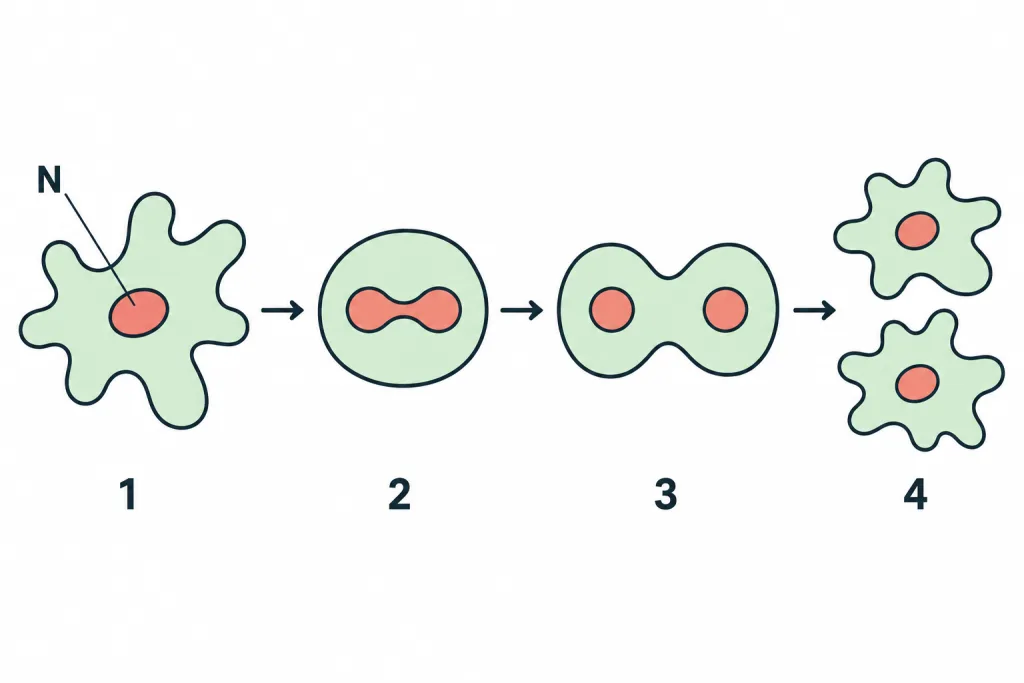
(a) Draw diagrams to show the stages of binary fission in Amoeba. (2 marks)
Answer.
Model answer:
The diagram is shown below. Stage 1: the parent Amoeba with its nucleus (N). Stage 2: the nucleus divides into two. Stage 3: the cytoplasm pinches in the middle, with one nucleus on each side. Stage 4: two daughter Amoebae are formed.
Marking scheme:
- Diagrams of the stages in the correct order: parent cell, division of the nucleus, division of the cytoplasm, two daughter cells — 1.5 marks
- Nucleus labelled and the stages shown in sequence (with arrows) — 0.5 marks
(b) How is multiple fission different from binary fission? Name an organism that shows it. (1 mark)
Answer.
- In multiple fission the parent cell divides into many daughter cells at the same time, not into two (0.5); Plasmodium (the malarial parasite) (0.5) — 1 mark
Question 2 (2 marks)
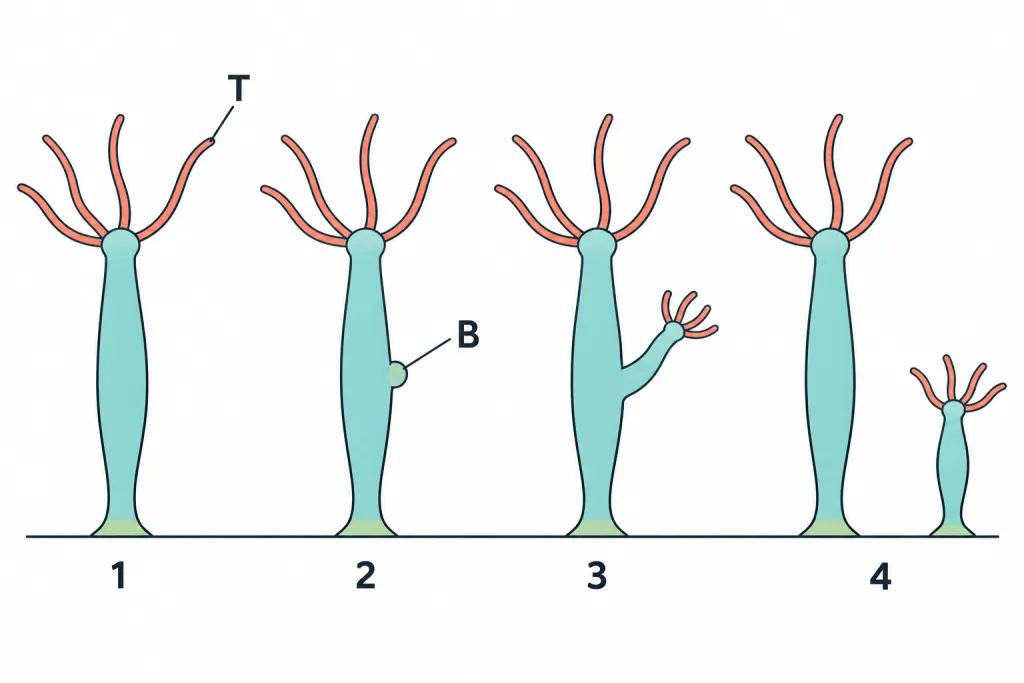
Draw labelled diagrams to show how a new Hydra develops from its parent by budding. Where on the parent does the bud form, and how?
Answer.
Model answer:
The diagrams are shown below. Key: T tentacles, B bud; 1 to 4 are the stages.
In Hydra, cells at one particular place on the body keep dividing again and again. This makes a small outgrowth, the bud (stage 2). The bud grows and develops its own mouth and tentacles (stage 3). When it is fully grown, it separates from the parent and lives as a new Hydra (stage 4).
Marking scheme:
- Diagrams of at least three stages: parent with a small bud, bud with tentacles, bud separated as a new Hydra — 1 mark
- Bud and tentacles labelled — 0.5 marks
- The bud forms as an outgrowth at one specific site on the body, due to repeated cell division there (regenerative cells) — 0.5 marks
Question 3 (2 marks)
Study the figure, which shows new organisms being formed in two different ways, P and Q.
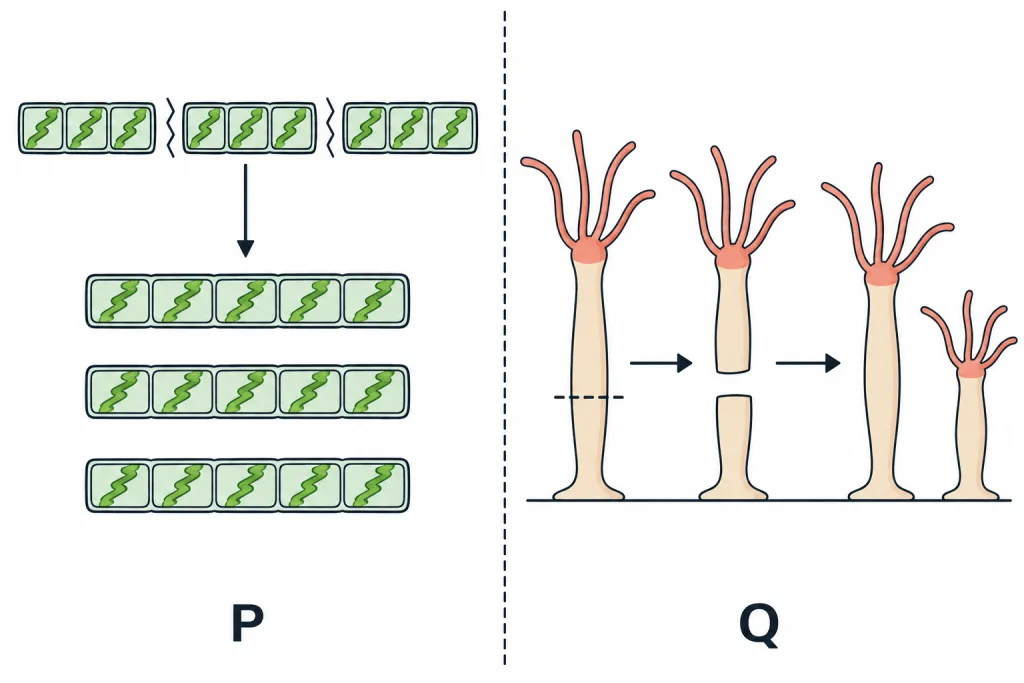
(i) Name the process shown in P and in Q. (1 mark)
Answer.
- P: fragmentation (in Spirogyra) (0.5); Q: regeneration (in Hydra) (0.5) — 1 mark
(ii) Which of the two is the organism's normal way of reproducing? Why is the other not usually counted as reproduction? (1 mark)
Answer.
- P: Spirogyra normally breaks up into pieces when mature (0.5); organisms do not depend on being cut up to reproduce, and Hydra normally reproduces by budding (0.5) — 1 mark
Question 4 (3 marks)
A chapati left in a closed, damp tiffin box for four days got covered with white threads and tiny black dots. The mould was Rhizopus.
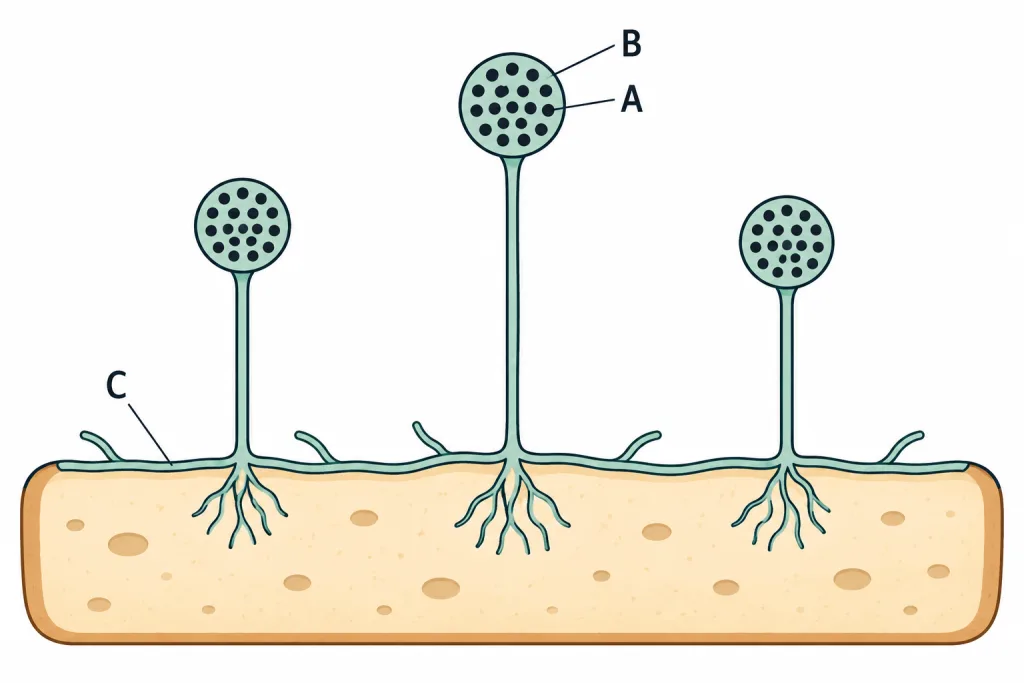
(a) Draw a labelled diagram to show spore formation in Rhizopus. Label the hyphae, a sporangium and the spores. (2 marks)
Answer.
Model answer:
The diagram is shown below. Key: A spores, B sporangium, C hypha.
Marking scheme:
- Correct diagram: thread-like hyphae on the food, with upright stalks carrying round sporangia — 1 mark
- Hyphae, sporangium and spores labelled — 1 mark
(b) Spores of this mould float in the air all the time. Why did the mould grow on the damp chapati but not on the dry roasted chana kept in the next box? (1 mark)
Answer.
- The spores have thick protective walls and stay inactive until they land on a moist surface with food; only then do they begin to grow — 1 mark
Question 5 (2 marks)
Bacteria and Amoeba reproduce simply by dividing into two. Why can a complex multicellular animal, such as a dog, not reproduce by simply dividing cell by cell?
Answer.
- Its body is not a random collection of cells: specialised cells form tissues, and tissues form organs placed at definite positions, so cell-by-cell division would be impractical — 1 mark
- So such organisms use more complex methods, in which reproduction is the job of a specific cell type (germ cells) made in reproductive organs — 1 mark
Question 6 (3 marks)
A fruit grower near Lucknow has one mango tree whose fruits are very sweet. He wants many more trees that give exactly the same fruit, and he wants them to start bearing fruit soon. Should he raise them from seeds or by vegetative propagation? Give three advantages of the method you suggest.
Answer.
Model answer:
He should use vegetative propagation, for example layering or grafting, in which a new plant is raised from a part of the parent plant.
- Same fruit: the new plants are genetically similar to the parent, so they have all its characters, including the sweet fruit. Seeds are formed by sexual reproduction and may give trees with different fruit.
- Early fruit: plants raised by vegetative propagation bear flowers and fruits earlier than plants grown from seeds.
- Many plants, quickly: a large number of plants can be raised from one good tree quickly and cheaply.
Marking scheme:
- Vegetative propagation (for example by layering or grafting); the new plants are genetically similar to the parent, so they have all its characters, including the sweet fruit — 1 mark
- Plants raised this way bear flowers and fruits earlier than plants grown from seeds — 1 mark
- Many plants can be raised from one parent plant quickly and cheaply — 1 mark
Question 7 (3 marks)
Answer the following about DNA copying during reproduction.
(a) Why must a cell copy its DNA before it divides?
(b) Why are the two copies not always exactly the same?
(c) How can the small differences that arise in this way help a species to survive? Give an example.
Answer.
Model answer:
(a) DNA carries the information for making proteins, and so for the design of the body. Each new cell needs its own copy of the DNA, together with its own cell apparatus, to work. So the DNA is copied first and then the two copies separate into the two new cells.
(b) The copying is done by biochemical reactions, and no such reaction is perfectly reliable. So small variations creep in, and the copies are similar but not always identical.
(c) If the surroundings change a lot, most individuals may die, but a few that have a suitable variation may survive and continue the species. For example, if the water in which some bacteria live becomes much warmer, most of them die, but the few variants that can bear heat survive and multiply.
Marking scheme:
- (a) DNA carries the information for making proteins and so for the body design; each new cell needs its own copy of DNA (along with its own cell apparatus) to work — 1 mark
- (b) Copying is done by biochemical reactions, which are never perfectly reliable, so small variations creep in — 1 mark
- (c) If the surroundings change drastically, a few individuals with a suitable variation may survive and continue the species; e.g. if the water of a lake gets much warmer, bacteria that can bear heat survive — 1 mark
Question 8 (3 marks)
Answer the following about the events that follow pollination.
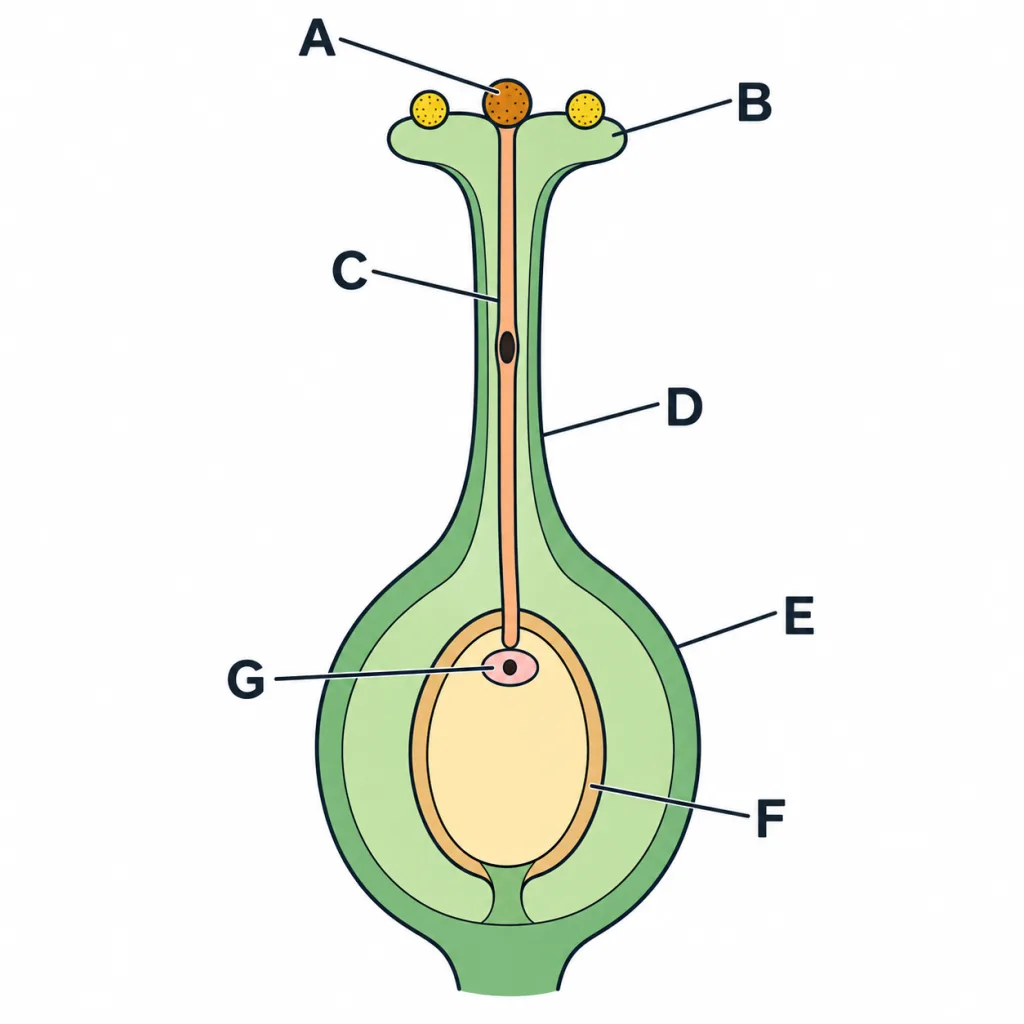
(a) Draw a labelled diagram to show the germination of a pollen grain on the stigma. Label the pollen grain, pollen tube, style, ovary and female germ cell. (2 marks)
Answer.
Model answer:
The diagram is shown below. Key: A pollen grain, B stigma, C pollen tube, D style, E ovary, F ovule, G female germ cell.
Marking scheme:
- Correct diagram: pollen grain on the stigma with a tube growing through the style into the ovary to reach an ovule — 1 mark
- Five labels correct: pollen grain, pollen tube, style, ovary, female germ cell — 1 mark
(b) What happens when the pollen tube reaches the ovule? (1 mark)
Answer.
- The male germ cell carried by the tube fuses with the female germ cell in the ovule (fertilisation), forming the zygote — 1 mark
Question 9 (2 marks)
What is meant by self-pollination and cross-pollination? Why can a papaya flower not be self-pollinated?
Answer.
- Self-pollination: pollen reaches the stigma of the same flower (or another flower of the same plant); cross-pollination: pollen is carried from one flower to a flower of another plant (0.5 + 0.5) — 1 mark
- Papaya flowers are unisexual, and male and female flowers are usually on separate plants; so a female flower's stigma must get pollen from another plant — 1 mark
Question 10 (2 marks)
Changes of puberty start in the early teenage years, yet doctors advise that a girl of this age should not become pregnant. Give two reasons.
Answer.
- Sexual maturation is gradual and happens while general body growth is still going on, so the body is not yet ready to bear a child — 1 mark
- The mind is also not ready for having and bringing up a child; pregnancy makes heavy demands on the mother's body and health — 1 mark
Question 11 (3 marks)
Give three differences between asexual reproduction and sexual reproduction.
Answer.
Model answer:
| Point | Asexual reproduction | Sexual reproduction |
|---|---|---|
| Parents | Only one parent | Usually two parents, male and female |
| Germ cells | No germ cells are formed and nothing fuses | Male and female germ cells fuse (fertilisation) |
| Variation | Offspring are very similar to the parent | DNA from two parents mixes, so offspring show more variation |
Marking scheme:
- Number of parents: asexual needs only one parent; sexual usually needs two (male and female) — 1 mark
- Germ cells: no germ cells or fusion in asexual; in sexual, male and female germ cells fuse (fertilisation) — 1 mark
- Variation: asexual gives offspring very similar to the parent; sexual mixes DNA from two parents, so offspring show more variation — 1 mark
Question 12 (2 marks)
Trace the path of sperm from the organ where they are made to the outside of a man's body. What is added to the sperm on the way, and why?
Answer.
- Testis vas deferens urethra (the common passage for sperm and urine) outside — 1 mark
- The prostate gland and seminal vesicles add their secretions, which make the sperm float in a fluid; this makes their transport easier and also gives them nutrition — 1 mark
Long Answer and Case-Based Questions
Question 13 (5 marks)
Attempt either option (A) or (B).
(A) The figure shows the longitudinal section of a flower.
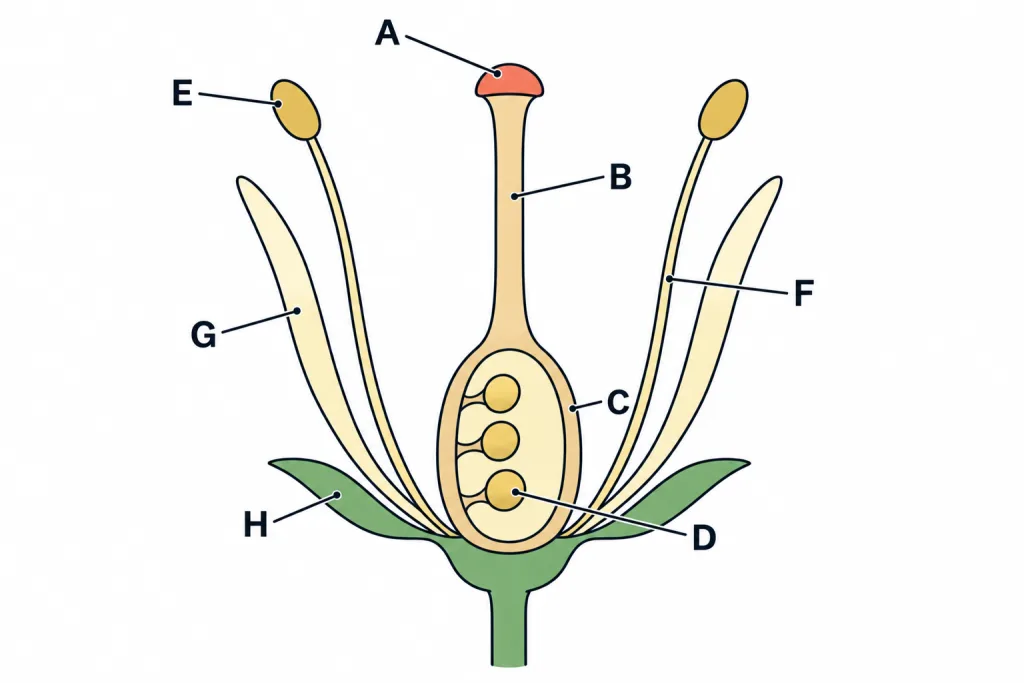
(i) Name the parts marked A, C, D and E. (2 marks)
Answer.
Model answer:
Key: A stigma, B style, C ovary, D ovule, E anther, F filament, G petal, H sepal.
Marking scheme:
- A stigma; C ovary — 1 mark
- D ovule; E anther — 1 mark
(ii) Is this flower unisexual or bisexual? Give a reason, and name one plant that has such flowers. (1 mark)
Answer.
- Bisexual, because it has both stamens (E, F) and a pistil (A, B, C) (0.5); Hibiscus or mustard (0.5) — 1 mark
(iii) Trace the journey of the male germ cell from part E to the female germ cell in part D, naming each part on the way (use the letters). Where does fertilisation take place? (2 marks)
Answer.
- Pollen from the anther (E) reaches the stigma (A) by pollination; a pollen tube grows from the pollen grain down through the style (B) into the ovary (C) — 1 mark
- The tube reaches the ovule (D) and the male germ cell fuses with the female germ cell there; fertilisation takes place inside the ovule — 1 mark
OR
(B) The figure shows the human female reproductive system.
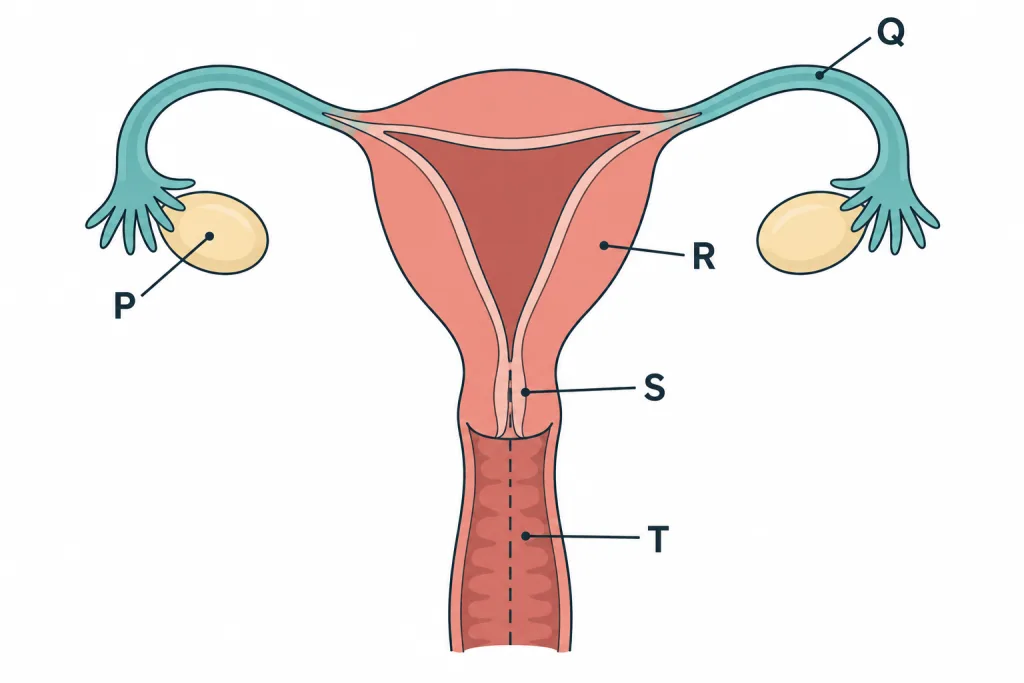
(i) Name the parts marked P, Q, R and T. (2 marks)
Answer.
Model answer:
Key: P ovary, Q oviduct (fallopian tube), R uterus, S cervix, T vagina.
Marking scheme:
- P ovary; Q oviduct (fallopian tube) — 1 mark
- R uterus; T vagina — 1 mark
(ii) State one function each of P and R. (2 marks)
Answer.
- P (ovary): produces eggs, one egg being released every month by one of the ovaries; it also makes hormones such as oestrogen — 1 mark
- R (uterus): the embryo gets implanted in its thick lining and grows there, getting nutrition from the mother through the placenta — 1 mark
(iii) In a tubectomy, which of the parts shown is blocked? How does this prevent pregnancy? (1 mark)
Answer.
- Q, the oviduct (0.5); the egg cannot travel down it and sperm cannot reach the egg, so fertilisation cannot take place (0.5) — 1 mark
Question 14 (4 marks)
Students of a school in Patna soaked some gram (chana) seeds in water overnight. Next morning they split one seed open and found two thick halves, with a tiny structure attached between them at one end. They kept the other soaked seeds on wet cotton. After two days a small root came out of each seed, and by the fourth day a small shoot with tiny leaves had appeared. As the seedlings grew, the two thick halves became smaller and shrivelled.
(a) Name the parts of the tiny structure that grow into the root and into the shoot. (1 mark)
Answer.
- Radicle grows into the root (0.5); plumule grows into the shoot (0.5) — 1 mark
(b) Why did the two thick halves become smaller as the seedlings grew? (1 mark)
Answer.
- They are the cotyledons, which store food; the growing seedling used up this food until it could make its own — 1 mark
(c) Each gram seed was formed from an ovule in a flower of the gram plant. Starting from fertilisation, explain how the ovule became this seed. (2 marks)
Answer.
- The male germ cell fused with the female germ cell in the ovule, forming the zygote; the zygote divided several times to form the embryo inside the ovule — 1 mark
- The ovule developed a tough coat and became the seed, containing the embryo and the food stored in the cotyledons; the ovary grew into the fruit (the pod) — 1 mark
OR
(c) Is a seed a product of sexual or asexual reproduction? Will the plants raised from these seeds all be exactly like the parent plant? Explain. (2 marks)
Answer.
- Sexual: a seed forms only after the fusion of male and female germ cells (fertilisation) — 1 mark
- No: the embryo gets DNA from two germ cells, which may even come from two different plants, so new combinations arise and the plants show variation — 1 mark
Question 15 (4 marks)
A doctor at a health centre in Bhopal explained to a group of expecting mothers how a baby develops. She said that after fertilisation the zygote keeps dividing and, in about a week, reaches the uterus as a tiny ball of cells, the embryo. The embryo then sinks into the thick wall of the uterus. The baby is usually born about nine months after fertilisation.
(a) In which part of the female reproductive system does fertilisation take place? What is the sinking of the embryo into the wall of the uterus called? (1 mark)
Answer.
- In the oviduct (fallopian tube) (0.5); implantation (0.5) — 1 mark
(b) State two changes that take place in the uterus after implantation. (1 mark)
Answer.
- The lining of the uterus becomes thick and is richly supplied with blood (0.5); the placenta develops, connecting the embryo to the uterus wall (0.5) — 1 mark
(c) Menstruation does not take place during pregnancy. Explain why. (2 marks)
Answer.
- Menstruation is the breaking down and shedding of the thick uterine lining, which happens only when the egg is not fertilised — 1 mark
- In pregnancy this lining holds the embryo and, through the placenta, supplies its food and oxygen, so it is kept and not shed — 1 mark
OR
(c) How is the baby born at the end of about nine months? Until then, how does the embryo get its food, although it cannot eat? (2 marks)
Answer.
- The baby is born as a result of rhythmic contractions of the muscles of the uterus — 1 mark
- Food (glucose) and oxygen pass from the mother's blood to the embryo through the placenta, whose villi give a large surface — 1 mark
Question 16 (4 marks)
At a family-planning session in a community hall in Jaipur, a doctor explained different ways of preventing pregnancy. Some methods change the hormonal balance of the woman's body, some are small devices placed inside the body, and some block a tube by a minor surgery. She also spoke about why the law does not allow tests to find out the sex of an unborn child.
(a) How do oral pills prevent pregnancy? Why can they cause side effects? (1 mark)
Answer.
- They change the hormonal balance of the body so that eggs are not released (0.5); because they change the hormonal balance, they can cause side effects (0.5) — 1 mark
(b) Where is the copper-T placed, and why can it cause side effects? (1 mark)
Answer.
- In the uterus (0.5); it can irritate the uterus (0.5) — 1 mark
(c) Why was a law needed to ban prenatal sex determination, and why must the ratio of females to males be kept balanced? (2 marks)
Answer.
- Some people misused tests to find the sex of the unborn child and got female foetuses aborted illegally (female foeticide); the law stops this misuse — 1 mark
- This lowers the number of girls compared with boys; a healthy society needs a balanced female-male sex ratio — 1 mark
OR
(c) In male sterilisation (vasectomy), which tube is blocked? Why can fertilisation not take place after it? (2 marks)
Answer.
- The vas deferens is blocked (or cut and tied) — 1 mark
- Sperm made in the testes cannot pass out of the body, so they never reach the egg — 1 mark