
Our Environment
Our Environment carries 5 marks in the board paper (4 in February 2026). It is the only chapter of its unit left in the syllabus.
The marks usually come as one or two MCQs and an Assertion-Reason item on food chains, the 10 per cent law, biological magnification or ozone, plus a 2- or 3-mark question on energy flow, food chains or waste. The board has not set a 5-mark or case-based question from this chapter so far, so the case-based questions here practise the same ideas in a longer format.
Where marks are usually lost:
- applying the 10 per cent law at the wrong step, or applying it to sunlight instead of the 1% the plants trap;
- drawing food-chain arrows from the eater to the eaten;
- saying energy is recycled, like nutrients;
- placing the highest pesticide level in the producers instead of the top consumers.
Revise in 5 Minutes
Ecosystem
- Biotic (living) components: producers, consumers, decomposers. Abiotic (non-living): sunlight, temperature, water, air, soil minerals.
- Natural: forest, pond, lake, grassland. Artificial (made and kept by people): garden, crop field, aquarium.
- Decomposers (bacteria, fungi) break down dead remains and wastes and return nutrients to the soil.
Food chains and energy
| Level | Who | Example |
|---|---|---|
| 1 | producers | grass |
| 2 | herbivores, primary consumers | grasshopper |
| 3 | small carnivores, secondary consumers | frog |
| 4 | large carnivores, tertiary consumers | snake |
- Arrows point from the eaten to the eater. A food web is many linked food chains.
- Plants trap about 1% of the sunlight falling on their leaves.
- 10 per cent law: about 10% of the energy at one level reaches the next; the rest is used in life processes and lost as heat. Producers 10,000 J → 1000 J → 100 J → 10 J.
- Energy flow is unidirectional; nutrients are recycled. So food chains have only 3 or 4 levels.
Biological magnification: non-biodegradable chemicals such as pesticides are not broken down or passed out, so their concentration rises at each level. The top consumers, often human beings, have the most.
Ozone
- Formed high up: (UV), then .
- Absorbs UV radiation high up; a deadly poison at ground level.
- Thinned from the 1980s by CFCs (refrigerants, fire extinguishers). UV can cause skin cancer. UNEP, 1987: freeze CFC production at 1986 levels.
Waste
- Biodegradable: broken down by decomposers (peels, paper, cotton). Non-biodegradable: not broken down (polythene, glass, DDT) because decomposers have no enzymes for them.
- Separate wet and dry waste; compost the biodegradable part; reuse and recycle the rest. Kulhads on a large scale would use up fertile top-soil.
Traps
- 10% goes to the next level; 90% does not.
- Pesticide is highest at the top, not in plants.
- Energy is not recycled.
How to use this page: try each question on paper first, then read the answer. The marks against each step show what an examiner looks for. The 1-mark MCQs and Assertion-Reason questions are in the quiz at the end, together with questions that test how well you understand the chapter; every quiz answer comes with its explanation.
Short Answer Questions (2 and 3 Marks)
Question 1 (2 marks)
Bacteria and fungi can break down vegetable peels but not a polythene bag. Why? What happens to substances like polythene when they are dumped?
Answer.
Model answer:
- Bacteria and fungi break things down using enzymes, and each enzyme works only on certain substances. They have enzymes for natural materials like vegetable peels, so the peels are biodegradable. They have no enzymes that can act on polythene, so polythene is non-biodegradable.
- When polythene is dumped, it stays in the environment for a very long time. It can block drains, make the soil poorer and harm animals such as cows that swallow it with food waste.
Marking scheme:
- Decomposers break substances down with enzymes, and each enzyme acts only on particular substances; they have enzymes for natural materials like peels but none for polythene, so polythene is non-biodegradable — 1 mark
- Such substances stay in the environment for a very long time; they can block drains, spoil the soil and harm animals that swallow them — 1 mark
Question 2 (2 marks)
What is biological magnification? Why is its level highest in organisms at the top trophic level of a food chain?
Answer.
Model answer:
- Biological magnification is the increase in the concentration of harmful chemicals, such as pesticides, at each higher trophic level of a food chain.
- These chemicals are non-biodegradable. They are neither digested nor passed out, so they stay in the body. Each animal eats many organisms from the level below it and collects all the chemical in them. So the amount keeps building up, and the organisms at the top of the chain have the most.
Marking scheme:
- Biological magnification: the increase in the concentration of harmful non-biodegradable chemicals, such as pesticides, at each higher trophic level of a food chain — 1 mark
- These chemicals are not broken down or passed out, so they collect in the body; each organism eats many organisms of the level below, so the top level collects the most — 1 mark
Question 3 (2 marks)
Kabir claims that a food chain in a very large forest could have eight trophic levels. Do you agree? Give a reason using the 10 per cent law.
Answer.
Model answer:
No, I do not agree.
- Only about 10% of the energy at one trophic level reaches the next level. The rest is used up by the organisms in their life processes and lost as heat.
- From the first level to the eighth there are 7 steps, so only of the producers' energy would reach the eighth level. That is far too little to keep any population alive.
Marking scheme:
- No; only about 10% of the energy at one trophic level passes on to the next, the rest being used up in life processes — 1 mark
- At the eighth level only of the producers' energy (0.00001%) would be left, far too little to support any population; so food chains usually have only 3 or 4 levels — 1 mark
Question 4 (2 marks)
Every year, trees in a forest shed a huge number of leaves, yet the forest floor does not get buried under metres of dead leaves. Why? What would happen to the plants of the forest if this process stopped?
Answer.
Model answer:
- Decomposers, mainly bacteria and fungi, break down the dead leaves into simple substances. These mix with the soil, so the leaves do not pile up.
- If decomposers stopped working, dead leaves and bodies would keep piling up. The nutrients in them would stay locked away and not go back into the soil. Soon the soil would run short of nutrients, and the plants of the forest would not be able to grow well.
Marking scheme:
- Decomposers such as bacteria and fungi break down the dead leaves into simple substances that mix with the soil — 1 mark
- Without decomposers, dead matter would pile up and the nutrients locked in it would not return to the soil; the soil would run short of nutrients and the plants would not grow well — 1 mark
Question 5 (2 marks)
What is a trophic level? Write a food chain with four trophic levels that could be found in a pond, and mark the trophic level of each organism.
Answer.
Model answer:
- A trophic level is each step or level of a food chain at which energy is transferred. Producers form the first trophic level, herbivores the second, and so on.
- A pond food chain:
algae → tadpoles → water beetles → pond heron
Algae are at the 1st level (producers), tadpoles at the 2nd (primary consumers), water beetles at the 3rd (secondary consumers) and the pond heron at the 4th (tertiary consumer).
Marking scheme:
- A trophic level is each step of a food chain at which energy is transferred, such as producers or herbivores — 1 mark
- Example: algae (1st, producer) → tadpoles (2nd, primary consumer) → water beetles (3rd, secondary consumer) → pond heron (4th, tertiary consumer) — 1 mark
Question 6 (2 marks)
Distinguish between a food chain and a food web. Why does an animal that is part of a food web usually survive when one of the organisms it eats becomes scarce?
Answer.
Model answer:
- A food chain is a single series of organisms in which each one eats the one before it, like grass → deer → tiger. A food web is many food chains linked together, because most organisms eat more than one kind of food and are eaten by more than one kind of animal.
- In a food web, an animal has more than one source of food. If one kind becomes scarce, it can eat more of the others, so it usually survives. In a single food chain it would have nothing else to eat.
Marking scheme:
- A food chain is a single series of organisms, each eating the one before it; a food web is many food chains linked together, as most organisms eat and are eaten by more than one kind — 1 mark
- In a food web the animal has other kinds of food, so it can eat more of those when one kind becomes scarce — 1 mark
Question 7 (3 marks)
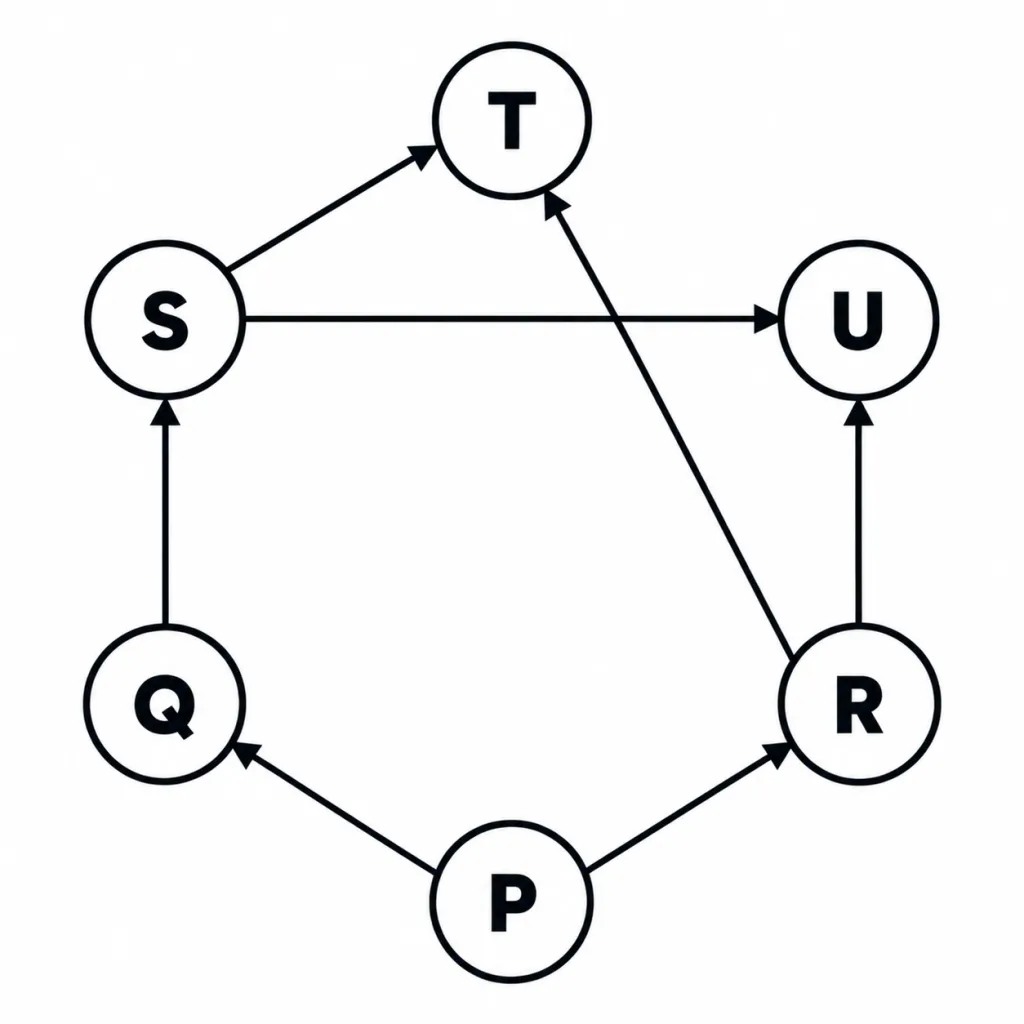
The diagram shows who eats whom among six kinds of living things in the Thar desert near Jaisalmer: P - grasses and shrubs, Q - beetles, R - gerbils (desert rats), S - lizards, T - snakes, U - desert foxes. An arrow is drawn from each living thing to the animal that feeds on it.
(a) How many food chains are there in this web? Write one that has four trophic levels, using the names of the organisms.
(b) Which animals occupy more than one trophic level? Name the levels for each.
(c) A long drought kills most of the beetles. Which animal will suffer the most? Why will the snakes and the foxes suffer less?
Answer.
Model answer:
(a) There are four food chains: P → Q → S → T, P → Q → S → U, P → R → T and P → R → U. A chain with four levels is grasses → beetles → lizards → snakes.
(b) Snakes (T) are at the 3rd level when they eat gerbils and at the 4th level when they eat lizards. Foxes (U) are the same: 3rd level through gerbils, 4th level through lizards.
(c) The lizards (S) will suffer the most, because beetles are the only food they have in this web. Snakes and foxes eat gerbils as well as lizards, so they can turn to gerbils when lizards become few.
Marking scheme:
- (a) Four food chains: P→Q→S→T, P→Q→S→U, P→R→T, P→R→U; for example grasses → beetles → lizards → snakes — 1 mark
- (b) Snakes (T): 3rd and 4th trophic levels; foxes (U): 3rd and 4th trophic levels — 1 mark
- (c) The lizards (S), since beetles are their only food; snakes and foxes also eat gerbils, so they can eat more gerbils — 1 mark
Question 8 (3 marks)
Tanvi noted the following at a village pond: water, fish, sunlight, algae, bacteria in the mud, minerals in the soil, frogs and the temperature of the water.
(a) Sort these into biotic and abiotic components.
(b) Name one producer and one decomposer from the list.
(c) How does energy enter this pond ecosystem, and how are the nutrients in it used again and again?
Answer.
Model answer:
(a) Biotic (living): fish, algae, bacteria and frogs. Abiotic (non-living): water, sunlight, minerals in the soil and temperature.
(b) Producer: algae. Decomposer: bacteria in the mud.
(c) Energy enters through the algae, which trap sunlight and make food. This food energy then passes to the animals that eat algae, and on to fish and frogs. When plants and animals die, the bacteria break down their remains into simple substances. These nutrients go back into the water and mud, and the algae use them again.
Marking scheme:
- (a) Biotic: fish, algae, bacteria, frogs; abiotic: water, sunlight, soil minerals, temperature — 1 mark
- (b) Producer: algae; decomposer: bacteria in the mud — 1 mark
- (c) Algae trap sunlight and store it as food, which passes to fish and frogs; bacteria break down dead matter and return nutrients to the water and mud for the algae to use again — 1 mark
Question 9 (3 marks)
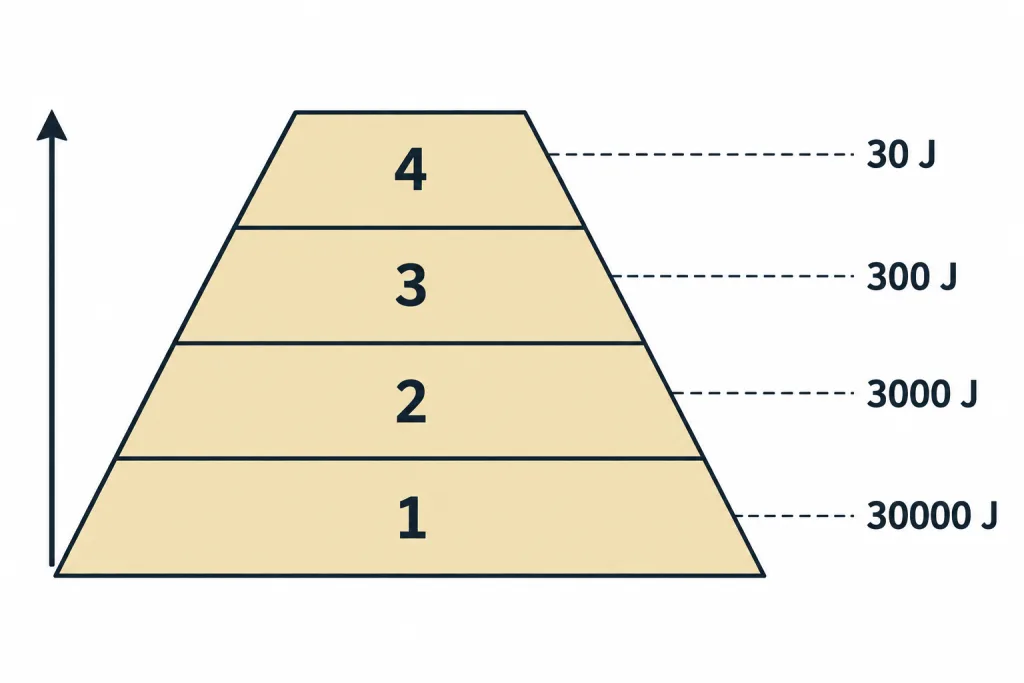
The producers in a food chain trap 30,000 J of solar energy. Draw a labelled diagram to show how this energy flows through four trophic levels, and write the energy available at each level. Why does the energy become less at each higher level?
Answer.
Model answer:
The diagram is given below. In it, 1 = producers (green plants), 2 = herbivores (primary consumers), 3 = small carnivores (secondary consumers) and 4 = large carnivores (tertiary consumers). The arrow shows the direction in which energy flows.
By the 10 per cent law:
- Level 1: 30,000 J
- Level 2: 10% of 30,000 J = 3000 J
- Level 3: 10% of 3000 J = 300 J
- Level 4: 10% of 300 J = 30 J
Why energy becomes less: at each level, the organisms use most of the energy in their food for their own life processes, like moving and breathing, and it is lost as heat. Some parts of the food are also not eaten or not digested. So only about 10% is stored in their bodies and passed on.
Marking scheme:
- Diagram with four levels in order, producers at the base and the direction of flow shown — 1 mark
- Energy by the 10 per cent law: 30,000 J, 3000 J, 300 J and 30 J at levels 1 to 4 — 1 mark
- Only about 10% passes on; the rest is used by the organisms for their own life processes and lost as heat, and some parts are not eaten — 1 mark
Question 10 (3 marks)
Meenakshi dug two pits in her school garden: pit P in moist soil and pit Q in dry sand. In each pit she buried a banana skin, a handful of fallen leaves, a broken glass bangle and a plastic straw. She dug them out after a month.
(a) Which items would she find unchanged in both pits? What are such substances called?
(b) The banana skin in pit P had rotted much more than the one in pit Q. Give a reason.
(c) Suggest a better way than burying to deal with the items that did not change.
Answer.
Model answer:
(a) The glass bangle and the plastic straw would be unchanged in both pits. Such substances are called non-biodegradable.
(b) The banana skin is broken down by decomposers such as bacteria and fungi, and these need moisture to work. In the moist soil of pit P they were active, so the skin rotted fast. In the dry sand of pit Q they could hardly work.
(c) Broken glass should be kept apart and sent for recycling. Plastic straws are best avoided altogether; used ones should go for recycling with other plastic. Burying them only hides them in the soil for years.
Marking scheme:
- (a) The glass bangle and the plastic straw; they are non-biodegradable — 1 mark
- (b) Decomposers such as bacteria and fungi need moisture to work; they are active in moist soil, so the skin in P was broken down faster — 1 mark
- (c) Send the glass for recycling; avoid plastic straws, or send them for recycling with other plastic — 1 mark
Long Answer and Case-Based Questions
Question 11 (4 marks)
In the paddy fields of a village near Thanjavur, grasshoppers feed on the rice plants, frogs eat the grasshoppers, and snakes eat the frogs. One year, many frogs were caught from the fields and sold. By the next season the grasshoppers had increased so much that the farmers sprayed a pesticide on their crop again and again. Tests later found this pesticide in the snakes of the area at levels far higher than in the rice plants.
(a) Arrange the organisms in the passage as a food chain. Which trophic level do the frogs occupy? (1 mark)
Answer.
- Rice plants → grasshoppers → frogs → snakes; the frog is at the third trophic level (secondary consumer) — 1 mark
(b) Why did the grasshoppers increase after the frogs were caught? (1 mark)
Answer.
- Frogs were eating the grasshoppers; with fewer frogs, fewer grasshoppers were eaten, so their numbers rose — 1 mark
(c) Why was the pesticide found at far higher levels in the snakes than in the rice plants? What is this called? (2 marks)
Answer.
- The pesticide is non-biodegradable; it is not broken down or removed, so it builds up at each trophic level, and the snakes at the top collect the most — 1 mark
- This is called biological magnification — 1 mark
OR
(c) Suggest how the farmers could keep the grasshoppers in check while spraying much less pesticide. Explain how this would help both the rice crop and the snakes. (2 marks)
Answer.
- Stop catching the frogs (protect them), so that the frogs go on eating the grasshoppers — 1 mark
- Fewer grasshoppers means less damage to the rice; the snakes get more frogs to eat, and with less spraying they take in less pesticide — 1 mark
Question 12 (4 marks)
About forty years ago, scientists measuring the air high above Antarctica found that the ozone layer there had become much thinner. The damage was traced to chlorofluorocarbons (CFCs), gases that leaked out of old refrigerators and fire extinguishers and slowly drifted up into the sky. Meeting under the United Nations Environment Programme (UNEP), countries agreed in 1987 to stop increasing the production of CFCs. Refrigerators sold in India today carry a 'CFC-free' label.
(a) How is ozone formed in the upper atmosphere? Write the two steps. (1 mark)
Answer.
- UV radiation splits oxygen molecules into atoms: — 0.5 marks
- Each atom joins an oxygen molecule to form ozone: — 0.5 marks
(b) Ozone is useful high up in the atmosphere but harmful at ground level. Explain. (1 mark)
Answer.
- High up, it absorbs most of the Sun's harmful UV radiation and so shields life on the Earth — 0.5 marks
- At ground level it is a deadly poison if breathed in — 0.5 marks
(c) Explain how the agreement to limit the production of CFCs helps to protect human health. (2 marks)
Answer.
- Less CFC in the air means less ozone is broken down, so the ozone layer can go on absorbing most of the UV radiation — 1 mark
- Less UV radiation reaches the Earth, so there is less risk of diseases such as skin cancer in human beings — 1 mark
OR
(c) The ozone layer first thinned above Antarctica, where very few people live. Why should families in India also care about it? Name one thing a family can do to help. (2 marks)
Answer.
- The ozone layer shields the whole Earth; CFCs released anywhere reach it, and a thinner layer lets more UV radiation reach everyone, raising the risk of skin cancer — 1 mark
- Any one: buy CFC-free refrigerators and air conditioners; hand over old appliances for proper disposal instead of breaking them open — 1 mark
Question 13 (4 marks)
The canteen of a school in Indore used to serve snacks on plastic plates, which were thrown away after a single use. The school's eco-club persuaded the canteen to switch to plates made of dried sal leaves (pattal). The used leaf plates now go into a compost pit in the school garden, while the plastic wrappers of packed snacks are collected in a separate bin and sent for recycling.
(a) Why can the leaf plates go into the compost pit, while the plastic plates cannot? (1 mark)
Answer.
- Leaf plates are biodegradable and are broken down by decomposers; plastic is non-biodegradable and does not break down — 1 mark
(b) Give one harm caused by plastic plates if they are thrown into an open dump. (1 mark)
Answer.
- Any one: they stay for years and pile up; they block drains; animals that eat them are harmed; they make the soil poorer — 1 mark
(c) How does composting the leaf plates help the school garden? Why should the plastic wrappers be kept separate from the leaf plates? (2 marks)
Answer.
- Decomposers turn the leaf plates into compost, which returns nutrients to the soil and acts as manure for the garden plants — 1 mark
- Wrappers would not decompose and would spoil the compost; kept clean and separate, they can be recycled — 1 mark
OR
(c) Suggest two changes in the habits of students that would reduce the non-biodegradable waste produced in the school. Explain how each helps. (2 marks)
Answer.
- Any one change with how it helps, e.g. carrying a steel tiffin box and water bottle instead of buying snacks in plastic packets and bottled water, so fewer wrappers and bottles are thrown away — 1 mark
- A second change with how it helps, e.g. using cloth bags instead of polythene bags, or refusing plastic straws and spoons, so these items do not reach the dump — 1 mark
Question 14 (4 marks)
A field of bajra (pearl millet) near Jodhpur receives 50,00,000 kJ of sunlight during a season. The bajra plants trap about 1% of this energy and store it as food. Part of the grain is eaten by the farmer's family, and part is fed to goats whose meat the family also eats.
(a) How much energy do the bajra plants store as food in the season? (1 mark)
Answer.
- 1% of 50,00,000 kJ = 50,000 kJ — 1 mark
(b) At which trophic levels are the goats, and the family when it eats goat meat? (1 mark)
Answer.
- Goats: second trophic level (primary consumers); the family eating goat meat: third trophic level (secondary consumers) — 1 mark
(c) Grain holding 10,000 kJ of energy can either be eaten by the family directly, or be fed to goats whose meat the family then eats. In each case, about how much of this energy reaches the family as food? Which way can feed more people from the same field? (2 marks)
Answer.
- Directly: all 10,000 kJ of the grain reaches the family as food; through goats: only about 10%, 1000 kJ, is stored in the goats' bodies and reaches the family as meat (also accept 1000 kJ and 100 kJ if the 10 per cent law is applied once more to the family, with the tenfold difference shown) — 1 mark
- Eating the grain directly gives about 10 times more energy, so it can feed more people; each extra step in a food chain loses about 90% of the energy — 1 mark
OR
(c) There are far more deer than tigers in a forest. Explain this using the flow of energy through the food chain grass → deer → tiger. (2 marks)
Answer.
- Only about 10% of the energy in the deer reaches the tigers; the rest is used up in the deer's life processes and lost as heat — 1 mark
- So much less energy is available at the tigers' level, and it can support only a small number of tigers compared with the deer — 1 mark