
Life Processes
Life Processes is the biggest chapter of the Biology section. It carried 7 to 11 marks in the 2026-27 sample paper and in the board papers of 2025 and 2026. Expect two to four MCQs, often an Assertion-Reason, and a 2- or 3-mark question on nutrition, respiration, transport or excretion. In two of those papers it also had the 5-mark long answer, with a diagram such as the heart, stomata or the nephron.
Marks are most often lost on diagrams drawn without the labels or arrows that were asked for; on mixing up where each step of respiration happens (cytoplasm or mitochondria); on writing "arteries carry oxygenated blood" instead of "arteries carry blood away from the heart"; and on muddling filtration with selective reabsorption in the kidney.
Revise in 5 Minutes
Nutrition
- Heterotrophs: saprotrophs (bread mould digests outside, then absorbs), parasites (Cuscuta, tapeworm), Amoeba (food vacuole), Paramecium (cilia).
- Photosynthesis: (1) chlorophyll absorbs light; (2) light → chemical energy, water split; (3) carbon dioxide reduced to carbohydrate. Extra stored as starch (we store glycogen).
- (sunlight, chlorophyll)
- Guard cells swell → stoma opens; shrink → closes. Desert plants open stomata at night, store the carbon dioxide and use it by day.
- Leaf gases: by day oxygen out, carbon dioxide in; at night only respiration, so oxygen in, carbon dioxide out.
| Part | What happens |
|---|---|
| Mouth | Salivary amylase: starch → sugar |
| Stomach | HCl (acidic medium for pepsin), pepsin (proteins), mucus (protects lining) |
| Small intestine | Bile (alkaline medium, emulsifies fat), trypsin (proteins), lipase (fats), intestinal juice → glucose, amino acids, fatty acids + glycerol; villi absorb |
| Large intestine | Absorbs water |
Respiration: Glucose → pyruvate + energy (cytoplasm), then: yeast, no oxygen → ethanol + carbon dioxide; muscle, oxygen short → lactic acid (cramps); with oxygen, in mitochondria → carbon dioxide + water + most energy. The energy is stored as ATP, the cell's energy currency.
Breathing in: ribs up, diaphragm flat, chest cavity larger. Alveoli: huge, thin surface. Haemoglobin carries oxygen; carbon dioxide travels mostly dissolved. Aquatic animals breathe faster: water holds far less oxygen than air.
Transport: Body → right atrium → right ventricle → lungs → left atrium → left ventricle → body (double circulation). Hearts: fish 2 chambers, amphibians and many reptiles 3, birds and mammals 4 (full separation suits their high energy needs). Arteries: away from heart, thick elastic walls. Veins: to heart, valves. Capillaries: one cell thick. Platelets clot; lymph carries fat. Xylem: water up (root pressure at night, transpiration pull by day). Phloem: food up and down, uses ATP.
Excretion: kidney → ureter → bladder → urethra. Glomerulus filters into Bowman's capsule; the tubule takes back glucose, amino acids, salts, water. Plants: transpiration, falling leaves, vacuoles, gums in old xylem.
Diagrams: stoma, alimentary canal, respiratory system, heart, nephron, excretory system.
Traps: the pulmonary artery carries oxygen-poor blood; yeast makes ethanol, not lactic acid; bile has no enzyme.
How to use this page: try each question on paper first, then read the answer. The marks against each step show what an examiner looks for. The 1-mark MCQs and Assertion-Reason questions are in the quiz at the end, together with questions that test how well you understand the chapter; every quiz answer comes with its explanation.
Short Answer Questions (2 and 3 Marks)
Question 1 (2 marks)
Answer the following:
(a) In what form do plants store the carbohydrate they do not use at once? In what form does our body store some of its energy? (1 mark)
Answer.
- Plants store it as starch — 0.5 marks
- Our body stores some energy as glycogen — 0.5 marks
(b) Why must the food we eat be broken down into small, simple molecules before the body can use it? (1 mark)
Answer.
- Starch, proteins and fats are large, complex molecules; they cannot pass through the wall of the intestine into the blood — 0.5 marks
- Enzymes break them into small soluble molecules (glucose, amino acids, fatty acids and glycerol), which are absorbed and carried to the cells — 0.5 marks
Question 2 (3 marks)
Tanvi took 3 mL of starch solution in each of three test tubes. To A she added 1 mL of fresh saliva, to B 1 mL of saliva that had been boiled for two minutes and then cooled, and to C 1 mL of water. She kept all three tubes in a beaker of water at about 37 °C for 20 minutes, and then added two drops of iodine solution to each.
(a) Which tubes will turn blue-black? Give a reason. (1 mark)
Answer.
- B and C turn blue-black, because their starch has not been digested — 0.5 marks
- A shows little or no blue-black colour, because salivary amylase in fresh saliva has broken the starch down into sugar — 0.5 marks
(b) Why does tube B give the same result as tube C? (1 mark)
Answer.
- Boiling destroyed the enzyme salivary amylase, so the boiled saliva could no longer digest starch, just like water — 1 mark
(c) Why did she keep the tubes at about 37 °C? (1 mark)
Answer.
- 37 °C is our body temperature, the temperature at which salivary amylase works in our mouth — 1 mark
Question 3 (3 marks)
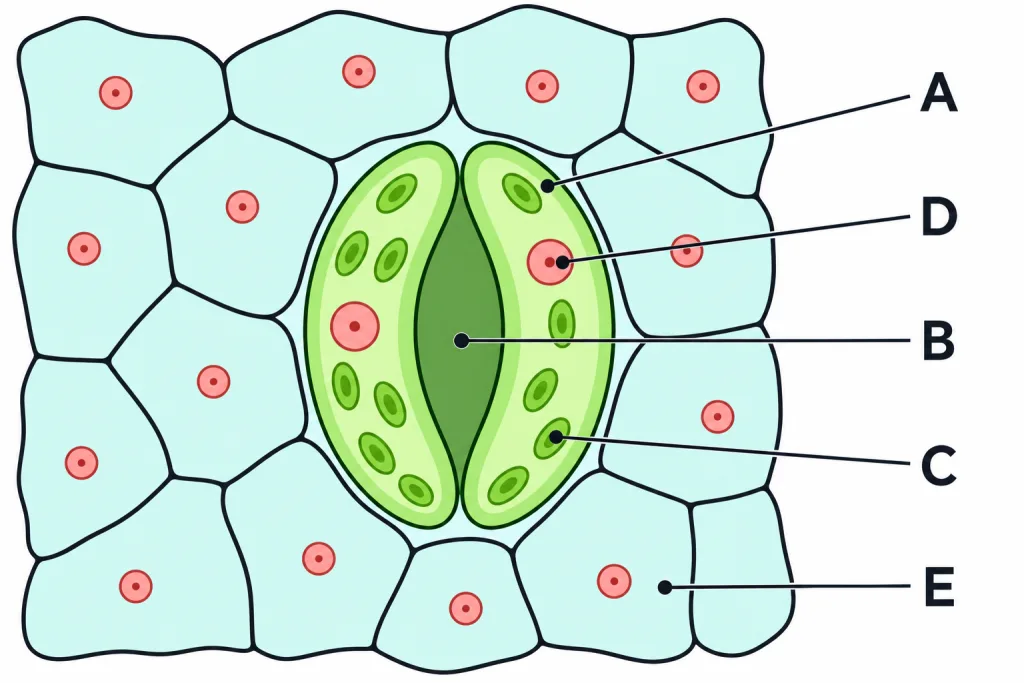
Draw a labelled diagram of an open stomatal pore. Label the guard cells, the stomatal pore and the chloroplasts. How does the exchange of gases through the stomata of a leaf differ between day and night?
Answer.
Model answer:
The diagram shows the pore between its two guard cells. Key: A guard cell, B stomatal pore, C chloroplast, D nucleus, E epidermal cell.
- By day: the leaf respires and photosynthesises together. Photosynthesis uses up the carbon dioxide made in respiration and takes in more from the air. The main gas given out is oxygen.
- At night: there is no light and no photosynthesis. The leaf only respires, so it takes in oxygen and gives out carbon dioxide.
Marking scheme:
- Correct diagram: an open pore between two bean-shaped guard cells, with epidermal cells around them — 1 mark
- Guard cells, stomatal pore and chloroplasts correctly labelled (in the figure: A guard cell, B stomatal pore, C chloroplast; D is the nucleus and E an epidermal cell) — 1 mark
- Day: photosynthesis uses up the carbon dioxide made in respiration, so oxygen is given out and carbon dioxide is taken in — 0.5 marks
- Night: there is no photosynthesis, so the leaf only respires; it takes in oxygen and gives out carbon dioxide — 0.5 marks
Question 4 (2 marks)
Arun says, "A cactus in the Thar desert cannot make food, because it keeps its stomata closed through the hot day." Beena says it can. Who is right? Explain how the cactus manages, and why it keeps its stomata closed by day.
Answer.
- Beena is right: the cactus opens its stomata at night, takes in carbon dioxide and stores it as an intermediate substance — 1 mark
- By day it uses this stored carbon dioxide with sunlight to make food; keeping the stomata shut in the hot, dry day saves water that would be lost in transpiration — 1 mark
Question 5 (2 marks)
Answer the following:
(a) How are the lungs designed so that a very large area is available for the exchange of gases? (1 mark)
Answer.
- Inside the lungs the air passage divides into smaller and smaller tubes, which end in balloon-like alveoli — 0.5 marks
- There are millions of alveoli, and together they give a huge surface (about 80 square metres if spread out) — 0.5 marks
(b) Why is it useful that the walls of the alveoli are very thin and have a dense network of blood capillaries? (1 mark)
Answer.
- Gases have to cross only a very short distance, so oxygen passes quickly from the air in the alveoli into the blood — 0.5 marks
- Carbon dioxide passes from the blood into the alveoli to be breathed out, and the moving blood keeps carrying the oxygen away — 0.5 marks
Question 6 (3 marks)
Use a flow chart to show how glucose is broken down (i) in yeast, (ii) in our muscle cells when oxygen runs short, and (iii) in the presence of oxygen. Name the part of the cell where each step takes place. Which pathway releases the most energy?
Answer.
Model answer:
Step 1 (in the cytoplasm, same for all three): Glucose (6-carbon) → Pyruvate (3-carbon) + energy
Step 2, three different ways:
- In yeast, without oxygen (in the cytoplasm): Pyruvate → Ethanol + Carbon dioxide + energy. This is fermentation.
- In muscle cells, when oxygen is short (in the cytoplasm): Pyruvate → Lactic acid + energy
- With oxygen (in the mitochondria): Pyruvate → Carbon dioxide + Water + energy
The third pathway, aerobic respiration, releases much more energy than the other two.
Marking scheme:
- First step, common to all three: glucose (6-carbon) → pyruvate (3-carbon) + energy, in the cytoplasm — 1 mark
- Yeast, no oxygen: pyruvate → ethanol + carbon dioxide + energy; muscle, lack of oxygen: pyruvate → lactic acid + energy (both in the cytoplasm) — 1 mark
- With oxygen: pyruvate → carbon dioxide + water + energy, in the mitochondria; this aerobic pathway releases the most energy — 1 mark
Question 7 (3 marks)
Rahul wrote in his notes: "Arteries carry oxygenated blood and veins carry deoxygenated blood."
(a) Name one blood vessel which shows that this is not always true. What is the correct way to tell an artery from a vein? (1 mark)
Answer.
- The pulmonary artery carries deoxygenated blood from the heart to the lungs (or: the pulmonary vein carries oxygenated blood from the lungs to the heart) — 0.5 marks
- Arteries carry blood away from the heart; veins bring blood back to the heart — 0.5 marks
(b) Give two differences between arteries and veins in their structure, with a reason for each. (2 marks)
Answer.
Model answer:
- Wall: Arteries have thick, elastic walls. Blood leaves the heart under high pressure, so the walls have to be strong and stretchy. Veins have thinner walls, because by the time blood reaches them it is no longer under high pressure.
- Valves: Veins have valves and arteries do not. The pressure in veins is low, so the valves are needed to stop the blood from flowing back; they let it move only towards the heart.
Marking scheme:
- Arteries have thick, elastic walls, because blood comes out of the heart under high pressure — 1 mark
- Veins have thinner walls and have valves, because the blood in them is no longer under high pressure; the valves let it flow only towards the heart — 1 mark
Question 8 (2 marks)
What would happen
(a) if a person's blood had far fewer platelets than normal? (1 mark)
Answer.
- Platelets help the blood to clot at a cut and plug the leak; with few platelets, bleeding from a cut would not stop quickly — 0.5 marks
- Much blood would be lost; blood pressure falls, so less blood reaches the organs — 0.5 marks
(b) if the amount of haemoglobin in a person's blood fell well below normal? (1 mark)
Answer.
- Haemoglobin in the red blood cells carries oxygen from the lungs to the tissues — 0.5 marks
- With less haemoglobin, less oxygen reaches the cells, less energy is released in respiration, and the person feels tired and breathless — 0.5 marks
Question 9 (3 marks)
Give reasons:
(a) The walls of blood capillaries are only one cell thick. (1 mark)
Answer.
- Materials are exchanged between the blood and the body cells across the capillary wall; a wall one cell thick lets this exchange happen quickly — 1 mark
(b) Most of the carbon dioxide in our blood is carried dissolved in the plasma, while oxygen is carried by haemoglobin. (1 mark)
Answer.
- Carbon dioxide is more soluble in water than oxygen, so it can dissolve in the plasma; oxygen does not dissolve enough, so it is carried by haemoglobin, which has a very high affinity for it — 1 mark
(c) The food that enters the small intestine from the stomach has to be made alkaline. (1 mark)
Answer.
- Food coming from the stomach is acidic, but the pancreatic enzymes act only in an alkaline medium; bile from the liver makes it alkaline — 1 mark
Question 10 (3 marks)
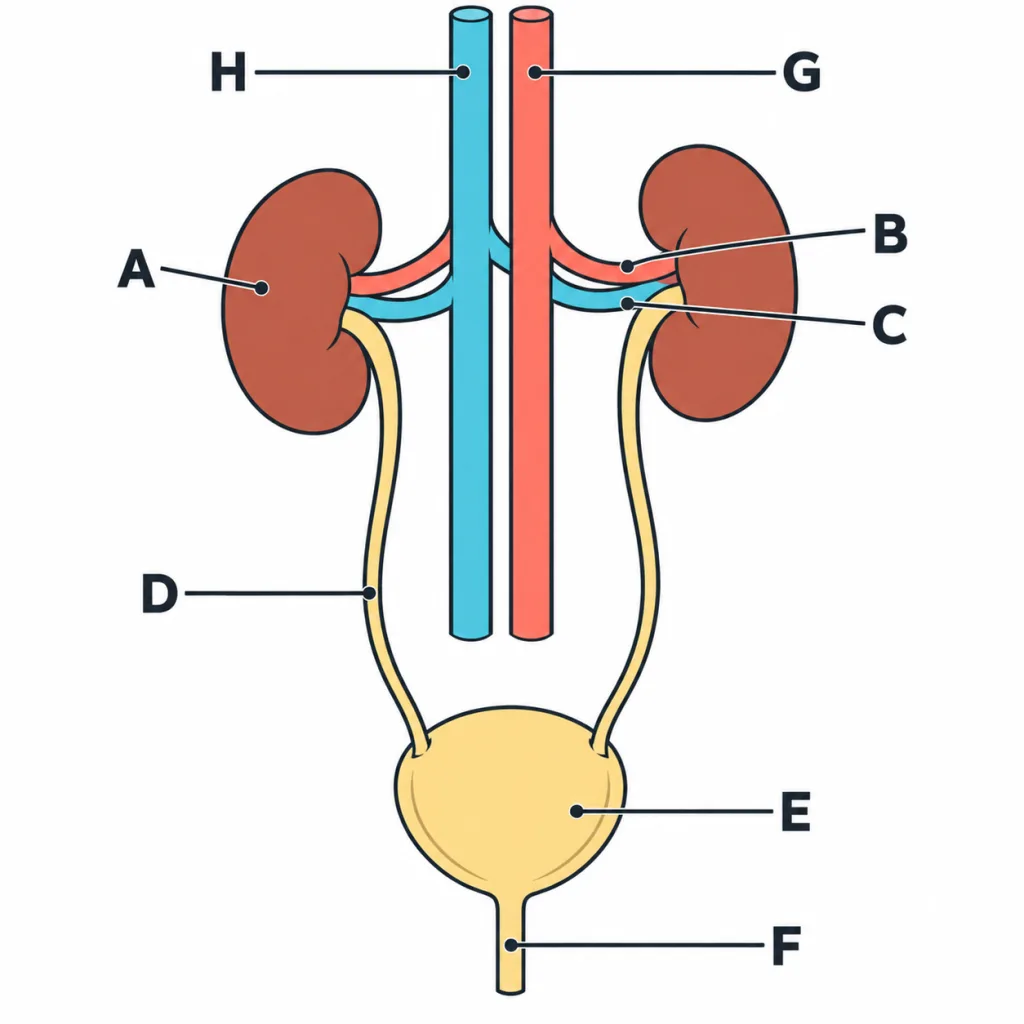
Draw a labelled diagram of the human excretory system. Label any four of these: kidney, ureter, urinary bladder, urethra, renal artery, renal vein. What is the job of the ureters and of the urinary bladder?
Answer.
- Correct diagram: a pair of kidneys joined by the ureters to the urinary bladder, with the urethra below it — 1 mark
- Any four parts correctly labelled, 0.25 each (in the figure: A kidney, B renal artery, C renal vein, D ureter, E urinary bladder, F urethra, G aorta, H vena cava) — 1 mark
- Ureters carry the urine made in the kidneys to the urinary bladder — 0.5 marks
- The urinary bladder stores urine until it is passed out through the urethra; it is muscular and under nervous control — 0.5 marks
Question 11 (2 marks)
Plants have no special organs for excretion. How do they get rid of (a) excess water and the oxygen made in photosynthesis, (b) other waste products? Give two ways for (b).
Answer.
- (a) Excess water is lost by transpiration, and oxygen diffuses out, both through the stomata of the leaves — 1 mark
- (b) Any two: wastes are stored in cell vacuoles; stored in leaves that later fall off; stored as resins and gums, mostly in old xylem; released into the soil around the plant — 1 mark
Long Answer and Case-Based Questions
Question 12 (5 marks)
Attempt either option (A) or (B).
(A) Human digestion
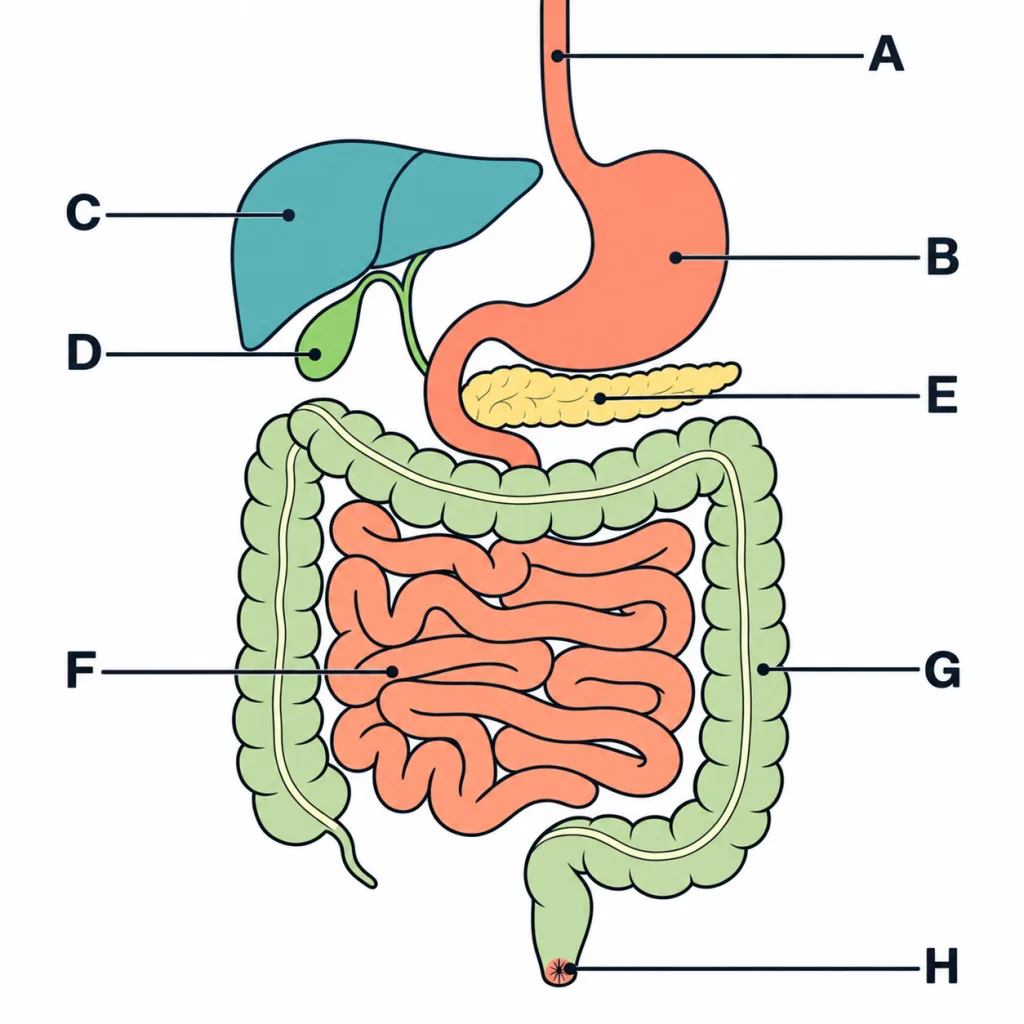
(i) Draw a diagram of the human alimentary canal and label any six of these: oesophagus, stomach, liver, gall bladder, pancreas, small intestine, large intestine, anus. (3 marks)
Answer.
- Correct diagram: oesophagus leading into the stomach, then the small intestine (coiled) and the large intestine ending at the anus, with the liver, gall bladder and pancreas in place — 1.5 marks
- Any six parts correctly labelled, 0.25 each (in the figure: A oesophagus, B stomach, C liver, D gall bladder, E pancreas, F small intestine, G large intestine, H anus) — 1.5 marks
(ii) Name two enzymes present in pancreatic juice and state what each one acts on. What do the enzymes of the intestinal juice finally convert proteins, complex carbohydrates and fats into? (2 marks)
Answer.
Model answer:
Pancreatic juice has trypsin, which digests proteins, and lipase, which breaks down the fats that bile has already emulsified.
The glands in the wall of the small intestine release intestinal juice. Its enzymes finish the job: proteins become amino acids, complex carbohydrates become glucose, and fats become fatty acids and glycerol. These small molecules are then absorbed by the villi.
Marking scheme:
- Trypsin digests proteins — 0.5 marks
- Lipase breaks down emulsified fats — 0.5 marks
- Proteins → amino acids; complex carbohydrates → glucose; fats → fatty acids and glycerol — 1 mark
OR
(B) Autotrophic nutrition
(i) What is photosynthesis? List the three main events that take place during photosynthesis, and write its balanced chemical equation. (3 marks)
Answer.
Model answer:
Photosynthesis is the process in which green plants make carbohydrates from carbon dioxide and water, using the energy of sunlight absorbed by chlorophyll. Oxygen is given out.
The three events are:
- Light energy is absorbed by chlorophyll.
- Light energy is changed into chemical energy, and water molecules are split into hydrogen and oxygen.
- Carbon dioxide is reduced to carbohydrates.
(sunlight, chlorophyll)
Marking scheme:
- Photosynthesis: green plants make carbohydrates from carbon dioxide and water, using sunlight absorbed by chlorophyll — 0.5 marks
- Events: (1) light energy is absorbed by chlorophyll; (2) light energy is converted into chemical energy and water is split into hydrogen and oxygen; (3) carbon dioxide is reduced to carbohydrates; 0.5 each — 1.5 marks
- , in the presence of sunlight and chlorophyll — 1 mark
(ii) Photosynthesis is a redox process. Which of its reactants is reduced and which is oxidised? Give a reason for each. (2 marks)
Answer.
- Carbon dioxide is reduced: it gains hydrogen (and loses oxygen) as it is turned into glucose — 1 mark
- Water is oxidised: it loses hydrogen when it is split, and its oxygen is set free as oxygen gas — 1 mark
Question 13 (5 marks)
Attempt either option (A) or (B).
(A) The human heart
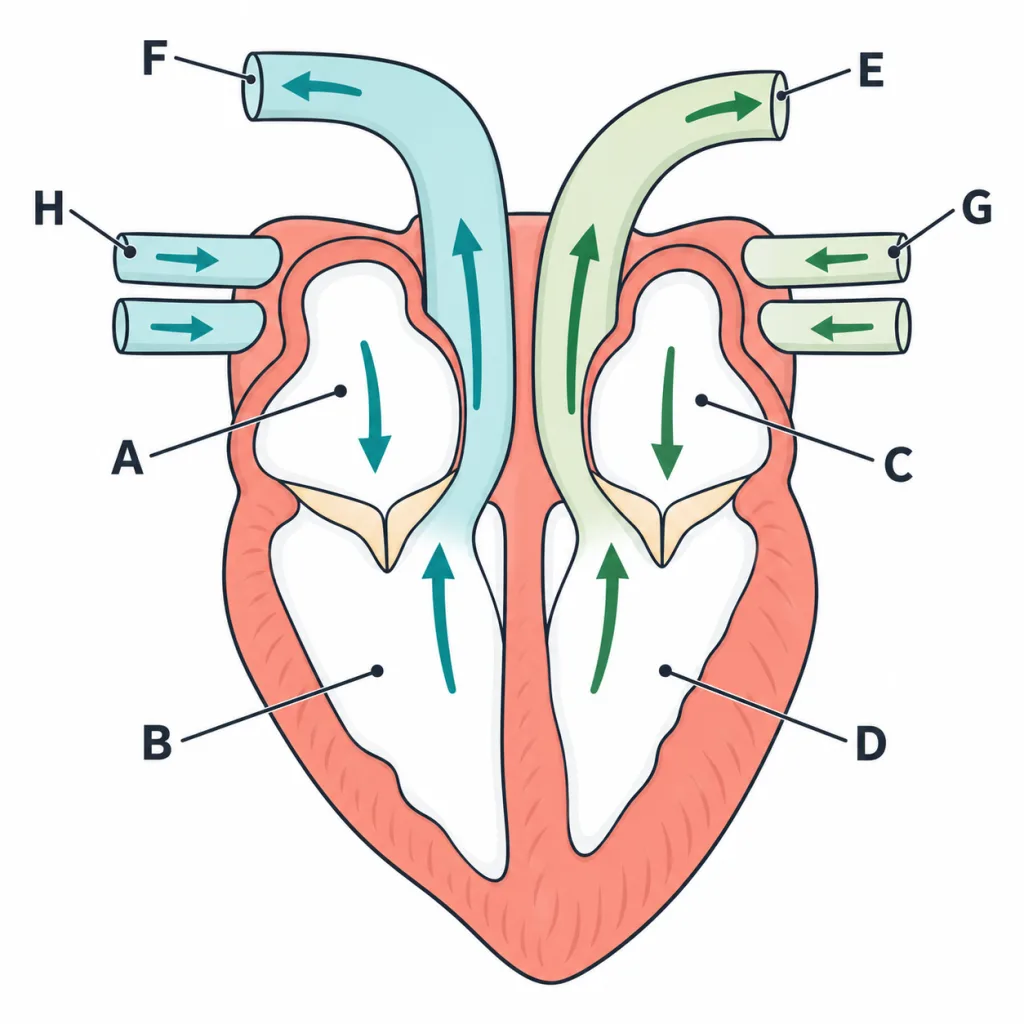
(i) Draw a schematic sectional view of the human heart. Label any six of these: right atrium, right ventricle, left atrium, left ventricle, aorta, pulmonary artery, pulmonary vein, vena cava. Show the direction of blood flow with arrows. (3 marks)
Answer.
- Correct diagram: four chambers, the right and left sides separated by a wall, valves between atria and ventricles, ventricle walls thicker than the atria and the left ventricle wall the thickest — 1 mark
- Any six parts correctly labelled, 0.25 each (in the figure: A right atrium, B right ventricle, C left atrium, D left ventricle, E aorta, F pulmonary artery, G pulmonary veins, H vena cava) — 1.5 marks
- Arrows showing blood flowing from the atria into the ventricles and out through the arteries — 0.5 marks
(ii) A drop of blood is pumped out of the right ventricle. Name, in order, the vessels, organ and chambers it passes through until it is pumped out to the body. What stops it from flowing backwards on the way? (2 marks)
Answer.
- Right ventricle → pulmonary artery → lungs (takes up oxygen, gives up carbon dioxide) → pulmonary vein → left atrium → left ventricle → aorta → body — 1 mark
- Valves: they close when the atria or ventricles contract, so the blood cannot flow backwards — 1 mark
OR
(B) Breathing
(i) Trace the path of air from the nostrils to the alveoli. What happens to the ribs, the diaphragm and the chest cavity when we breathe in, and when we breathe out? (3 marks)
Answer.
- Nostrils (fine hairs and mucus filter the air) → throat → trachea (kept open by rings of cartilage) → bronchi → smaller tubes (bronchioles) → alveoli — 1 mark
- Breathing in: the ribs are lifted and the diaphragm flattens; the chest cavity becomes larger and air is sucked into the lungs — 1 mark
- Breathing out: the ribs come down and the diaphragm curves up again; the chest cavity becomes smaller and air is pushed out — 1 mark
(ii) How does a fish take in oxygen, and why does it have to breathe much faster than a land animal? (2 marks)
Answer.
- It takes in water through its mouth and forces it past the gills, where the blood takes up the oxygen dissolved in the water — 1 mark
- Much less oxygen is dissolved in water than is present in the same volume of air, so it has to breathe much faster to get enough — 1 mark
Question 14 (5 marks)
Attempt either option (A) or (B).
(A) Excretion in human beings
(i) Draw a labelled diagram of a nephron and label these parts: Bowman's capsule, glomerulus, tubule, collecting duct, branch of renal artery, branch of renal vein. (3 marks)
Answer.
- Correct diagram: cup-shaped Bowman's capsule holding the glomerulus, a long coiled tubule opening into the collecting duct, with blood vessels — 1.5 marks
- Six parts correctly labelled, 0.25 each (in the figure: A Bowman's capsule, B glomerulus, C tubule, D collecting duct, E branch of renal artery, F branch of renal vein) — 1.5 marks
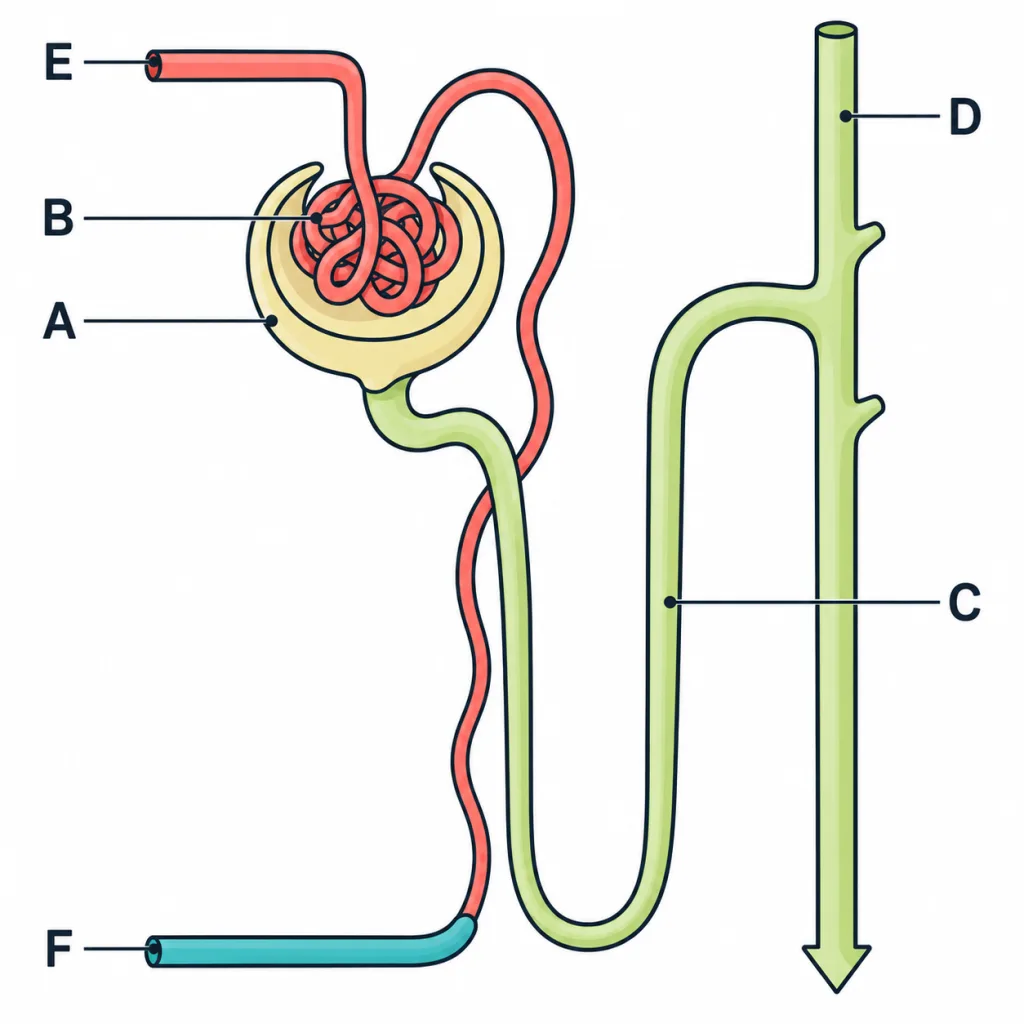
(ii) The fluid that collects in Bowman's capsule is not the same as the urine that leaves the collecting duct. Name two substances present in the first that are normally absent from urine, and say what happens to them. Why does urine contain much less water than this fluid? (2 marks)
Answer.
- Glucose and amino acids; as the fluid flows along the tubule they are selectively reabsorbed into the blood in the capillaries around it — 1 mark
- Most of the water is also reabsorbed along the tubule, so only a small volume of concentrated urine is left — 1 mark
OR
(B) Blood and lymph
(i) Blood has a fluid part and cells floating in it. State one job each of the plasma, the red blood cells and the platelets. (3 marks)
Answer.
- Plasma carries food, carbon dioxide and nitrogenous wastes in dissolved form — 1 mark
- Red blood cells contain haemoglobin, which carries oxygen from the lungs to the tissues — 1 mark
- Platelets help the blood to clot at a cut and plug the leak, so that blood is not lost — 1 mark
(ii) What is lymph and how is it formed? Give two of its functions. (2 marks)
Answer.
- Some plasma, proteins and blood cells escape through the pores in the walls of capillaries into the spaces between cells; this tissue fluid is lymph, a colourless fluid like plasma with less protein — 1 mark
- It carries digested and absorbed fat from the intestine, and drains extra fluid from the spaces between cells back into the blood — 1 mark
Question 15 (4 marks)
Priya's mother noticed that bhature dough mixed with a little yeast puffs up in about an hour in summer, but takes much longer in winter. To study this, Priya set up four test tubes. Each was closed with a cork carrying a bent glass tube whose other end dipped into freshly prepared lime water. She noted how long the lime water took to turn milky.
| Tube | Contents | Kept at | Lime water turned milky after |
|---|---|---|---|
| 1 | Yeast + sugar solution | 35 °C | 6 minutes |
| 2 | Yeast + sugar solution | 10 °C | 28 minutes |
| 3 | Yeast + water only | 35 °C | No change in 1 hour |
| 4 | Boiled and cooled yeast + sugar solution | 35 °C | No change in 1 hour |
(a) Which gas turned the lime water milky? Name the other product formed by the yeast in tube 1. (1 mark)
Answer.
- Carbon dioxide — 0.5 marks
- Ethanol (alcohol) — 0.5 marks
(b) Why was there no change in tube 3? (1 mark)
Answer.
- The yeast had no sugar to break down; without food it could not respire, so no carbon dioxide was made — 1 mark
(c) What do tubes 1 and 4 together show? What does comparing tubes 1 and 2 tell Priya's mother about her dough? (2 marks)
Answer.
- Boiling killed the yeast in tube 4; only living yeast cells respire and give out carbon dioxide — 1 mark
- Yeast respires much faster when it is warm; in summer it makes carbon dioxide quickly, and the gas bubbles make the dough rise sooner — 1 mark
OR
(c) Priya's brother says, "The yeast must be taking oxygen from the air in the tube to make this gas." Is he right? Give a reason and name the process that takes place in the yeast. (2 marks)
Answer.
- No; yeast can break down sugar without oxygen, into ethanol and carbon dioxide, so the gas does not depend on oxygen from the air — 1 mark
- The process is anaerobic respiration (fermentation) — 1 mark
Question 16 (4 marks)
Kavya, a student in Jodhpur, took three potted plants of the same kind and size, P, Q and R, and a fourth pot S with only soil in it. She watered all four pots equally and covered the soil of each pot with a polythene sheet, tied around the stem (or around the rim for S). She removed all the leaves of plant R. She kept P, R and S in bright sunlight and Q in the shade, and weighed each pot at 8 a.m. and again at 2 p.m.
| Pot | P | Q | R | S |
|---|---|---|---|---|
| Loss in mass from 8 a.m. to 2 p.m. (g) | 46 | 17 | 4 | 1 |
(a) Why did she cover the soil with polythene, and why did she set up pot S? (1 mark)
Answer.
- So that water evaporating from the soil is not counted; only the water lost by the plant is measured — 0.5 marks
- S is the control: it shows that a covered pot with no plant loses almost no water — 0.5 marks
(b) Name the process that caused most of the loss in P. Which result shows that the leaves are the main site of this loss? (1 mark)
Answer.
- Transpiration — 0.5 marks
- R, with no leaves, lost only 4 g, against 46 g for P in the same sunlight — 0.5 marks
(c) Why did P lose much more water than Q? Give one way in which this loss of water helps the plant. (2 marks)
Answer.
- In bright sunlight the stomata are open and the leaves are warmer, so water evaporates from the leaves much faster than in the shade — 1 mark
- Any one: it creates the pull that brings water and dissolved minerals up from the roots to the leaves; it helps to keep the plant cool — 1 mark
OR
(c) Using the results for P and R, find the water lost by the leaves of P in grams per hour. Name the openings through which this water is lost and the cells that open and close them. (2 marks)
Answer.
- Loss due to leaves g in 6 hours, so g per hour — 1 mark
- The water is lost through the stomata, which are opened and closed by the guard cells — 1 mark