
The One Principle: Volume Is Conserved
When a solid is melted and recast, drawn into a wire, or reshaped in any way, its material does not change — so its volume stays the same:
Every problem in this section is really one equation:
Key Point: Set up "old volume new volume" and solve for whatever is unknown (a new dimension, or the number of pieces).
Melting and Recasting into Many Pieces
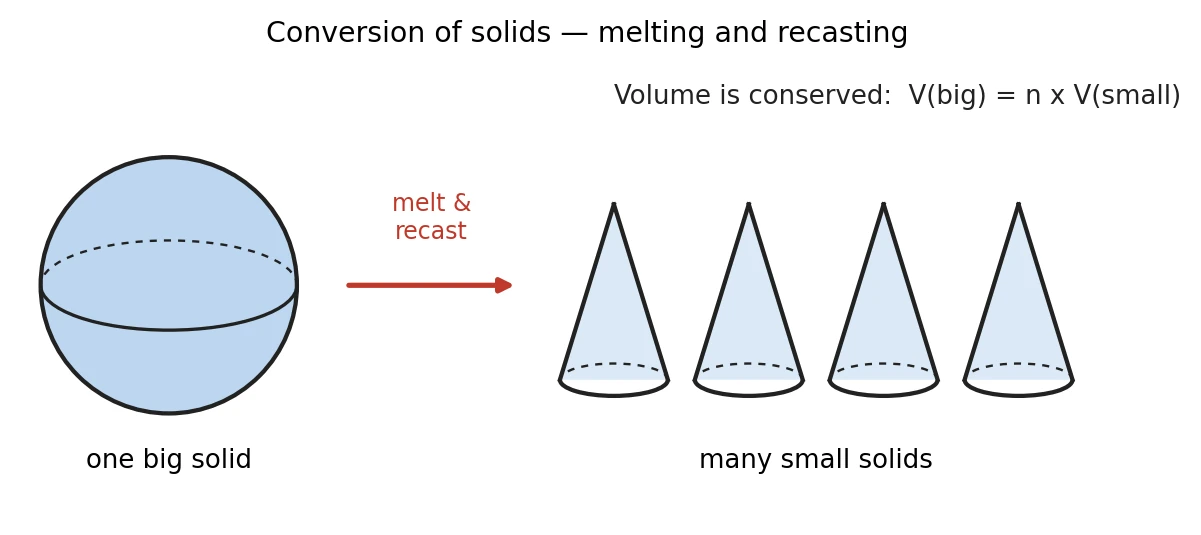
If one big solid is melted and recast into identical small pieces:
For example, a sphere melted into small cones, or a big sphere into small spheres, or a cylinder into coins.
[Board Important] The usually cancels on both sides — leave it as and it disappears, saving arithmetic.
Drawing into a Wire (or a Long Cylinder)
A lump of metal drawn into a long thin wire is just a cylinder of very small radius and very large length. Again, volume is conserved:
So the wire's length .
Key Point: "Drawn into a wire of diameter " means a cylinder of radius — find its length from the conserved volume.
Water Displacement and Rising Levels
When a solid is dropped into water in a container, the water it pushes up equals the solid's volume (or the submerged part):
For "how many lead shots make the water rise/overflow by a given amount," use
Key Point: Rise in water level base area volume of the object submerged. Same conservation idea, just with water.
Solved Examples
Example 1: Sphere melted into cones
A metallic sphere of radius 3 cm is melted and recast into small cones, each of radius 1 cm and height 3 cm. How many cones are formed?
Solution:
- Volume of sphere cm.
- Volume of one cone cm.
- Number .
Final Answer: 36 cones.
Takeaway: Number ; cancels.
Example 2: Sphere drawn into a wire
A copper sphere of radius 3 cm is melted and drawn into a wire of diameter 0.2 cm. Find the length of the wire.
Solution:
- Volume of sphere cm.
- Wire radius cm; volume .
- cm m.
Final Answer: 36 m.
Takeaway: Wire is a thin cylinder; length .
Example 3: Recasting a cylinder into a sphere
A solid metallic cylinder of radius 6 cm and height 32 cm is melted and recast into a single sphere. Find the radius of the sphere.
Solution:
- Cylinder volume cm.
- Set .
- cm.
Final Answer: cm.
Takeaway: Equate volumes and solve for the new radius.
Example 4: Lead shots in a cone of water
A conical vessel (height 8 cm, top radius 5 cm) is full of water. When lead shots (spheres of radius 0.5 cm) are dropped in, one-fourth of the water overflows. How many shots were dropped?
Solution:
- Volume of cone (water) cm.
- Water displaced cm.
- One shot cm.
- Number .
Final Answer: 100 shots.
Takeaway: Displaced water volume one shot's volume number.