Volumes Simply Add Up
Surface area was tricky because joined faces disappeared. Volume is easier. When two solids are joined, no volume is lost — the volume of the combined solid is exactly the sum of the volumes of its parts.
Volume of combination=Volume of part 1+Volume of part 2+…
Key Point: For surface area you drop the hidden faces; for volume you just add everything. Different rules — do not mix them up.
Add for a Join, Subtract for a Cavity
If a solid has a hollow or a depression, subtract that empty volume:
Actual volume (capacity)=Outer solid−hollowed-out part.
- A glass (cylinder) with a hemispherical raised bottom: actual capacity =πr2h−32πr3.
- A pen stand (cuboid) with conical depressions: volume of wood =cuboid−(number of cones)×31πr2h.
Key Point: "How much it holds" or "how much material is left" ⇒ subtract the empty/removed part.
Familiar Combinations
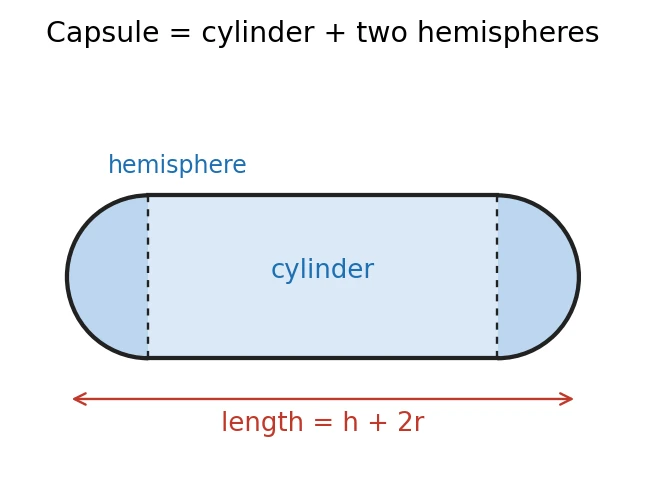
- Capsule / gulab jamun (cylinder + two hemispheres): V=πr2h+2×32πr3=πr2h+34πr3, where h=length−2r.
- Toy (cone + hemisphere): V=31πr2h+32πr3.
- Model (cylinder + a cone at each end): V=πr2hcyl+2×31πr2hcone.
- Shed (cuboid + half-cylinder roof): V=lbh+21πr2L.
[Board Important] Always read off which radius/height belongs to which part — combinations often reuse the letter r or h for different pieces.
Capacity vs Volume of Material
Be clear on what is being asked:
- Capacity / volume of air / how much it holds = inner (empty) volume.
- Volume of material / wood / metal = solid volume − any hollow.
For a vessel with walls, use the inner radius for capacity. If the question gives outer dimensions and a thickness, capacity uses (outer − thickness).
Key Point: Decide first: am I measuring the stuff (material) or the space (capacity)? Then add or subtract accordingly.
Solved Examples
Example 1: Glass with a hemispherical bottom
A cylindrical glass of inner diameter 5 cm and height 10 cm has a hemispherical raised bottom. Find its apparent and actual capacity. (π=3.14)
Solution:
- r=2.5 cm. Apparent capacity =πr2h=3.14×6.25×10=196.25 cm3.
- Hemisphere volume =32πr3=32×3.14×15.625=32.71 cm3.
- Actual capacity =196.25−32.71=163.54 cm3.
Final Answer: Apparent 196.25 cm3; actual 163.54 cm3.
Takeaway: A raised bottom reduces capacity — subtract the hemisphere.
Example 2: Toy volume
A solid toy is a hemisphere surmounted by a cone. The cone's height is 2 cm and the base diameter is 4 cm. Find the toy's volume. (π=3.14)
Solution:
- r=2 cm. V=32πr3+31πr2h.
- =32×3.14×8+31×3.14×4×2=16.75+8.37=25.12 cm3.
Final Answer: 25.12 cm3.
Takeaway: Volume adds: hemisphere + cone.
Example 3: Air in a shed
A shed is a cuboid (15 m×7 m×8 m) topped by a half-cylinder of diameter 7 m and length 15 m. Find the volume of air it can hold. (π=722)
Solution:
- Cuboid =15×7×8=840 m3.
- Half-cylinder =21πr2L=21×722×3.52×15=288.75 m3.
- Total =840+288.75=1128.75 m3.
Final Answer: 1128.75 m3.
Takeaway: Half-cylinder volume =21πr2L.
Example 4: Volume of wood in a pen stand
A cuboidal pen stand (15×10×3.5 cm) has 4 conical depressions, each of radius 0.5 cm and depth 1.4 cm. Find the volume of wood. (π=722)
Solution:
- Cuboid =15×10×3.5=525 cm3.
- One cone =31πr2h=31×722×0.25×1.4=3011≈0.3667 cm3; four cones ≈1.4667 cm3.
- Wood =525−1.4667≈523.53 cm3.
Final Answer: ≈523.53 cm3.
Takeaway: Volume of material = solid − (cavities).
