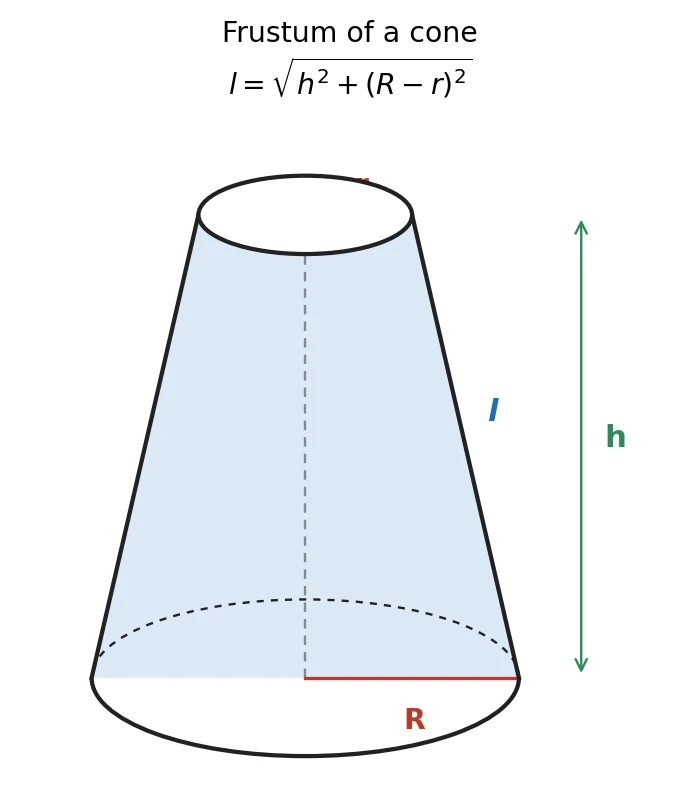
Take a cone and slice off the pointed top with a cut parallel to the base. The piece left at the bottom — a cone with its tip removed — is a frustum of a cone. A bucket, a drinking glass, a lampshade and a flowerpot are everyday frustums.
A frustum has two circular faces: a bigger base of radius R and a smaller top of radius r, separated by a vertical height h and a slant side l.
The Slant Height
The slant side of a frustum is the hypotenuse of a right triangle whose legs are the heighth and the difference of the radii(R−r):
l=h2+(R−r)2
Key Point: Use (R−r), the difference of the radii — not R+r — inside the slant-height formula. Find l first if the question gives h, R, r.
Surface Areas of a Frustum
Curved (lateral) surface area:CSA=πl(R+r).
Total surface area: add both circular faces:
TSA=πl(R+r)+πR2+πr2.
For an open bucket, there is no top face, so its surface (metal used) =πl(R+r)+πr2 (curved side + the smaller closed base).
Key Point: CSA uses (R+r); the two flat faces are πR2 and πr2. Read whether the object is open or closed.
Volume of a Frustum
V=31πh(R2+r2+Rr)
This neatly reduces to a full cone when r=0 (V=31πhR2) and to a cylinder when R=r (V=πhR2) — a good way to remember it.
[Board Important] Capacity of a bucket =31πh(R2+r2+Rr); give the answer in litres if asked (1 litre=1000 cm3).
Solved Examples
Example 1: Slant height and CSA
A frustum has radii R=20 cm and r=8 cm and vertical height h=16 cm. Find its slant height and curved surface area. (π=3.14)
Solution:
l=h2+(R−r)2=162+122=256+144=400=20 cm.
CSA =πl(R+r)=3.14×20×28=1758.4 cm2.
Final Answer:l=20 cm; CSA =1758.4 cm2.
Takeaway:(R−r)=12 and h=16 give the 12,16,20 triple.
Example 2: Volume of a bucket
A bucket is a frustum with R=20 cm, r=8 cm and height h=16 cm. Find its capacity in litres. (π=3.14)
Solution:
V=31πh(R2+r2+Rr)=31×3.14×16×(400+64+160).
=31×3.14×16×624=10449.92 cm3.
In litres =100010449.92≈10.45 L.
Final Answer:≈10.45 litres.
Takeaway:V=31πh(R2+r2+Rr); divide by 1000 for litres.
Example 3: Metal in an open bucket
Find the area of metal sheet used to make the open bucket of Example 1 (R=20, r=8, l=20 cm). (π=3.14)
Solution:
Open bucket = curved side + smaller base =πl(R+r)+πr2.
=3.14×20×28+3.14×64=1758.4+200.96=1959.36 cm2.
Final Answer:1959.36 cm2.
Takeaway: Open bucket has no top face — add only the smaller base.
Example 4: Frustum glass
A glass is a frustum with top radius 3 cm, bottom radius 2 cm and height 6 cm. Find its capacity. (π=3.14)
Solution:
Here R=3, r=2, h=6.
V=31×3.14×6×(9+4+6)=31×3.14×6×19=119.32 cm3.
Final Answer:≈119.32 cm3.
Takeaway: It does not matter which end you call R or r in the volume formula — R2+r2+Rr is symmetric.
Ready to test your knowledge?
Take a quick interactive quiz on this topic —
free, works without login.