
The Five Basic Solids
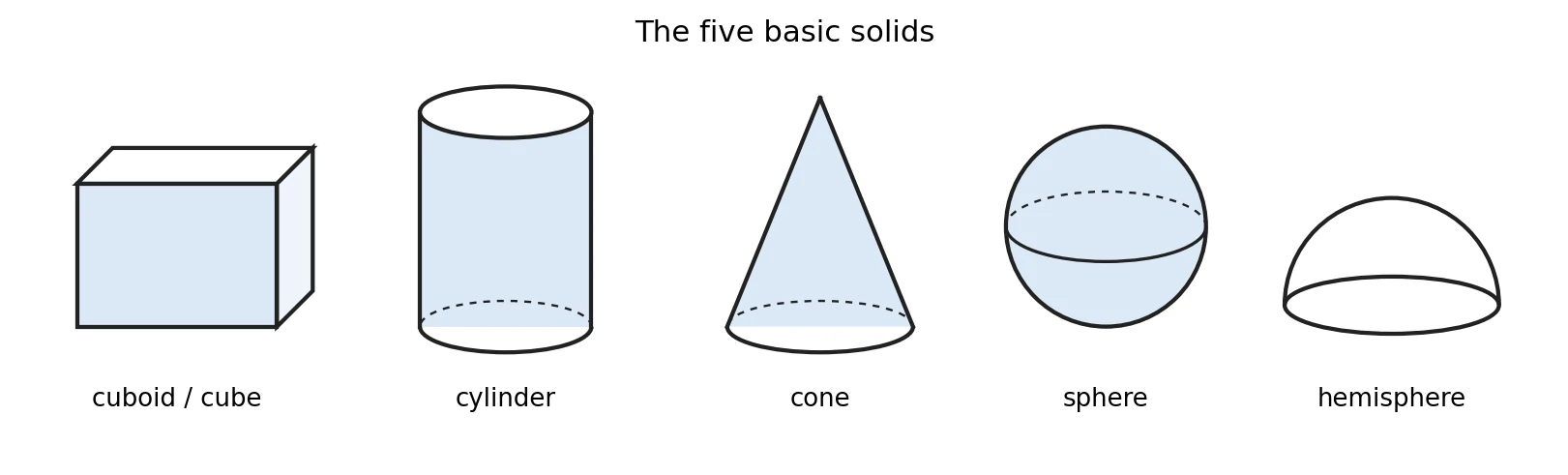
Everything in this chapter is built from just five shapes you met in Class 9: the cuboid, cube, cylinder, cone, sphere and hemisphere. Master their formulas and the rest of the chapter is simply adding and subtracting.
Two words we use constantly:
- CSA = Curved (Lateral) Surface Area — the "side" surface only.
- TSA = Total Surface Area — every face, including flat tops and bottoms.
Key Point: For a solid with a flat base (cylinder, cone, hemisphere), TSA CSA the area of the flat face(s). A sphere has no flat face, so its "CSA" and "TSA" are the same.
Cuboid and Cube
Cuboid with length , breadth , height :
- Volume
- Total surface area
- Lateral surface area (4 walls)
- Diagonal
Cube with edge (a cuboid with all sides equal):
- Volume
- Total surface area
- Lateral surface area
- Diagonal
Cylinder and Cone
Cylinder with base radius , height :
- Volume
- Curved surface area
- Total surface area
Cone with base radius , height , slant height :
- Slant height (from Pythagoras)
- Volume
- Curved surface area
- Total surface area
Key Point: A cone's volume is exactly one-third of the cylinder on the same base and height. Always find from and before using .
Sphere and Hemisphere, and a Ready Table
Sphere of radius : Surface area ; Volume .
Hemisphere of radius (half a sphere): CSA ; TSA (curved the flat circular face ); Volume .
| Solid | CSA / Curved | TSA | Volume |
|---|---|---|---|
| Cuboid | |||
| Cube | |||
| Cylinder | |||
| Cone | |||
| Sphere | |||
| Hemisphere |
[Board Important] Memorise this table cold — most of the chapter is choosing the right rows and combining them.
Solved Examples
Example 1: Cylinder
Find the volume and total surface area of a cylinder of radius 7 cm and height 10 cm.
Solution:
- Volume cm.
- TSA cm.
Final Answer: Volume cm, TSA cm.
Example 2: Cone slant height
A cone has radius 6 cm and height 8 cm. Find its slant height, CSA and volume.
Solution:
- cm.
- CSA cm.
- Volume cm.
Final Answer: cm, CSA cm, Volume cm.
Takeaway: is a Pythagorean triple — find first.
Example 3: Sphere and hemisphere
Find the surface area of a sphere of radius 7 cm, and the TSA of a hemisphere of the same radius.
Solution:
- Sphere: cm.
- Hemisphere TSA cm.
Final Answer: Sphere cm; hemisphere TSA cm.
Takeaway: Hemisphere TSA is (not ) — it includes the flat circle.
Example 4: Cube
A cube has edge 5 cm. Find its volume, total surface area and diagonal.
Solution:
- Volume cm.
- TSA cm.
- Diagonal cm.
Final Answer: cm, cm, cm.
Takeaway: Cube diagonal ; face diagonal .