
The Big Idea — Add Only the Exposed Surfaces
When two solids are joined, part of each one's surface is hidden inside the join and disappears. So the surface area of the combined solid is not the sum of the two full surface areas — it is the sum of only the exposed surfaces.
Key Point: TSA of a combination sum of the visible (usually curved) surface areas of the parts. The flat faces where they are glued together are not counted.
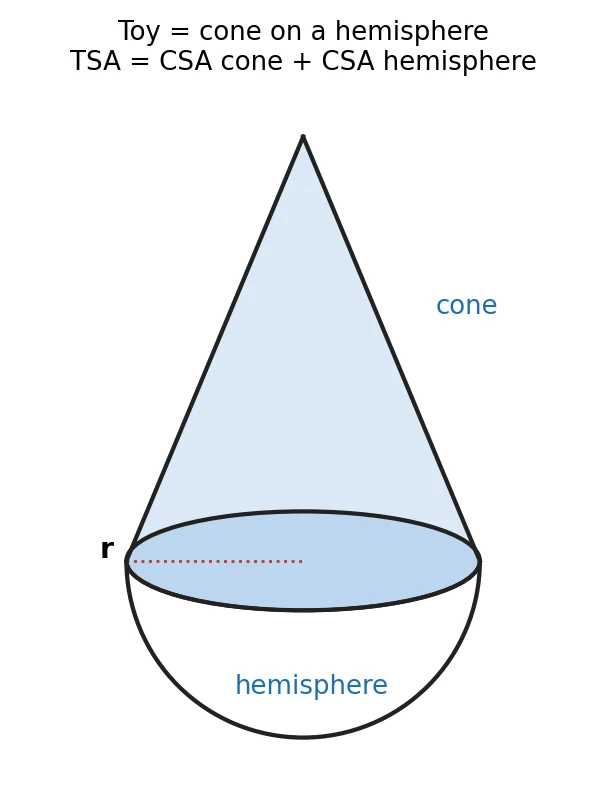
Think of a toy = a cone stuck on a hemisphere. From outside you see only the curved surface of the cone and the curved surface of the hemisphere — the two flat circular faces vanish into the join.
Cone on a Hemisphere (a Toy / Top)
For a toy that is a cone surmounted on a hemisphere of the same radius :
Watch the heights: if the whole toy is tall and the hemisphere has radius , the cone's height is , and then .
[Board Important] The "total surface area of the toy" is not (TSA of cone) (TSA of hemisphere) — you would be double-counting the hidden circles.
Cylinder with Hemispherical / Conical Ends
- Capsule (cylinder a hemisphere at each end, same radius ): , where is the length of the cylindrical part. Note the full length .
- Tent (cylinder surmounted by a cone): area of canvas (the base is open, so no base area).
- Cube with a hemisphere on top (radius ): (remove the circle the hemisphere covers, add its curved surface).
Cavities and Scooped-Out Solids
When a shape is hollowed out of another, the hidden flat face is replaced by the new inner curved surface:
- Cylinder with a cone scooped out (same , same ): (cylinder CSA cone CSA one circular base).
- Cube with a hemispherical depression (diameter edge): .
- Cylinder with a hemisphere scooped from each end: (the two flat ends are replaced by the two inner hemispherical surfaces).
Key Point: Adding a bump or cutting a dent both replace a flat circle () by a curved hemisphere () — a net change of .
Solved Examples
Example 1: Toy (cone on hemisphere)
A playing top is a cone surmounted on a hemisphere. The whole top is 5 cm tall and its diameter is 3.5 cm. Find its surface area.
Solution:
- cm. Cone height cm.
- cm.
- TSA cm.
Final Answer: cm.
Takeaway: Cone height total height hemisphere radius.
Example 2: Cube with a hemisphere
A decorative block is a cube of edge 5 cm with a hemisphere of diameter 4.2 cm fixed on top. Find the total surface area.
Solution:
- TSA of cube cm.
- cm; adding the hemisphere changes the area by .
- TSA cm.
Final Answer: cm.
Takeaway: A hemisphere on a flat face adds (curved minus the covered circle ).
Example 3: Capsule
A medicine capsule is a cylinder with a hemisphere on each end. The whole capsule is 14 mm long and 5 mm in diameter. Find its surface area.
Solution:
- mm; cylinder length mm.
- Surface .
- mm.
Final Answer: mm.
Takeaway: Full length , so cylinder part .
Example 4: Tent (canvas area)
A tent is a cylinder (height 2.1 m, diameter 4 m) surmounted by a cone of slant height 2.8 m. Find the area of canvas used (base is open).
Solution:
- m. Canvas CSA of cylinder CSA of cone .
- m.
Final Answer: m.
Takeaway: For a tent, no base area — only the two curved surfaces.