
The Area-Ratio Theorem
We know similar triangles have proportional sides. How do their areas compare? Not in the same ratio as the sides — areas grow faster.
Theorem: The ratio of the areas of two similar triangles is equal to the square of the ratio of their corresponding sides.
If , then:
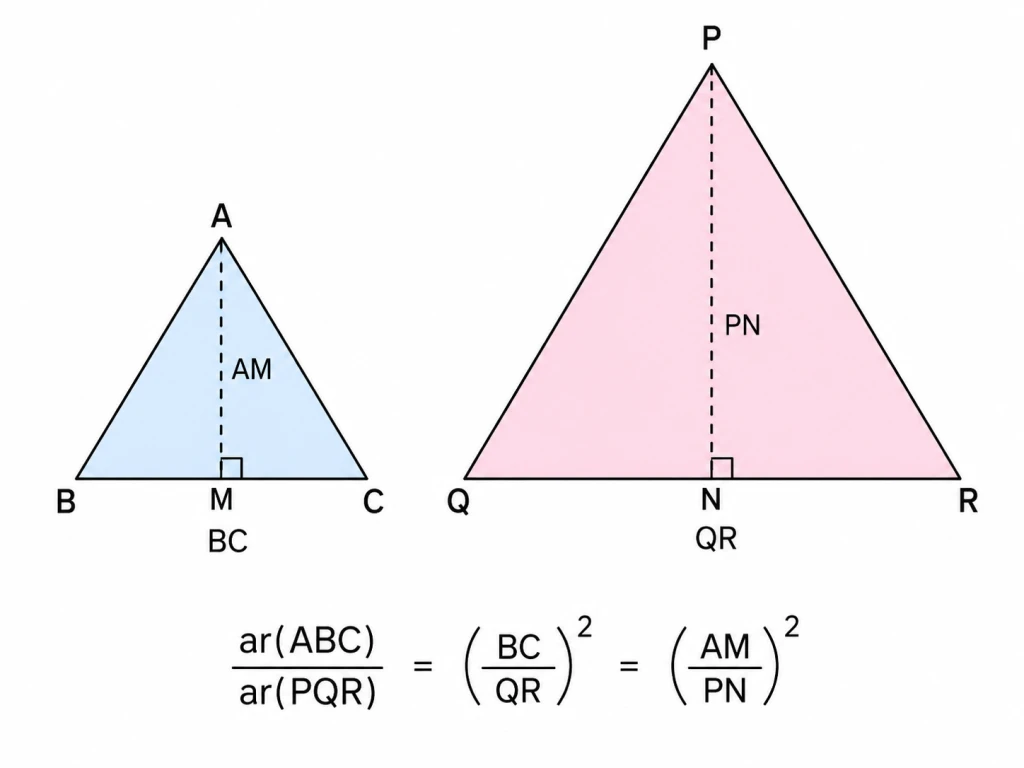
Key Point: Areas are in the ratio of the square of sides. If sides are in ratio , areas are in ratio .
[Board Important] Don't confuse: perimeters are in the side ratio (e.g. 2:3), but areas are in the squared ratio (4:9). This is a very common error.
Why the Square?
The idea: area depends on two dimensions (base and height), each of which scales by the side ratio . So area scales by .
The proof idea
For similar triangles, the corresponding altitudes are also in the ratio . Since , and both base and height scale by :
Key Point: Because area uses two scaled lengths, the area ratio is the square of the length ratio.
[Board Important] Corresponding altitudes, medians, and angle bisectors of similar triangles are all in the side ratio — and the areas in .
Equivalent Forms of the Area Ratio
Since all corresponding linear measures of similar triangles are in the ratio , the area ratio equals the square of any of them:
Worked outline
If the ratio of perimeters of two similar triangles is , the ratio of their areas is .
Key Point: The area ratio is the square of the ratio of any pair of corresponding linear measures (sides, altitudes, medians, or perimeters).
[Board Important] If a problem gives the ratio of areas and asks for the ratio of sides, take the square root: areas ⇒ sides .
Going Both Ways
The theorem works in both directions:
- Sides → areas: square the side ratio.
- Areas → sides: take the square root of the area ratio.
Worked outline
Two similar triangles have areas and . The ratio of areas is , so the ratio of corresponding sides is .
Key Point: Square to go from sides to areas; square-root to go from areas to sides.
[Board Important] Always simplify the area ratio to a perfect-square form (like ) so the square root is clean.
Solved Examples
Example 1: Sides to areas
Two similar triangles have corresponding sides in the ratio . Find the ratio of their areas.
Solution:
- Area ratio .
Final Answer: .
Takeaway: Square the side ratio to get the area ratio.
Example 2: Areas to sides
The areas of two similar triangles are in the ratio . Find the ratio of their corresponding sides.
Solution:
- Side ratio .
Final Answer: .
Takeaway: Take the square root of the area ratio for the side ratio.
Example 3: Find an area
. ar and . Find ar.
Solution:
- .
- .
Final Answer: .
Takeaway: Use the squared side ratio to relate the two areas.
Example 4: Perimeters and areas
The perimeters of two similar triangles are in the ratio . Find the ratio of their areas.
Solution:
- Perimeter ratio = side ratio = .
- Area ratio .
Final Answer: .
Takeaway: Perimeter ratio equals side ratio; area ratio is its square.
Example 5: Altitudes
Two similar triangles have corresponding altitudes in the ratio . Find the ratio of their areas.
Solution:
- Altitudes are in the side ratio, .
- Area ratio .
Final Answer: .
Takeaway: Altitudes follow the side ratio; areas the square.
Example 6: Areas to a length
with ar, ar. If cm, find .
Solution:
- Side ratio .
- cm.
Final Answer: cm.
Takeaway: Get the side ratio from area ratio, then find the length.
Example 7: Medians given
Two similar triangles have corresponding medians 6 cm and 9 cm. Find the ratio of their areas.
Solution:
- Median ratio = side ratio.
- Area ratio .
Final Answer: .
Takeaway: Medians scale like sides; areas like the square.
Example 8: Equal areas ⇒ congruent
If two similar triangles have equal areas, show they are congruent.
Solution:
- Equal areas ⇒ area ratio .
- Side ratio , so corresponding sides are equal.
- Equal corresponding sides ⇒ the triangles are congruent.
Final Answer: They are congruent.
Takeaway: Similar + equal areas ⇒ congruent (scale factor 1).
Example 9: Ratio from a shared figure
In , with on , on , and . Find .
Solution:
- (AA), with side ratio .
- Area ratio .
Final Answer: .
Takeaway: A parallel line creates similar triangles; areas in the squared ratio.
Example 10: Find the larger area
with cm, cm. If ar, find ar.
Solution:
- .
- .
Final Answer: .
Takeaway: Larger triangle ⇒ larger area, found via the squared ratio.