
The Theorem (BPT / Thales' Theorem)
Here is one of the most useful theorems in geometry, discovered by the Greek mathematician Thales.
Basic Proportionality Theorem (BPT): If a line is drawn parallel to one side of a triangle to intersect the other two sides at distinct points, then it divides those two sides in the same ratio.
In , if a line parallel to meets at and at , then:
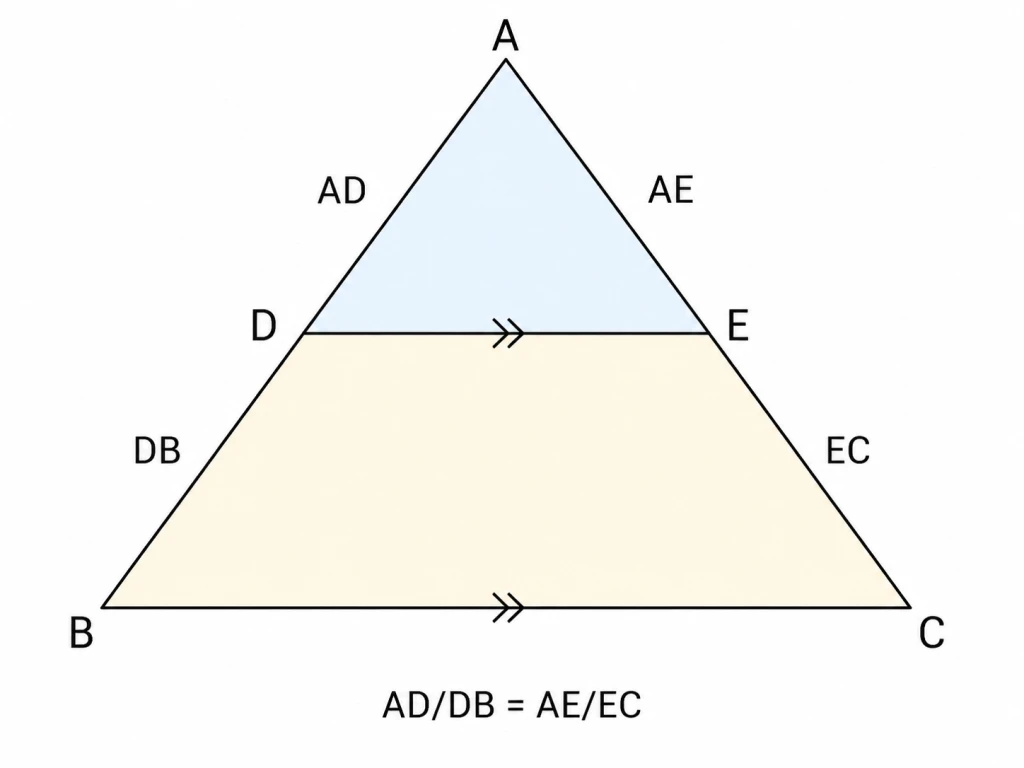
Key Point: The line must be parallel to the third side. Then the two sides it cuts are split in equal ratios.
[Board Important] BPT is proved using the areas of triangles on the same base between the same parallels. Learn the statement precisely — it is the foundation of the whole chapter.
Equivalent Ratio Forms
The BPT ratio can be rearranged into other useful forms:
- (each small part to the whole side)
- (taking reciprocals)
These follow by simple algebra (adding 1, inverting, etc.).
Key Point: Once you have one BPT ratio, you can convert to whichever form the problem needs. The most common in problems is .
[Board Important] Be careful which segments are 'parts' and which are 'whole'. (part : part) is different from (part : whole).
The Converse of BPT
The converse is equally important and is used to prove lines are parallel.
Converse of BPT: If a line divides two sides of a triangle in the same ratio, then the line is parallel to the third side.
So in with on and on : if , then .
Key Point: Use the BPT to find lengths/ratios when a line is known to be parallel; use the converse to prove parallelism when the ratios are equal.
[Board Important] A typical exam line: 'Show that .' Compute the two ratios; if they are equal, cite the converse of BPT to conclude parallelism.
Applications — Trapezium and Beyond
BPT appears in trapeziums and in problems with several parallel lines.
Trapezium application
In a trapezium with , the diagonals intersect at . Triangles formed there give (the diagonals cut each other in the same ratio).
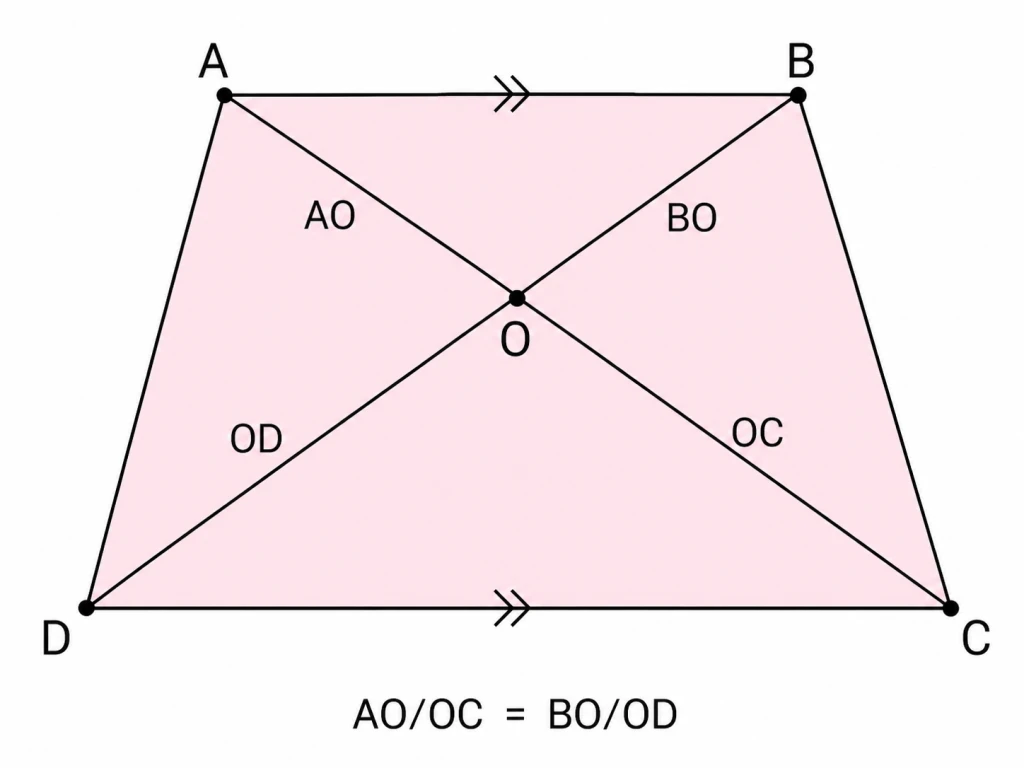
Key Point: Whenever a line is parallel to a side (or to the parallel sides of a trapezium), set up the equal-ratio relation from BPT.
[Board Important] In a trapezium with , the diagonals divide each other proportionally — a frequent 3-mark proof or computation.
Solved Examples
Example 1: Find a length using BPT
In , with on , on . If cm, cm, cm, find .
Solution:
- By BPT, .
- cm.
Final Answer: cm.
Takeaway: Substitute into and cross-multiply.
Example 2: Find
In , . , , , . Find .
Solution:
- BPT: .
- Cross-multiply: .
- .
Final Answer: .
Takeaway: BPT often produces a solvable equation in .
Example 3: Prove
In , on , on with cm, cm, cm, cm. Is ?
Solution:
- ; .
- The ratios are equal, so by the converse of BPT, .
Final Answer: Yes, .
Takeaway: Equal ratios ⇒ parallel (converse of BPT).
Example 4: Part-to-whole form
In , with on , on . If , , , find .
Solution:
- By BPT (part to whole): .
- .
Final Answer: .
Takeaway: Use the part-to-whole form when whole sides are given.
Example 5: Trapezium diagonals
In trapezium with , the diagonals meet at . If , , , find .
Solution:
- Diagonals divide each other in the same ratio: .
- .
Final Answer: .
Takeaway: Trapezium diagonals split proportionally.
Example 6: Mid-point line
In , is the midpoint of and meets at . Show is the midpoint of .
Solution:
- midpoint ⇒ , so .
- By BPT, .
- So is the midpoint of .
Final Answer: is the midpoint of .
Takeaway: This is the midpoint theorem, a special case of BPT.
Example 7: Find
In , . cm, cm, cm. Find .
Solution:
- .
- cm.
Final Answer: cm.
Takeaway: Rearrange the proportion to solve for the unknown segment.
Example 8: Two unknown ratios
In , . If and cm, find and .
Solution:
- By BPT, , so .
- . Parts: , .
Final Answer: cm, cm.
Takeaway: Split the whole side in the BPT ratio.
Example 9: Not parallel
In , on , on with , , , . Is ?
Solution:
- ; .
- .
Final Answer: No, is not parallel to .
Takeaway: Unequal ratios ⇒ not parallel (converse fails).
Example 10: BPT with algebra
In , with , , , . Find .
Solution:
- BPT: .
- Cross-multiply: .
- .
- (reject as it makes lengths negative).
Final Answer: .
Takeaway: Cross-multiplying BPT can give a quadratic; reject inadmissible roots.