
The Pythagoras Theorem
One of the most famous results in all of mathematics.
Pythagoras Theorem: In a right-angled triangle, the square of the hypotenuse (the side opposite the right angle) equals the sum of the squares of the other two sides.
If is right-angled at , with hypotenuse , then:
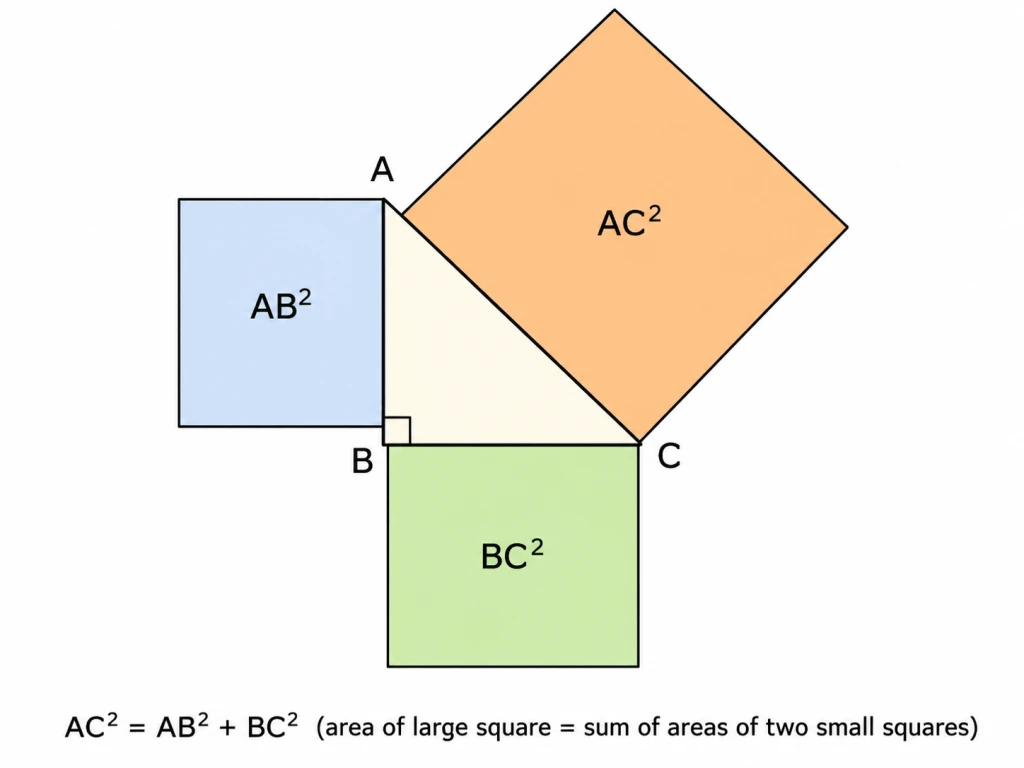
Key Point: The hypotenuse is always the longest side, opposite the right angle. Its square equals the sum of the squares of the two legs.
[Board Important] In rationalised CBSE the proof was trimmed, but the theorem is heavily used and is retained in State Boards. Identify the hypotenuse correctly before applying it.
The Converse of Pythagoras
The converse lets us test whether a triangle is right-angled.
Converse: In a triangle, if the square of one side equals the sum of the squares of the other two sides, then the angle opposite the first side is a right angle.
So if for some triangle, then the angle at (opposite ) is .
Example
Sides : . So the triangle is right-angled (right angle opposite the side of length 5).
Key Point: Check whether (largest side) = sum of squares of the other two. If yes, the triangle is right-angled; if not, it isn't.
[Board Important] Sets like , , , are Pythagorean triples — memorise a few to spot right triangles quickly.
Applications — Finding a Side
Given any two sides of a right triangle, the third follows from .
- Find the hypotenuse: .
- Find a leg: .
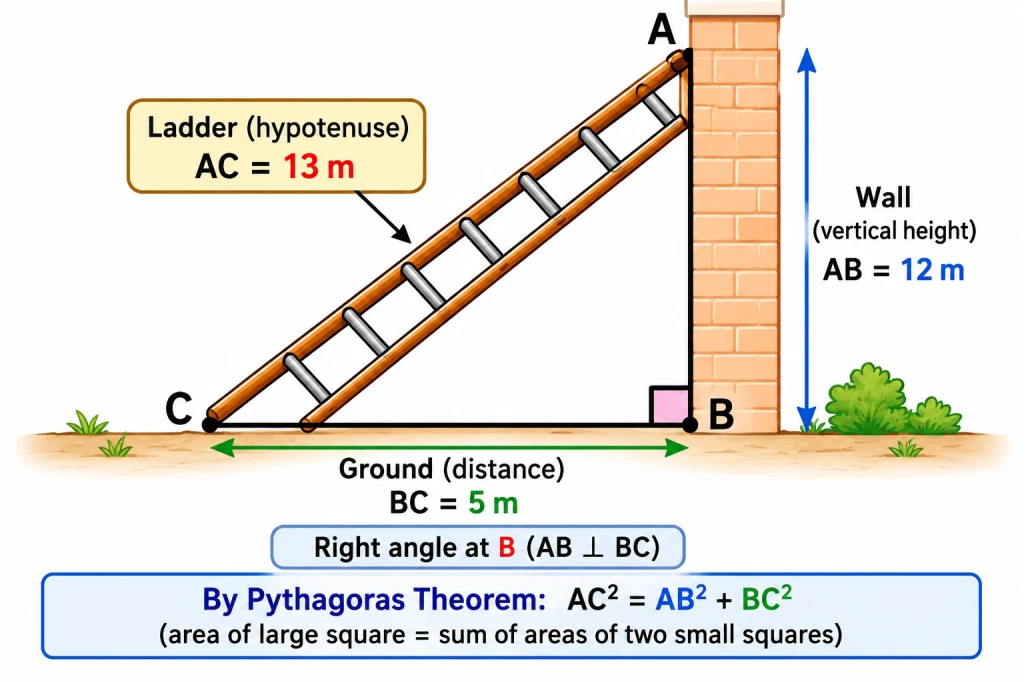
Key Point: Rearrange the theorem to solve for whichever side is unknown — add squares for the hypotenuse, subtract for a leg.
[Board Important] Real-life problems (ladders, poles, distances) form right triangles. Identify which length is the hypotenuse (always the slant/longest) before substituting.
Pythagoras and Similar Triangles
The Pythagoras theorem is closely linked to similarity. The altitude from the right angle to the hypotenuse creates two smaller triangles, each similar to the original — and this relationship is one elegant way to prove the theorem.
A useful related result
In right (right angle at ) with :
- (the altitude is the geometric mean of the segments of the hypotenuse),
- and .
Key Point: The altitude to the hypotenuse splits a right triangle into two triangles similar to it and to each other.
[Board Important] These 'mean proportional' results () appear in State Board exams and follow directly from the similar triangles formed.
Solved Examples
Example 1: Find the hypotenuse
In right (right angle at ), cm, cm. Find .
Solution:
- .
- cm.
Final Answer: cm.
Takeaway: Add the squares of the legs, then take the square root.
Example 2: Find a leg
A right triangle has hypotenuse 13 cm and one leg 5 cm. Find the other leg.
Solution:
- Other leg cm.
Final Answer: 12 cm.
Takeaway: Subtract the known leg's square from the hypotenuse's square.
Example 3: Test for a right angle
Is a triangle with sides 7 cm, 24 cm, 25 cm right-angled?
Solution:
- Largest side is 25. Check .
- Equal, so by the converse the triangle is right-angled.
Final Answer: Yes, right-angled (right angle opposite 25 cm).
Takeaway: is a Pythagorean triple.
Example 4: Not right-angled
Is a triangle with sides 4, 5, 6 right-angled?
Solution:
- Largest side 6: , but .
- .
Final Answer: No, it is not right-angled.
Takeaway: If the squares don't match, the triangle isn't right-angled.
Example 5: Ladder problem
A ladder 13 m long reaches a window 12 m above the ground. How far is the foot of the ladder from the wall?
Solution:
- The ladder is the hypotenuse (13), the height is one leg (12).
- Distance m.
Final Answer: 5 m.
Takeaway: The ladder is the hypotenuse; solve for the ground distance (a leg).
Example 6: Diagonal of a rectangle
A rectangle is 9 cm by 12 cm. Find the length of its diagonal.
Solution:
- The diagonal is the hypotenuse of a right triangle with legs 9 and 12.
- Diagonal cm.
Final Answer: 15 cm.
Takeaway: A rectangle's diagonal uses Pythagoras with the two sides as legs.
Example 7: Equilateral triangle altitude
Find the altitude (height) of an equilateral triangle of side 10 cm.
Solution:
- The altitude splits the base into two halves of 5 cm and forms a right triangle with hypotenuse 10.
- Height cm.
Final Answer: cm.
Takeaway: The altitude of a side- equilateral triangle is .
Example 8: Two poles
Two poles of heights 6 m and 11 m stand on level ground. If the distance between their feet is 12 m, find the distance between their tops.
Solution:
- The difference in heights is m (vertical leg); the horizontal distance is 12 m.
- Distance between tops m.
Final Answer: 13 m.
Takeaway: Use the height difference and the ground distance as the two legs.
Example 9: Mean proportional (altitude)
In right (right angle at ), . If cm and cm, find .
Solution:
- The altitude is the geometric mean: .
- cm.
Final Answer: cm.
Takeaway: for the altitude to the hypotenuse.
Example 10: Distance walked
A man walks 15 m due east, then 8 m due north. How far is he from the starting point?
Solution:
- East and north legs are perpendicular: legs 15 and 8.
- Distance m.
Final Answer: 17 m.
Takeaway: Perpendicular displacements form a right triangle; the straight-line distance is the hypotenuse.