
Congruent vs Similar
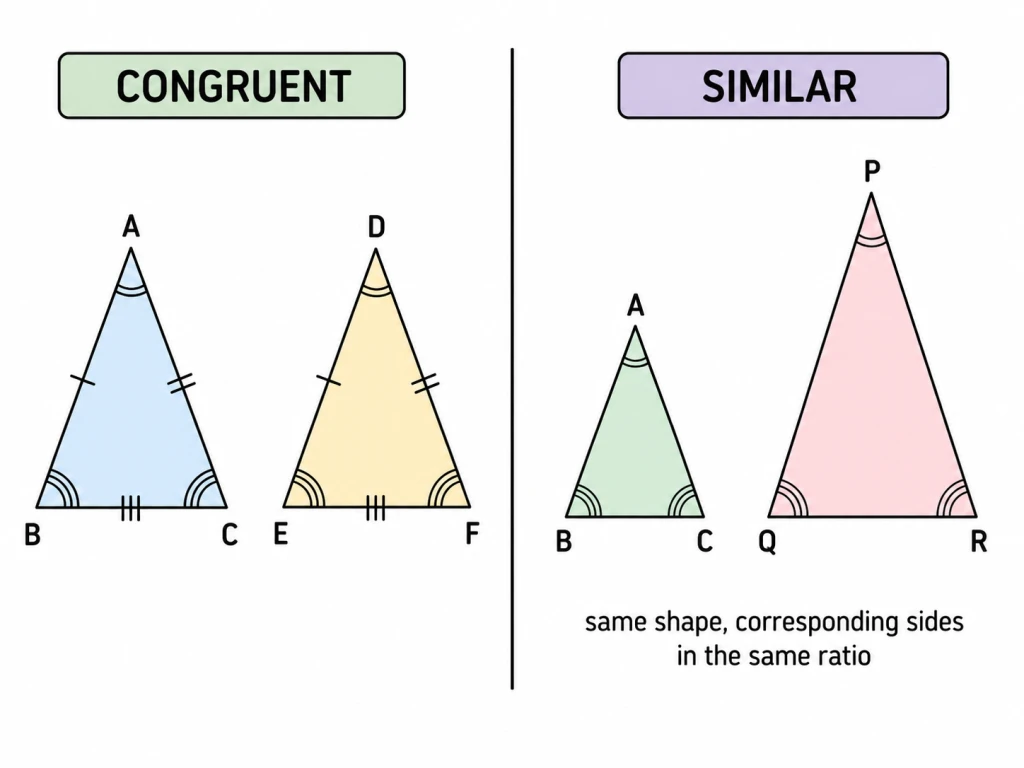
Think about two photographs of the same person — one small, one large. They look exactly alike in shape, but differ in size. In geometry, such figures are called similar.
- Congruent figures have the same shape AND the same size — one can be placed exactly over the other.
- Similar figures have the same shape but not necessarily the same size — one is an enlargement or reduction of the other.
Key Point: All congruent figures are similar, but similar figures need not be congruent. Congruence is the special case of similarity where the ratio of sizes is 1.
Think of it this way: similar = 'same shape, scaled'; congruent = 'same shape, same scale'.
[Board Important] Two circles are always similar; two squares are always similar; but two rectangles or two triangles are similar only under conditions we will study.
When Are Two Polygons Similar?
Two polygons with the same number of sides are similar if both of these hold:
- their corresponding angles are equal, and
- their corresponding sides are in the same ratio (proportional).
Both conditions are needed. One alone is not enough.
Example
A square and a rectangle both have all angles 90°, but their sides are not in the same ratio, so they are not similar. A rhombus and a square both have proportional sides (in some cases) but unequal angles, so again not similar.
Key Point: For polygons, similarity needs BOTH equal angles AND proportional sides. (For triangles, we'll see that just one of these is often enough — that's special.)
[Board Important] State both conditions when defining similar polygons in the exam — leaving one out loses marks.
The Symbol and Correspondence
We write '' to mean triangle is similar to triangle . The symbol '' means 'is similar to'.
The order of letters matters — it tells you the correspondence:
- , , .
- So , , , and .
Key Point: Always write similar triangles in correct corresponding order. The equal angles and proportional sides must be matched by position in the names.
[Board Important] If , the ratio pairs the first letters with the first letters, and so on. Getting the order wrong gives wrong ratios.
The Ratio of Similarity (Scale Factor)
When two figures are similar, the common ratio of corresponding sides is the scale factor (or ratio of similarity), often written .
- If , the figures are congruent.
- If , the first is an enlargement; if , a reduction.
The ratio of perimeters of two similar figures equals (the same as the side ratio).
Key Point: For similar figures, perimeters are in the same ratio as the sides. (Areas, as we'll see later, are in the ratio .)
[Board Important] A common 1-mark question: 'If two similar triangles have sides in ratio 2:3, what is the ratio of their perimeters?' Answer: 2:3 (same as sides).
Solved Examples
Example 1: Congruent or similar?
Two triangles have exactly the same shape and size. Are they congruent, similar, both, or neither?
Solution:
- Same shape and size ⇒ congruent.
- Same shape ⇒ also similar (with scale factor 1).
Final Answer: Both (congruent triangles are a special case of similar).
Takeaway: Congruent ⇒ similar, but not conversely.
Example 2: Are all squares similar?
Are any two squares always similar?
Solution:
- All squares have equal angles (90°).
- All sides of a square are equal, so corresponding sides are always in the same ratio.
- Both conditions hold.
Final Answer: Yes, any two squares are similar.
Takeaway: Regular figures of the same type (squares, equilateral triangles, circles) are always similar.
Example 3: Rectangles need not be similar
Is a 2 × 4 rectangle similar to a 3 × 9 rectangle?
Solution:
- Both have all 90° angles.
- Side ratios: and . Since , sides are not proportional.
Final Answer: No, they are not similar.
Takeaway: Equal angles alone don't make polygons similar — sides must be proportional too.
Example 4: Read the correspondence
If , which angle equals and which ratio equals ?
Solution:
- Correspondence: , , .
- So , and .
Final Answer: ; .
Takeaway: Match letters by position to get correct angle and side correspondences.
Example 5: Scale factor
with cm and cm. Find the scale factor (ratio of to ).
Solution:
- .
Final Answer: .
Takeaway: Scale factor = ratio of corresponding sides.
Example 6: Ratio of perimeters
Two similar triangles have corresponding sides in the ratio 5 : 7. Find the ratio of their perimeters.
Solution:
- For similar figures, the ratio of perimeters equals the ratio of sides.
- So the ratio is .
Final Answer: .
Takeaway: Perimeter ratio = side ratio for similar figures.
Example 7: Find a side using similarity
with . If cm, find .
Solution:
- All side ratios equal , so .
- cm.
Final Answer: cm.
Takeaway: Use the common ratio to find any unknown corresponding side.
Example 8: Equilateral triangles
Are any two equilateral triangles similar? Justify.
Solution:
- Every equilateral triangle has all angles 60°, so corresponding angles are equal.
- All three sides equal, so corresponding sides are proportional.
Final Answer: Yes, all equilateral triangles are similar.
Takeaway: Same fixed angles + equal sides ⇒ always similar.
Example 9: Similar polygons — find a side
Two similar pentagons have a pair of corresponding sides 8 cm and 12 cm. A side of the smaller pentagon is 6 cm. Find the corresponding side of the larger.
Solution:
- Scale factor (larger : smaller) .
- Corresponding side cm.
Final Answer: 9 cm.
Takeaway: Multiply by the scale factor to go from one figure to the other.
Example 10: Why two figures are not similar
Explain why a circle and an ellipse (oval) are not similar.
Solution:
- Similarity requires the same shape, scaled uniformly in all directions.
- An ellipse is stretched more in one direction than another, so it is not a uniform scaling of a circle.
Final Answer: They are not similar (the shapes differ).
Takeaway: Similar figures are exact scaled copies — uniform in every direction.