
Why We Need Criteria
For general polygons, similarity needs both equal angles and proportional sides. But triangles are special — for triangles, one of these conditions usually forces the other. This gives us quick similarity criteria (shortcuts) to decide similarity without checking everything.
There are three main criteria: AAA (or AA), SSS, and SAS. We look at each in turn.
Key Point: For triangles, you don't need to verify both conditions fully — one criterion (AA, SSS, or SAS) is enough to conclude similarity.
[Board Important] Always write the similarity statement in the correct correspondence (), matching equal angles and proportional sides by position.
AAA and AA Similarity
AAA criterion: If in two triangles the corresponding angles are equal, then their corresponding sides are in the same ratio, and the triangles are similar.
Since the angles of a triangle sum to 180°, if two pairs of angles are equal, the third pair is automatically equal. So we usually just check two angles — this is the AA criterion.
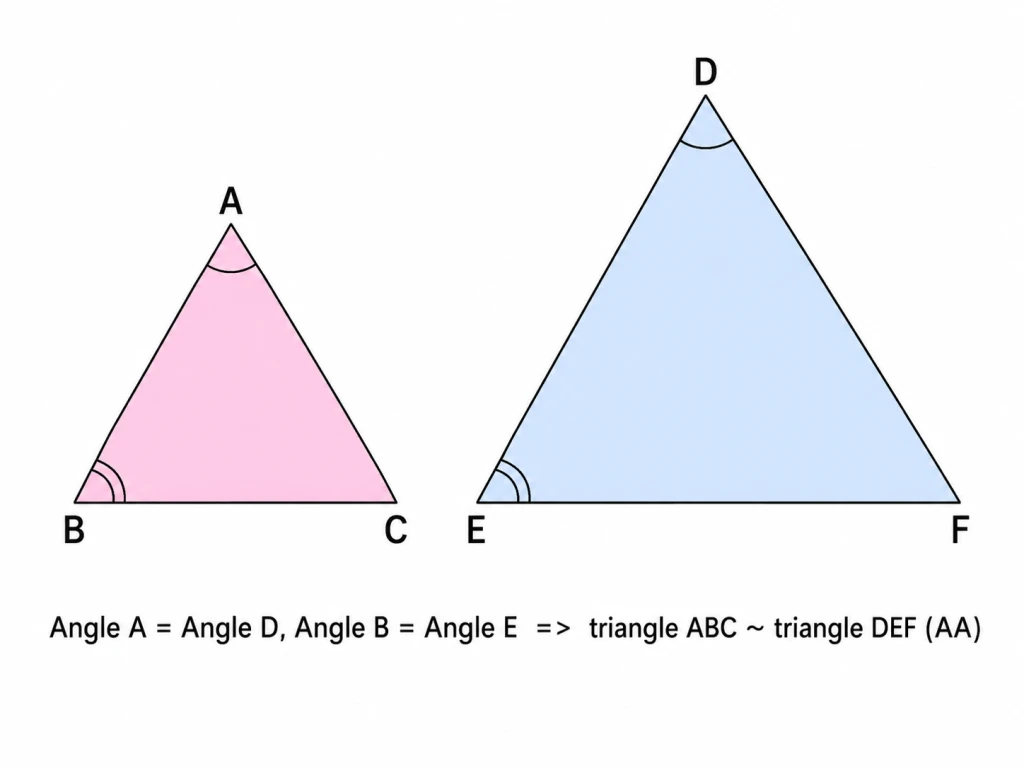
Key Point: AA is the most-used criterion. Two equal angles ⇒ similar triangles. The third angle and the side ratios follow automatically.
[Board Important] When two triangles share equal angles (often from parallel lines or vertically opposite angles), state 'by AA similarity' to conclude .
SSS and SAS Similarity
SSS criterion: If the corresponding sides of two triangles are in the same ratio (proportional), then their corresponding angles are equal and the triangles are similar.
SAS criterion: If one angle of a triangle equals one angle of the other, and the sides including these equal angles are in the same ratio, then the triangles are similar.
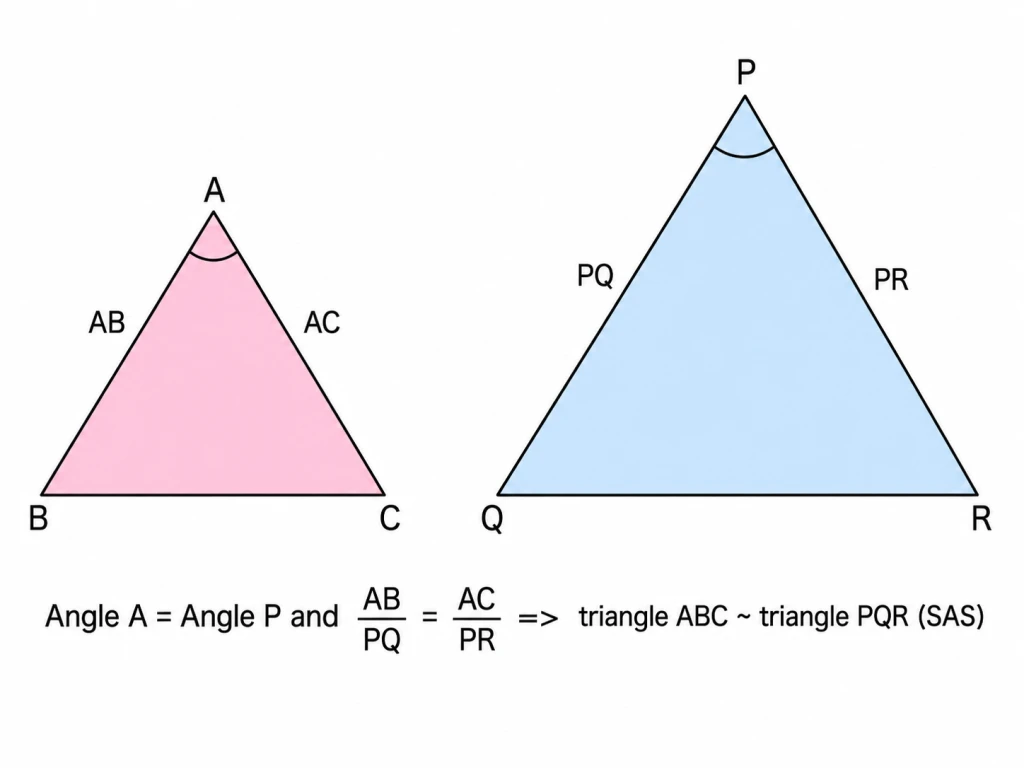
Key Point: For SAS, the equal angle must be the included angle — the angle between the two proportional sides. An equal non-included angle does NOT guarantee similarity.
[Board Important] Distinguish SAS similarity (one equal angle + two proportional sides) from SAS congruence (one equal angle + two equal sides). Similarity uses ratios; congruence uses equalities.
Using Similarity to Find Sides
Once two triangles are proved similar (by any criterion), all pairs of corresponding sides are in the same ratio. This lets you find unknown lengths.
Worked outline
If with , and , , , then .
Key Point: First prove similarity (state the criterion), then write the equal ratios in correct correspondence, then solve for the unknown.
[Board Important] In the exam, structure your answer: (1) identify equal angles/proportional sides, (2) cite the criterion, (3) write 'therefore ', (4) use the side ratios. Each step carries marks.
Solved Examples
Example 1: AA similarity (parallel lines)
Two lines and intersect at with . Show .
Solution:
- (vertically opposite angles).
- (alternate angles, since ).
- By AA, .
Final Answer: (AA).
Takeaway: Parallel lines give equal alternate angles; vertically opposite angles are equal.
Example 2: Find an angle
. If and , find .
Solution:
- .
- By correspondence, .
Final Answer: .
Takeaway: Corresponding angles of similar triangles are equal.
Example 3: SSS similarity check
Are triangles with sides and similar?
Solution:
- Ratios: .
- All three ratios equal, so by SSS the triangles are similar.
Final Answer: Yes, similar (SSS).
Takeaway: All three side ratios equal ⇒ SSS similarity.
Example 4: SAS similarity
In and , , , , , . Are they similar?
Solution:
- ; .
- The sides including the equal angle are proportional.
- By SAS, .
Final Answer: Yes, similar (SAS).
Takeaway: Equal included angle + proportional including-sides ⇒ SAS.
Example 5: Find a side
with , , . Find .
Solution:
- .
- .
Final Answer: .
Takeaway: Use the common ratio with the correct correspondence.
Example 6: Tower/shadow (AA)
A girl 90 cm tall casts a shadow. At the same time a lamp-post casts a shadow. The triangles formed (object + shadow) are similar. If the girl's shadow is 1.2 m and the lamp-post's shadow is 4.8 m, find the lamp-post's height.
Solution:
- Sun's rays make equal angles, so the triangles are similar (AA).
- is constant: .
- m.
Final Answer: 3.6 m.
Takeaway: Object-and-shadow problems use AA similarity (equal sun-ray angle).
Example 7: Altitude in a right triangle
In right , right-angled at , . Show … more precisely .
Solution:
- is common to both triangles.
- .
- By AA, .
Final Answer: (AA).
Takeaway: The altitude to the hypotenuse creates triangles similar to the original.
Example 8: Find via similarity
with , , , . Find .
Solution:
- .
- .
Final Answer: .
Takeaway: Set up the proportion and solve.
Example 9: Medians of similar triangles
If with ratio of sides , what is the ratio of their corresponding medians?
Solution:
- In similar triangles, corresponding medians are in the same ratio as the sides.
- So the ratio of medians is .
Final Answer: .
Takeaway: Medians, altitudes, and angle bisectors of similar triangles share the side ratio.
Example 10: Not similar by SAS
In and , , , , , . Are they similar by SAS?
Solution:
- ; .
- , so the including sides are not proportional.
Final Answer: No, not similar by SAS.
Takeaway: SAS needs the including sides in equal ratio — here they are not.