
Same Syllabus. A Different Exam.
The Solved Examples section worked this chapter the way a textbook does - define, describe, compare. NEET does not ask you to describe anything. It hands you one line, four options and about half a minute, and it wants the right one.
So this section covers the same syllabus with a different question in mind: not "do you understand this?" but "can you place it instantly and eliminate the other three?"
The marking is what forces the change. A correct answer is +4 and a wrong one is -1, so a guess you are not sure of costs you a mark and, worse, costs you the time you spent on it. Biological Classification is a high-yield chapter and everything it can ask you is either a named example, a row of Table 2.1, or a date. There is nothing here to work out.
Key Point: This is a list chapter. Whoever holds the lists holds the marks. If you find yourself reasoning your way towards an answer here, you have already spent the time this chapter was supposed to save you.
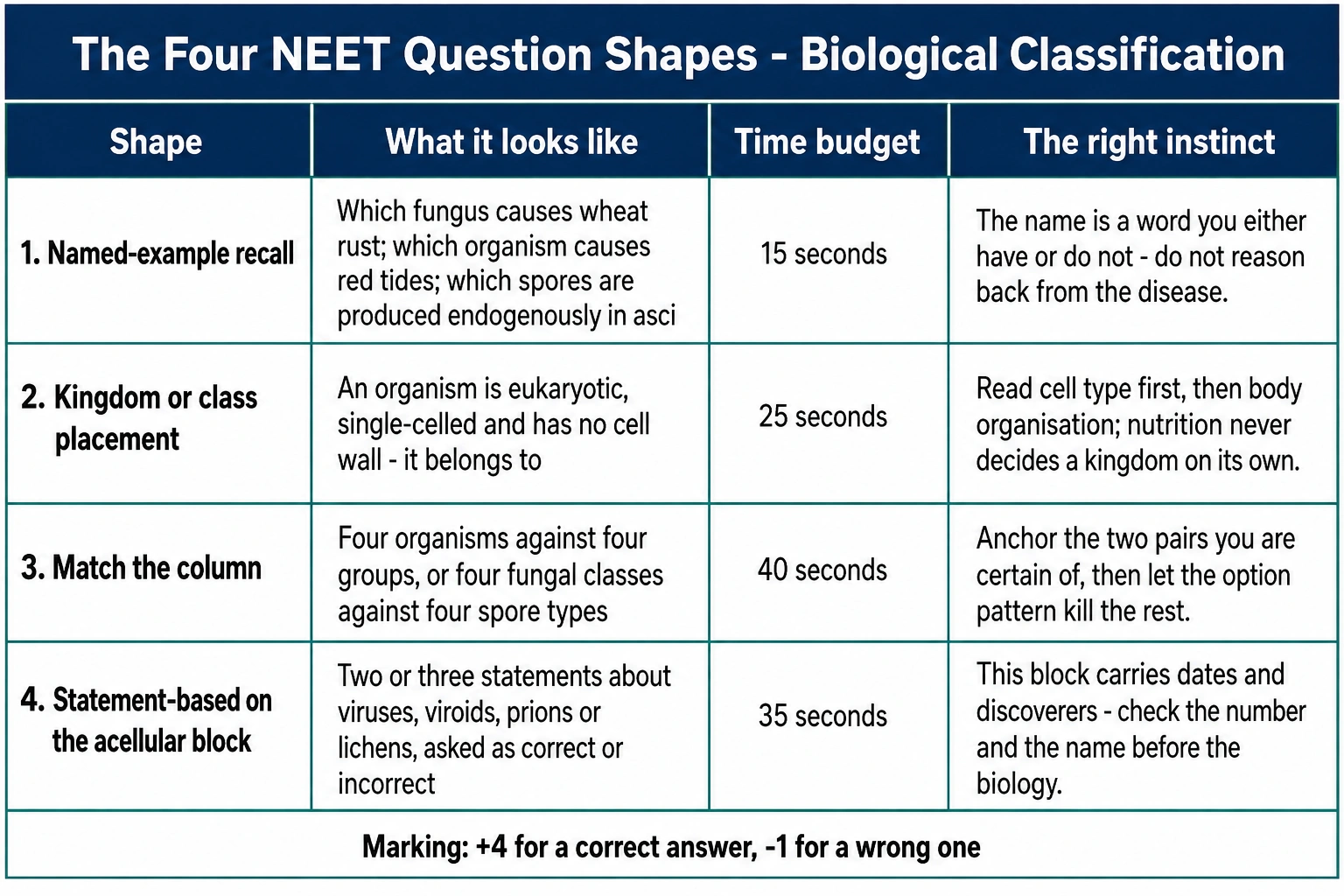
The four shapes, and what each should cost you
| Shape | What it looks like | Budget | The right instinct |
|---|---|---|---|
| 1. Named-example recall | "Which fungus causes wheat rust?" "Which organism causes red tides?" "Which spores are produced endogenously in asci?" | 15 seconds | The name is a word you either have or do not. Do not reason back from the disease - move on if the name is not there. |
| 2. Kingdom or class placement | "An organism is eukaryotic, single-celled and has no cell wall. It belongs to…" | 25 seconds | Read cell type first, then body organisation. Mode of nutrition never decides a kingdom on its own. |
| 3. Match the column | Four organisms against four groups, or four fungal classes against four spore types | 40 seconds | Anchor the two pairs you are certain of, then let the option pattern kill the rest. Never work all four. |
| 4. Statement-based on the acellular block | Two or three statements about viruses, viroids, prions or lichens, asked as correct or incorrect | 35 seconds | This block carries dates and discoverers. Check the number and the name before you check the biology. |
What this section repeats, and what it does not
It does not re-explain the chapter. It gives you the exact wording the exam quotes, the tables it turns into matching items, the named examples it expects on sight, and the confusable pairs every wrong option is built from - and then drills them at speed.
The Exact-Recall Card
This chapter is quoted almost word for word, so approximate memory is the main way marks are lost here. Learn these as phrases, not as ideas.
| Term | The wording that scores |
|---|---|
| Whittaker's five criteria | Cell structure, body organisation, mode of nutrition, reproduction and phylogenetic relationships |
| Monera | Bacteria are the sole members; bacteria as a group show the most extensive metabolic diversity |
| Mycoplasma | Completely lack a cell wall; the smallest living cells known; can survive without oxygen; many are pathogenic in animals and plants |
| Heterocysts | Specialised cells in which cyanobacteria fix atmospheric nitrogen, e.g. Nostoc and Anabaena |
| Protista | All single-celled eukaryotes; the boundaries of this kingdom are not well defined |
| Diatom cell wall | Two thin overlapping shells which fit together as in a soap box, embedded with silica, and therefore indestructible |
| Diatomaceous earth | The accumulation of diatom cell wall deposits over billions of years; being gritty it is used in polishing and in filtration of oils and syrups |
| Red tide | Red dinoflagellates such as Gonyaulax multiply so rapidly that they make the sea appear red; their toxins may kill other marine animals such as fishes |
| Pellicle | A protein rich layer in place of a cell wall in euglenoids, which makes the body flexible |
| Plasmodium (slime mould) | An aggregation formed under suitable conditions which may grow and spread over several feet |
| Mycelium | The network of hyphae |
| Coenocytic hyphae | Continuous tubes filled with multinucleated cytoplasm |
| Dikaryon | An intervening stage of n + n, two nuclei per cell, in ascomycetes and basidiomycetes; the phase is the dikaryophase |
| Basis of fungal classes | Morphology of the mycelium, mode of spore formation and fruiting bodies |
| Deuteromycetes | The imperfect fungi, because only the asexual or vegetative phases are known |
| Virus | Non-cellular, with an inert crystalline structure outside the living cell; a nucleoprotein; an obligate parasite |
| Capsid | The protein coat made of subunits called capsomeres, arranged in helical or polyhedral geometric forms |
| Viroid | Smaller than a virus; a free RNA which lacks the protein coat found in viruses; the RNA is of low molecular weight |
| Prion | An agent of abnormally folded protein, similar in size to viruses |
| Lichen | A symbiotic, mutually useful association between algae and fungi; very good pollution indicators - they do not grow in polluted areas |
| Animalia | Heterotrophic, eukaryotic, multicellular, cells lack cell walls; nutrition is holozoic, by ingestion; reserves stored as glycogen or fat |
The dates and the names
These four lines are set as a block, and the distractor is always a swapped year or a swapped person.
| Year | Who | What |
|---|---|---|
| 1892 | Dmitri Ivanowsky | Recognised certain microbes as the causal organism of the mosaic disease of tobacco; they passed through bacteria-proof filters |
| 1898 | M. W. Beijerinck | Showed the extract of infected tobacco plants could infect healthy plants; named the pathogen virus and the fluid Contagium vivum fluidum, meaning infectious living fluid |
| 1935 | W. M. Stanley | Showed viruses could be crystallised and that the crystals consist largely of proteins |
| 1971 | T. O. Diener | Discovered the viroid, which caused potato spindle tuber disease |
Two more numbers. R. H. Whittaker proposed the Five Kingdom Classification in 1969. The three-domain system divides Monera into two domains and so gives a six kingdom classification.
[NEET Important] The genetic material line is set almost every year in one form or another. A virus contains either RNA or DNA - no virus contains both. Plant viruses generally have single stranded RNA; animal viruses have single or double stranded RNA or double stranded DNA; bacteriophages are usually double stranded DNA viruses. Any option that gives a virus both nucleic acids is dead on sight.
Table 2.1, Rebuilt as a Matching Table
Almost every "identify the kingdom" question is this table read as a decision tree. Learn it as columns you can recite down, because that is how the matching item is built.
| Character | Monera | Protista | Fungi | Plantae | Animalia |
|---|---|---|---|---|---|
| Cell type | Prokaryotic | Eukaryotic | Eukaryotic | Eukaryotic | Eukaryotic |
| Cell wall | Noncellulosic - polysaccharide plus amino acid | Present in some | Present, with chitin | Present, cellulose | Absent |
| Nuclear membrane | Absent | Present | Present | Present | Present |
| Body organisation | Cellular | Cellular | Multicellular or loose tissue | Tissue or organ | Tissue, organ or organ system |
| Mode of nutrition | Autotrophic - chemosynthetic and photosynthetic - and heterotrophic - saprophytic or parasitic | Autotrophic (photosynthetic) and heterotrophic | Heterotrophic - saprophytic or parasitic | Autotrophic (photosynthetic) | Heterotrophic - holozoic, saprophytic |
The 20-second placement ladder
Run it in this order. The first two steps settle four questions out of five.
- Is there a nuclear membrane? No means Monera, and nothing else matters. This is what puts cyanobacteria in Monera even though they are photosynthetic and are called blue-green algae.
- Is it a single cell? A single-celled eukaryote is Protista, whatever it eats. This is what puts diatoms in Protista even though they are the chief producers in the oceans.
- What is the wall made of? Chitin means Fungi; cellulose means Plantae; no wall at all, in a multicellular eukaryote, means Animalia.
- Only now look at nutrition. It separates Fungi from Plantae once you already know both are multicellular eukaryotes with walls. On its own it decides nothing.
[NEET Important] The single commonest trap in this chapter is an option that decides a kingdom from nutrition alone. Photosynthetic does not mean Plantae - cyanobacteria and diatoms are both photosynthetic and neither is a plant. Cell type first, body organisation second, nutrition last.
The other three tables NEET converts into matching items
Bacterial shapes.
| Shape | Name |
|---|---|
| Spherical | Coccus, plural cocci |
| Rod-shaped | Bacillus, plural bacilli |
| Comma-shaped | Vibrium, plural vibrio |
| Spiral | Spirillum, plural spirilla |
Archaebacterial habitats.
| Habitat | Group |
|---|---|
| Extreme salty areas | Halophiles |
| Hot springs | Thermoacidophiles |
| Marshy areas | Methanogens |
The four fungal classes. This is the table the comparison questions are cut from, so read it in rows and in columns.
| Class | Mycelium | Asexual spores | Sexual spores | Fruiting body |
|---|---|---|---|---|
| Phycomycetes | Aseptate and coenocytic | Zoospores (motile) or aplanospores (non-motile), produced endogenously in a sporangium | Zygospore, from isogamous, anisogamous or oogamous gametes | None named |
| Ascomycetes | Branched and septate | Conidia, produced exogenously on conidiophores | Ascospores, produced endogenously in sac-like asci | Ascocarp |
| Basidiomycetes | Branched and septate | Generally not found; fragmentation is common | Four basidiospores, produced exogenously on the basidium | Basidiocarp |
| Deuteromycetes | Septate and branched | Conidia only | Sexual stage unknown | None |
The two words that carry these rows. Endogenous goes with sporangiospores and ascospores; exogenous goes with conidia and basidiospores. Swap those two and you have the commonest wrong option in the fungal block.
The Named Examples It Expects on Sight
There are close to fifty names in this chapter and NEET asks them straight. A name you have to think about is a name you do not have. Read this table down until each row is instant.
| Name | What it is | The one fact attached to it |
|---|---|---|
| Nostoc, Anabaena | Cyanobacteria, Monera | Fix atmospheric nitrogen in heterocysts |
| Mycoplasma | Monera | Smallest living cells known, completely lack a cell wall |
| Halophiles, thermoacidophiles, methanogens | Archaebacteria | Salty areas, hot springs, marshy areas |
| Diatoms | Chrysophytes, Protista | Chief producers in the oceans; diatomaceous earth |
| Desmids | Golden algae, chrysophytes | Grouped with diatoms |
| Gonyaulax | Dinoflagellate, Protista | Red tides |
| Euglena | Euglenoid, Protista | Pellicle; two flagella, a short and a long one |
| Slime moulds | Protista | Saprophytic; form a plasmodium; spores possess true walls |
| Amoeba | Amoeboid protozoan | Moves and captures prey by pseudopodia |
| Entamoeba | Amoeboid protozoan | Parasite |
| Trypanosoma | Flagellated protozoan | Sleeping sickness |
| Paramoecium | Ciliated protozoan | Thousands of cilia; a gullet |
| Plasmodium | Sporozoan | Malaria |
| Mucor, Rhizopus, Albugo | Phycomycetes | Rhizopus is the bread mould; Albugo is the parasitic fungus on mustard |
| Aspergillus, Claviceps, Neurospora | Ascomycetes | Neurospora is used extensively in biochemical and genetic work |
| Yeast (Saccharomyces) | Ascomycete | The unicellular exception among fungi |
| Morels and truffles | Ascomycetes | Edible, considered delicacies |
| Agaricus | Basidiomycete | The mushroom |
| Ustilago | Basidiomycete | Smut |
| Puccinia | Basidiomycete | Wheat rust |
| Alternaria, Colletotrichum, Trichoderma | Deuteromycetes | Decomposers of litter, helping in mineral cycling |
| Penicillium | Ascomycete | Source of antibiotics |
| Bladderwort, Venus fly trap | Plantae | Insectivorous, so partially heterotrophic |
| Cuscuta | Plantae | Parasite, so partially heterotrophic |
| Chlamydomonas, Chlorella | Protista now | Once in Algae within Plants because they have cell walls |
The diseases, as a straight match
| Organism | Disease |
|---|---|
| Trypanosoma | Sleeping sickness |
| Plasmodium | Malaria |
| Puccinia | Wheat rust |
| Ustilago | Smut |
| Albugo | White spots on mustard leaves |
| Bacteria | Cholera, typhoid, tetanus, citrus canker |
| Viruses | Mumps, small pox, herpes, influenza, and AIDS |
| Viroid | Potato spindle tuber disease |
| Prions | BSE, mad cow disease in cattle, and CJD in humans |
Plant viral symptoms, asked as a set: mosaic formation, leaf rolling and curling, yellowing and vein clearing, dwarfing and stunted growth.
The Confusable Pairs, and the Distractors Built From Them
Every wrong option in this chapter comes from one of these. Learn the pairs and you are reading the options instead of puzzling over them.
| Pair | The separator |
|---|---|
| Virus against viroid | A viroid is smaller, is free RNA and has no protein coat; its RNA is of low molecular weight. A virus has a capsid and carries RNA or DNA |
| Virus against prion | A prion is abnormally folded protein only, with no nucleic acid, though it is similar in size to viruses |
| Ivanowsky against Beijerinck against Stanley | 1892 recognised the microbe, 1898 named it virus and coined Contagium vivum fluidum, 1935 crystallised it |
| Cyanobacteria against algae | Cyanobacteria are prokaryotic, so Monera, however green they look and however like green plants their chlorophyll a is |
| Diatoms against plants | Diatoms are single-celled eukaryotes, so Protista, even though they are the chief producers in the oceans |
| Slime moulds against fungi | Slime moulds are protists with a cellular body forming a plasmodium; fungi are filamentous, built of hyphae with chitin walls |
| Coenocytic against septate hyphae | Coenocytic hyphae are continuous tubes with multinucleated cytoplasm and belong to Phycomycetes; the other three classes are septate |
| Endogenous against exogenous spores | Sporangiospores and ascospores are endogenous; conidia and basidiospores are exogenous |
| Ascocarp against basidiocarp | Ascospores sit in asci in ascocarps; basidiospores sit on basidia in basidiocarps |
| Zygospore against basidiospore | A zygospore is formed by fusion of two gametes in Phycomycetes; four basidiospores follow karyogamy and meiosis in the basidium |
| Plasmogamy against karyogamy | Plasmogamy is fusion of protoplasms; karyogamy is fusion of two nuclei. Meiosis in the zygote comes third |
| Phycobiont against mycobiont | Phycobiont is the alga and is autotrophic; mycobiont is the fungus and is heterotrophic |
| Halophile against methanogen | Salty areas against marshy areas and the gut of ruminants |
| Vibrium against spirillum | Comma-shaped against spiral |
| Holozoic against saprophytic | Holozoic is nutrition by ingestion, the animal mode; saprophytic is absorption from dead substrates, the fungal mode |
| Plasmodium the slime mould stage against Plasmodium the sporozoan | One is an aggregation that spreads over several feet; the other is the malarial parasite. The context word beside it tells you which |
The five distractor patterns
- Nutrition given as the deciding character. "Cyanobacteria are photosynthetic, therefore Plantae." Cell type decides. This is the pattern behind more wrong answers in this chapter than any other.
- The swapped date or discoverer. Stanley given 1898, Diener given 1961, Beijerinck credited with crystallising. Read the number before the sentence.
- Both nucleic acids in one virus. "Viruses contain RNA and DNA." No virus contains both. One glance kills the option.
- Endogenous and exogenous traded. "Conidia are produced endogenously." They are exogenous, on conidiophores. Check that one word before anything else in a fungal option.
- A real example moved one class sideways. Puccinia put in Ascomycetes, Rhizopus put in Basidiomycetes, Alternaria put in Phycomycetes. The name is right and the class is wrong, so the option reads well. Match the name to its class, not to its plausibility.
[NEET Important] When two options both look right, the difference is almost always one word - endogenous against exogenous, septate against aseptate, prokaryotic against eukaryotic, RNA against DNA. Go straight to that word rather than rereading the whole option.
Solved Examples at NEET Pace
Each item names the shortcut it uses, because the shortcut is the point.
Question 1
Q. An organism is eukaryotic, single-celled, has no cell wall and swims using thousands of short hair-like projections. Which kingdom, and which genus is likely?
Answer. Kingdom Protista, and the genus is likely Paramoecium. Run the placement ladder. There is a nuclear membrane, so it is not Monera. It is a single cell, so it is Protista and you can stop there - the wall and the nutrition never need reading. The thousands of cilia then name it a ciliated protozoan. Shortcut: cell type, then cellularity. Two steps, and you are done.
Question 2
Q. Which of these belongs to a different kingdom from the other three: Nostoc, Anabaena, Chlorella, Mycoplasma?
Answer. Chlorella. The other three are all prokaryotic and so sit in Monera - Nostoc and Anabaena are cyanobacteria with heterocysts, and Mycoplasma is the wall-less, smallest living cell. Chlorella is a single-celled eukaryote and is now in Protista, though it was once placed in Algae within Plants because it has a cell wall. Shortcut: sort the list by nuclear membrane first. The odd one out in this chapter is almost always the eukaryote hiding among prokaryotes.
Question 3
Q. Answer each in under 15 seconds. (i) Which organism causes red tides? (ii) What is the wall of a diatom made of and how is it built? (iii) Which fungus is used extensively in biochemical and genetic work? (iv) Which cells fix nitrogen in cyanobacteria? (v) Who named the fluid Contagium vivum fluidum?
Answer.
- (i) Gonyaulax, a red dinoflagellate.
- (ii) Two thin overlapping shells which fit together as in a soap box, embedded with silica and therefore indestructible.
- (iii) Neurospora.
- (iv) Heterocysts.
- (v) M. W. Beijerinck, in 1898.
Shortcut: these are pure recall. If a name does not arrive in five seconds it is not there, and the right move is to leave it and come back.
Question 4
Q. An option reads: "Conidia are the sexual spores of ascomycetes, produced endogenously in asci." How many faults, and what are they?
Answer. Two faults. Conidia are asexual, not sexual, and they are produced exogenously on conidiophores. The spores produced endogenously in sac-like asci are the ascospores, and those are the sexual ones. Shortcut: in any fungal option, check the word endogenous or exogenous first. Sporangiospores and ascospores are endogenous; conidia and basidiospores are exogenous.
Question 5
Q. Match each fungus to its class: Rhizopus, Claviceps, Ustilago, Trichoderma.
Answer. Rhizopus - Phycomycetes (the bread mould). Claviceps - Ascomycetes. Ustilago - Basidiomycetes (smut). Trichoderma - Deuteromycetes. Shortcut: anchor the two you are sure of and let the option pattern do the rest. In a four-pair match you almost never have to place all four yourself - two correct anchors usually leave only one option standing.
Question 6
Q. Cyanobacteria are photosynthetic and are called blue-green algae. Diatoms are photosynthetic and are the chief producers in the oceans. Why is neither in Kingdom Plantae?
Answer. Because nutrition does not decide a kingdom. Cyanobacteria are prokaryotic - no nuclear membrane - so cell structure puts them in Monera, and their chlorophyll a being similar to green plants does not change that. Diatoms are eukaryotic but single-celled, and all single-celled eukaryotes go to Protista. Plantae needs eukaryotic chlorophyll-containing organisms with tissue or organ level organisation and a cellulose wall, and neither group reaches it. Shortcut: this is distractor pattern one. Whenever an option argues from photosynthesis, check cell type and body organisation instead.
Question 7
Q. A statement reads: "A viroid is a free RNA of low molecular weight which lacks the protein coat found in viruses." Correct or incorrect? And how does a prion differ from both?
Answer. Correct, exactly as worded. A prion differs from both because it is abnormally folded protein only - it has no nucleic acid at all - though it is similar in size to viruses. Its notable diseases are BSE, or mad cow disease, in cattle and CJD in humans. Shortcut: line the three up by what they carry - virus carries RNA or DNA in a capsid, viroid carries RNA and no coat, prion carries protein and no nucleic acid. Every question in this block is decided by that one line.
A Drill Before You Move On
Decide each one before you read the verdict. Aim for 25 seconds each.
Question 8
Q. Which class of fungi has an aseptate, coenocytic mycelium, and which class has no known sexual stage?
Answer. Phycomycetes has the aseptate and coenocytic mycelium - continuous tubes filled with multinucleated cytoplasm. Deuteromycetes has no known sexual stage, which is why it is called the group of imperfect fungi; once a sexual stage is found, the member is moved to ascomycetes or basidiomycetes. Shortcut: only one class is aseptate and only one is imperfect. Learn those two as the endpoints of the table and the middle two sort themselves out.
Question 9
Q. Match each organism to its disease: Trypanosoma, Puccinia, Albugo, Plasmodium.
Answer. Trypanosoma - sleeping sickness. Puccinia - wheat rust. Albugo - the white spots on mustard leaves. Plasmodium - malaria. Shortcut: split by kingdom first. Trypanosoma and Plasmodium are protozoans and their diseases are animal diseases; Puccinia and Albugo are fungi and their diseases are plant diseases. That halves the grid before you match anything.
Question 10
Q. An option reads: "The three-domain system divides Kingdom Protista into two domains, giving a six kingdom classification." Accept or reject.
Answer. Reject. It is Kingdom Monera that is divided into two domains, with the remaining eukaryotic kingdoms in the third domain, and that is what gives the six kingdom classification. Shortcut: this is the swapped-noun distractor. The number six is right and the kingdom is wrong, so the option reads fluently. Check the noun the number is attached to.
Question 11
Q. State the three steps of the fungal sexual cycle in order, and say where the dikaryon fits.
Answer. (i) Plasmogamy - fusion of protoplasms between two motile or non-motile gametes. (ii) Karyogamy - fusion of two nuclei. (iii) Meiosis in the zygote, giving haploid spores. The dikaryon sits between plasmogamy and karyogamy, in ascomycetes and basidiomycetes, as an intervening stage of n plus n, two nuclei per cell; the phase is the dikaryophase. Shortcut: cytoplasms first, nuclei second, meiosis third. Any option that puts karyogamy before plasmogamy is inverted.
Question 12
Q. Arrange in order of increasing structural complexity and say what separates each step: a prion, a virus, Mycoplasma, Paramoecium.
Answer. Prion, virus, Mycoplasma, Paramoecium.
- Prion to virus: the prion is protein only; the virus adds nucleic acid, RNA or DNA, inside a capsid.
- Virus to Mycoplasma: the virus is still non-cellular and inert outside the host; Mycoplasma is a cell, in fact the smallest living cell known, though it completely lacks a cell wall.
- Mycoplasma to Paramoecium: Mycoplasma is prokaryotic; Paramoecium is eukaryotic, with a well defined nucleus and membrane-bound organelles.
Shortcut: the step that matters is virus to Mycoplasma, because that is the line between non-cellular and cellular - and the five kingdom classification is built on exactly that line, which is why viruses have no place in it.
Question 13
Q. An assertion reads: "Lichens are very good pollution indicators." A reason reads: "A lichen is a mutually useful association in which the phycobiont is heterotrophic and the mycobiont is autotrophic." Are both true?
Answer. The assertion is true and the reason is false. Lichens do not grow in polluted areas, which is what makes them good indicators. But the reason has the partners swapped - the phycobiont is the algal component and is autotrophic, and the mycobiont is the fungal component and is heterotrophic. Algae prepare food for the fungi; fungi provide shelter and absorb mineral nutrients and water. Shortcut: phyco goes with alga, myco goes with fungus. Read the prefix and the swap gives itself away.