
Bacteria Are the Sole Members
Bacteria are the sole members of the Kingdom Monera.
That one-line statement is worth a mark on its own, and it also settles a lot of "which kingdom?" questions: if it is a bacterium, it is Monera, full stop.
They are the most abundant micro-organisms. the chapter's illustration of the scale: hundreds of bacteria are present in a handful of soil.
Where they live: bacteria occur almost everywhere. They also live in extreme habitats where very few other life forms can survive -
- hot springs
- deserts
- snow
- deep oceans
And many of them live in or on other organisms as parasites.
The Four Shapes
Bacteria are grouped under four categories based on their shape.
| Shape category | Singular / plural | Shape |
|---|---|---|
| Coccus | coccus / cocci | Spherical |
| Bacillus | bacillus / bacilli | Rod-shaped |
| Vibrium | vibrium / vibrio | Comma-shaped |
| Spirillum | spirillum / spirilla | Spiral |
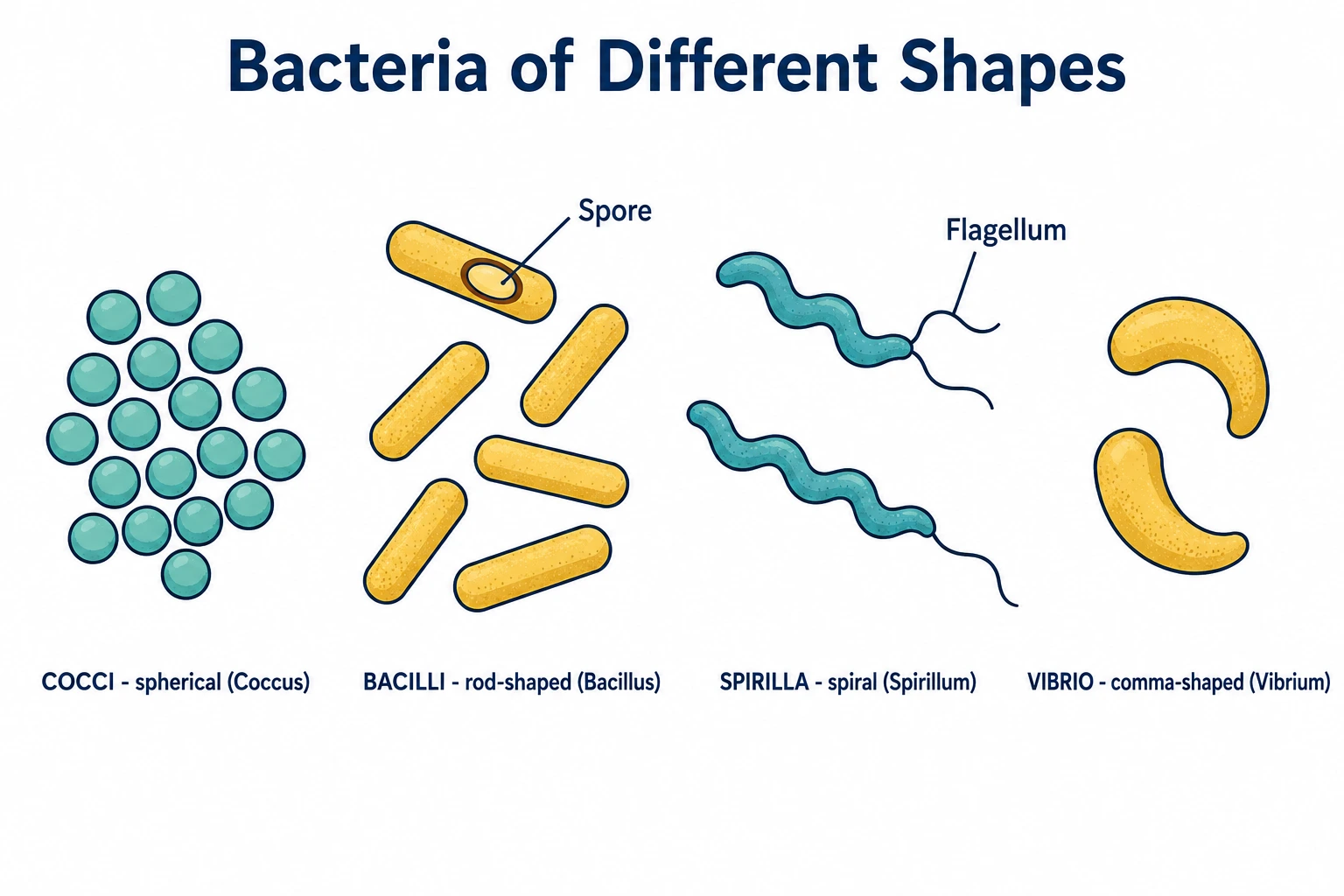
[NEET Important] Learn the shape-to-name pairing in both directions, and learn the plurals - NEET writes options using the plural form. The comma-shaped one is the one students most often miss: vibrium (pl. vibrio).
A memory hook: Coccus is a circle, bacillus is a bar, vibrium is a comma like a virgule, spirillum is a spiral.
Simple Structure, Complex Behaviour
There is a point here that is easy to skim past and is asked as an assertion-reason item:
Though the bacterial structure is very simple, they are very complex in behaviour.
Compared to many other organisms, bacteria as a group show the most extensive metabolic diversity.
So simplicity of structure and diversity of metabolism are two different things, and bacteria maximise the second while minimising the first.
Modes of Nutrition in Bacteria
The split is clean and it is examinable in both branches.
Autotrophic bacteria - they synthesise their own food from inorganic substrates. Two kinds:
- Photosynthetic autotrophic
- Chemosynthetic autotrophic
Heterotrophic bacteria - they depend on other organisms or on dead organic matter for food.
[NEET Important] The proportions matter. The vast majority of bacteria are heterotrophs. A question offering "most bacteria are autotrophic" is testing exactly this line.
And note how this feeds Table 2.1: Monera's mode of nutrition is listed as autotrophic (chemosynthetic and photosynthetic) and heterotrophic (saprophytic / parasitic) - both branches, which is why Monera cannot be called purely autotrophic or purely heterotrophic.
Quick Recap
- Bacteria are the sole members of Kingdom Monera and the most abundant micro-organisms - hundreds in a handful of soil.
- They occur almost everywhere, including hot springs, deserts, snow and deep oceans, and many live in or on other organisms as parasites.
- Four shape categories: spherical coccus (cocci), rod-shaped bacillus (bacilli), comma-shaped vibrium (vibrio), spiral spirillum (spirilla).
- Structure is very simple but behaviour is very complex; as a group bacteria show the most extensive metabolic diversity.
- Autotrophic bacteria synthesise food from inorganic substrates and are photosynthetic or chemosynthetic.
- The vast majority are heterotrophs, depending on other organisms or on dead organic matter.
Solved Examples
Question 1
Q. Who are the sole members of Kingdom Monera?
Answer. Bacteria.
Question 2
Q. Name the four shape categories of bacteria.
Answer. Coccus (spherical), bacillus (rod-shaped), vibrium (comma-shaped) and spirillum (spiral).
Question 3
Q. Give the plural forms of coccus, bacillus, vibrium and spirillum.
Answer. Cocci, bacilli, vibrio, spirilla.
Question 4
Q. Which shape category is comma-shaped?
Answer. Vibrium (pl. vibrio).
Question 5
Q. List four extreme habitats in which bacteria are found.
Answer. Hot springs, deserts, snow and deep oceans - habitats where very few other life forms can survive.
Question 6
Q. What does it mean to say bacteria show the most extensive metabolic diversity?
Answer. As a group, bacteria run a wider range of metabolic strategies than most other groups of organisms - some are photosynthetic autotrophs, some are chemosynthetic autotrophs that build food from inorganic substrates, and the vast majority are heterotrophs feeding on other organisms or on dead organic matter. Now set that against their very simple structure.
Question 7
Q. Are most bacteria autotrophic or heterotrophic?
Answer. Heterotrophic. the vast majority of bacteria are heterotrophs; autotrophic bacteria - photosynthetic or chemosynthetic - are the smaller group.
Question 8
Q. Distinguish photosynthetic autotrophic from chemosynthetic autotrophic bacteria in one line each.
Answer.
- Photosynthetic autotrophic: synthesise their own food from inorganic substrates using light energy.
- Chemosynthetic autotrophic: synthesise their own food from inorganic substrates using energy released by oxidising inorganic substances.
Question 9
Q. Why can Monera not be described as either purely autotrophic or purely heterotrophic in Table 2.1?
Answer. Because both modes happen inside the same kingdom. Table 2.1 gives Monera's mode of nutrition as autotrophic (chemosynthetic and photosynthetic) and heterotrophic (saprophytic / parasitic). Some bacteria build their own food from inorganic substrates, while the vast majority depend on other organisms or on dead organic matter. Only Plantae is purely autotrophic, and only Fungi and Animalia are purely heterotrophic.
Question 10
Q. A soil sample from a hot spring yields rod-shaped, wall-bearing prokaryotes that fix carbon from inorganic substrates without light. Classify them as fully as this section allows.
Answer.
- Kingdom: Monera - they are prokaryotic, and bacteria are its sole members.
- Shape category: bacillus (rod-shaped).
- Mode of nutrition: chemosynthetic autotrophic - they synthesise food from inorganic substrates, and the absence of a light requirement rules out photosynthetic autotrophy.
- Habitat note: a hot spring is one of the extreme habitats named for bacteria, and the next section will show that hot-spring dwellers in particular are thermoacidophiles, a group of archaebacteria.
Takeaway: "Classify as fully as possible" questions want kingdom, then the sub-grouping the section provides, then the mode of nutrition. Answer in that order.