
Slime Moulds
Slime moulds are saprophytic protists.
That first word is the one to hold on to - saprophytic, not photosynthetic and not parasitic. It is what makes slime moulds the fungus-like arm of Protista.
How they live:
- The body moves along decaying twigs and leaves engulfing organic material.
Under suitable conditions:
- They form an aggregation called plasmodium, which may grow and spread over several feet.
During unfavourable conditions:
- The plasmodium differentiates and forms fruiting bodies bearing spores at their tips.
The spores:
- Possess true walls.
- Are extremely resistant and survive for many years, even under adverse conditions.
- Are dispersed by air currents.
[NEET Important] Two conditions, two structures - suitable to plasmodium, unfavourable to fruiting bodies. Questions reverse this pairing to catch you. And the spore description carries three separate marks: true walls, extremely resistant / survive many years, dispersed by air currents.
Protozoans - The General Picture
All protozoans are heterotrophs and live as predators or parasites. They are believed to be primitive relatives of animals.
There are four major groups of protozoans, and each is described by how it moves and one named example. Getting the movement organelle right is most of the battle.
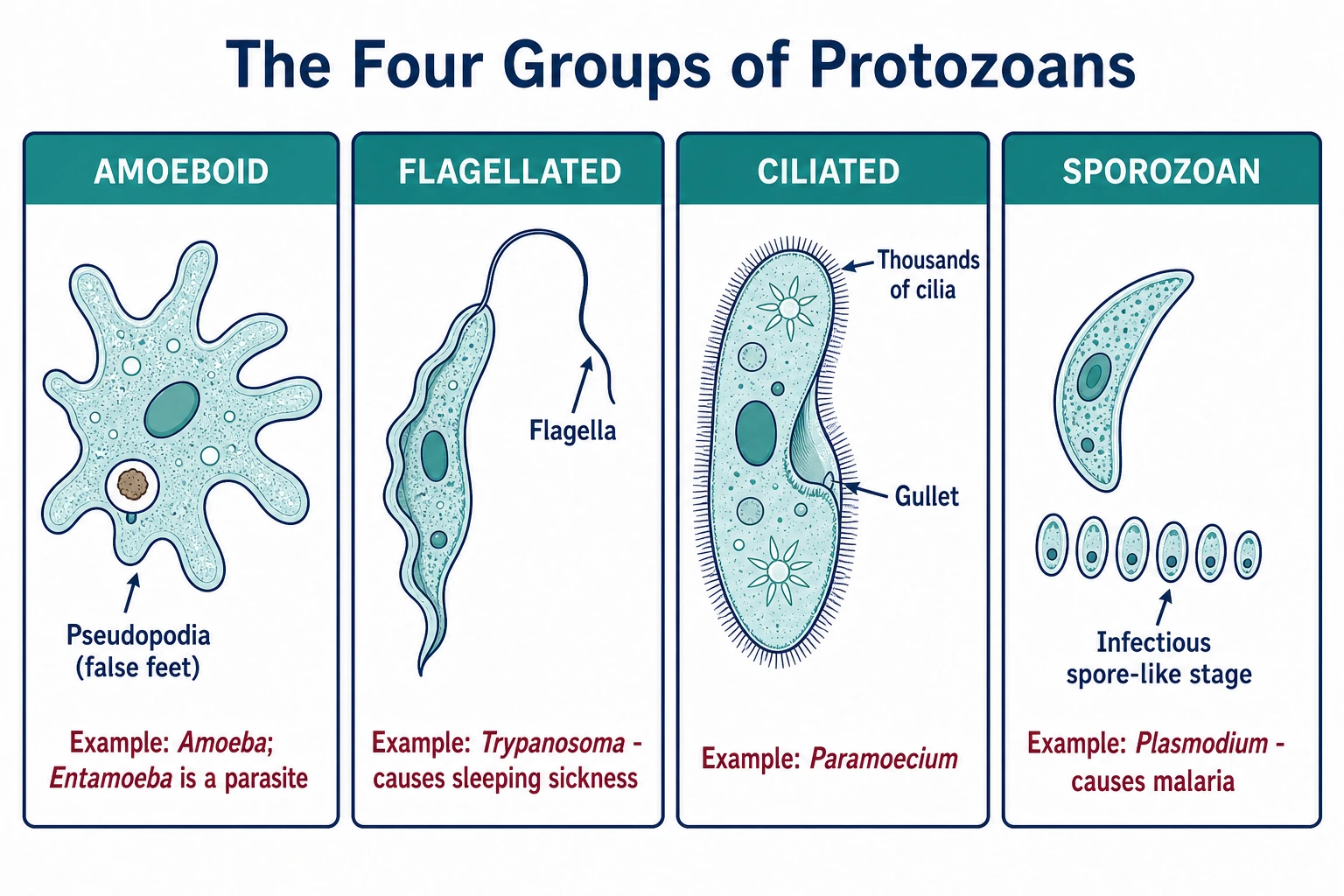
1. Amoeboid Protozoans
- These organisms live in fresh water, sea water or moist soil.
- They move and capture their prey by putting out pseudopodia (false feet), as in Amoeba.
- Marine forms have silica shells on their surface.
- Some of them, such as Entamoeba, are parasites.
[NEET Important] Pseudopodia literally means false feet - that translation is given, and questions use it. Note also that the silica shells belong to the marine forms only, and do not confuse them with the silica walls of diatoms.
2. Flagellated Protozoans
- The members of this group are either free-living or parasitic.
- They have flagella.
- The parasitic forms cause diseases such as sleeping sickness.
- Example: Trypanosoma.
[NEET Important] Trypanosoma - sleeping sickness is one of the most frequently asked pairings in the chapter.
3. Ciliated Protozoans
- These are aquatic, actively moving organisms because of the presence of thousands of cilia.
- They have a cavity (gullet) that opens to the outside of the cell surface.
- The coordinated movement of rows of cilia causes the water laden with food to be steered into the gullet.
- Example: Paramoecium.
[NEET Important] The gullet and the mechanism - coordinated movement of rows of cilia steering food-laden water into it - is a 2-mark description. Do not shorten it to "cilia help in movement".
4. Sporozoans
- This includes diverse organisms that have an infectious spore-like stage in their life cycle.
- The most notorious is Plasmodium (malarial parasite), which causes malaria, a disease which has a staggering effect on human population.
[NEET Important] Note the trap: Plasmodium (the sporozoan, malarial parasite) is not the same as plasmodium (the aggregation formed by slime moulds). Same word, capital letter and italics distinguish them, and NEET has used this collision.
The Four Groups Side by Side
| Group | Locomotion / feeding structure | Habitat or habit | Example | Disease |
|---|---|---|---|---|
| Amoeboid protozoans | Pseudopodia (false feet) | Fresh water, sea water, moist soil; marine forms with silica shells | Amoeba; Entamoeba (parasite) | - |
| Flagellated protozoans | Flagella | Free-living or parasitic | Trypanosoma | Sleeping sickness |
| Ciliated protozoans | Thousands of cilia; gullet | Aquatic, actively moving | Paramoecium | - |
| Sporozoans | Infectious spore-like stage in the life cycle | Parasitic | Plasmodium | Malaria |
A memory line: Amoeba pushes (pseudopodia), Trypanosoma whips (flagella), Paramoecium sweeps (cilia), Plasmodium spores.
Quick Recap
Slime moulds
- Saprophytic protists. The body moves along decaying twigs and leaves engulfing organic material.
- Suitable conditions to plasmodium - an aggregation that may spread over several feet.
- Unfavourable conditions to fruiting bodies bearing spores at their tips.
- Spores have true walls, are extremely resistant, survive many years and are dispersed by air currents.
Protozoans
- All are heterotrophs, living as predators or parasites; believed to be primitive relatives of animals; four major groups.
- Amoeboid: fresh water, sea water or moist soil; move and capture prey by pseudopodia (false feet); marine forms have silica shells; Amoeba, and Entamoeba as a parasite.
- Flagellated: free-living or parasitic; have flagella; parasitic forms cause sleeping sickness; Trypanosoma.
- Ciliated: aquatic and actively moving with thousands of cilia; a gullet opening to the cell surface; coordinated movement of rows of cilia steers food-laden water into the gullet; Paramoecium.
- Sporozoans: have an infectious spore-like stage; Plasmodium, the malarial parasite.
Solved Examples
Question 1
Q. What is the mode of nutrition of slime moulds?
Answer. Saprophytic.
Question 2
Q. Name the aggregation formed by slime moulds under suitable conditions.
Answer. The plasmodium, which may grow and spread over several feet.
Question 3
Q. Which protozoan causes sleeping sickness?
Answer. Trypanosoma, a flagellated protozoan.
Question 4
Q. Which protozoan group does Paramoecium belong to?
Answer. Ciliated protozoans.
Question 5
Q. Name the malarial parasite and its protozoan group.
Answer. Plasmodium; it is a sporozoan.
Question 6
Q. Describe briefly the four major groups of Protozoa.
Answer.
- Amoeboid protozoans - live in fresh water, sea water or moist soil; move and capture prey by putting out pseudopodia (false feet) as in Amoeba; marine forms have silica shells on their surface; some, such as Entamoeba, are parasites.
- Flagellated protozoans - either free-living or parasitic; they have flagella; the parasitic forms cause diseases such as sleeping sickness; example Trypanosoma.
- Ciliated protozoans - aquatic, actively moving because of thousands of cilia; they have a cavity (gullet) opening to the outside of the cell surface, and the coordinated movement of rows of cilia steers water laden with food into the gullet; example Paramoecium.
- Sporozoans - diverse organisms with an infectious spore-like stage in the life cycle; the most notorious is Plasmodium, the malarial parasite, causing a disease with a staggering effect on the human population.
Takeaway: This one is set at the end of the chapter. Give the locomotory structure and the named example for each - those are where the marks are.
Question 7
Q. What happens to the plasmodium of a slime mould under unfavourable conditions?
Answer. It differentiates and forms fruiting bodies bearing spores at their tips. The spores possess true walls, are extremely resistant, survive for many years even under adverse conditions, and are dispersed by air currents.
Question 8
Q. How does Paramoecium obtain food?
Answer. It has a cavity called the gullet that opens to the outside of the cell surface. The coordinated movement of rows of cilia causes the water laden with food to be steered into the gullet.
Question 9
Q. Give one free-living and one parasitic amoeboid protozoan.
Answer. Free-living: Amoeba. Parasitic: Entamoeba.
Question 10
Q. Why are protozoans believed to be primitive relatives of animals?
Answer. Because all protozoans are heterotrophs and live as predators or parasites - that is the animal way of living - and they manage it as single-celled eukaryotes. The belief rests directly on that.
Question 11
Q. Distinguish Plasmodium from plasmodium.
Answer. They are entirely different things that happen to share a word.
- Plasmodium (capitalised, italicised) is a genus - a sporozoan protozoan, the malarial parasite, with an infectious spore-like stage in its life cycle.
- plasmodium (lower case, not a genus) is the aggregation formed by a slime mould under suitable conditions, which may grow and spread over several feet.
Takeaway: Capitalisation and italics are the whole distinction - which is exactly why the nomenclature rules of Chapter 1 matter in practice.
Question 12
Q. A protist from moist soil moves by extending temporary projections of its body and has no shell. Another from sea water does the same but bears a shell of silica. Classify both and explain the difference.
Answer. Both are amoeboid protozoans, since they move and capture their prey by putting out pseudopodia (false feet). What separates them is habitat. Amoeboid protozoans live in fresh water, sea water or moist soil, and the marine forms have silica shells on their surface. So the soil-dweller is a naked amoeboid form like Amoeba, and the sea-water one is a marine shelled form.
Question 13
Q. Slime moulds are protists, yet they behave in ways that recall fungi. Identify the fungus-like features and the reason they are nevertheless placed in Protista.
Answer. Fungus-like features: they are saprophytic, feeding on decaying twigs and leaves; they form fruiting bodies bearing spores under unfavourable conditions; and the spores possess true walls, are extremely resistant and are dispersed by air currents - which is exactly how fungal spores behave. Why Protista: Whittaker's criteria place organisms by cell structure and body organisation, and slime moulds are eukaryotic protists whose body organisation is cellular rather than the filamentous hyphae and mycelium that define Kingdom Fungi. Fungi are also defined by walls of chitin, which the slime mould body does not have.
Takeaway: This is the section's version of the chapter's theme - resemblance in habit does not decide the kingdom; the criteria do.