
Kingdom Plantae
Kingdom Plantae includes all eukaryotic chlorophyll-containing organisms commonly called plants.
But not every plant is fully autotrophic. The exceptions are flagged immediately:
A few members are partially heterotrophic, such as the insectivorous plants or parasites.
| Type | Examples |
|---|---|
| Insectivorous plants | Bladderwort and Venus fly trap |
| Parasite | Cuscuta |
Cell structure: the plant cells have an eukaryotic structure with prominent chloroplasts and a cell wall mainly made of cellulose.
Groups included: algae, bryophytes, pteridophytes, gymnosperms and angiosperms.
[NEET Important] The three named partial heterotrophs - bladderwort, Venus fly trap, Cuscuta - answer the chapter-end exercise ("Plants are autotrophic. Can you think of some plants that are partially heterotrophic?"). Note the wording: partially heterotrophic. They still have chlorophyll.
Alternation of Generations
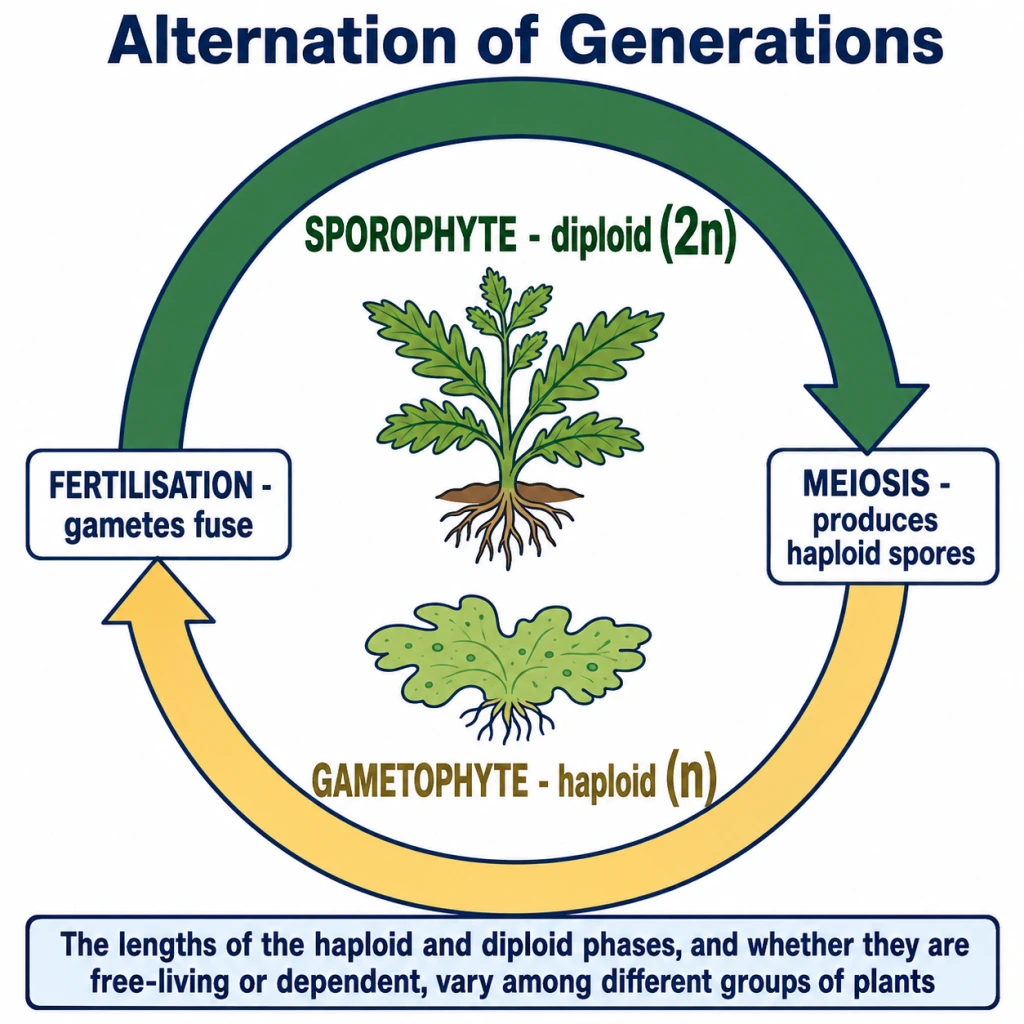
Life cycle of plants has two distinct phases - the diploid sporophytic and the haploid gametophytic - that alternate with each other.
The lengths of the haploid and diploid phases, and whether these phases are free-living or dependent on others, vary among different groups in plants.
This phenomenon is called alternation of generations.
Three things to fix:
- Sporophytic phase = diploid. Gametophytic phase = haploid. Getting the ploidy the wrong way round is the standard error.
- The two phases alternate.
- Their relative lengths and their free-living or dependent status vary between groups - which is what Chapter 3 then explores across algae, bryophytes, pteridophytes, gymnosperms and angiosperms.
Kingdom Animalia
This kingdom is characterised by heterotrophic eukaryotic organisms that are multicellular and their cells lack cell walls.
That opening sentence packs four characters - heterotrophic, eukaryotic, multicellular, no cell wall - and each shows up in Table 2.1.
The rest of the characters, in the chapter's order:
- They directly or indirectly depend on plants for food.
- They digest their food in an internal cavity and store food reserves as glycogen or fat.
- Their mode of nutrition is holozoic - by ingestion of food.
- They follow a definite growth pattern and grow into adults that have a definite shape and size.
- Higher forms show elaborate sensory and neuromotor mechanism.
- Most of them are capable of locomotion.
- The sexual reproduction is by copulation of male and female followed by embryological development.
[NEET Important] Holozoic means nutrition by ingestion of food - the whole particle is taken in, then digested internally. Contrast it with the fungal mode, which is absorption of soluble organic matter. And note the storage products: glycogen or fat in animals, against starch in plants.
Plantae and Animalia Compared
| Character | Plantae | Animalia |
|---|---|---|
| Cell type | Eukaryotic | Eukaryotic |
| Cell wall | Present, mainly cellulose | Absent |
| Plastids | Prominent chloroplasts | Absent |
| Mode of nutrition | Autotrophic (photosynthetic); a few partially heterotrophic | Heterotrophic, holozoic - by ingestion |
| Digestion | - | In an internal cavity |
| Food reserve | - | Glycogen or fat |
| Body organisation | Tissue / organ | Tissue / organ / organ system |
| Growth | - | Definite growth pattern, definite adult shape and size |
| Locomotion | - | Most are capable of locomotion |
| Life cycle | Alternation of generations - diploid sporophytic and haploid gametophytic | Copulation of male and female followed by embryological development |
| Groups included | Algae, bryophytes, pteridophytes, gymnosperms, angiosperms | Various phyla, dealt with in Chapter 4 |
Quick Recap
Plantae
- All eukaryotic chlorophyll-containing organisms.
- A few are partially heterotrophic: the insectivorous bladderwort and Venus fly trap, and the parasite Cuscuta.
- Cells are eukaryotic with prominent chloroplasts and a cell wall mainly of cellulose.
- Includes algae, bryophytes, pteridophytes, gymnosperms and angiosperms.
- Alternation of generations: a diploid sporophytic phase and a haploid gametophytic phase alternate; their lengths and whether they are free-living or dependent vary among groups.
Animalia
- Heterotrophic, eukaryotic, multicellular; cells lack cell walls.
- Directly or indirectly depend on plants for food; digest food in an internal cavity; store reserves as glycogen or fat.
- Mode of nutrition is holozoic - by ingestion of food.
- Definite growth pattern, growing into adults of definite shape and size.
- Higher forms show elaborate sensory and neuromotor mechanisms; most are capable of locomotion.
- Sexual reproduction by copulation of male and female, followed by embryological development.
Solved Examples
Question 1
Q. What does Kingdom Plantae include?
Answer. All eukaryotic chlorophyll-containing organisms commonly called plants - algae, bryophytes, pteridophytes, gymnosperms and angiosperms.
Question 2
Q. Name two insectivorous plants.
Answer. Bladderwort and Venus fly trap.
Question 3
Q. Name a parasitic plant.
Answer. Cuscuta.
Question 4
Q. What is the mode of nutrition of animals?
Answer. Holozoic - by ingestion of food.
Question 5
Q. In what form do animals store food reserves?
Answer. As glycogen or fat.
Question 6
Q. Plants are autotrophic. Can you think of some plants that are partially heterotrophic?
Answer. Yes. A few members of Kingdom Plantae are partially heterotrophic:
- Insectivorous plants such as the bladderwort and the Venus fly trap, which trap and digest insects to supplement their nutrition.
- Parasites such as Cuscuta, which draws nutrition from a host plant.
The insectivorous plants are only partially heterotrophic because they still contain chlorophyll and photosynthesise - trapping insects tops up their mineral nutrition, it does not replace photosynthesis. Cuscuta is the other kind of case: a parasite that draws its nutrition from a host plant.
Takeaway: This is one of the chapter-end exercises. The word partially is worth a mark on its own.
Question 7
Q. Define alternation of generations.
Answer. The life cycle of plants has two distinct phases - the diploid sporophytic and the haploid gametophytic - that alternate with each other. The lengths of the haploid and diploid phases, and whether these phases are free-living or dependent on others, vary among different groups in plants. This phenomenon is called alternation of generations.
Question 8
Q. State four characters of Kingdom Animalia.
Answer. Any four of: heterotrophic, eukaryotic, multicellular, cells lack cell walls, digest food in an internal cavity, store reserves as glycogen or fat, holozoic nutrition by ingestion, definite growth pattern with a definite adult shape and size, elaborate sensory and neuromotor mechanisms in higher forms, most capable of locomotion, sexual reproduction by copulation followed by embryological development.
Question 9
Q. Which phase of the plant life cycle is diploid, and which is haploid?
Answer. The sporophytic phase is diploid; the gametophytic phase is haploid.
Question 10
Q. Both fungi and animals are heterotrophic. How does the way they obtain food differ, and what structural feature accompanies the difference?
Answer. Fungi absorb - most are saprophytes that absorb soluble organic matter from dead substrates, and parasitic fungi absorb from living hosts. Animals ingest - their mode of nutrition is holozoic, that is by ingestion of food, and they digest their food in an internal cavity.
The accompanying structural difference is the cell wall. Fungi have a cell wall of chitin and polysaccharides, which permits absorption of dissolved material but not the engulfing of particles; animal cells lack a cell wall entirely, which is what makes ingestion and an internal digestive cavity possible. This is also why Table 2.1 lists a wall for Fungi and none for Animalia.
Question 11
Q. A plant traps and digests insects. Does this move it out of Kingdom Plantae? Justify using the kingdom's defining criterion.
Answer. No. Kingdom Plantae is defined as all eukaryotic chlorophyll-containing organisms, and insectivorous plants such as the bladderwort and the Venus fly trap retain chlorophyll and prominent chloroplasts with a cellulosic cell wall. The chapter counts them as partially heterotrophic members of Plantae, not as members of another kingdom.
This is the chapter's theme again: a kingdom is decided by the whole set of criteria - cell structure, body organisation, mode of nutrition, reproduction and phylogenetic relationships - not by one behaviour. An extra heterotrophic habit does not outweigh eukaryotic chlorophyll-containing cells with cellulose walls and a plant life cycle.
Question 12
Q. Using Table 2.1, explain why 'multicellular' alone cannot distinguish Animalia from Fungi and Plantae, and give the character that can.
Answer. All three are non-unicellular in Table 2.1 - Fungi are multicellular or loose tissue, Plantae reach tissue / organ, and Animalia reach tissue / organ / organ system - so multicellularity is shared, and even the body-organisation row only separates Animalia by degree.
The character that separates cleanly is the cell wall: present with chitin in Fungi, present with cellulose in Plantae, and absent in Animalia. Animalia is the only kingdom in Table 2.1 with no cell wall, so that row alone identifies it. A second clean separator is mode of nutrition, where Plantae is purely autotrophic photosynthetic while Fungi and Animalia are heterotrophic - but Fungi absorb while Animalia are holozoic.