
The Ones the Five Kingdoms Leave Out
In the five kingdom classification of Whittaker there is no mention of lichens and some acellular organisms like viruses, viroids and prions.
So this last section is a set of appendices - four groups that had nowhere to go in the scheme.
Why viruses were excluded:
Viruses did not find a place in classification since they are not considered truly 'living', if we understand living as those organisms that have a cell structure.
The viruses are non-cellular organisms that are characterised by having an inert crystalline structure outside the living cell.
Once they infect a cell, they take over the machinery of the host cell to replicate themselves, killing the host.
[NEET Important] The exclusion argument turns on cell structure - viruses are non-cellular and inert and crystalline outside the host. Both halves are needed for a full-mark answer.
The History of the Virus - Three Names, Three Dates
Virus means venom or poisonous fluid.
| Year | Scientist | Contribution |
|---|---|---|
| 1892 | Dmitri Ivanowsky | Recognised certain microbes as the causal organism of the mosaic disease of tobacco. These were found to be smaller than bacteria because they passed through bacteria-proof filters. |
| 1898 | M. W. Beijerinck | Demonstrated that the extract of infected tobacco plants could cause infection in healthy plants; named the new pathogen 'virus' and called the fluid Contagium vivum fluidum (infectious living fluid). |
| 1935 | W. M. Stanley | Showed that viruses could be crystallised and the crystals consist largely of proteins. |
And one more character: viruses are inert outside their specific host cell and are obligate parasites.
[NEET Important] This table is asked as a match-the-column almost every year in some form. Learn name + year + contribution as a unit. The Latin phrase Contagium vivum fluidum and its meaning infectious living fluid belong to Beijerinck, not Ivanowsky.
Virus Structure and Genetic Material
Genetic material:
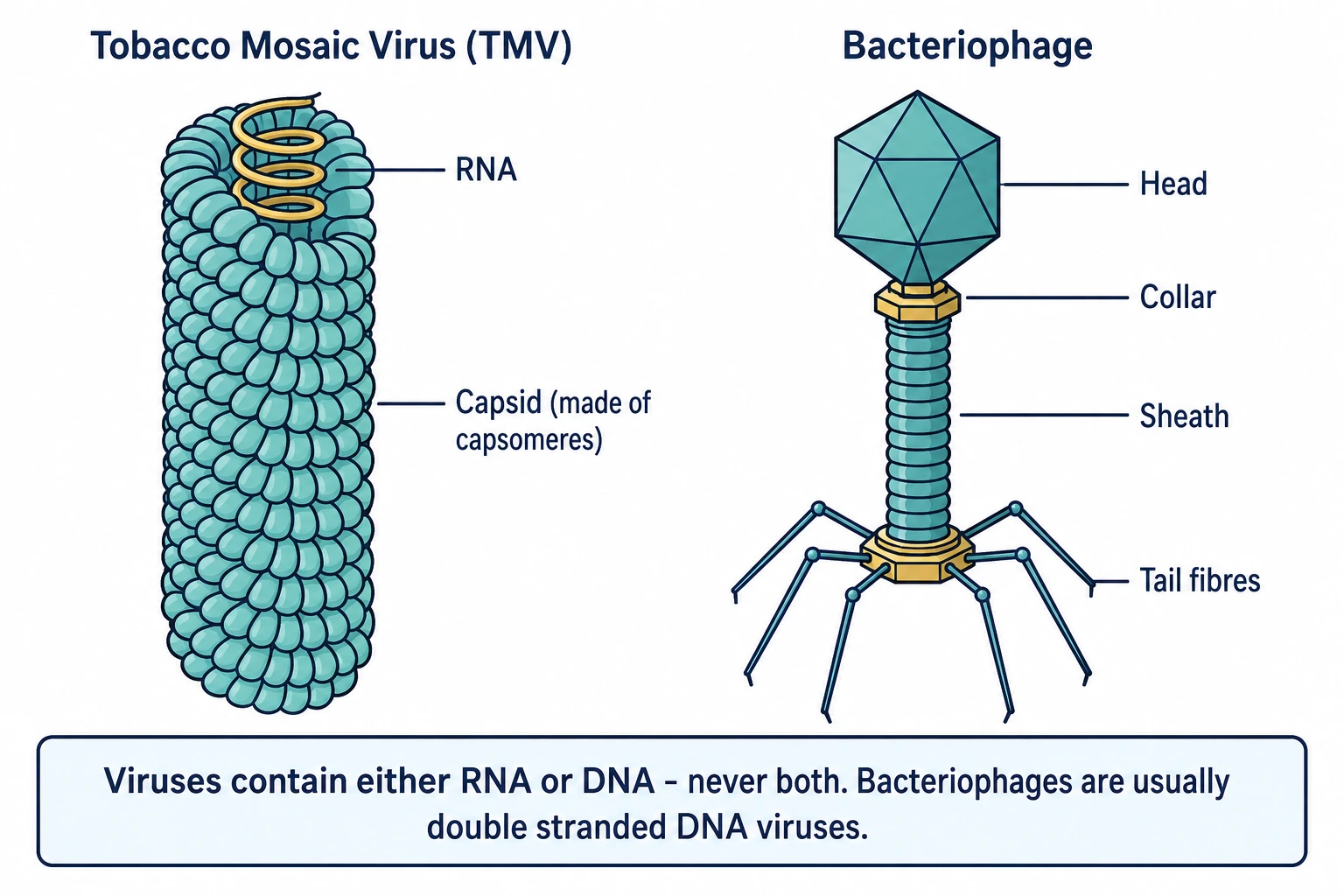
In addition to proteins, viruses also contain genetic material, that could be either RNA or DNA. No virus contains both RNA and DNA.
A virus is a nucleoprotein and the genetic material is infectious.
Which nucleic acid, in which host - this table is pure NEET material:
| Virus type | Genetic material |
|---|---|
| Viruses that infect plants | Single stranded RNA |
| Viruses that infect animals | Single or double stranded RNA, or double stranded DNA |
| Bacteriophages (bacterial viruses) | Usually double stranded DNA |
The protein coat:
The protein coat called capsid, made of small subunits called capsomeres, protects the nucleic acid. These capsomeres are arranged in helical or polyhedral geometric forms.
Diseases:
- In humans: mumps, small pox, herpes and influenza; AIDS in humans is also caused by a virus.
- In plants, the symptoms: mosaic formation, leaf rolling and curling, yellowing and vein clearing, dwarfing and stunted growth.
[NEET Important] No virus contains both RNA and DNA - this absolute statement is asked directly and is a favourite "which statement is false" option. And capsid is the coat while capsomeres are its subunits; the two words are routinely swapped in options.
Viroids
In 1971, T. O. Diener discovered a new infectious agent that was smaller than viruses and caused potato spindle tuber disease.
It was found to be a free RNA; it lacked the protein coat that is found in viruses, hence the name viroid. The RNA of the viroid was of low molecular weight.
Four facts, all examinable:
- T. O. Diener, 1971
- Smaller than viruses
- Causes potato spindle tuber disease
- Free RNA of low molecular weight, lacking a protein coat - which is where the name comes from
[NEET Important] The absence of the protein coat is the whole difference from a virus, and it is what the chapter-end exercise on how viroids differ from viruses is asking for.
Prions
In modern medicine certain infectious neurological diseases were found to be transmitted by an agent consisting of abnormally folded protein. The agent was similar in size to viruses. These agents were called prions.
The two diseases named:
- Bovine spongiform encephalopathy (BSE), commonly called mad cow disease, in cattle
- Its analogous variant Creutzfeldt-Jacob disease (CJD) in humans
[NEET Important] A prion is protein only - abnormally folded protein, with no nucleic acid at all. Set the three acellular agents against each other and the pattern is clean:
| Agent | Composition |
|---|---|
| Virus | Nucleic acid (RNA or DNA) + protein coat (capsid) |
| Viroid | Free RNA only - no protein coat |
| Prion | Abnormally folded protein only - no nucleic acid |
Lichens
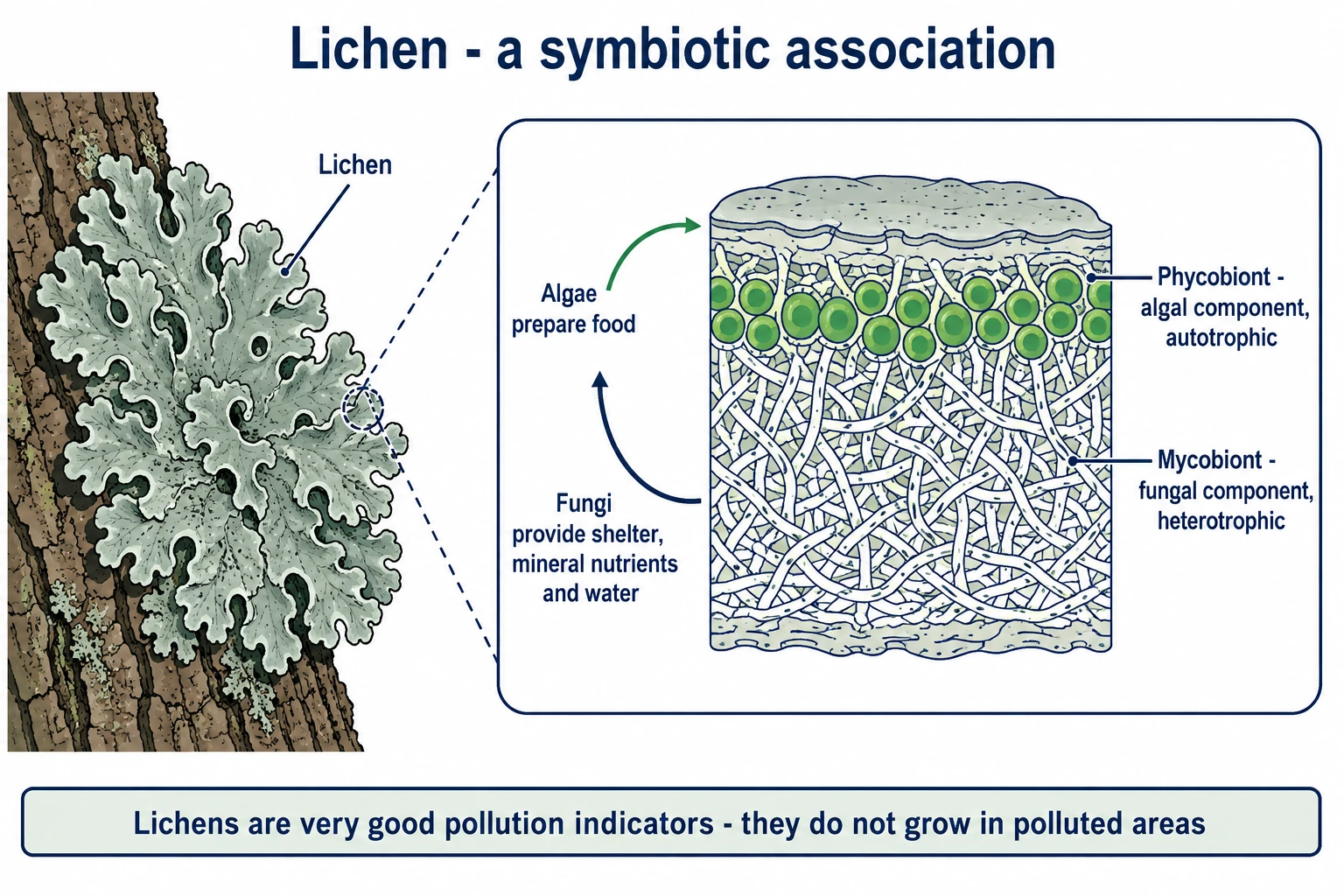
Lichens are symbiotic associations, i.e. mutually useful associations, between algae and fungi.
The two partners:
| Component | Name | Nutrition |
|---|---|---|
| Algal | Phycobiont | Autotrophic |
| Fungal | Mycobiont | Heterotrophic |
What each contributes:
Algae prepare food for fungi, and fungi provide shelter and absorb mineral nutrients and water for its partner.
How close is the association?
So close is their association that if one saw a lichen in nature one would never imagine that they had two different organisms within them.
And the ecological headline:
Lichens are very good pollution indicators - they do not grow in polluted areas.
[NEET Important] Phyco = alga = autotroph = makes food. Myco = fungus = heterotroph = provides shelter, absorbs minerals and water. And lichens do not grow in polluted areas, which is exactly why they serve as pollution indicators.
Quick Recap
Why excluded: the five kingdom classification has no mention of lichens and the acellular viruses, viroids and prions. Viruses are not considered truly living because they lack cell structure; they are non-cellular, with an inert crystalline structure outside the living cell, and once inside they take over the host machinery to replicate, killing the host.
Virus history: Ivanowsky (1892) - microbes causing tobacco mosaic disease, smaller than bacteria, passing bacteria-proof filters. Beijerinck (1898) - extract of infected plants infects healthy plants; named it virus, fluid called Contagium vivum fluidum (infectious living fluid). Stanley (1935) - viruses can be crystallised, crystals largely proteins.
Virus structure: a nucleoprotein; genetic material RNA or DNA, never both, and infectious. Plant viruses - single stranded RNA; animal viruses - single or double stranded RNA or double stranded DNA; bacteriophages - usually double stranded DNA. Capsid = protein coat, made of capsomeres, arranged in helical or polyhedral forms. Viruses are obligate parasites and inert outside their specific host.
Diseases: mumps, small pox, herpes, influenza, AIDS in humans; in plants mosaic formation, leaf rolling and curling, yellowing and vein clearing, dwarfing and stunted growth.
Viroids: T. O. Diener, 1971; smaller than viruses; cause potato spindle tuber disease; free RNA of low molecular weight, lacking the protein coat.
Prions: abnormally folded protein, similar in size to viruses; cause BSE (mad cow disease) in cattle and CJD in humans.
Lichens: symbiotic, mutually useful associations between algae and fungi; phycobiont = algal, autotrophic; mycobiont = fungal, heterotrophic; algae prepare food, fungi provide shelter and absorb mineral nutrients and water; very good pollution indicators - they do not grow in polluted areas.
Solved Examples
Question 1
Q. Why are viruses not included in the five kingdom classification?
Answer. Because they are not considered truly 'living' - not if living means organisms that have a cell structure. Viruses are non-cellular and are inert crystalline structures outside the living cell.
Question 2
Q. What does the word 'virus' mean?
Answer. Venom or poisonous fluid.
Question 3
Q. Who discovered viroids, and in which year?
Answer. T. O. Diener, in 1971.
Question 4
Q. Name the disease caused by viroids.
Answer. Potato spindle tuber disease.
Question 5
Q. What is a capsid, and what is it made of?
Answer. It is the protein coat of a virus, built from small subunits called capsomeres, and it protects the nucleic acid.
Question 6
Q. Which two diseases are caused by prions?
Answer. Bovine spongiform encephalopathy (BSE), or mad cow disease, in cattle, and its analogous variant Creutzfeldt-Jacob disease (CJD) in humans.
Question 7
Q. How are viroids different from viruses?
Answer.
- A viroid is smaller than a virus.
- A viroid is a free RNA - it lacks the protein coat that is found in viruses. (A virus has a capsid made of capsomeres.)
- The RNA of the viroid is of low molecular weight.
- A virus's genetic material may be either RNA or DNA, whereas a viroid is always RNA.
The absence of the protein coat is what gives the viroid its name.
Takeaway: This one is set at the end of the chapter. Lead with the missing protein coat - it is the defining difference.
Question 8
Q. What did Ivanowsky, Beijerinck and Stanley each contribute?
Answer.
- Dmitri Ivanowsky (1892): recognised certain microbes as the causal organism of the mosaic disease of tobacco, found to be smaller than bacteria because they passed through bacteria-proof filters.
- M. W. Beijerinck (1898): demonstrated that the extract of infected tobacco plants could cause infection in healthy plants; named the new pathogen 'virus' and called the fluid Contagium vivum fluidum, meaning infectious living fluid.
- W. M. Stanley (1935): showed that viruses could be crystallised, and that the crystals consist largely of proteins.
Question 9
Q. What do the terms phycobiont and mycobiont signify?
Answer. They are the two partners of a lichen, a symbiotic, mutually useful association between algae and fungi. The algal component is the phycobiont, which is autotrophic; the fungal component is the mycobiont, which is heterotrophic. Algae prepare food for the fungi, and the fungi provide shelter and absorb mineral nutrients and water for the partner.
Takeaway: This is one of the chapter-end exercises.
Question 10
Q. State the nature of the genetic material in plant viruses, animal viruses and bacteriophages.
Answer.
- Plant viruses: usually single stranded RNA.
- Animal viruses: single or double stranded RNA, or double stranded DNA.
- Bacteriophages: usually double stranded DNA.
And in every case, no virus contains both RNA and DNA.
Question 11
Q. Give a brief account of viruses with respect to their structure and nature of genetic material. Also name four common viral diseases.
Answer. Structure. A virus is a non-cellular entity and a nucleoprotein. Its nucleic acid is protected by a protein coat called the capsid, which is made of small subunits called capsomeres; these are arranged in helical or polyhedral geometric forms. Outside its specific host cell the virus is inert, with an inert crystalline structure, and it is an obligate parasite - once it infects a cell it takes over the machinery of the host cell to replicate itself, killing the host.
Genetic material. Viruses contain either RNA or DNA - never both, and the genetic material is infectious. Plant viruses generally have single stranded RNA; animal viruses have single or double stranded RNA or double stranded DNA; bacteriophages are usually double stranded DNA viruses.
Four viral diseases. Mumps, small pox, herpes and influenza. (AIDS in humans is also caused by a virus.)
Takeaway: This is one of the chapter-end exercises - a 5-mark answer with three parts. Do not forget the four diseases at the end.
Question 12
Q. Why are lichens called good pollution indicators?
Answer. Because they do not grow in polluted areas. Their presence therefore signals clean air, and their absence from an area where they would otherwise be expected signals pollution.
Question 13
Q. Organise the argument on both sides of the question: Are viruses living or non-living?
Answer.
The case for non-living:
- They are non-cellular, and the chapter's working definition of living is organisms that have a cell structure.
- Outside the living cell they have an inert crystalline structure - W. M. Stanley showed in 1935 that viruses could be crystallised, and that the crystals consist largely of proteins, which is behaviour we associate with chemicals rather than organisms.
- They are inert outside their specific host cell and are obligate parasites - they have no metabolism of their own.
The case for living:
- They contain genetic material - RNA or DNA - and that genetic material is infectious.
- They replicate, though only by taking over the machinery of the host cell.
- They cause disease in a way that is characteristically biological, and Beijerinck named the infectious fluid Contagium vivum fluidum - literally infectious living fluid.
The resolution offered is not a verdict but a boundary problem: Viruses sit outside the five kingdom scheme precisely because the scheme is built on cell structure, and viruses have none.
Takeaway: This one is set at the end of the chapter. In an exam, structure it as for / against / why the question is hard.
Question 14
Q. Three infectious agents are isolated. Agent A is protein only. Agent B is a free RNA with no coat. Agent C has DNA inside a protein coat. Identify each, name a disease for each, and state which of them could be crystallised.
Answer.
- Agent A: a prion - it consists of abnormally folded protein and has no nucleic acid. Diseases: BSE (mad cow disease) in cattle and CJD in humans. Prions are described as similar in size to viruses.
- Agent B: a viroid - free RNA of low molecular weight lacking the protein coat found in viruses. Disease: potato spindle tuber disease. Discovered by T. O. Diener in 1971.
- Agent C: a virus - a nucleoprotein with genetic material inside a capsid of capsomeres; DNA inside a coat suggests an animal virus (double stranded DNA) or a bacteriophage. Diseases: mumps, small pox, herpes, influenza, AIDS.
Crystallisation: Agent C, the virus - W. M. Stanley (1935) showed that viruses could be crystallised and that the crystals consist largely of proteins.
Question 15
Q. A lichen is described as so close an association that one would never imagine two organisms were involved. Explain the exchange between the partners and why the association counts as symbiosis rather than parasitism.
Answer. The algal phycobiont is autotrophic and the fungal mycobiont heterotrophic. Algae prepare food for fungi, and fungi provide shelter and absorb mineral nutrients and water for its partner. Because both partners gain - food one way, shelter and mineral nutrition the other - the association is mutually useful, which is exactly how symbiosis is defined here. In parasitism only one partner benefits and the other is harmed, as when a parasitic fungus depends on living plants and animals.
The closeness follows from that mutual dependence. Neither partner in a lichen occupies the habitat alone, so the composite body looks like a single organism.