
A Unique Kingdom of Heterotrophs
The fungi constitute a unique kingdom of heterotrophic organisms. They show a great diversity in morphology and habitat.
They are introduced through things you have actually seen:
- Fungi on moist bread and rotten fruits
- The common mushroom you eat, and toadstools
- White spots seen on mustard leaves - due to a parasitic fungus
- Yeast, a unicellular fungus, used to make bread and beer
- Puccinia, causing wheat rust - a plant disease
- Penicillium, a source of antibiotics
Distribution: fungi are cosmopolitan and occur in air, water, soil and on animals and plants. They prefer to grow in warm and humid places - which is why we keep food in the refrigerator: to prevent food from going bad due to bacterial or fungal infections.
[NEET Important] Four named examples appear in this opening paragraph alone - yeast (bread and beer), Puccinia (wheat rust), Penicillium (antibiotics), and the parasitic fungus of mustard leaves (which section 7 identifies as Albugo). Attach each name to its use or disease now.
The Fungal Body - Hyphae and Mycelium
With the exception of yeasts which are unicellular, fungi are filamentous.
The vocabulary:
| Term | Meaning |
|---|---|
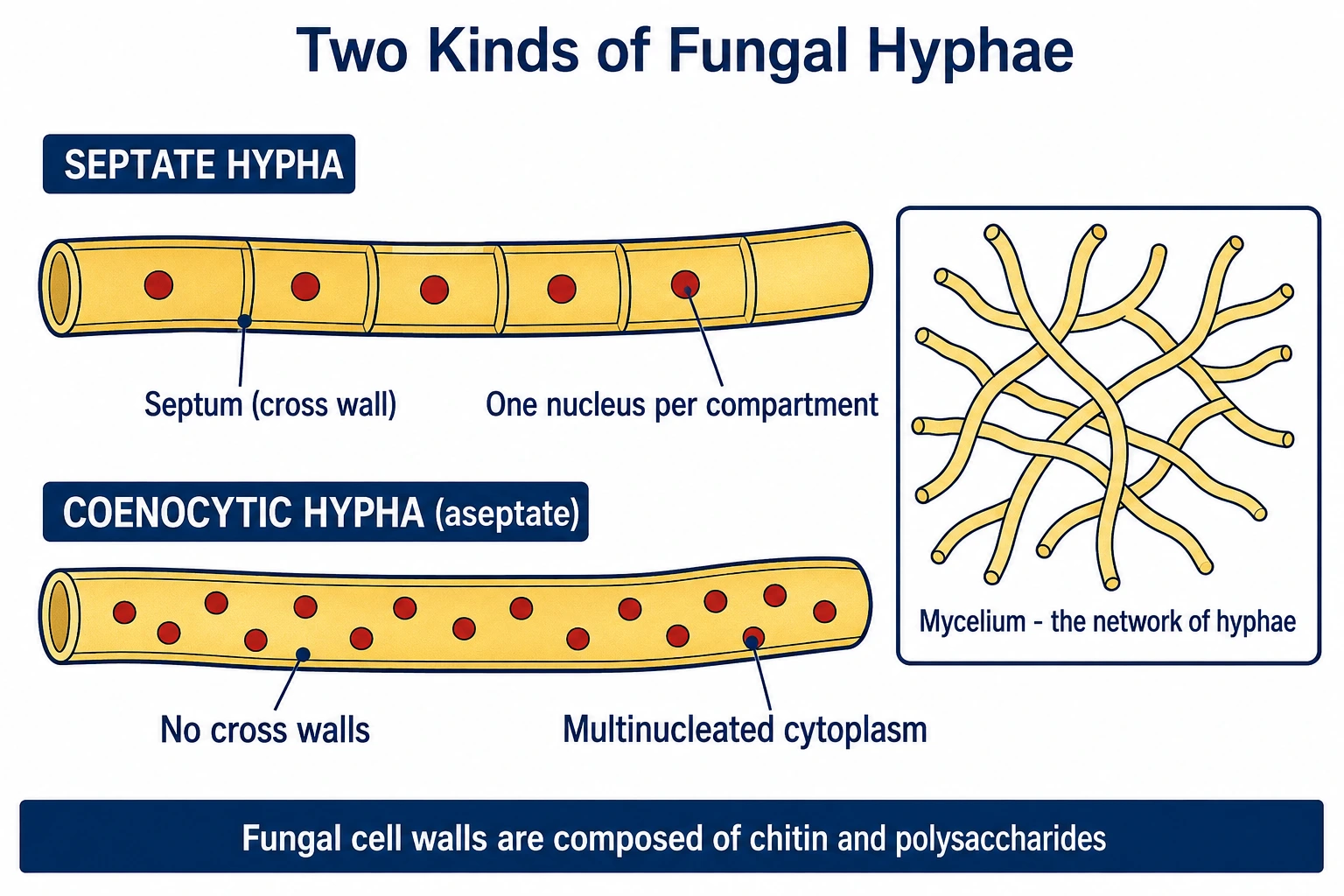
| Hyphae | Long, slender, thread-like structures that make up the body |
| Mycelium | The network of hyphae |
| Coenocytic hyphae | Continuous tubes filled with multinucleated cytoplasm |
| Septate hyphae | Hyphae with septae or cross walls |
And the wall:
The cell walls of fungi are composed of chitin and polysaccharides.
[NEET Important] Chitin is the single character that pulled fungi out of the plant kingdom - table 2.1 lists it, and section 1 explains the history. Also learn coenocytic = aseptate + multinucleate; that equation is what section 7 uses to identify Phycomycetes.
Modes of Nutrition
Most fungi are heterotrophic and absorb soluble organic matter from dead substrates and hence are called saprophytes.
Three ways of living, and all three are examinable:
| Mode | Definition |
|---|---|
| Saprophytes | Absorb soluble organic matter from dead substrates |
| Parasites | Depend on living plants and animals |
| Symbionts | Live in association with another organism |
The two symbiotic associations:
- With algae, as lichens
- With roots of higher plants, as mycorrhiza
[NEET Important] Lichen = fungus + alga. Mycorrhiza = fungus + roots of higher plants. These two are asked constantly, often as a match-the-column pair, and students routinely swap them.
Reproduction in Fungi
Three routes, and the spore names under each are prime NEET material.
1. Vegetative means
- Fragmentation
- Fission
- Budding
2. Asexual reproduction - by spores called:
- Conidia
- Sporangiospores
- Zoospores
3. Sexual reproduction - by spores called:
- Oospores
- Ascospores
- Basidiospores
The various spores are produced in distinct structures called fruiting bodies.
[NEET Important] Keep the two spore lists apart. Asexual: Conidia, sporangiospores, zoospores. Sexual: Oospores, ascospores, basidiospores. A question that offers "ascospores" among asexual spores is testing exactly this split.
The Sexual Cycle - Three Steps
The sexual cycle involves the following three steps:
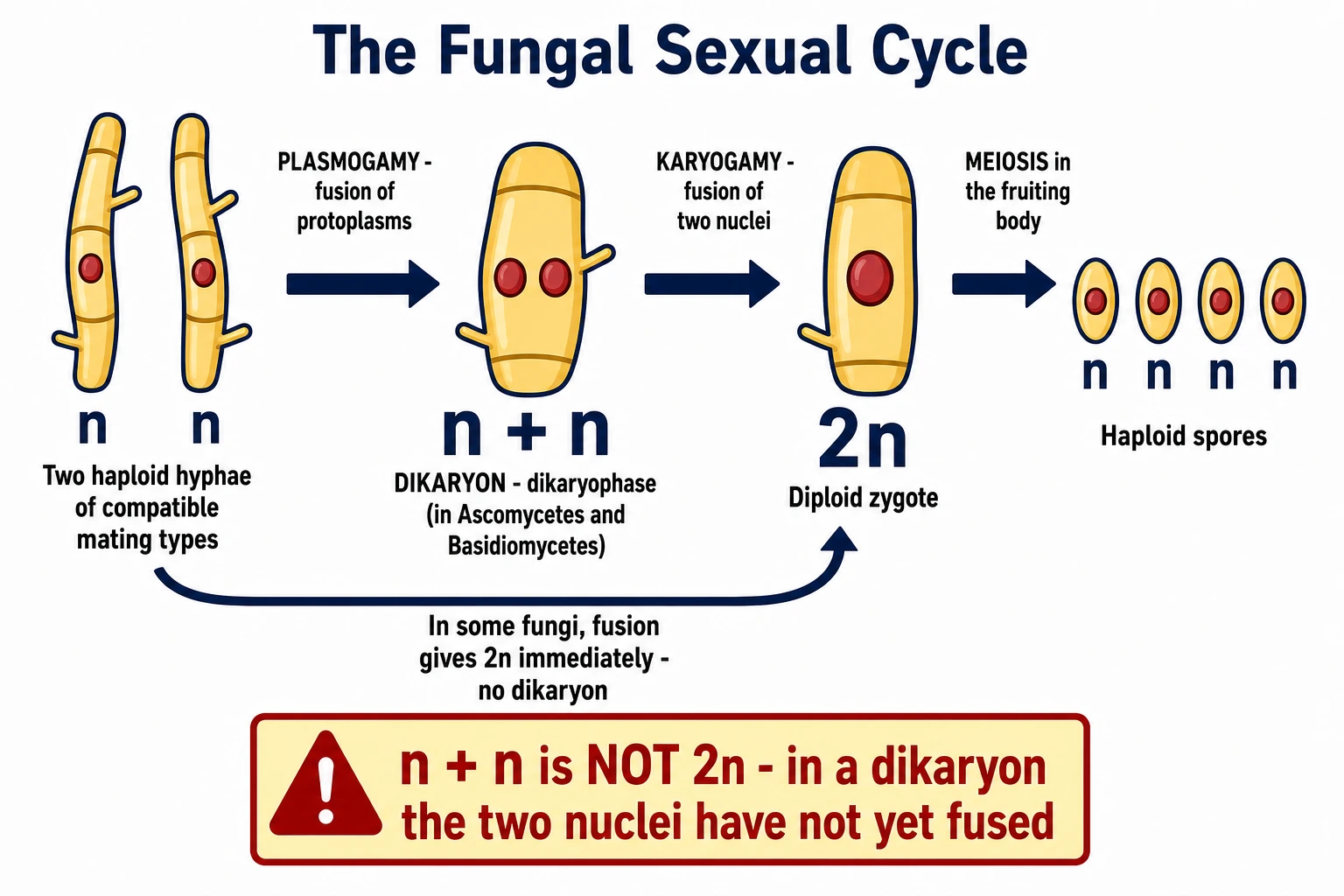
(i) Fusion of protoplasms between two motile or non-motile gametes called plasmogamy.
(ii) Fusion of two nuclei called karyogamy.
(iii) Meiosis in zygote resulting in haploid spores.
Learn them in this order and with these exact definitions - plasmogamy is protoplasm fusion, karyogamy is nuclear fusion. The one-word difference is the whole question.
The Dikaryophase
What happens between plasmogamy and karyogamy is where fungi get interesting, and where NEET concentrates its harder questions.
When a fungus reproduces sexually, two haploid hyphae of compatible mating types come together and fuse.
In some fungi the fusion of two haploid cells immediately results in diploid cells (2n).
However, in other fungi (ascomycetes and basidiomycetes), an intervening dikaryotic stage (n + n, i.e., two nuclei per cell) occurs; such a condition is called a dikaryon and the phase is called dikaryophase of fungus.
Later, the parental nuclei fuse and the cells become diploid. The fungi form fruiting bodies in which reduction division occurs, leading to formation of haploid spores.
Read the ploidy carefully:
| Stage | Ploidy | What it means |
|---|---|---|
| Two compatible hyphae | n and n | Both haploid |
| After plasmogamy, in ascomycetes and basidiomycetes | n + n (dikaryon) | Two separate nuclei per cell - not 2n |
| After karyogamy | 2n | Nuclei have fused; now truly diploid |
| After meiosis in the fruiting body | n | Haploid spores |
[NEET Important] n + n is not the same as 2n. A dikaryon has two nuclei sitting side by side in one cell; a diploid cell has one nucleus with two sets. NEET builds options around exactly this confusion. And remember which classes show the dikaryophase: ascomycetes and basidiomycetes.
The Basis of Classification Within the Kingdom
The morphology of the mycelium, mode of spore formation and fruiting bodies form the basis for the division of the kingdom into various classes.
Three criteria - and they are exactly what section 7 uses to separate Phycomycetes, Ascomycetes, Basidiomycetes and Deuteromycetes. Memorise the trio; it is a clean one-mark question.
Quick Recap
- Fungi are a unique kingdom of heterotrophic organisms with great diversity in morphology and habitat; cosmopolitan, occurring in air, water, soil and on animals and plants, preferring warm and humid places.
- Except yeasts, which are unicellular, fungi are filamentous. Body of hyphae; network = mycelium.
- Coenocytic hyphae = continuous tubes with multinucleated cytoplasm; others have septae (cross walls).
- Cell walls are composed of chitin and polysaccharides.
- Saprophytes absorb soluble organic matter from dead substrates; parasites depend on living plants and animals; symbionts associate with algae as lichens and with roots of higher plants as mycorrhiza.
- Vegetative reproduction: fragmentation, fission, budding.
- Asexual spores: conidia, sporangiospores, zoospores. Sexual spores: oospores, ascospores, basidiospores. Both are produced in fruiting bodies.
- Sexual cycle: (i) plasmogamy - fusion of protoplasms; (ii) karyogamy - fusion of two nuclei; (iii) meiosis in the zygote giving haploid spores.
- In ascomycetes and basidiomycetes an intervening dikaryotic stage (n + n) occurs - the dikaryon, and the dikaryophase.
- Classes are separated on mycelium morphology, mode of spore formation and fruiting bodies.
Solved Examples
Question 1
Q. What are hyphae and mycelium?
Answer. Hyphae are the long, slender, thread-like structures that make up the fungal body. The network of hyphae is the mycelium.
Question 2
Q. Which fungi are unicellular?
Answer. Yeasts. All other fungi are filamentous.
Question 3
Q. What are fungal cell walls composed of?
Answer. Chitin and polysaccharides.
Question 4
Q. Name the three steps of the fungal sexual cycle.
Answer. Plasmogamy, karyogamy and meiosis in the zygote resulting in haploid spores.
Question 5
Q. What is coenocytic hyphae?
Answer. Hyphae that are continuous tubes filled with multinucleated cytoplasm - that is, without septae.
Question 6
Q. Define plasmogamy and karyogamy and state the difference in one line.
Answer.
- Plasmogamy: fusion of protoplasms between two motile or non-motile gametes.
- Karyogamy: fusion of two nuclei.
The difference: plasmogamy fuses the cytoplasm and leaves the nuclei separate; karyogamy fuses the nuclei themselves.
Question 7
Q. What is a dikaryon, and in which classes does the dikaryophase occur?
Answer. A dikaryon is the intervening stage after plasmogamy in which a cell has two nuclei (n + n) rather than one diploid nucleus; the phase is called the dikaryophase. It occurs in ascomycetes and basidiomycetes.
Takeaway: Write n + n, never 2n. The nuclei have not fused yet.
Question 8
Q. List the asexual and the sexual spores of fungi separately.
Answer.
- Asexual: conidia, sporangiospores, zoospores.
- Sexual: oospores, ascospores, basidiospores.
All are produced in distinct structures called fruiting bodies.
Question 9
Q. What do the terms phycobiont and mycobiont signify?
Answer. They name the two partners of a lichen - a symbiotic, mutually useful association between algae and fungi. The algal component is the phycobiont and the fungal component the mycobiont; the phycobiont is autotrophic and the mycobiont heterotrophic. The alga prepares food for the fungus, and the fungus provides shelter and absorbs mineral nutrients and water for its partner.
Takeaway: This is one of the chapter-end exercises. Phyco points to the alga and myco to the fungus - the roots do the remembering for you.
Question 10
Q. Distinguish saprophytic, parasitic and symbiotic fungi.
Answer.
- Saprophytic: absorb soluble organic matter from dead substrates.
- Parasitic: depend on living plants and animals.
- Symbiotic: live in association with another organism - with algae as lichens and with roots of higher plants as mycorrhiza.
Question 11
Q. What three features form the basis for dividing Kingdom Fungi into classes?
Answer. The morphology of the mycelium, the mode of spore formation, and the fruiting bodies.
Question 12
Q. Trace the ploidy of the nucleus through a full fungal sexual cycle in an ascomycete.
Answer.
- Two haploid hyphae (n and n) of compatible mating types come together and fuse.
- Plasmogamy - the protoplasms fuse but the nuclei do not, giving a cell with two nuclei, n + n. This is the dikaryon, and the phase is the dikaryophase, characteristic of ascomycetes and basidiomycetes.
- Karyogamy - the parental nuclei fuse and the cell becomes diploid (2n).
- Meiosis occurs in the fruiting body - reduction division - restoring the haploid (n) condition and producing haploid spores (ascospores in ascomycetes).
Takeaway: The trap is step 2. In some fungi the fusion of two haploid cells immediately gives 2n, with no dikaryon at all; ascomycetes and basidiomycetes are the ones that insert the n + n stage.
Question 13
Q. Why is chitin in the fungal cell wall historically important?
Answer. Chitin is the character that pulled fungi out of the plant kingdom. Earlier classifications threw bacteria, blue green algae, fungi, mosses, ferns, gymnosperms and angiosperms together under 'Plants' for one reason only - all had a cell wall. That scheme did not differentiate between the heterotrophic fungi and the autotrophic green plants, even though their walls differed: fungi had chitin in their walls while green plants had a cellulosic cell wall. Once that difference was counted along with mode of nutrition, fungi were placed in a separate kingdom, Kingdom Fungi.
Question 14
Q. A fungal sample shows aseptate hyphae with many nuclei in a continuous cytoplasm, and it reproduces asexually by motile spores. What can you already predict about its class, and what would confirm it?
Answer. Prediction: it is a Phycomycete. The mycelium is aseptate and coenocytic and asexual reproduction is by motile zoospores - those two together are the diagnostic features of that class in section 7.
Confirmation: check for a sporangium producing the spores endogenously, and for a zygospore formed by the fusion of two gametes that are isogamous, anisogamous or oogamous. Also check that the fungus is not showing a dikaryophase - that stage occurs only in ascomycetes and basidiomycetes.
Takeaway: The three class-defining criteria - mycelium morphology, mode of spore formation, fruiting bodies - are exactly the three things to look at when a question hands you an unnamed fungus.