
Where Classification Started
Since the dawn of civilisation there have been many attempts to classify living organisms. Early attempts were instinctive, not scientific - they were borne out of a need to use organisms for our own use: For food, shelter and clothing.
Aristotle was the earliest to attempt a more scientific basis for classification. He used simple morphological characters:
- Plants into trees, shrubs and herbs
- Animals into those which had red blood and those that did not
[NEET Important] Aristotle's two criteria are asked directly. Plants by growth form, animals by presence or absence of red blood.
The Two Kingdom System and Why It Failed
In Linnaeus' time a Two Kingdom system of classification was developed, with the kingdoms Plantae and Animalia, including all plants and animals respectively.
It was easy to use and easy to understand - but a large number of organisms did not fall into either category. What the system could not distinguish is set out exactly, and this list is the source of a standard exam question:
| Could not distinguish between | Example of the problem |
|---|---|
| Eukaryotes and prokaryotes | Bacteria sat with green plants |
| Unicellular and multicellular organisms | Chlamydomonas placed with Spirogyra under algae |
| Photosynthetic (green algae) and non-photosynthetic (fungi) organisms | Fungi sat with green plants |
And there was a deeper problem: besides gross morphology, a need was felt for including other characteristics -
- cell structure
- nature of wall
- mode of nutrition
- habitat
- methods of reproduction
- evolutionary relationships
So classification systems for living organisms have undergone several changes over time. Plant and animal kingdoms have been a constant under all different systems, but the understanding of what belongs in them has kept changing, and the number and nature of other kingdoms has been understood differently by different scientists.
Whittaker's Five Kingdom Classification
R. H. Whittaker (1969) proposed a Five Kingdom Classification. The kingdoms he defined were Monera, Protista, Fungi, Plantae and Animalia.
The main criteria he used - memorise all five:
- Cell structure
- Body organisation
- Mode of nutrition
- Reproduction
- Phylogenetic relationships
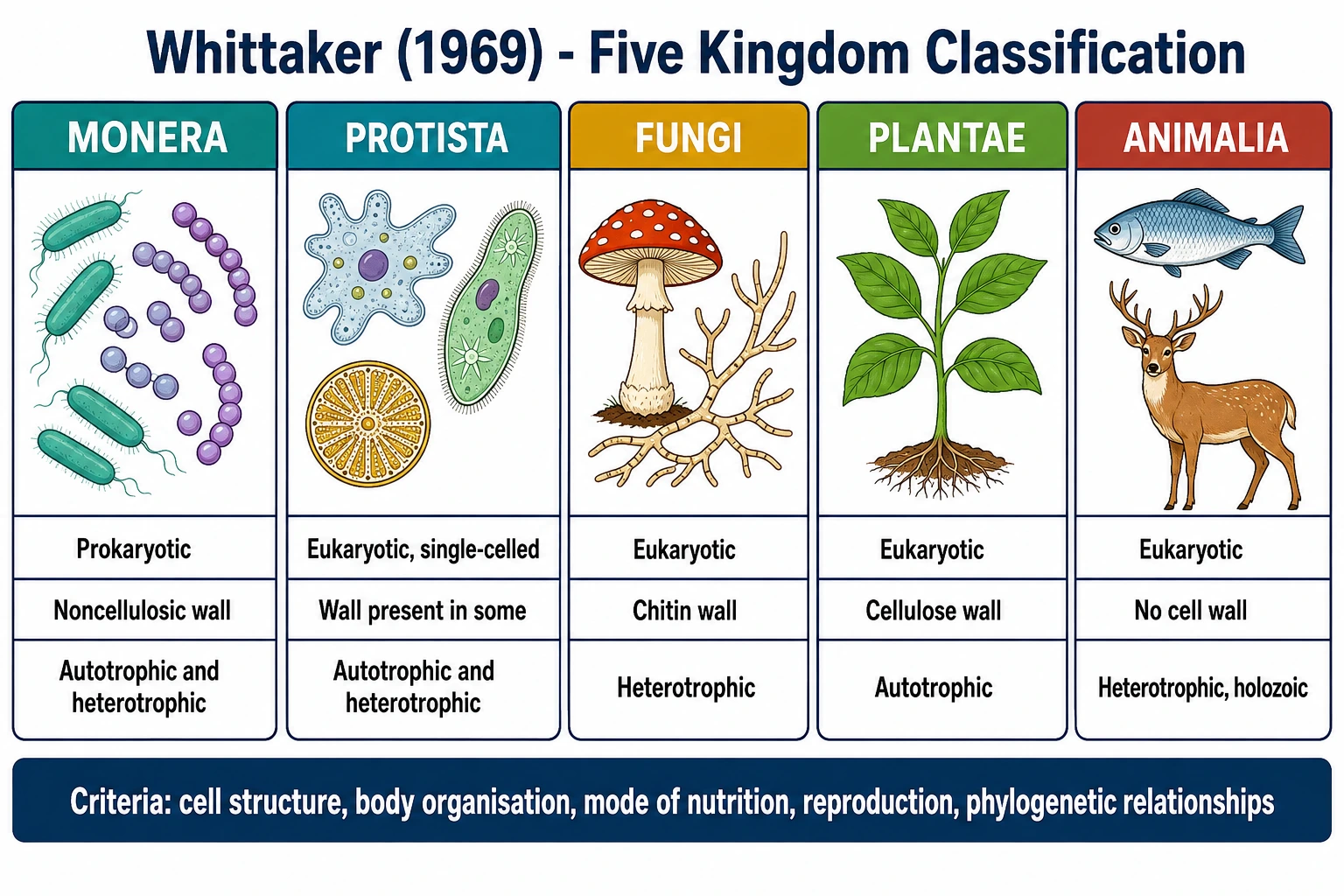
[NEET Important] The year 1969 and the name R. H. Whittaker are both asked. So is the criteria list - and "habitat" is a common wrong option slipped into it.
Table 2.1 - Characteristics of the Five Kingdoms
This is the single most examined table in the chapter. Learn it row by row, not kingdom by kingdom, because that is how match-the-column questions come.
| Character | Monera | Protista | Fungi | Plantae | Animalia |
|---|---|---|---|---|---|
| Cell type | Prokaryotic | Eukaryotic | Eukaryotic | Eukaryotic | Eukaryotic |
| Cell wall | Noncellulosic (polysaccharide + amino acid) | Present in some | Present, with chitin | Present (cellulose) | Absent |
| Nuclear membrane | Absent | Present | Present | Present | Present |
| Body organisation | Cellular | Cellular | Multicellular / loose tissue | Tissue / organ | Tissue / organ / organ system |
| Mode of nutrition | Autotrophic (chemosynthetic and photosynthetic) and heterotrophic (saprophytic / parasitic) | Autotrophic (photosynthetic) and heterotrophic | Heterotrophic (saprophytic / parasitic) | Autotrophic (photosynthetic) | Heterotrophic (holozoic / saprophytic etc.) |
The rows that generate questions:
- Only Monera is prokaryotic and only Monera lacks a nuclear membrane - these two rows always agree.
- Cell wall composition is the discriminator: noncellulosic in Monera, chitin in Fungi, cellulose in Plantae, absent in Animalia, and present in some Protista.
- Only Animalia shows organ system level organisation. Monera and Protista are cellular.
- Only Fungi and Animalia are purely heterotrophic. Only Plantae is purely autotrophic. Monera and Protista are both.
How the New Kingdoms Were Carved Out
The reasoning is worth following, because it makes the table make sense.
Earlier classifications included bacteria, blue green algae, fungi, mosses, ferns, gymnosperms and the angiosperms all under 'Plants'. The character that unified this whole kingdom was that all the organisms included had a cell wall in their cells.
That single criterion placed together groups that differed widely in everything else:
- It brought prokaryotic bacteria and blue green algae (cyanobacteria) together with eukaryotic groups.
- It grouped unicellular organisms with multicellular ones - Chlamydomonas was placed with Spirogyra under algae.
- It did not differentiate the heterotrophic fungi from the autotrophic green plants, though fungi had chitin in their walls while green plants had a cellulosic cell wall.
So, when such characteristics were considered:
- Fungi were placed in a separate kingdom - Kingdom Fungi.
- All prokaryotic organisms were grouped under Kingdom Monera.
- Unicellular eukaryotic organisms were placed in Kingdom Protista.
Kingdom Protista is the interesting one. It brought together Chlamydomonas and Chlorella - earlier placed in Algae within Plants, both having cell walls - with Paramoecium and Amoeba - earlier placed in the animal kingdom, which lack a cell wall. It put together organisms that earlier classifications had placed in different kingdoms, and it did so because the criteria for classification changed.
[NEET Important] That last point is the chapter's thesis in one line: the same organisms move between kingdoms not because they change, but because the criteria change. such changes will take place in future too, depending on improvements in our understanding of characteristics and evolutionary relationships.
Phylogenetic Classification and the Three-Domain System
Over time an attempt has been made to evolve a classification system which reflects not only the morphological, physiological and reproductive similarities, but is also phylogenetic - that is, based on evolutionary relationships.
And beyond Whittaker:
The three-domain system has also been proposed, which divides the Kingdom Monera into two domains, leaving the remaining eukaryotic kingdoms in the third domain, and thereby a six kingdom classification.
This is studied in detail in higher classes, so the examinable content is exactly what is written above: Monera splits into two domains, the eukaryotic kingdoms make the third, and the result is six kingdoms.
Scope note for this chapter: you will study Monera, Protista and Fungi here. Plantae and Animalia are dealt with separately in Chapters 3 and 4.
Quick Recap
- Earliest classifications were instinctive, based on the use of organisms for food, shelter and clothing.
- Aristotle made the first more scientific attempt using simple morphological characters: Plants into trees, shrubs and herbs; animals into red-blooded and not red-blooded.
- Linnaeus' time: the Two Kingdom system - Plantae and Animalia. It could not distinguish eukaryotes from prokaryotes, unicellular from multicellular, or photosynthetic from non-photosynthetic organisms.
- Beyond gross morphology, classification needed cell structure, nature of wall, mode of nutrition, habitat, methods of reproduction and evolutionary relationships.
- R. H. Whittaker (1969) proposed the Five Kingdom Classification: Monera, Protista, Fungi, Plantae, Animalia.
- His five criteria: cell structure, body organisation, mode of nutrition, reproduction, phylogenetic relationships.
- Fungi were separated because their walls have chitin, not cellulose; all prokaryotes went to Monera; unicellular eukaryotes went to Protista.
- Protista united Chlamydomonas and Chlorella (formerly plants) with Paramoecium and Amoeba (formerly animals).
- The three-domain system splits Monera into two domains, giving a six kingdom classification.
Solved Examples
Question 1
Q. Who was the earliest to attempt a more scientific basis for classification, and on what?
Answer. Aristotle, using simple morphological characters - plants into trees, shrubs and herbs, and animals into those with red blood and those without.
Question 2
Q. Name the five kingdoms of Whittaker's classification and the year proposed.
Answer. Monera, Protista, Fungi, Plantae and Animalia, proposed in 1969.
Question 3
Q. Which kingdom is the only prokaryotic one?
Answer. Monera. It is also the only kingdom in which the nuclear membrane is absent.
Question 4
Q. State the cell wall composition in Fungi and in Plantae.
Answer. Fungi: chitin. Plantae: cellulose.
Question 5
Q. In which kingdom is the cell wall absent?
Answer. Animalia.
Question 6
Q. List the five main criteria Whittaker used.
Answer. Cell structure, body organisation, mode of nutrition, reproduction and phylogenetic relationships.
Takeaway: "Habitat" is the classic wrong option here - it is on the chapter's list of characteristics that classification needed, but it is not one of Whittaker's five criteria.
Question 7
Q. What three distinctions could the Two Kingdom system not make?
Answer. It could not tell eukaryotes and prokaryotes apart, nor unicellular and multicellular organisms, nor photosynthetic (green algae) and non-photosynthetic (fungi) organisms.
Question 8
Q. What single character unified the old 'Plants' kingdom, and what was wrong with using it?
Answer. They were put together because all the organisms included had a cell wall. But a cell wall turns up in groups that differ in every other way, so it parked prokaryotic bacteria and cyanobacteria next to eukaryotes, unicellular organisms next to multicellular ones, and heterotrophic fungi next to autotrophic green plants - even though fungal walls have chitin and green plant walls have cellulose.
Question 9
Q. Which two kingdoms show both autotrophic and heterotrophic modes of nutrition?
Answer. Monera and Protista. Monera is autotrophic (chemosynthetic and photosynthetic) and heterotrophic (saprophytic or parasitic); Protista is autotrophic (photosynthetic) and heterotrophic.
Question 10
Q. Give the body organisation of each of the five kingdoms.
Answer. Monera - cellular. Protista - cellular. Fungi - multicellular or loose tissue. Plantae - tissue or organ. Animalia - tissue, organ or organ system.
Question 11
Q. What does the three-domain system propose?
Answer. It divides Kingdom Monera into two domains and puts the remaining eukaryotic kingdoms in the third domain. So you end up with a six kingdom classification.
Question 12
Q. Discuss how classification systems have undergone several changes over a period of time.
Answer.
- The earliest attempts were instinctive and based on the use of organisms for food, shelter and clothing.
- Aristotle introduced a more scientific basis using simple morphological characters - trees, shrubs and herbs; red-blooded and non-red-blooded animals.
- In Linnaeus' time came the Two Kingdom system (Plantae, Animalia), but it could not separate prokaryotes from eukaryotes, unicellular from multicellular, or photosynthetic from non-photosynthetic organisms, and many organisms fell into neither category.
- Gross morphology alone was clearly not enough, so cell structure, nature of wall, mode of nutrition, habitat, methods of reproduction and evolutionary relationships had to come in.
- R. H. Whittaker (1969) proposed the Five Kingdom Classification on five criteria, separating Fungi on chitin walls, Monera on prokaryotic structure, and Protista as unicellular eukaryotes.
- Later the three-domain system split Monera into two domains, giving six kingdoms.
- The plant and animal kingdoms kept their names all along, but what was included in them kept changing - and it will change again as our understanding of characteristics and evolutionary relationships improves.
Takeaway: This is one of the chapter-end exercises, and it is a 5-mark answer. The marks are in the sequence - use the numbered form.
Question 13
Q. Chlamydomonas, Chlorella, Paramoecium and Amoeba now sit in one kingdom. What were they before, and what does this teach?
Answer. Chlamydomonas and Chlorella were earlier placed in Algae within Plants - both have cell walls. Paramoecium and Amoeba were earlier placed in the animal kingdom - both lack cell walls. All four are now in Kingdom Protista because they are unicellular eukaryotes.
The lesson is the chapter's main point: organisms that earlier classifications placed in different kingdoms came together because the criteria for classification changed - from presence of a cell wall to cellularity plus nuclear organisation. The organisms did not change; the way we grouped them did.
Question 14
Q. A student is told an organism is eukaryotic, has a cell wall, and is heterotrophic. Which kingdom is it, and what one further check would confirm it?
Answer. Kingdom Fungi. Eukaryotic rules out Monera; a cell wall rules out Animalia; heterotrophic rules out Plantae, which is purely autotrophic photosynthetic. Protista can also be eukaryotic, walled in some members and heterotrophic, so the check that separates them is cell wall composition and body organisation: Fungi have chitin in the wall and are multicellular or loose tissue, while Protista are cellular (single-celled) and their walls, where present, are not chitinous.
Takeaway: Table 2.1 read as a decision tree - cell type, then wall, then nutrition, then body organisation - answers almost every "identify the kingdom" question in the chapter.