
How the Four Classes Are Separated
Recall the three criteria from section 6: the morphology of the mycelium, the mode of spore formation, and the fruiting bodies. Every difference below traces back to one of those three.
This is the most example-dense part of the chapter. Every class has three or so named genera, and NEET asks them relentlessly - usually as "which of the following belongs to X" or as a match-the-column.
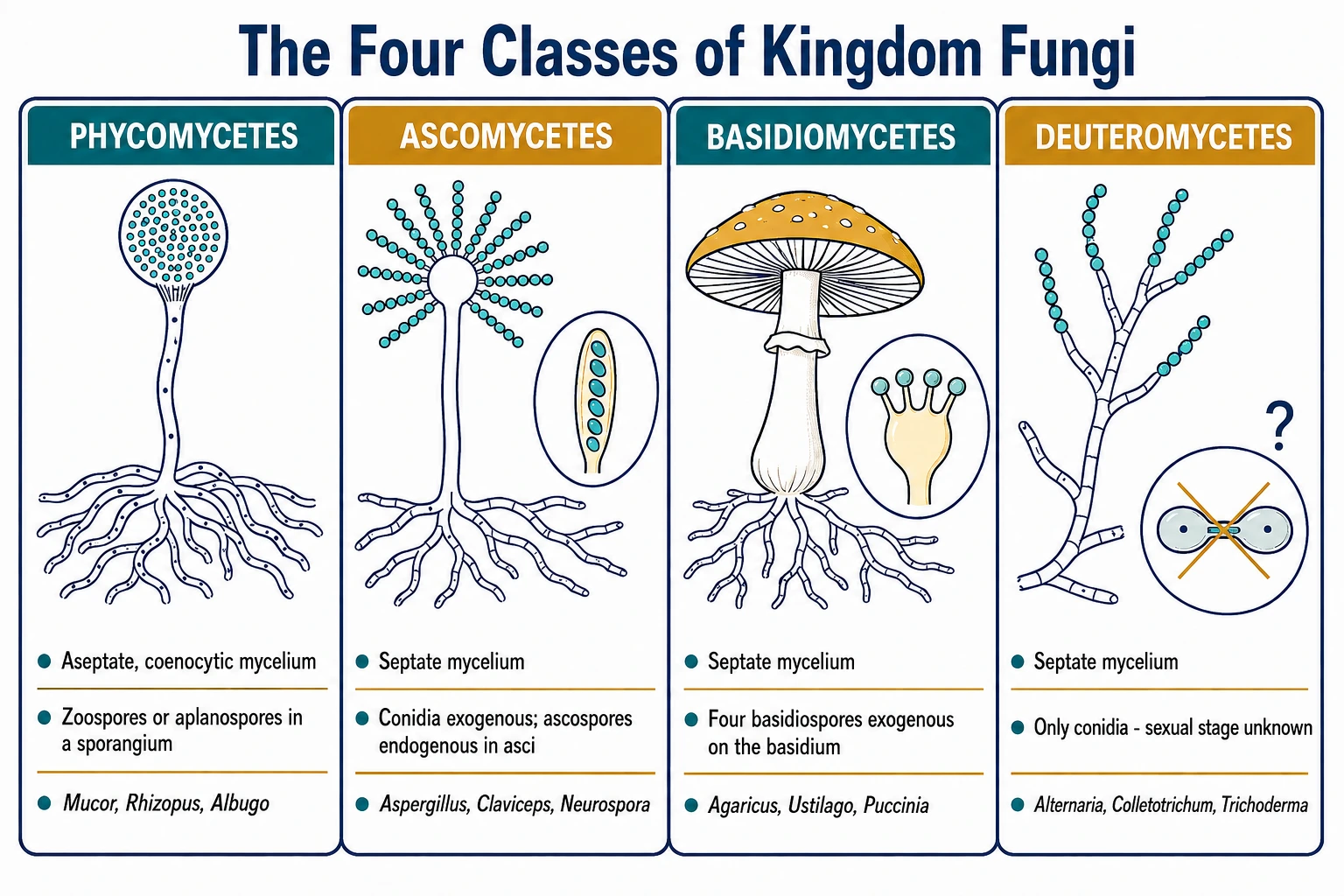
Phycomycetes
Habitat: found in aquatic habitats and on decaying wood in moist and damp places, or as obligate parasites on plants.
Mycelium: aseptate and coenocytic.
Asexual reproduction: takes place by zoospores (motile) or by aplanospores (non-motile). These spores are produced endogenously in a sporangium.
Sexual reproduction: a zygospore is formed by the fusion of two gametes. These gametes are:
- similar in morphology - isogamous, or
- dissimilar - anisogamous or oogamous.
Examples: Mucor, Rhizopus (the bread mould) and Albugo (the parasitic fungi on mustard).
[NEET Important] Three things are unique to this class among the four: The aseptate coenocytic mycelium, the zygospore, and the motile zoospores. And the two named diseases attach here - Rhizopus is the bread mould from the chapter's opening, Albugo the cause of the white spots on mustard leaves.
Ascomycetes
Common name: sac-fungi.
Body: mostly multicellular, e.g. Penicillium, or rarely unicellular, e.g. yeast (Saccharomyces).
Habit: saprophytic, decomposers, parasitic or coprophilous (growing on dung).
Mycelium: branched and septate.
Asexual spores: conidia, produced exogenously on a special mycelium called conidiophores. Conidia on germination produce mycelium.
Sexual spores: ascospores, produced endogenously in sac-like asci (singular: ascus). These asci are arranged in different types of fruiting bodies called ascocarps.
Examples: Aspergillus, Claviceps and Neurospora. Neurospora is used extensively in biochemical and genetic work. Many members like morels and truffles are edible and are considered delicacies.
[NEET Important] The exogenous / endogenous contrast is the highest-yield fact in this class: conidia exogenous on conidiophores, ascospores endogenous in asci. And Neurospora - biochemical and genetic work is a standard one-mark recall.
Basidiomycetes
Common forms: mushrooms, bracket fungi or puffballs.
Habitat: grow in soil, on logs and tree stumps and in living plant bodies as parasites, e.g. rusts and smuts.
Mycelium: branched and septate.
Asexual reproduction: asexual spores are generally not found, but vegetative reproduction by fragmentation is common.
Sexual reproduction: the sex organs are absent, but plasmogamy is brought about by fusion of two vegetative or somatic cells of different strains or genotypes. The resultant structure is dikaryotic, which ultimately gives rise to the basidium. Karyogamy and meiosis take place in the basidium, producing four basidiospores. The basidiospores are exogenously produced on the basidium (pl.: basidia). The basidia are arranged in fruiting bodies called basidiocarps.
Examples: Agaricus (mushroom), Ustilago (smut) and Puccinia (rust fungus).
[NEET Important] Two facts here are asked more than any others: four basidiospores produced exogenously on the basidium, and sex organs are absent - plasmogamy occurs by fusion of two somatic cells of different strains. Note also the deliberate contrast with Ascomycetes: ascospores endogenous, basidiospores exogenous.
Deuteromycetes
Common name: imperfect fungi - because only the asexual or vegetative phases of these fungi are known.
Why the class is a holding pen: the logic, and it is worth reading twice.
When the sexual forms of these fungi were discovered they were moved into classes they rightly belong to. It is also possible that the asexual and vegetative stage have been given one name (and placed under deuteromycetes) and the sexual stage another (and placed under another class). Later, when the linkages were established, the fungi were correctly identified and moved out of deuteromycetes. Once perfect (sexual) stages of members of deuteromycetes were discovered, they were often moved to ascomycetes and basidiomycetes.
Reproduction: only by asexual spores known as conidia.
Mycelium: septate and branched.
Habit: some members are saprophytes or parasites, while a large number of them are decomposers of litter and help in mineral cycling.
Examples: Alternaria, Colletotrichum and Trichoderma.
[NEET Important] "Imperfect" here has a precise meaning: the sexual (perfect) stage is unknown, not that the fungus is defective. And when the perfect stage turns up, members are moved to ascomycetes or basidiomycetes - which is why deuteromycetes is sometimes called an artificial or form class.
The Four Classes Side by Side
| Phycomycetes | Ascomycetes | Basidiomycetes | Deuteromycetes | |
|---|---|---|---|---|
| Common name | - | Sac-fungi | Mushrooms, bracket fungi, puffballs | Imperfect fungi |
| Mycelium | Aseptate, coenocytic | Branched, septate | Branched, septate | Septate, branched |
| Asexual spores | Zoospores (motile) or aplanospores (non-motile), endogenous in a sporangium | Conidia, exogenous on conidiophores | Generally not found; fragmentation common | Only conidia |
| Sexual spores | Zygospore | Ascospores, endogenous in asci | Four basidiospores, exogenous on the basidium | Unknown (sexual stage not known) |
| Fruiting body | - | Ascocarp | Basidiocarp | - |
| Sex organs | Gametes: Isogamous, anisogamous or oogamous | Present | Absent; plasmogamy by fusion of two somatic cells | - |
| Examples | Mucor, Rhizopus, Albugo | Aspergillus, Claviceps, Neurospora, yeast, morels, truffles | Agaricus, Ustilago, Puccinia | Alternaria, Colletotrichum, Trichoderma |
Two mnemonics that work:
- Endogenous vs exogenous: Ascospores in Asci are inside; Basidiospores on Basidia are outside.
- Examples: Phycomycetes = Mucor, Rhizopus, Albugo ("MRA"); Basidiomycetes = Agaricus, Ustilago, Puccinia ("AUP"); Deuteromycetes = Alternaria, Colletotrichum, Trichoderma ("ACT").
Quick Recap
- Phycomycetes: aquatic habitats, decaying wood in moist damp places, or obligate parasites on plants; aseptate coenocytic mycelium; asexual by zoospores (motile) or aplanospores (non-motile), produced endogenously in a sporangium; zygospore from fusion of isogamous, anisogamous or oogamous gametes. Mucor, Rhizopus (bread mould), Albugo (parasite on mustard).
- Ascomycetes (sac-fungi): mostly multicellular (Penicillium), rarely unicellular (yeast, Saccharomyces); saprophytic, decomposers, parasitic or coprophilous; branched septate mycelium; conidia exogenous on conidiophores; ascospores endogenous in asci, asci arranged in ascocarps. Aspergillus, Claviceps, Neurospora (biochemical and genetic work); morels and truffles edible.
- Basidiomycetes: mushrooms, bracket fungi, puffballs; soil, logs, tree stumps, and parasites - rusts and smuts; branched septate mycelium; asexual spores generally absent, fragmentation common; sex organs absent, plasmogamy by fusion of two somatic cells of different strains; dikaryotic structure gives rise to the basidium; karyogamy and meiosis in the basidium produce four basidiospores exogenously; basidia in basidiocarps. Agaricus, Ustilago (smut), Puccinia (rust).
- Deuteromycetes (imperfect fungi): only asexual or vegetative phases known; reproduce only by conidia; septate branched mycelium; saprophytes, parasites, and many are decomposers of litter helping in mineral cycling; members are moved to ascomycetes or basidiomycetes once a perfect stage is found. Alternaria, Colletotrichum, Trichoderma.
Solved Examples
Question 1
Q. Which class of fungi has an aseptate, coenocytic mycelium?
Answer. Phycomycetes.
Question 2
Q. What is the common name of Ascomycetes?
Answer. Sac-fungi.
Question 3
Q. Name the fruiting bodies of Ascomycetes and Basidiomycetes.
Answer. Ascocarp in Ascomycetes; basidiocarp in Basidiomycetes.
Question 4
Q. How many basidiospores are produced on a basidium?
Answer. Four.
Question 5
Q. Give the three examples of Deuteromycetes.
Answer. Alternaria, Colletotrichum and Trichoderma.
Question 6
Q. Which fungus is the bread mould, and which is the parasite on mustard?
Answer. Rhizopus is the bread mould; Albugo is the parasitic fungus on mustard. Both are Phycomycetes.
Question 7
Q. Distinguish the way conidia and ascospores are produced.
Answer.
- Conidia are asexual spores produced exogenously on a special mycelium called conidiophores.
- Ascospores are sexual spores produced endogenously in sac-like asci, which are arranged in ascocarps.
Question 8
Q. Why are Deuteromycetes called imperfect fungi?
Answer. Because only the asexual or vegetative phases of these fungi are known - the sexual, or 'perfect', stage has not been discovered. Once perfect stages are found, the members are often moved to ascomycetes or basidiomycetes.
Question 9
Q. Describe sexual reproduction in Basidiomycetes.
Answer. The sex organs are absent, but plasmogamy is brought about by the fusion of two vegetative or somatic cells of different strains or genotypes. The resultant structure is dikaryotic and ultimately gives rise to the basidium. Karyogamy and meiosis take place in the basidium, producing four basidiospores, which are exogenously produced on the basidium. The basidia are arranged in fruiting bodies called basidiocarps.
Question 10
Q. What are zoospores and aplanospores, and where are they formed?
Answer. Both are asexual spores of Phycomycetes. Zoospores are motile; aplanospores are non-motile. Both are produced endogenously in a sporangium.
Question 11
Q. Give a comparative account of the classes of Kingdom Fungi under (i) mode of nutrition and (ii) mode of reproduction.
Answer.
(i) Mode of nutrition
- Phycomycetes: saprophytic on decaying wood in moist and damp places, or obligate parasites on plants; some aquatic.
- Ascomycetes: saprophytic, decomposers, parasitic or coprophilous (growing on dung).
- Basidiomycetes: saprophytic in soil, on logs and tree stumps, or parasitic in living plant bodies as rusts and smuts.
- Deuteromycetes: saprophytes or parasites, and a large number are decomposers of litter that help in mineral cycling.
(ii) Mode of reproduction
- Phycomycetes: asexual by zoospores (motile) or aplanospores (non-motile) formed endogenously in a sporangium; sexual by fusion of isogamous, anisogamous or oogamous gametes forming a zygospore.
- Ascomycetes: asexual by conidia produced exogenously on conidiophores; sexual by ascospores produced endogenously in asci, borne in ascocarps.
- Basidiomycetes: asexual spores generally absent; vegetative reproduction by fragmentation is common; sexual by plasmogamy between two somatic cells, giving a dikaryotic structure and then a basidium, in which karyogamy and meiosis yield four exogenous basidiospores borne in basidiocarps.
- Deuteromycetes: only asexual reproduction, by conidia; the sexual stage is unknown.
Takeaway: This one is set at the end of the chapter. Answer it as a four-by-two grid - the marks are for covering all four classes under both headings.
Question 12
Q. A fungus has septate hyphae, produces no asexual spores, and reproduces sexually without sex organs. Identify the class and justify each clue.
Answer. Basidiomycetes.
- Septate hyphae rules out Phycomycetes, whose mycelium is aseptate and coenocytic.
- No asexual spores rules out Ascomycetes (conidia) and Deuteromycetes (which reproduce only by conidia); asexual spores are generally not found in Basidiomycetes, vegetative reproduction being by fragmentation.
- Sexual reproduction without sex organs is the clincher - in Basidiomycetes the sex organs are absent and plasmogamy occurs by fusion of two vegetative or somatic cells of different strains or genotypes.
Question 13
Q. Why is Deuteromycetes described as a class members can be moved out of, and what does this say about its status?
Answer. A fungus lands in Deuteromycetes only because its sexual stage is unknown. It is also possible that the asexual and vegetative stage was given one name and placed under deuteromycetes, while the sexual stage was given another name and placed under a different class. When the linkages between the two are established, or when a perfect stage is discovered, the fungus is correctly identified and moved out - usually into ascomycetes or basidiomycetes.
So the class is really defined by an absence of knowledge rather than by a shared biological character. That makes it a provisional or form class, not a natural one - it shrinks as knowledge grows.
Question 14
Q. Puccinia appears in this chapter twice - as wheat rust in the introduction to fungi and as an example of a class. Give its class, the class characters it shows, and the two other examples from that class.
Answer. Puccinia is a Basidiomycete. The class characters it fits: it lives in living plant bodies as a parasite - rusts and smuts are named for exactly this habit - and it has a branched septate mycelium, generally no asexual spores, and a sexual cycle with absent sex organs, somatic plasmogamy, a dikaryotic stage, and four basidiospores produced exogenously on the basidium. The other two examples from the class are Agaricus (mushroom) and Ustilago (smut).
Question 15
Q. Both Ascomycetes and Basidiomycetes show a dikaryophase. Trace where the dikaryon arises in each and where it ends.
Answer.
- In both classes the dikaryon arises after plasmogamy, when the protoplasms of two compatible cells fuse but the nuclei do not, giving the n + n condition.
- In Ascomycetes the plasmogamy is between gametes and the dikaryotic condition is resolved in the ascus, where karyogamy is followed by meiosis, producing ascospores endogenously; the asci sit in ascocarps.
- In Basidiomycetes there are no sex organs, so plasmogamy occurs by fusion of two vegetative or somatic cells of different strains or genotypes. The resultant dikaryotic structure ultimately gives rise to the basidium, and karyogamy and meiosis take place in the basidium, producing four basidiospores exogenously; the basidia sit in basidiocarps.
In both, the dikaryophase ends at karyogamy - the point at which the parental nuclei fuse and the cell becomes 2n.