
Archaebacteria - Life in Harsh Habitats
These bacteria are special since they live in some of the most harsh habitats.
Three named groups, each tied to a habitat. This pairing is asked in both directions, so learn it as a table:
| Group | Habitat |
|---|---|
| Halophiles | Extreme salty areas |
| Thermoacidophiles | Hot springs |
| Methanogens | Marshy areas |
And the reason they survive:
Archaebacteria differ from other bacteria in having a different cell wall structure, and this feature is responsible for their survival in extreme conditions.
[NEET Important] The cause is the cell wall structure - not the membrane, not special enzymes. Options offering those are distractors.
Methanogens and biogas
Methanogens are present in the gut of several ruminant animals such as cows and buffaloes, and they are responsible for the production of methane (biogas) from the dung of these animals.
This is the one archaebacterial fact with an economic angle, and it is exactly what the chapter-end exercise - "two economically important uses of archaebacteria" - is built on.
Eubacteria - The 'True Bacteria'
There are thousands of different eubacteria or 'true bacteria'. Two defining features:
- A rigid cell wall
- A flagellum, if motile
Note the conditional in the second - a flagellum is present if the bacterium is motile, not in every eubacterium.
Cyanobacteria (Blue-Green Algae)
The cyanobacteria - also referred to as blue-green algae - are the eubacteria that carry the most exam weight.
Key characters:
- They have chlorophyll a similar to green plants and are photosynthetic autotrophs.
- They are unicellular, colonial or filamentous.
- They are freshwater, marine or terrestrial algae.
- The colonies are generally surrounded by a gelatinous sheath.
- They often form blooms in polluted water bodies.
And the fact NEET asks most often:
Some of these organisms can fix atmospheric nitrogen in specialised cells called heterocysts, e.g. Nostoc and Anabaena.
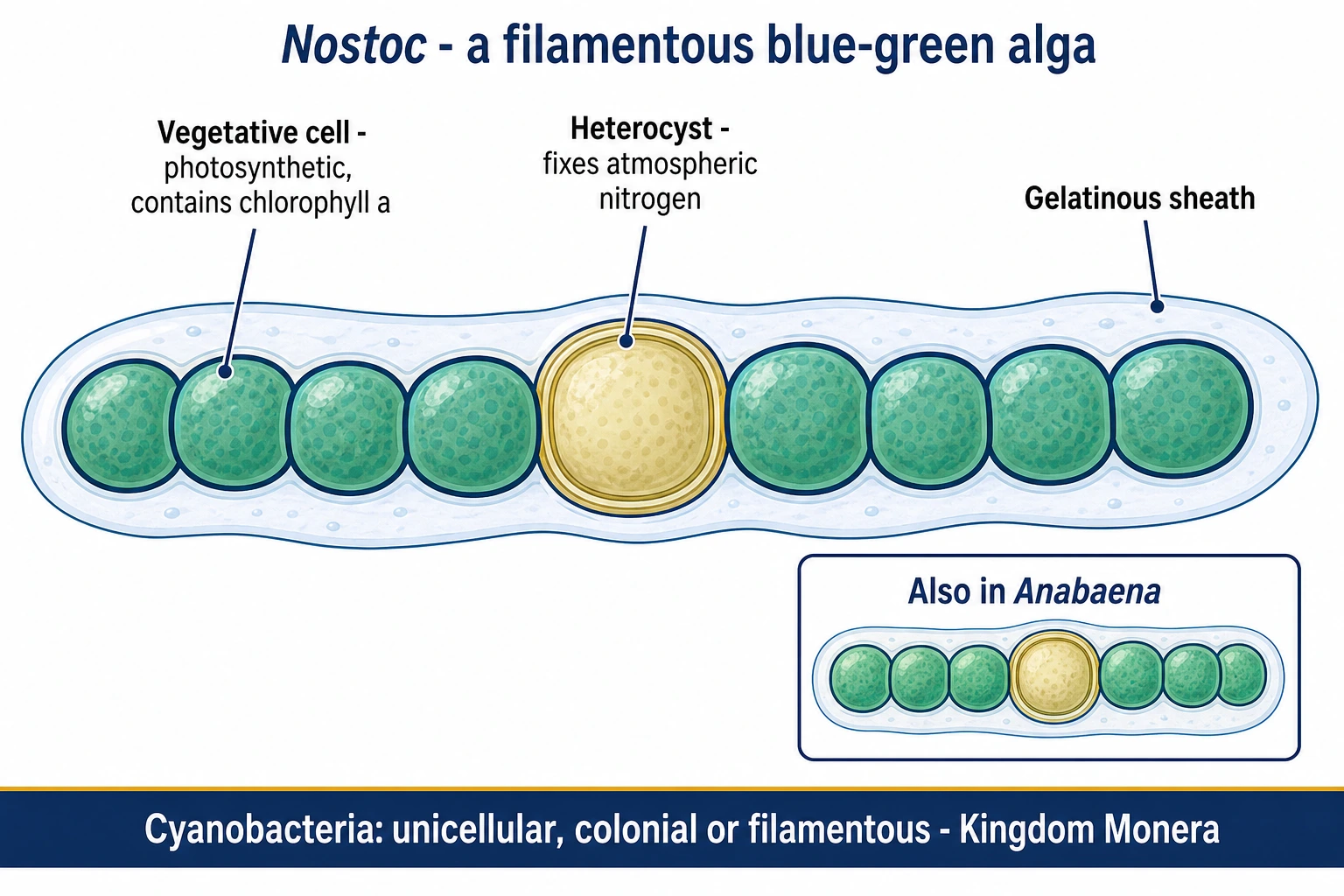
[NEET Important] Three things travel together and must never be separated: heterocyst (the specialised cell), nitrogen fixation (the function), and Nostoc and Anabaena (the examples). A question naming any one expects the other two.
Chemosynthetic Autotrophic Bacteria
Chemosynthetic autotrophic bacteria oxidise various inorganic substances such as nitrates, nitrites and ammonia and use the released energy for their ATP production.
And their ecological value:
They play a great role in recycling nutrients like nitrogen, phosphorous, iron and sulphur.
Four nutrients, three substances oxidised - both lists get asked, so keep them separate in your memory:
| Oxidise | Recycle |
|---|---|
| Nitrates, nitrites, ammonia | Nitrogen, phosphorous, iron, sulphur |
Heterotrophic Bacteria - The Useful and the Harmful
Heterotrophic bacteria are the most abundant in nature. The majority are important decomposers.
Helpful roles - and these are exactly the "economically important uses of heterotrophic bacteria" the chapter-end exercise wants:
- Making curd from milk
- Production of antibiotics
- Fixing nitrogen in legume roots
Harmful roles - some are pathogens causing damage to human beings, crops, farm animals and pets. The four diseases named:
- Cholera
- Typhoid
- Tetanus
- Citrus canker
[NEET Important] Citrus canker is the plant disease in this list - a question asking for a bacterial disease of plants wants that one. The other three are human diseases.
Reproduction in Bacteria
Three routes, in the chapter's own order:
- Mainly by fission.
- Sometimes, under unfavourable conditions, they produce spores.
- They also reproduce by a sort of sexual reproduction by adopting a primitive type of DNA transfer from one bacterium to the other.
[NEET Important] Read point 3 carefully. It is called a sort of sexual reproduction and involves a primitive type of DNA transfer - not gamete fusion. Questions built on this expect the hedged wording, not a claim of true sexual reproduction. Note also that spores here are a response to unfavourable conditions, not the main reproductive method.
Mycoplasma - The Smallest Living Cells
A short paragraph, and a reliable one-mark question.
The Mycoplasma are organisms that completely lack a cell wall. They are the smallest living cells known and can survive without oxygen. Many mycoplasma are pathogenic in animals and plants.
Four facts, all examinable:
- Completely lack a cell wall
- Smallest living cells known
- Can survive without oxygen
- Many are pathogenic in animals and plants
[NEET Important] "Smallest living cells" is Mycoplasma. Do not confuse this with viruses, viroids or prions, which are not cells at all - and are covered in section 9.
Quick Recap
Archaebacteria
- Live in the most harsh habitats; halophiles in extreme salty areas, thermoacidophiles in hot springs, methanogens in marshy areas.
- Survive because of a different cell wall structure.
- Methanogens live in the gut of ruminants such as cows and buffaloes and produce methane (biogas) from their dung.
Eubacteria
- Thousands of species; characterised by a rigid cell wall and, if motile, a flagellum.
- Cyanobacteria (blue-green algae): chlorophyll a like green plants, photosynthetic autotrophs, unicellular / colonial / filamentous, freshwater / marine / terrestrial, colonies with a gelatinous sheath, blooms in polluted water, and nitrogen fixation in heterocysts - Nostoc, Anabaena.
- Chemosynthetic autotrophs: oxidise nitrates, nitrites and ammonia for ATP; recycle nitrogen, phosphorous, iron and sulphur.
- Heterotrophic bacteria: most abundant, majority are decomposers; make curd, produce antibiotics, fix nitrogen in legume roots; pathogens cause cholera, typhoid, tetanus and citrus canker.
Reproduction: mainly by fission; spores under unfavourable conditions; a sort of sexual reproduction by a primitive type of DNA transfer.
Mycoplasma: completely lack a cell wall, smallest living cells known, survive without oxygen, many pathogenic in animals and plants.
Solved Examples
Question 1
Q. Where do halophiles live?
Answer. In extreme salty areas.
Question 2
Q. Which archaebacteria live in hot springs?
Answer. Thermoacidophiles.
Question 3
Q. Name the specialised cells in which cyanobacteria fix atmospheric nitrogen.
Answer. Heterocysts.
Question 4
Q. Give two examples of nitrogen-fixing cyanobacteria.
Answer. Nostoc and Anabaena.
Question 5
Q. Which organisms completely lack a cell wall and are the smallest living cells known?
Answer. Mycoplasma.
Question 6
Q. Why do archaebacteria survive in extreme conditions?
Answer. It comes down to the wall. They differ from other bacteria in having a different cell wall structure, and that is what is responsible for their survival in extreme conditions.
Question 7
Q. State two economically important uses of (a) heterotrophic bacteria and (b) archaebacteria.
Answer. (a) Heterotrophic bacteria: they are helpful in making curd from milk and in the production of antibiotics. (A third acceptable use: fixing nitrogen in legume roots.) (b) Archaebacteria: methanogens present in the gut of ruminants such as cows and buffaloes are responsible for the production of methane (biogas) from dung, which is used as fuel; the same methanogens are used in biogas plants for treating animal waste.
Takeaway: This is one of the chapter-end exercises. For archaebacteria the answer is essentially all about methanogens - that is the only economically framed archaebacterial fact in the chapter.
Question 8
Q. What are the two defining characters of eubacteria?
Answer. A rigid cell wall, and a flagellum if motile. The flagellum depends on the bacterium being motile, so it is not universal.
Question 9
Q. How do chemosynthetic autotrophic bacteria obtain energy, and why do they matter ecologically?
Answer. They oxidise various inorganic substances such as nitrates, nitrites and ammonia and use the released energy for ATP production. Ecologically they play a great role in recycling nutrients like nitrogen, phosphorous, iron and sulphur.
Question 10
Q. Name four diseases caused by bacteria, and say which of them affects plants.
Answer. Cholera, typhoid, tetanus and citrus canker. Citrus canker is the plant disease; the other three affect human beings.
Question 11
Q. Describe reproduction in bacteria.
Answer. Bacteria reproduce mainly by fission. Sometimes, under unfavourable conditions, they produce spores. They also reproduce by a sort of sexual reproduction, adopting a primitive type of DNA transfer from one bacterium to the other.
Question 12
Q. Find out what the terms 'algal bloom' and 'red tides' signify.
Answer.
- Algal bloom: the excessive, often visible, growth of algae in a water body. cyanobacteria often form blooms in polluted water bodies - so a bloom signals nutrient-rich, typically polluted water, and the dense growth can deoxygenate the water and harm other aquatic life.
- Red tide: the reddening of the sea caused by red dinoflagellates such as Gonyaulax undergoing such rapid multiplication that they make the sea appear red. Toxins released by such large numbers may even kill other marine animals such as fishes.
Takeaway: This one is set at the end of the chapter. It spans two kingdoms - the bloom is a moneran (cyanobacterial) phenomenon and the red tide a protistan (dinoflagellate) one. Say which organism causes each.
Question 13
Q. Cyanobacteria are called blue-green algae, yet they are placed in Monera. Explain.
Answer. The name is historical. Earlier classifications put bacteria and blue green algae under 'Plants' along with true algae, because the unifying character used was the presence of a cell wall. But cyanobacteria are prokaryotic - they lack a nuclear membrane and membrane-bound organelles - while true algae are eukaryotic. Once Whittaker made cell structure a criterion, all prokaryotic organisms were grouped under Kingdom Monera, so cyanobacteria went there too - even though they carry chlorophyll a similar to green plants and are photosynthetic autotrophs. The word 'algae' in their name is just left over from the older scheme.
Takeaway: This is the chapter's thesis again - the organism did not change, the criterion did.
Question 14
Q. A filamentous prokaryote from a freshwater pond is photosynthetic, has a gelatinous sheath, and shows occasional enlarged pale cells along the filament. Identify the group, the special cells, their function, and two example genera.
Answer.
- Group: Cyanobacteria (blue-green algae), which are eubacteria within Kingdom Monera. The clues are prokaryotic, filamentous, photosynthetic and the gelatinous sheath around the colony.
- Special cells: heterocysts.
- Function: fixation of atmospheric nitrogen.
- Examples: Nostoc and Anabaena.
Question 15
Q. A patient's sample yields a wall-less, oxygen-independent, extremely small pathogen. Why is it not classified as a virus, and what is it?
Answer. It is a Mycoplasma. It is not a virus because it is a cell - mycoplasma are described as the smallest living cells known, and they are placed in Kingdom Monera. Viruses, by contrast, are non-cellular, have an inert crystalline structure outside the living cell, and are not considered truly living; they also cannot be cultured independently, being obligate parasites. Being wall-less is what makes Mycoplasma odd among bacteria, because eubacteria otherwise have a rigid cell wall.