
What Goes Into Protista
All single-celled eukaryotes are placed under Protista, but the boundaries of this kingdom are not well defined.
The text is unusually candid about the fuzziness: what may be 'a photosynthetic protistan' to one biologist may be 'a plant' to another. That admission is itself asked as a comprehension question.
The five groups included in this book:
- Chrysophytes
- Dinoflagellates
- Euglenoids
- Slime moulds
- Protozoans
General characters of the kingdom:
- Members are primarily aquatic.
- This kingdom forms a link with the others dealing with plants, animals and fungi.
- Being eukaryotes, the protistan cell body contains a well defined nucleus and other membrane-bound organelles.
- Some have flagella or cilia.
- Protists reproduce asexually and sexually by a process involving cell fusion and zygote formation.
[NEET Important] "Forms a link with plants, animals and fungi" is a favourite fill-in-the-blank. So is "primarily aquatic".
This section covers the first three groups; slime moulds and protozoans are section 5.
Chrysophytes
This group includes diatoms and golden algae (desmids).
- Found in fresh water as well as in marine environments.
- They are microscopic and float passively in water currents - that is, they are plankton.
- Most of them are photosynthetic.
The diatom cell wall - A soap box of silica
In diatoms the cell walls form two thin overlapping shells, which fit together as in a soap box. The walls are embedded with silica and thus the walls are indestructible.
The consequence:
Diatoms have left behind large amounts of cell wall deposits in their habitat; this accumulation over billions of years is referred to as 'diatomaceous earth'. Being gritty, this soil is used in polishing and in the filtration of oils and syrups.
And the ecological headline:
Diatoms are the chief 'producers' in the oceans.
[NEET Important] Four diatom facts are asked over and over: two overlapping shells like a soap box, silica in the walls making them indestructible, diatomaceous earth used in polishing and filtration of oils and syrups, and chief producers in the oceans. This last one is the answer to "which organism is the chief producer in the oceans".
Dinoflagellates
- Mostly marine and photosynthetic.
- They appear yellow, green, brown, blue or red depending on the main pigments present in their cells.
- The cell wall has stiff cellulose plates on the outer surface.
- Most of them have two flagella; one lies longitudinally and the other transversely in a furrow between the wall plates.
Red tides
Very often, red dinoflagellates (example: Gonyaulax) undergo such rapid multiplication that they make the sea appear red (red tides). Toxins released by such large numbers may even kill other marine animals such as fishes.
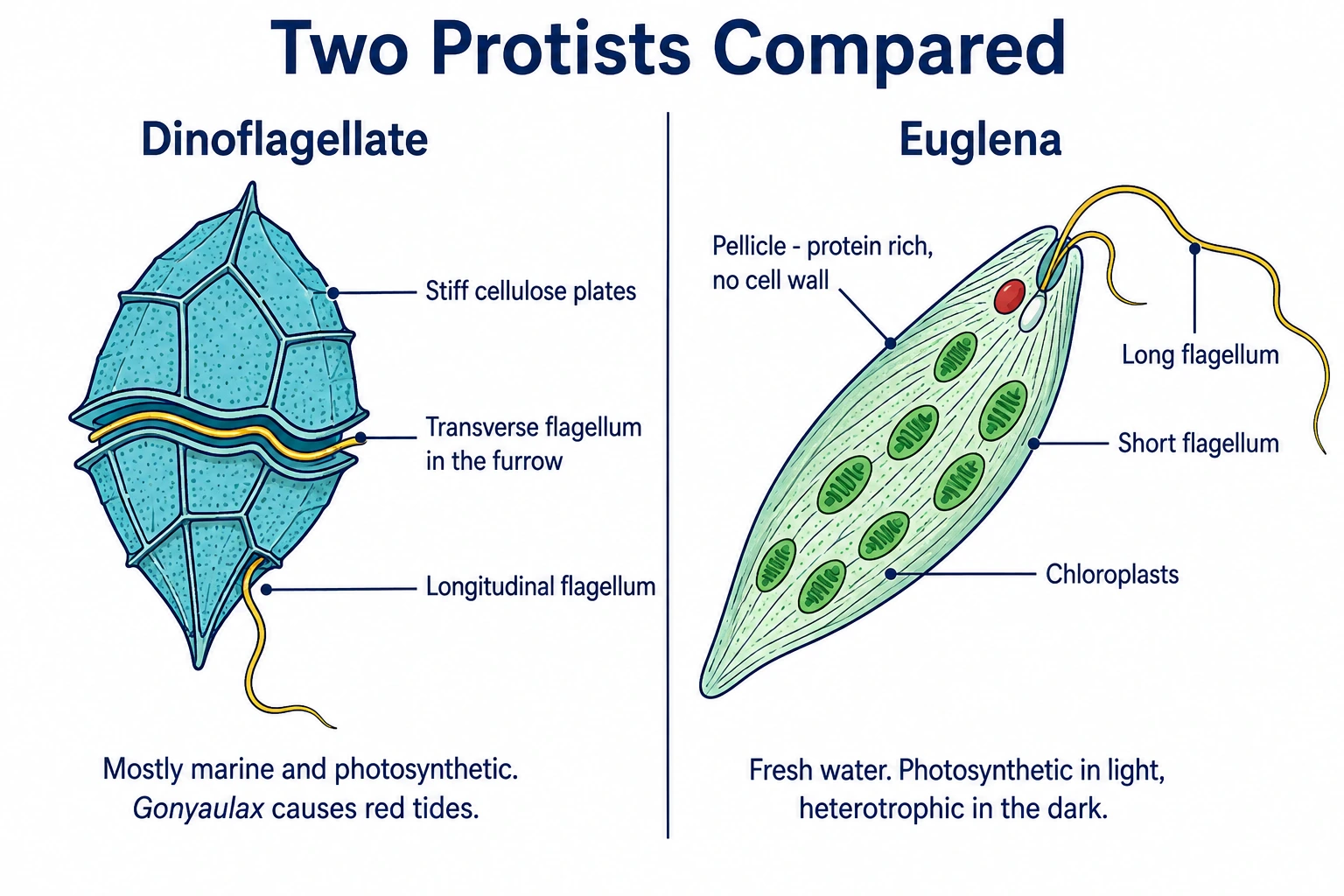
[NEET Important] Two flagella, one longitudinal and one transverse, sitting in a furrow between the wall plates - the arrangement is asked directly. And Gonyaulax is the name to attach to red tides.
Euglenoids
- The majority are fresh water organisms found in stagnant water.
- Instead of a cell wall, they have a protein rich layer called pellicle, which makes their body flexible.
- They have two flagella, a short and a long one.
- Though they are photosynthetic in the presence of sunlight, when deprived of sunlight they behave like heterotrophs by predating on other smaller organisms.
- Interestingly, the pigments of euglenoids are identical to those present in higher plants.
- Example: Euglena.
[NEET Important] Euglenoids are the classic "plant or animal?" organism, and you are handed both halves: plant-like because photosynthetic with pigments identical to higher plants; animal-like because they lack a cell wall (a flexible pellicle instead) and turn heterotrophic predators in the dark. This is a recurring NEET item and a standard written-answer question.
Do not confuse the two flagella here with the dinoflagellate pair. Euglenoids: One short, one long. Dinoflagellates: One longitudinal, one transverse.
The Three Groups Side by Side
| Chrysophytes | Dinoflagellates | Euglenoids | |
|---|---|---|---|
| Includes | Diatoms and golden algae (desmids) | Red, green, brown, blue, yellow forms | Euglena |
| Habitat | Fresh water and marine | Mostly marine | Fresh water, stagnant water |
| Covering | Cell walls of two overlapping shells with silica | Stiff cellulose plates on the outer surface | No cell wall; protein-rich pellicle |
| Flagella | - | Two - one longitudinal, one transverse | Two - one short, one long |
| Nutrition | Most photosynthetic | Photosynthetic | Photosynthetic in light; heterotrophic predator in the dark |
| Signature fact | Diatomaceous earth; chief producers in the oceans | Red tides (Gonyaulax), toxins kill fishes | Pigments identical to higher plants |
Quick Recap
- Protista = all single-celled eukaryotes, with boundaries not well defined; primarily aquatic, and the kingdom forms a link with plants, animals and fungi.
- Protistan cells have a well defined nucleus and membrane-bound organelles; some have flagella or cilia; they reproduce asexually and sexually by cell fusion and zygote formation.
- Chrysophytes = diatoms + golden algae (desmids); microscopic plankton floating passively; mostly photosynthetic. Diatom walls: two thin overlapping shells like a soap box, embedded with silica, hence indestructible, giving diatomaceous earth used in polishing and filtration of oils and syrups. Diatoms are the chief producers in the oceans.
- Dinoflagellates = mostly marine and photosynthetic; colour depends on main pigments; stiff cellulose plates on the outer surface; two flagella - one longitudinal, one transverse in a furrow between plates. Gonyaulax causes red tides; toxins may kill fishes.
- Euglenoids = mostly fresh water, in stagnant water; no cell wall but a protein-rich pellicle making the body flexible; two flagella, one short and one long; photosynthetic in sunlight but heterotrophic predators without it; pigments identical to higher plants. Example Euglena.
Solved Examples
Question 1
Q. Which organisms are placed under Kingdom Protista?
Answer. All single-celled eukaryotes. In this book: chrysophytes, dinoflagellates, euglenoids, slime moulds and protozoans.
Question 2
Q. What is the nature of cell-walls in diatoms?
Answer. The cell walls form two thin overlapping shells which fit together as in a soap box. The walls are embedded with silica and are therefore indestructible.
Takeaway: This is one of the chapter-end exercises - the soap box comparison and the word silica are both expected.
Question 3
Q. Which protists are the chief producers in the oceans?
Answer. Diatoms.
Question 4
Q. Name the organism responsible for red tides.
Answer. Gonyaulax, a red dinoflagellate.
Question 5
Q. What is the pellicle?
Answer. A protein rich layer found in euglenoids instead of a cell wall, which makes their body flexible.
Question 6
Q. What is diatomaceous earth and what is it used for?
Answer. Diatom walls are embedded with silica, which makes them indestructible, so diatoms have left behind large amounts of cell wall deposits in their habitat. That build-up over billions of years is called diatomaceous earth. Being gritty, this soil is used in polishing and in the filtration of oils and syrups.
Question 7
Q. Describe the flagella of dinoflagellates.
Answer. Most of them have two flagella; one lies longitudinally and the other transversely in a furrow between the wall plates.
Question 8
Q. What are the characteristic features of Euglenoids?
Answer.
- Majority are fresh water organisms found in stagnant water.
- Instead of a cell wall they have a protein rich layer called pellicle, which makes the body flexible.
- They have two flagella, a short and a long one.
- They are photosynthetic in the presence of sunlight, but when deprived of sunlight they behave like heterotrophs, predating on other smaller organisms.
- Their pigments are identical to those present in higher plants.
- Example: Euglena.
Takeaway: This is one of the chapter-end exercises. Six points, and the last two are the ones that earn the higher marks.
Question 9
Q. Why do dinoflagellates appear yellow, green, brown, blue or red?
Answer. Because the colour depends on the main pigments present in their cells.
Question 10
Q. Distinguish between the cell coverings of diatoms, dinoflagellates and euglenoids.
Answer.
- Diatoms: cell walls of two thin overlapping shells fitting like a soap box, embedded with silica, indestructible.
- Dinoflagellates: cell wall with stiff cellulose plates on the outer surface.
- Euglenoids: no cell wall at all - instead a protein-rich pellicle that makes the body flexible.
Question 11
Q. Euglenoids have been claimed by both botanists and zoologists. Present the case each side would make.
Answer. The plant case: euglenoids are photosynthetic in the presence of sunlight, and their pigments are identical to those present in higher plants - a very strong plant-like character. The animal case: they have no cell wall, only a flexible protein-rich pellicle; they are motile with two flagella; and when deprived of sunlight they behave like heterotrophs by predating on other smaller organisms.
That is exactly why the boundaries of Protista are not well defined - what one biologist calls 'a photosynthetic protistan' another calls 'a plant'. Whittaker's system settles it by grouping on cellularity and nuclear organisation: a single-celled eukaryote is a protist no matter how it feeds.
Question 12
Q. Two marine samples are examined. Sample A reddens the water and its organisms bear stiff cellulose plates and two dissimilar flagella. Sample B leaves behind a gritty indestructible sediment. Identify both and state one consequence of each.
Answer.
- Sample A: Dinoflagellates, specifically red ones such as Gonyaulax. The stiff cellulose plates and the two flagella - one longitudinal, one transverse in a furrow between the plates - are diagnostic. Consequence: their rapid multiplication makes the sea appear red (red tides), and the toxins they release may kill other marine animals such as fishes.
- Sample B: Diatoms, a chrysophyte group. The gritty indestructible sediment is diatomaceous earth, formed because the walls are embedded with silica. Consequence: the soil is used in polishing and in the filtration of oils and syrups; ecologically, diatoms are the chief producers in the oceans.
Question 13
Q. Why is Kingdom Protista said to form a link with the kingdoms of plants, animals and fungi?
Answer. Because its members show characters that anticipate all three. Photosynthetic protists such as diatoms and dinoflagellates are plant-like autotrophs; protozoans are all heterotrophs living as predators or parasites and are believed to be primitive relatives of animals; and slime moulds are saprophytic, their body moving along decaying twigs and leaves engulfing organic material and later forming spore-bearing fruiting bodies, as fungi do. Protista holds the first eukaryotes in the classification, so it sits right where the plant, animal and fungal lines start to split - and that is why the boundaries of the kingdom are hard to draw.