
Same Syllabus. A Different Exam.
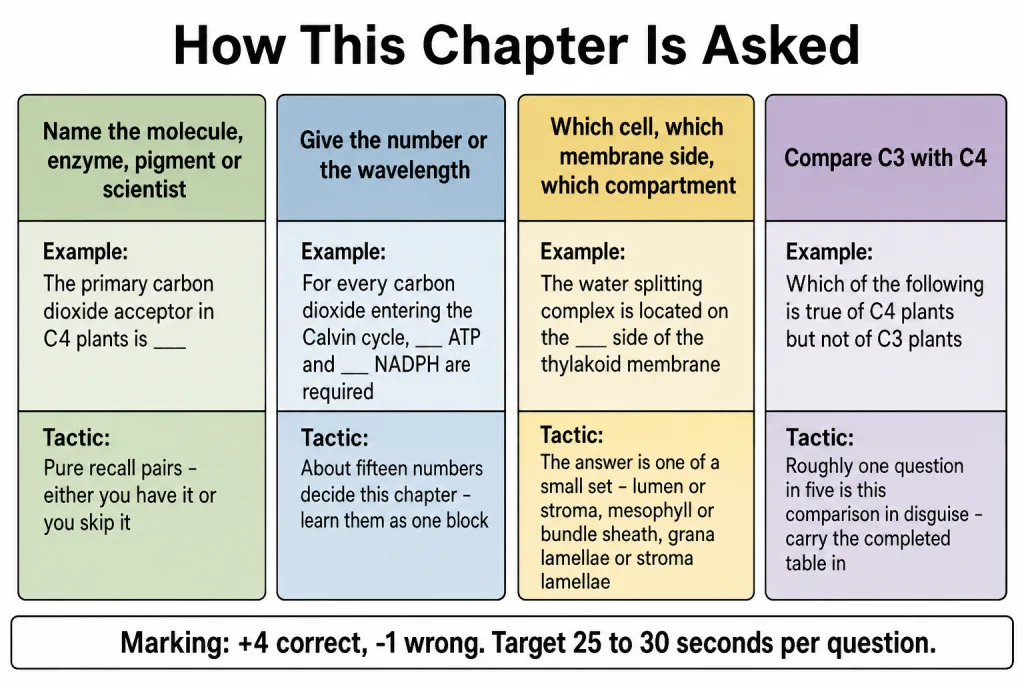
The Solved Examples section worked this chapter the way a written paper does - trace the pathway, explain the mechanism, compare the two plant types. NEET does not ask you to trace anything. It names one molecule, one membrane side, or one number, gives you four options, and you have about half a minute.
The marking is +4 for a correct answer and -1 for a wrong one. In a written answer, getting the Calvin cycle roughly right still earns most of the marks. Here, 3 ATP instead of 2 ATP is worth -1, which is five marks behind the person who skipped it.
Photosynthesis is one of the two or three highest-yielding chapters in the whole paper, and it is also one of the most mechanically memorisable. Nothing here needs to be reasoned out in the hall. Every mark is a name, a number, a wavelength, a location or a pairing.
The Four Shapes This Chapter Is Asked In
Shape 1 - Name the molecule, enzyme, pigment or scientist. "The primary acceptor in plants is _." Pure recall pairs. Either you have it or you skip it.
Shape 2 - Give the number or the wavelength. "For every entering the Calvin cycle, _ ATP and _ NADPH are required." This chapter has about fifteen numbers worth memorising and they are listed below as one block.
Shape 3 - Which cell, which membrane side, which compartment. "The water splitting complex is located on the _ side of the thylakoid membrane." This shape is unusually common here because the whole chapter is about where things happen, and the answer is almost always one of a small set: lumen or stroma, mesophyll or bundle sheath, grana lamellae or stroma lamellae.
Shape 4 - Compare with . Roughly one question in five from this chapter is this comparison in some disguise. The completed table is the single most valuable thing to carry in.
One Thing, One Address
Almost every Shape 1 and Shape 3 question is answered by one row of this table.
| The thing | Its one address |
|---|---|
| Light reactions | The membrane system - grana and stroma lamellae |
| Dark reactions | The stroma |
| Chlorophyll a | The chief pigment; forms the reaction centre |
| Accessory pigments | Chlorophyll b, xanthophylls, carotenoids; absorb light and transfer energy to chlorophyll a |
| The reaction centre of PS I | |
| The reaction centre of PS II | |
| Antennae | All the pigments of a photosystem except one molecule of chlorophyll a |
| Water splitting complex | Associated with PS II, on the inner side of the thylakoid membrane |
| Protons from water splitting | Accumulate in the lumen |
| NADP reductase | On the stroma side of the membrane |
| Cyclic photophosphorylation | The stroma lamellae, which lack PS II and NADP reductase |
| Embedded in the thylakoid membrane; the proton channel | |
| Protrudes on the outer surface, on the side facing the stroma | |
| RuBP | The acceptor; a 5-carbon ketose sugar |
| PGA | The first product in ; 3 carbons |
| PEP | The acceptor; 3 carbons; in the mesophyll |
| OAA | The first product in ; 4 carbons |
| PEPcase | Mesophyll cells of plants only |
| RuBisCO | Mesophyll in ; bundle sheath in |
| Calvin cycle | All photosynthetic plants; mesophyll in , bundle sheath only in |
| Kranz anatomy | The large bundle sheath cells around the vascular bundles of plants |
| Photorespiration | plants only; absent in |
The rule that saves the most marks here: when a question names a cell type, ask which plant. In a plant everything happens in the mesophyll. In a plant the work is split - is first fixed in the mesophyll and the Calvin cycle runs only in the bundle sheath. That single split explains Kranz anatomy, the absence of photorespiration, and the higher productivity, all at once.
The Numbers, and the Negatives
Every number in the chapter
- absorbs at 700 nm in PS I; at 680 nm in PS II.
- Cyclic photophosphorylation also occurs when only light beyond 680 nm is available.
- Water splitting: .
- RuBP - 5 carbons. PGA - 3 carbons. PEP - 3 carbons. OAA - 4 carbons. Phosphoglycolate - 2 carbons.
- Per fixed: 3 ATP and 2 NADPH - that is 2 ATP + 2 NADPH in reduction, plus 1 ATP in regeneration.
- Per glucose: 6 turns, 6 , 18 ATP, 12 NADPH.
- Light saturation at 10 per cent of full sunlight.
- Atmospheric - 0.03 to 0.04 per cent; an increase up to 0.05 per cent raises fixation, beyond which it is damaging.
- saturates at about ; only beyond .
- Temperature optimum - about to ; about to .
- Blackman's law of limiting factors - 1905. Priestley - 1770, oxygen 1774. Sachs - about 1854.
Why the ATP and NADPH numbers do not match. The Calvin cycle needs 3 ATP but only 2 NADPH per . Non-cyclic photophosphorylation makes both in roughly equal measure, so the extra ATP has to come from somewhere - and it is probably to meet this difference that cyclic photophosphorylation takes place. That sentence is a question in its own right.
The lists the "which is NOT" questions come from
- Products of the light reaction: ATP, NADPH, oxygen.
- The four pigments: chlorophyll a, chlorophyll b, xanthophylls, carotenoids. (Only the last three are accessory.)
- The three stages of the Calvin cycle: carboxylation, reduction, regeneration.
- What chemiosmosis requires: a membrane, a proton pump, a proton gradient, ATP synthase.
- The three causes of the proton gradient: water splitting into the lumen, the H carrier moving protons from stroma to lumen, NADP reductase taking protons from the stroma.
- What makes plants special: special leaf anatomy, tolerance of higher temperatures, response to high light intensities, no photorespiration, greater productivity of biomass.
- Bundle sheath cells: many chloroplasts, thick walls impervious to gaseous exchange, no intercellular spaces.
- In photorespiration there is: no sugar synthesis, no ATP synthesis, no NADPH synthesis - and ATP is consumed.
The pairs that get swapped
- Priestley - air is restored. Ingenhousz - sunlight is needed.
- Engelmann gave the ACTION spectrum, not the absorption spectrum.
- The oxygen comes from water, not from - hence twelve waters in the equation.
- is PS I; is PS II - and the photosystems are named by order of discovery, not by order of function, which is why the Z scheme starts at PS II.
- Cyclic makes ATP only; non-cyclic makes ATP and NADPH.
- Protons collect in the thylakoid LUMEN in photosynthesis, but in the mitochondrial INTERMEMBRANE SPACE in respiration.
- is in the membrane; faces the stroma.
- The mesophyll of a plant lacks RuBisCO; its bundle sheath lacks PEPcase.
Solved Examples at NEET Pace
Each item names the shortcut it uses, because the shortcut is the thing worth carrying into the exam hall.
Question 1
Q. For every molecule of entering the Calvin cycle, the requirement is (a) 2 ATP and 2 NADPH (b) 3 ATP and 2 NADPH (c) 2 ATP and 3 NADPH (d) 3 ATP and 3 NADPH
Answer. (b) 3 ATP and 2 NADPH. Shortcut - remember it as a sum, not a fact: 2 ATP + 2 NADPH in reduction, then 1 more ATP in regeneration. That gives 3 ATP and 2 NADPH, and over 6 turns it gives 18 ATP and 12 NADPH per glucose. Option (a) is what you get if you forget the regeneration step, which is exactly why it is offered first.
Question 2
Q. Cyclic photophosphorylation results in the synthesis of (a) ATP only (b) NADPH only (c) both ATP and NADPH (d) neither
Answer. (a) ATP only. Shortcut - cyclic means the electron comes back, so nothing is left over to reduce . It happens where only PS I is functional, thought to be in the stroma lamellae, which lack PS II as well as the NADP reductase enzyme. No NADP reductase means no NADPH - the two facts are the same fact.
Question 3
Q. In a plant, RuBisCO is found in (a) mesophyll cells only (b) bundle sheath cells only (c) both (d) neither
Answer. (b) bundle sheath cells only. Shortcut - in a plant the two enzymes live in different rooms. The mesophyll cells lack RuBisCO and carry PEPcase; the bundle sheath cells are rich in RuBisCO but lack PEPcase. This is also why the Calvin pathway in a plant runs only in the bundle sheath.
Question 4
Q. The splitting of water during photosynthesis is associated with (a) PS I, on the stroma side (b) PS I, on the lumen side (c) PS II, on the inner side of the thylakoid membrane (d) PS II, on the stroma side
Answer. (c) PS II, on the inner side of the thylakoid membrane. Shortcut - two attributes in every option means both are being tested. The splitting of water is associated with PS II, and the water splitting complex is physically located on the inner side of the membrane of the thylakoid - which is why the protons and the are released into the lumen, and why the lumen becomes the acidic compartment.
Question 5
Q. The photosystems are numbered PS I and PS II according to (a) the order in which they function (b) the sequence of their discovery (c) their absorption maxima (d) their position in the membrane
Answer. (b) the sequence of their discovery. Shortcut - the numbering is historical, and the exam knows it is counter-intuitive. They are named in the sequence of their discovery, and not in the sequence in which they function during the light reaction. In function, the Z scheme starts at PS II, passes down the chain to PS I, and only then reduces .
Question 6
Q. The primary acceptor of the Calvin cycle is a (a) 2-carbon compound (b) 3-carbon compound (c) 4-carbon compound (d) 5-carbon compound
Answer. (d) 5-carbon compound. Shortcut - the acceptor is bigger than the product, not smaller. RuBP is a 5-carbon ketose sugar. Adding one gives six carbons, which split into two molecules of 3-PGA. Option (a) is there for a reason: scientists believed the acceptor would be a 2-carbon compound and spent years looking for one before finding the 5-carbon RuBP.
Question 7
Q. In photorespiration (a) sugar and ATP are both made (b) ATP is made but no sugar (c) neither sugar nor ATP is made, and ATP is consumed (d) NADPH is made but no ATP
Answer. (c) neither sugar nor ATP is made, and ATP is consumed. Shortcut - photorespiration is pure loss; every "is made" option is wrong. In the photorespiratory pathway there is neither synthesis of sugars nor of ATP. Rather it results in the release of with the utilisation of ATP, and there is no synthesis of ATP or NADPH. Note also that its biological function is not known yet - a separate one-line question.
Question 8
Q. Which is the major limiting factor for photosynthesis? (a) light (b) carbon dioxide (c) temperature (d) water
Answer. (b) carbon dioxide. Shortcut - the limiting factor is the one in shortest supply, and is the scarcest input. Carbon dioxide is the major limiting factor for photosynthesis, at only 0.03 to 0.04 per cent of the atmosphere. Light is rarely a limiting factor in nature, because light saturation occurs at 10 per cent of full sunlight - so option (a) is the trap for a student who reasons from intuition instead of memory.
Question 9
Q. During chemiosmosis in the chloroplast, protons accumulate in the (a) stroma (b) intermembrane space (c) thylakoid lumen (d) cytoplasm
Answer. (c) thylakoid lumen. Shortcut - photosynthesis fills the lumen, respiration fills the intermembrane space. Here the proton accumulation is towards the inside of the membrane, that is in the lumen, and this causes a measurable decrease in pH in the lumen. Option (b) is the mitochondrial answer, offered because the two mechanisms are taught as parallels.
Question 10
Q. plants show saturation of photosynthesis at about (a) (b) (c) (d)
Answer. (b) . Shortcut - learn the pair, because whichever one is asked, the other is an option. plants show saturation at about , while responds to increased and saturation is seen only beyond . The consequence is the examinable part: current levels are limiting to plants, which is why greenhouse crops such as tomatoes and bell pepper are grown in a -enriched atmosphere.
Question 11
Q. The particle of ATP synthase (a) is embedded in the thylakoid membrane (b) forms the proton channel (c) protrudes on the side facing the stroma (d) splits water
Answer. (c) protrudes on the side facing the stroma. Shortcut - zero is in the membrane, one is out in the open. is embedded in the thylakoid membrane and forms a transmembrane channel that carries out facilitated diffusion of protons; protrudes on the outer surface of the thylakoid membrane on the side that faces the stroma, and it is the conformational change in that makes the enzyme synthesise ATP.
Question 12
Q. Kranz anatomy is characterised by bundle sheath cells with (a) few chloroplasts and thin walls (b) many chloroplasts, thick walls impervious to gaseous exchange and no intercellular spaces (c) no chloroplasts and large intercellular spaces (d) many chloroplasts and large intercellular spaces
Answer. (b) many chloroplasts, thick walls impervious to gaseous exchange and no intercellular spaces. Shortcut - three attributes, and all three serve the same purpose. Kranz means wreath, describing the arrangement of the particularly large cells around the vascular bundles. The thick impervious walls and absent intercellular spaces trap the released there, which raises the concentration at the enzyme site and so ensures RuBisCO functions as a carboxylase, minimising the oxygenase activity. That is the whole reason plants lack photorespiration.
A Drill Before You Move On
Decide each one before you read the verdict. Aim for 25 to 30 seconds per question.
Mark yourself honestly. A wrong answer here is worth -1 in the hall, so treat "I think it is B" as a skip, not an answer, and go back to the address table for that row.