
Internal Factors, External Factors, and the Law of Limiting Factors
The rate of photosynthesis is very important in determining the yield of plants, including crop plants, which is why the factors that affect it are worth knowing precisely. Photosynthesis is under the influence of several factors, both internal (plant) and external.
| Type | The factors |
|---|---|
| Plant, or internal | The number, size, age and orientation of leaves, mesophyll cells and chloroplasts, internal concentration and the amount of chlorophyll |
| External | The availability of sunlight, temperature, concentration and water |
The plant or internal factors are dependent on the genetic predisposition and the growth of the plant.
As a plant photosynthesises, all these factors will simultaneously affect its rate. But - and this is the examinable point - though several factors interact and simultaneously affect photosynthesis or fixation, usually one factor is the major cause, or is the one that limits the rate. Hence, at any point the rate will be determined by the factor available at sub-optimal levels.
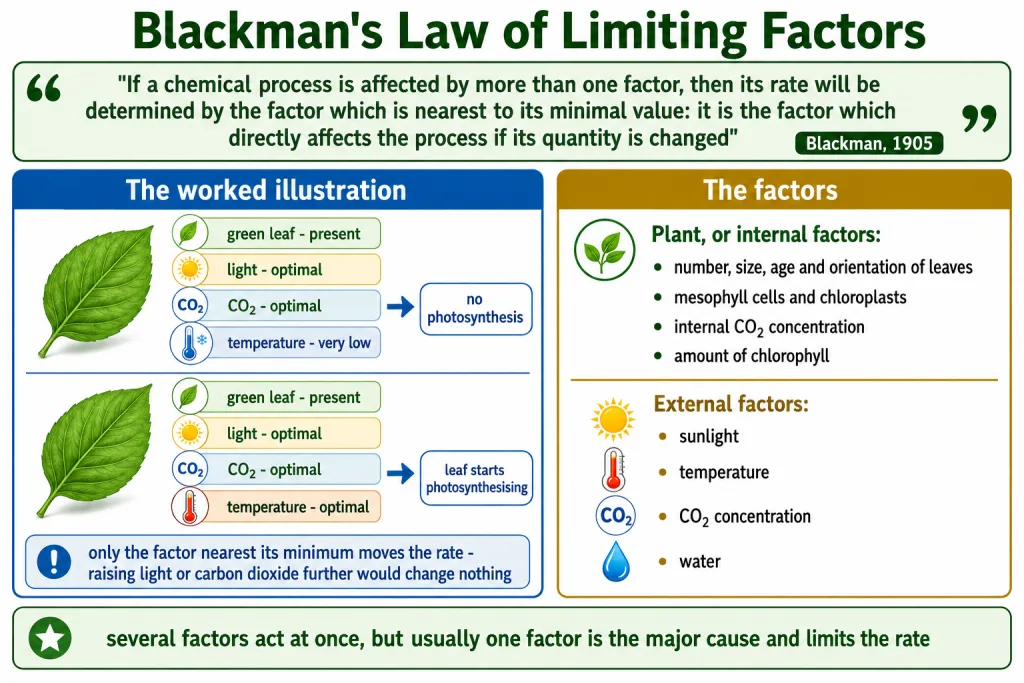
Blackman's (1905) Law of Limiting Factors puts that formally:
If a chemical process is affected by more than one factor, then its rate will be determined by the factor which is nearest to its minimal value: it is the factor which directly affects the process if its quantity is changed.
The worked example the chapter gives. Despite the presence of a green leaf and optimal light and conditions, the plant may not photosynthesise if the temperature is very low. This leaf, if given the optimal temperature, will start photosynthesising. Notice what that shows: light and were already optimal, so raising them further would change nothing. Only the factor nearest its minimum - here the temperature - moves the rate.
[NEET Important] Two details of the law are tested word for word. It is the factor nearest to its minimal value, not the factor present in the largest amount and not an average of the factors. And the year is 1905. The second half of the statement - it is the factor which directly affects the process if its quantity is changed - is the practical test: change it and the rate moves; change anything else and nothing happens.
Light
Three separate things travel under the word "light", and they must be distinguished: light quality, light intensity and the duration of exposure to light.
The shape of the light curve. There is a linear relationship between incident light and fixation rates at low light intensities. At higher light intensities, gradually the rate does not show further increase, as other factors become limiting. So the curve rises as a straight line, then bends, then flattens into a plateau.
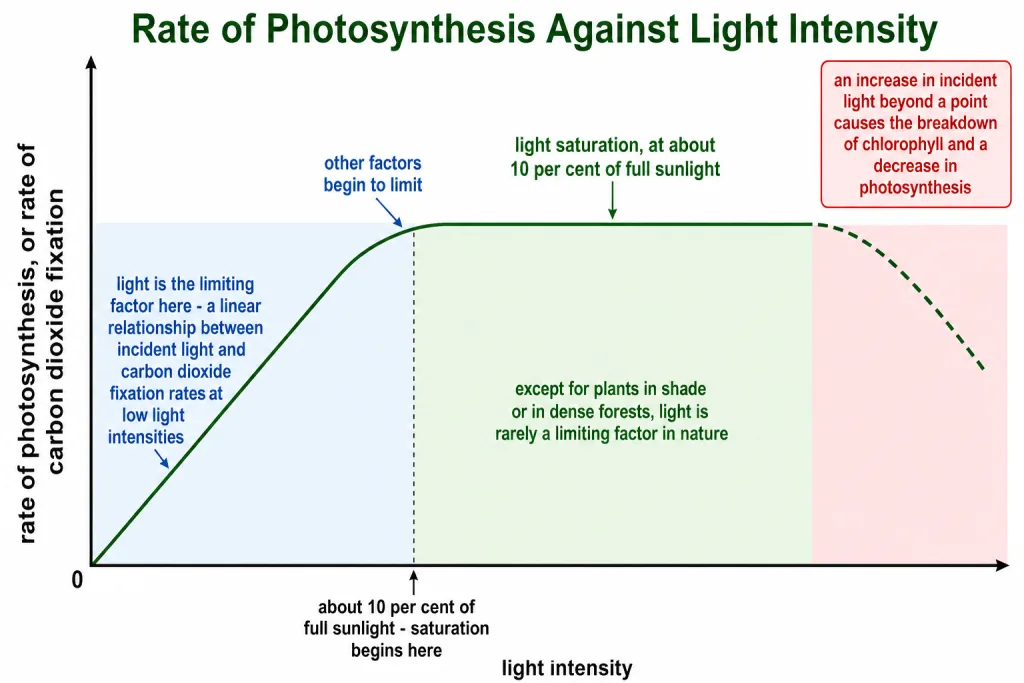
| Part of the curve | What is happening | What is limiting |
|---|---|---|
| The rising, linear portion at low light intensity | The rate increases in direct proportion to the incident light | Light itself |
| The bending region | The increase slows | Light, and increasingly other factors |
| The flat plateau | The rate no longer increases with more light - light saturation | Something other than light - typically concentration or temperature |
What is interesting to note is that light saturation occurs at 10 per cent of the full sunlight. Hence, except for plants in shade or in dense forests, light is rarely a limiting factor in nature.
And more light is not always better. Increase in incident light beyond a point causes the breakdown of chlorophyll and a decrease in photosynthesis.
[NEET Important] 10 per cent of full sunlight is the number to carry, and the conclusion attached to it - light is rarely a limiting factor in nature. The distractor set usually offers 50 per cent or 100 per cent. The second one-liner is that excess light breaks chlorophyll down, so the graph falls at very high intensity rather than staying flat forever.
Carbon Dioxide Concentration
Carbon dioxide is the major limiting factor for photosynthesis. Learn that sentence as it stands - it is the answer to "which is the major limiting factor" every time.
Why it limits. The concentration of is very low in the atmosphere, between 0.03 and 0.04 per cent. An increase in concentration up to 0.05 per cent can cause an increase in fixation rates; beyond this the levels can become damaging over longer periods.
and plants respond differently, and the two conditions must be kept apart:
- At low light conditions neither group responds to high conditions. Light is limiting, so extra buys nothing.
- At high light intensities, both and plants show an increase in the rates of photosynthesis.
Where they part company is the saturation point.
| Plant type | Saturation of the response |
|---|---|
| plants | Saturation at about |
| plants | Respond to increased concentration; saturation is seen only beyond |
Thus, current availability of levels is limiting to the plants. A plant is already close to saturated at today's atmospheric level; a plant is not, and would still speed up if given more.
This fact is put to work commercially. The fact that plants respond to higher concentration by showing increased rates of photosynthesis, leading to higher productivity, has been used for some greenhouse crops such as tomatoes and bell pepper. They are allowed to grow in a carbon dioxide enriched atmosphere, which leads to higher yields.
[NEET Important] Keep the two numbers with the right plant: is the saturation point and is where saturation begins. The higher number belongs to , which feels backwards to students who have learnt that plants are the better performers. And note the conclusion: it is the plants, not the plants, that are limited by present levels.
Temperature and Water
Temperature. The dark reactions, being enzymatic, are temperature controlled. Though the light reactions are also temperature sensitive, they are affected to a much lesser extent. That is the reason temperature matters at all - the carbon reactions are run by enzymes, and enzymes have temperature optima.
- The plants respond to higher temperatures and show a higher rate of photosynthesis, while plants have a much lower temperature optimum.
- The temperature optimum for photosynthesis of different plants also depends on the habitat that they are adapted to. Tropical plants have a higher temperature optimum than the plants adapted to temperate climates.
Water. This is the factor that works indirectly, and that is the whole point of it.
Even though water is one of the reactants in the light reaction, the effect of water as a factor is more through its effect on the plant, rather than directly on photosynthesis.
- Water stress causes the stomata to close, hence reducing the availability.
- Besides, water stress also makes leaves wilt, thus reducing the surface area of the leaves and their metabolic activity as well.
[NEET Important] The water question is almost always the same one: why does water shortage reduce photosynthesis when so little water is actually consumed as a reactant? Answer with the two indirect effects - stomatal closure cutting off , and wilting reducing leaf surface area and metabolic activity. Saying "because water is a reactant" is the wrong answer here, even though water is a reactant.
Quick Recap
- The rate of photosynthesis is very important in determining the yield of plants, including crop plants.
- Plant or internal factors: number, size, age and orientation of leaves, mesophyll cells and chloroplasts, internal concentration, amount of chlorophyll. They depend on the genetic predisposition and the growth of the plant.
- External factors: availability of sunlight, temperature, concentration and water.
- All the factors act simultaneously, but usually one factor is the major cause or the one that limits the rate; at any point the rate is determined by the factor available at sub-optimal levels.
- Blackman's (1905) Law of Limiting Factors: if a chemical process is affected by more than one factor, then its rate will be determined by the factor which is nearest to its minimal value: it is the factor which directly affects the process if its quantity is changed.
- Example: despite a green leaf and optimal light and , the plant may not photosynthesise if the temperature is very low; given the optimal temperature it will start.
- Light has three aspects: quality, intensity and duration of exposure.
- Linear relationship between incident light and fixation rates at low light intensities; at higher intensities the rate gradually does not increase further as other factors become limiting.
- Light saturation occurs at 10 per cent of full sunlight, so except for plants in shade or in dense forests, light is rarely a limiting factor in nature.
- Increase in incident light beyond a point causes the breakdown of chlorophyll and a decrease in photosynthesis.
- is the major limiting factor for photosynthesis.
- Atmospheric is between 0.03 and 0.04 per cent; an increase up to 0.05 per cent raises fixation rates, beyond which levels become damaging over longer periods.
- At low light neither nor plants respond to high ; at high light both show an increase.
- plants saturate at about ; saturation is seen only beyond .
- Current availability is limiting to the plants.
- Greenhouse crops such as tomatoes and bell pepper are grown in a carbon dioxide enriched atmosphere for higher yields.
- The dark reactions, being enzymatic, are temperature controlled; the light reactions are temperature sensitive but affected to a much lesser extent.
- plants respond to higher temperatures and show a higher rate; plants have a much lower temperature optimum.
- Tropical plants have a higher temperature optimum than plants adapted to temperate climates.
- Water acts more through its effect on the plant than directly on photosynthesis: water stress closes the stomata, reducing availability, and makes leaves wilt, reducing leaf surface area and metabolic activity.
Solved Examples
Question 1
Q. List the plant (internal) factors that affect photosynthesis.
Answer. The number, size, age and orientation of leaves; mesophyll cells and chloroplasts; internal concentration; and the amount of chlorophyll. These depend on the genetic predisposition and the growth of the plant.
Question 2
Q. List the external factors that affect photosynthesis.
Answer. The availability of sunlight, temperature, concentration and water.
Question 3
Q. State Blackman's Law of Limiting Factors and give its year.
Answer. Blackman's (1905) Law of Limiting Factors: if a chemical process is affected by more than one factor, then its rate will be determined by the factor which is nearest to its minimal value: it is the factor which directly affects the process if its quantity is changed.
Question 4
Q. Give the example the chapter uses to illustrate the law of limiting factors.
Answer. Despite the presence of a green leaf and optimal light and conditions, the plant may not photosynthesise if the temperature is very low. This leaf, if given the optimal temperature, will start photosynthesising. Temperature was the factor nearest its minimal value, so it alone controlled the rate.
Question 5
Q. Which three aspects of light must be distinguished when discussing it as a factor?
Answer. Light quality, light intensity and the duration of exposure to light.
Question 6
Q. Describe the relationship between incident light and fixation rate.
Answer. At low light intensities there is a linear relationship between incident light and fixation rates. At higher light intensities the rate gradually does not show further increase, as other factors become limiting.
Question 7
Q. At what fraction of full sunlight does light saturation occur, and what follows from that?
Answer. At 10 per cent of the full sunlight. Hence, except for plants in shade or in dense forests, light is rarely a limiting factor in nature.
Question 8
Q. What happens if incident light is increased beyond a point?
Answer. It causes the breakdown of chlorophyll and a decrease in photosynthesis. More light is not indefinitely better.
Question 9
Q. Figure 11.10 shows the effect of light on the rate of photosynthesis. Based on the graph, answer the following: (a) At which point or points (A, B or C) in the curve is light a limiting factor? (b) What could be the limiting factor or factors in region A? (c) What do C and D represent on the curve? This is one of the chapter-end exercises.
Answer. Start with the shape of the curve, because every part of the answer comes from it. A graph of light intensity on the horizontal axis against rate of photosynthesis on the vertical axis has three parts:
- A rising, straight-line portion at low light intensity. Here there is a linear relationship between incident light and fixation rates - double the light and the rate roughly doubles. Light is the limiting factor along this whole stretch.
- A bending region, where the rate still rises but no longer in proportion, because other factors are starting to become limiting.
- A flat plateau, where the rate does not show further increase however much more light is given. This is light saturation.
(a) Light is the limiting factor along the rising, linear portion of the curve - the point labelled A in the figure. On the plateau it is not limiting, because adding light changes nothing there.
(b) In region A the limiting factor is light itself, since the rate rises in direct proportion to the light supplied - and by Blackman's law, the factor that directly affects the process when its quantity is changed is the limiting one.
(c) The plateau region, C, represents light saturation - the rate has stopped responding to light because some factor other than light has become limiting, typically the concentration or the temperature. D, on the horizontal axis, represents the light intensity at which that saturation is reached. Recall that light saturation occurs at about 10 per cent of full sunlight, so D is a fairly modest light intensity.
A note on the labels. Which letter sits on which part of the curve depends on the figure printed in the book, so map these three descriptions onto the points as they are labelled there - the rising linear stretch, the bend, and the plateau with the intensity at which it begins. The reasoning does not change.
Question 10
Q. Which factor is described as the major limiting factor for photosynthesis, what is its atmospheric concentration, and up to what level does raising it help?
Answer. Carbon dioxide. Its concentration is very low in the atmosphere, between 0.03 and 0.04 per cent. An increase in concentration up to 0.05 per cent can cause an increase in fixation rates; beyond this the levels can become damaging over longer periods.
Question 11
Q. How do and plants respond to high at low light and at high light?
Answer. At low light conditions neither group responds to high conditions - light is limiting, so extra has no effect. At high light intensities, both and plants show an increase in the rates of photosynthesis.
Question 12
Q. Give the saturation points of the two plant types, and say which type is limited by present atmospheric levels.
Answer. plants show saturation at about . plants respond to increased concentration, and saturation is seen only beyond . Thus current availability of levels is limiting to the plants.
Question 13
Q. Why are greenhouse tomatoes and bell pepper grown in a carbon dioxide enriched atmosphere?
Answer. Because plants respond to higher concentration by showing increased rates of photosynthesis, leading to higher productivity. Growing them in a carbon dioxide enriched atmosphere leads to higher yields.
Question 14
Q. Why is temperature a factor at all, how do and plants differ in their response, and what else does the optimum depend on?
Answer. Temperature matters because the dark reactions, being enzymatic, are temperature controlled, while the light reactions are also temperature sensitive but affected to a much lesser extent. plants respond to higher temperatures and show a higher rate of photosynthesis, while plants have a much lower temperature optimum. The optimum also depends on the habitat the plant is adapted to - tropical plants have a higher temperature optimum than plants adapted to temperate climates.
Question 15
Q. Water is a reactant of the light reaction, yet its effect as a factor is called indirect. Explain.
Answer. The effect of water as a factor is more through its effect on the plant rather than directly on photosynthesis. Two effects matter. Water stress causes the stomata to close, hence reducing the availability. Water stress also makes leaves wilt, thus reducing the surface area of the leaves and their metabolic activity as well.