
What This Section Is For
This section does not add anything new. It gathers together material that has already been taught across the preceding sections - the Calvin cycle, Kranz anatomy, the Hatch and Slack pathway and photorespiration - and lays the two plant types side by side.
That is worth a section of its own for one reason: the comparison is asked as a table, and four of the chapter-end exercises turn on it. If you can reproduce the table, you can answer all of them.
The anatomical difference comes first, because everything else follows from it.
- In plants the Calvin cycle occurs in all the mesophyll cells. There is one cell type in the leaf that fixes - the mesophyll.
- In plants the Calvin cycle does not take place in the mesophyll cells, but only in the bundle sheath cells. There are two cell types that fix - the mesophyll and the bundle sheath.
- The particularly large cells around the vascular bundles of plants are the bundle sheath cells, and leaves with such anatomy are said to have Kranz anatomy. They have a large number of chloroplasts, thick walls impervious to gaseous exchange and no intercellular spaces.
Note what is the same in both. The initial carboxylation reaction occurs in the mesophyll in both types. In a plant that first carboxylation is the Calvin cycle step; in a plant it is the PEPcase step, and the Calvin cycle happens later and elsewhere.
[NEET Important] The row that is most often lost is cell type in which the initial carboxylation reaction occurs, because the answer is mesophyll for both. Students who have learnt " means bundle sheath" write bundle sheath here and lose the mark. Bundle sheath is the answer for the Calvin cycle row, not the initial carboxylation row.
The Biochemical Difference
Three linked rows: the acceptor, the enzyme and the first product.
- In plants the primary acceptor is RuBP, a 5-carbon molecule, the enzyme is RuBisCO, and the primary fixation product is PGA, a 3-carbon compound. The three carbons in that first product are where the name comes from.
- In plants the primary acceptor is PEP - phosphoenol pyruvate - a 3-carbon molecule present in the mesophyll cells, the enzyme is PEP carboxylase, or PEPcase, and the primary fixation product is OAA, a 4-carbon compound. The four carbons are where comes from.
Now the enzymes, which is where the trap sits.
- Both and plants have RuBisCO. The Calvin pathway is common to both - it is the pathway that results in the formation of the sugars in every plant.
- Only plants have PEPcase.
- In a plant RuBisCO is in the mesophyll cells. In a plant RuBisCO is in the bundle sheath cells - the mesophyll cells of a plant lack RuBisCO, and the bundle sheath cells lack PEPcase.
[NEET Important] Read the acceptor carbon numbers slowly, because they run backwards from what students expect. The plant has the 5-carbon acceptor (RuBP) and the 3-carbon product (PGA). The plant has the 3-carbon acceptor (PEP) and the 4-carbon product (OAA). The name of the plant comes from the product, never from the acceptor.
The Performance Difference
This is where the anatomy and the biochemistry pay off.
Photorespiration. The relative concentration of and decides whether RuBisCO acts as a carboxylase or an oxygenase.
- In plants photorespiration is high at high light intensities and high at low concentrations - both conditions leave RuBisCO short of relative to .
- It is negligible in plants at low light intensities and at high concentrations.
- In plants photorespiration is negligible under all four of those conditions, because the acid broken down in the bundle sheath keeps the concentration high at the enzyme site whatever the outside conditions are.
Fixation rate under high light. Low in plants, high in plants. plants show a response to high light intensities; plants lose part of what they fix to photorespiration just when light is strongest.
Temperature. The optimum is to . The optimum is to - plants tolerate higher temperatures and are adapted to dry tropical regions.
Examples. The chapter names maize and sorghum directly as plants, in the context of cutting leaf sections to see Kranz anatomy. Typical plants are the temperate crops such as wheat and rice - given here as familiar examples rather than as a list taken from the chapter.
[NEET Important] The two photorespiration rows for plants move in opposite directions: high light means high photorespiration, but high means negligible photorespiration. Fix that by remembering the cause - it is always the to ratio at the active site, never light or temperature acting directly.
The Complete Comparison Table
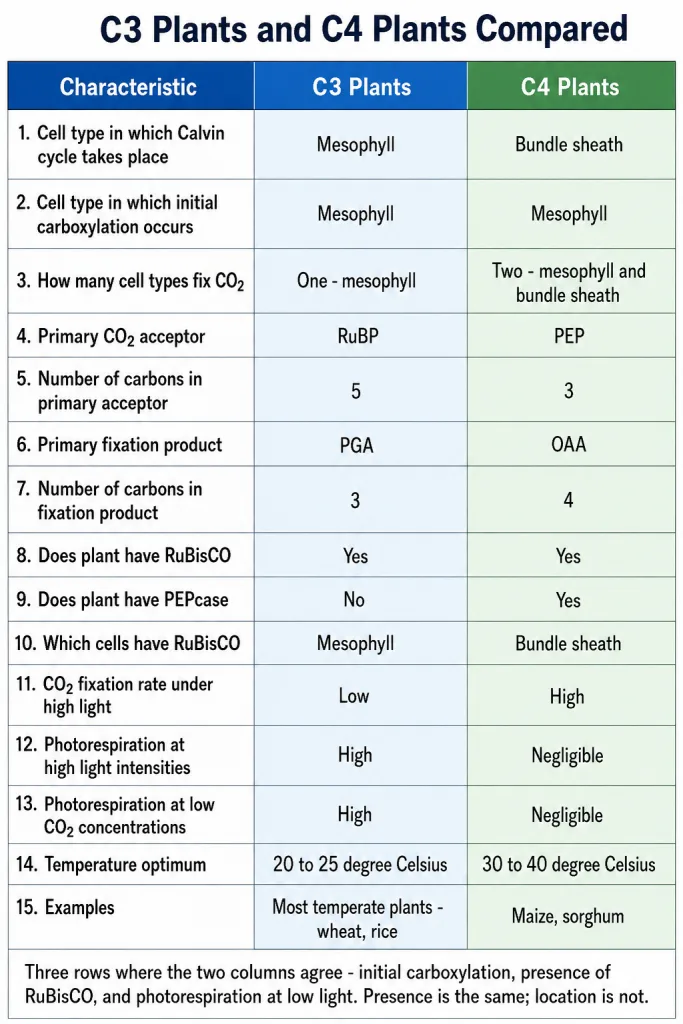
| Characteristic | Plants | Plants |
|---|---|---|
| Cell type in which the Calvin cycle takes place | Mesophyll | Bundle sheath |
| Cell type in which the initial carboxylation reaction occurs | Mesophyll | Mesophyll |
| How many cell types the leaf has that fix | One: mesophyll | Two: bundle sheath and mesophyll |
| Primary acceptor | RuBP | PEP |
| Number of carbons in the primary acceptor | 5 | 3 |
| Primary fixation product | PGA | OAA |
| Number of carbons in the primary fixation product | 3 | 4 |
| Does the plant have RuBisCO | Yes | Yes |
| Does the plant have PEPcase | No | Yes |
| Which cells have RuBisCO | Mesophyll | Bundle sheath |
| fixation rate under high light conditions | Low | High |
| Photorespiration at low light intensities | Negligible | Negligible |
| Photorespiration at high light intensities | High | Negligible |
| Photorespiration at low concentrations | High | Negligible |
| Photorespiration at high concentrations | Negligible | Negligible |
| Temperature optimum | to | to |
| Examples | Most temperate plants - wheat and rice are typical examples | Maize and sorghum, named in the chapter |
Three rows to circle before an exam, because they are the ones where the two columns agree and students assume they must differ: initial carboxylation is mesophyll in both, RuBisCO is present in both, and photorespiration is negligible in both at low light intensities and at high concentrations.
[NEET Important] Assertion-reason items are built from the disagreement between "does the plant have RuBisCO - yes in both" and "which cells have RuBisCO - mesophyll against bundle sheath". Both statements are true at the same time. Presence is the same; location is not.
Quick Recap
- Calvin cycle location: - mesophyll; - bundle sheath.
- Initial carboxylation reaction: mesophyll in both.
- Cell types in the leaf that fix : - one, the mesophyll; - two, the bundle sheath and the mesophyll.
- Primary acceptor: - RuBP, 5 carbons; - PEP, 3 carbons.
- Primary fixation product: - PGA, 3 carbons; - OAA, 4 carbons.
- RuBisCO: present in both. PEPcase: only in plants.
- RuBisCO sits in the mesophyll of a plant and in the bundle sheath of a plant.
- fixation rate under high light: low in , high in .
- Photorespiration at low light intensities: negligible in both.
- Photorespiration at high light intensities: high in , negligible in .
- Photorespiration at low concentrations: high in , negligible in .
- Photorespiration at high concentrations: negligible in both.
- Temperature optimum: - to ; - to .
- Examples: - most temperate plants, typically wheat and rice; - maize and sorghum.
- Kranz anatomy - large bundle sheath cells with many chloroplasts, thick walls impervious to gaseous exchange and no intercellular spaces - identifies a leaf.
- The Calvin pathway is common to both; it is the only sugar-forming pathway in either plant.
Solved Examples
Question 1
Q. In which cell type does the Calvin cycle take place in a plant, and in which in a plant?
Answer. - the mesophyll cells. - the bundle sheath cells only. In a plant the Calvin cycle does not take place in the mesophyll cells at all.
Question 2
Q. Where does the initial carboxylation reaction occur in each type?
Answer. In the mesophyll in both. In a plant that first carboxylation is RuBP plus by RuBisCO; in a plant it is PEP plus by PEPcase.
Question 3
Q. How many cell types in the leaf fix in each plant type?
Answer. - one, the mesophyll. - two, the bundle sheath and the mesophyll.
Question 4
Q. Name the primary acceptor in each type and give its carbon count.
Answer. - RuBP, a 5-carbon molecule. - PEP, phosphoenol pyruvate, a 3-carbon molecule.
Question 5
Q. Name the primary fixation product in each type and give its carbon count.
Answer. - PGA, a 3-carbon compound. - OAA, oxaloacetic acid, a 4-carbon compound. The plants are named after these products, not after the acceptors.
Question 6
Q. Do plants have RuBisCO? Do plants have PEPcase?
Answer. plants do have RuBisCO - it is in the bundle sheath cells, and the Calvin pathway is common to both plant types. plants do not have PEPcase.
Question 7
Q. Which cells contain RuBisCO in each plant type?
Answer. In a plant, the mesophyll cells. In a plant, the bundle sheath cells - the mesophyll cells of a plant lack RuBisCO.
Question 8
Q. Compare the fixation rate of the two types under high light.
Answer. Low in plants and high in plants. plants show a response to high light intensities, while in plants photorespiration is high at high light and eats into the fixation.
Question 9
Q. Under which two conditions is photorespiration negligible in a plant?
Answer. At low light intensities and at high concentrations. Both leave RuBisCO with enough relative to , so it acts as a carboxylase.
Question 10
Q. Under which conditions is photorespiration high in a plant?
Answer. At high light intensities and at low concentrations.
Question 11
Q. Is photorespiration ever significant in a plant?
Answer. No - it is negligible under all four conditions: low light, high light, low and high . The acid broken down in the bundle sheath keeps the concentration high at the enzyme site regardless of outside conditions.
Question 12
Q. Give the temperature optimum of each plant type.
Answer. plants - to . plants - to , which is why they are adapted to dry tropical regions and tolerate higher temperatures.
Question 13
Q. Name two plants named in the chapter, and give typical examples.
Answer. Maize and sorghum are the plants named, in the context of cutting leaf sections to look for Kranz anatomy. Typical plants are the temperate crops - wheat and rice are the familiar examples.
Question 14
Q. Give a comparison between the and pathways. This is one of the chapter-end exercises.
Answer. Take it in three groups - anatomy, biochemistry and performance.
Anatomy. In a plant the Calvin cycle occurs in all the mesophyll cells, and the leaf has one cell type that fixes . A leaf has Kranz anatomy - large bundle sheath cells around the vascular bundles, with a large number of chloroplasts, thick walls impervious to gaseous exchange and no intercellular spaces. Two cell types fix - the mesophyll and the bundle sheath - and the Calvin cycle runs only in the bundle sheath. The initial carboxylation, however, is in the mesophyll in both.
Biochemistry. In the pathway the primary acceptor is RuBP (5 carbon), the enzyme is RuBisCO, and the first product is PGA (3 carbon). In the pathway - the Hatch and Slack pathway - the primary acceptor is PEP (3 carbon) in the mesophyll, the enzyme is PEPcase, and the first product is OAA (4 carbon). The OAA becomes malic or aspartic acid, which is carried to the bundle sheath and broken down to release and a 3-carbon molecule; that 3-carbon molecule goes back to the mesophyll and is converted to PEP again. The released then enters the Calvin cycle, so the Calvin pathway is common to both. Both have RuBisCO; only plants have PEPcase, and RuBisCO sits in the mesophyll of a plant but in the bundle sheath of a plant.
Performance. fixation under high light is low in and high in . Photorespiration is high in plants at high light intensities and at low concentrations, but negligible in plants under every condition, because the acid broken down in the bundle sheath keeps the concentration high so RuBisCO functions as a carboxylase. The temperature optimum is to for plants and to for plants, so plants tolerate higher temperatures and have greater productivity of biomass. Examples: maize and sorghum are ; wheat and rice are typical plants.
Question 15
Q. A leaf section shows large cells with many chloroplasts wrapped around the vascular bundle. What can you say about this plant?
Answer. Those are bundle sheath cells, so the leaf has Kranz anatomy and the plant is a plant. From that one observation you can predict the rest of its column: PEP as the primary acceptor, OAA as the first product, PEPcase present, RuBisCO confined to the bundle sheath, negligible photorespiration, a high fixation rate under strong light and a temperature optimum of to .