
Electron Transport Starts at PS II
In photosystem II the reaction centre chlorophyll a absorbs wavelength of red light, causing electrons to become excited and jump into an orbit farther from the atomic nucleus.
That is the whole of what light does chemically - it lifts an electron to a higher energy level. What happens next is ordinary chemistry.
These electrons are picked up by an electron acceptor which passes them to an electron transport system consisting of cytochromes.
This movement of electrons is downhill, in terms of an oxidation-reduction or redox potential scale. Uphill was the jump the photon paid for; downhill is every step after it, and each step releases a little energy.
The electrons are not used up as they pass through the electron transport chain, but are passed on to the pigments of photosystem PS I.
So the chain is a relay, not a consumer. The same electrons that left arrive at PS I.
[NEET Important] Two phrases are lifted straight into options. The excited electron jumps into an orbit farther from the atomic nucleus - not out of the atom, not into the stroma. And the electrons are not used up in the electron transport chain; they are passed on to the pigments of PS I. Any option saying the electrons are consumed or destroyed in the chain is wrong.
PS I, the Second Excitation, and the Z Scheme
Simultaneously, electrons in the reaction centre of PS I are also excited when they receive red light of wavelength , and are transferred to another acceptor molecule that has a greater redox potential.
Note the word simultaneously. The two photosystems are not taking turns in time - both are being hit by light at the same moment; it is the electrons that move from one to the other.
These electrons then are moved downhill again, this time to a molecule of energy-rich . The addition of these electrons reduces to .
The whole path, in order:
- Start at PS II, where absorbs light
- Uphill to the acceptor - the excited electron is picked up
- Down the electron transport chain of cytochromes to PS I
- Excitation of electrons at PS I, where absorbs light
- Transfer to another acceptor, one with a greater redox potential
- Finally downhill to , reducing it to
This whole scheme of transfer of electrons is called the Z scheme, due to its characteristic shape. This shape is formed when all the carriers are placed in a sequence on a redox potential scale.
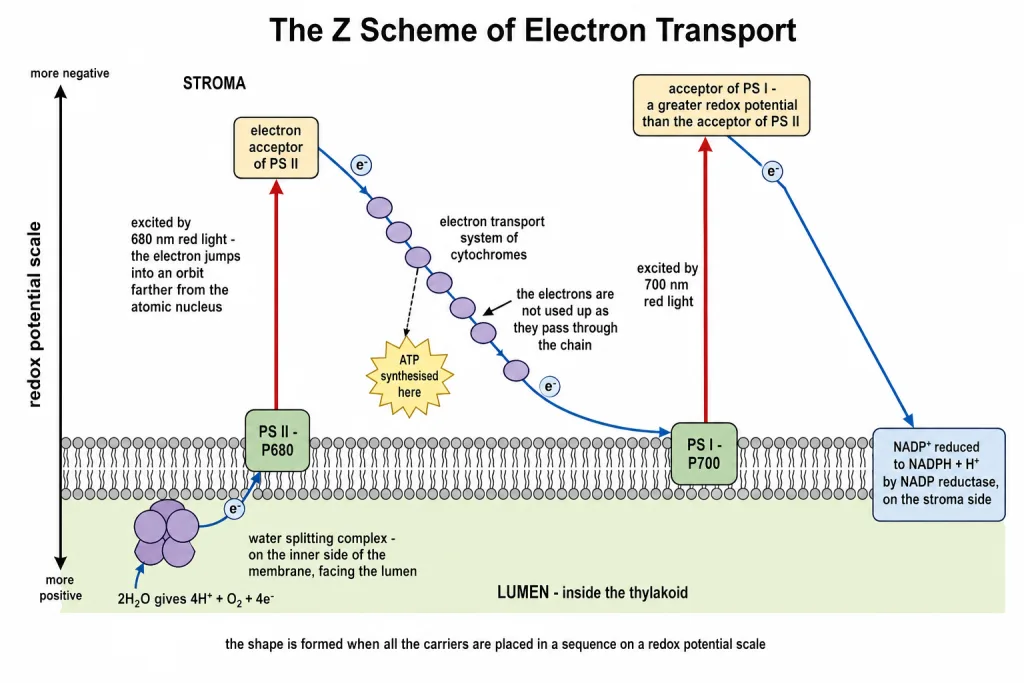
Trace it with a finger and the letter appears - up at PS II, a long slope down through the cytochromes, up again at PS I, then down to . Turned on its side that is a Z.
[NEET Important] The Z shape only appears when the carriers are plotted on a redox potential scale. It is not the physical arrangement of the complexes in the membrane, and it is not a graph of time or of wavelength. Examiners like the follow-up: the acceptor of PS I has a greater redox potential than the acceptor of PS II, and the final acceptor of the whole scheme is .
Splitting of Water
How does PS II supply electrons continuously?
The electrons that were moved from photosystem II must be replaced. This is achieved by electrons available due to splitting of water.
The splitting of water is associated with the PS II; water is split into , and electrons. This creates oxygen, one of the net products of photosynthesis. The electrons needed to replace those removed from photosystem I are provided by photosystem II.
Where the products go. The water splitting complex is associated with the PS II, which itself is physically located on the inner side of the membrane of the thylakoid. So the protons and the formed are released into the lumen, not on the outer side of the membrane.
| What water splitting gives | Where it goes |
|---|---|
| Protons, | Into the lumen of the thylakoid |
| Oxygen, | Released into the lumen - one of the net products of photosynthesis |
| Electrons, | Replace those lost from in PS II |
[NEET Important] Water splitting is associated with PS II, never with PS I. That single association answers a whole family of questions - the source of the released , the ultimate electron donor of the light reaction, and why the lumen becomes acidic. Also memorise the stoichiometry of the equation: two waters give four protons, one and four electrons.
Quick Recap
- In photosystem II the reaction centre chlorophyll a absorbs wavelength of red light, causing electrons to become excited and jump into an orbit farther from the atomic nucleus.
- These electrons are picked up by an electron acceptor which passes them to an electron transport system consisting of cytochromes.
- This movement of electrons is downhill, in terms of an oxidation-reduction or redox potential scale.
- The electrons are not used up as they pass through the electron transport chain, but are passed on to the pigments of photosystem PS I.
- Simultaneously, electrons in the reaction centre of PS I are also excited when they receive red light of wavelength , and are transferred to another acceptor molecule that has a greater redox potential.
- These electrons then move downhill again, this time to a molecule of energy-rich .
- The addition of these electrons reduces to .
- The whole scheme - from PS II, uphill to the acceptor, down the electron transport chain to PS I, excitation of electrons, transfer to another acceptor, and finally downhill to reducing it - is called the Z scheme, due to its characteristic shape.
- The Z shape is formed when all the carriers are placed in a sequence on a redox potential scale.
- The electrons moved from photosystem II must be replaced, and this is achieved by electrons available due to splitting of water.
- The splitting of water is associated with PS II. Water is split into , and electrons.
- This creates oxygen, one of the net products of photosynthesis.
- The equation is .
- The water splitting complex is associated with PS II, which is physically located on the inner side of the membrane of the thylakoid, so the protons and oxygen formed are released into the lumen.
Solved Examples
Question 1
Q. What happens in PS II when the reaction centre chlorophyll a absorbs light?
Answer. The reaction centre chlorophyll a absorbs wavelength of red light, and this causes electrons to become excited and jump into an orbit farther from the atomic nucleus.
Question 2
Q. What picks up the excited electron from PS II, and where does it go next?
Answer. An electron acceptor picks it up and passes it to an electron transport system consisting of cytochromes.
Question 3
Q. In what sense is the movement of electrons through the transport chain downhill?
Answer. Downhill in terms of an oxidation-reduction, or redox potential, scale. Each carrier in the chain sits at a lower energy level than the one before, so the electron loses a little energy at every step.
Question 4
Q. Are the electrons used up in the electron transport chain?
Answer. No. The electrons are not used up as they pass through the electron transport chain, but are passed on to the pigments of photosystem PS I. The chain is a relay, not a place where electrons disappear.
Question 5
Q. What happens at the reaction centre of PS I?
Answer. Electrons in the reaction centre of PS I are excited when they receive red light of wavelength , and are transferred to another acceptor molecule that has a greater redox potential.
Question 6
Q. What is the final destination of the electrons in the Z scheme?
Answer. A molecule of energy-rich . The addition of these electrons reduces to .
Question 7
Q. Why is the light reaction pathway called the Z scheme?
Answer. Because of its characteristic shape. This shape is formed when all the carriers are placed in a sequence on a redox potential scale - up at PS II, down the electron transport chain, up again at PS I, then down to , which drawn out looks like the letter Z.
Question 8
Q. Write out the full sequence of the Z scheme in order.
Answer. Starting from PS II, then uphill to the acceptor, then down the electron transport chain to PS I, then excitation of electrons at PS I, then transfer to another acceptor, and finally downhill to , reducing it to .
Question 9
Q. How does PS II supply electrons continuously?
Answer. The electrons that were moved from photosystem II must be replaced, and this is achieved by electrons available due to splitting of water. Water is the continuous supply.
Question 10
Q. Which photosystem is the splitting of water associated with?
Answer. PS II. The water splitting complex is associated with the PS II, and the electrons needed to replace those removed from photosystem I are provided by photosystem II.
Question 11
Q. Water is split into which three things?
Answer. Into , and electrons. This creates oxygen, one of the net products of photosynthesis.
Question 12
Q. Write the equation for the splitting of water.
Answer. Two molecules of water give four protons, one molecule of and four electrons.
Question 13
Q. Where are the protons and the oxygen from water splitting released, and why there?
Answer. Into the lumen of the thylakoid. The reason is a matter of position: the water splitting complex is associated with PS II, which itself is physically located on the inner side of the membrane of the thylakoid. Anything it makes is therefore released on the inner side, that is into the lumen - not on the outer side facing the stroma.
Question 14
Q. Which photosystem needs a shorter wavelength of light for its excitation, PS I or PS II?
Answer. PS II. Its reaction centre absorbs at , while PS I has , absorbing at . is the shorter wavelength, so it carries the higher energy per photon.